Digital Camera World Verdict
The Ricoh GR IV Monochrome can't do everything – but it excels at its niche: black-and-white photographs from a compact camera. I was blown away by how much cleaner the noise looks, even at low ISOs, and there's still plenty of tonal flex with the built-in red filter. Sure, there's a lot that this camera can't do, like take a color photo, photograph action, or shoot in the rain. But for fantastic black-and-white images without the price of a Leica, it's a phenomenal choice.
Pros
- +
Stunning black and white images
- +
Lovely image grain at all ISOs
- +
Pocketable design
- +
Fantastic red filter
- +
APS-C sensor and f/2.8 lens
Cons
- -
No weather-sealing
- -
Not meant for action
- -
Pricer than the color version
Why you can trust Digital Camera World Our expert reviewers spend hours testing and comparing products and services so you can choose the best for you. Find out how we test.
Most cameras don’t like to advertise what they can’t do, but with the Ricoh GR IV Monochrome, it’s right in the name: this camera can’t shoot in color.
Admittedly, when I picked up the Ricoh GR IV Monochrome, it was my first experience using a camera with a dedicated monochrome sensor, and I wasn’t quite sure what to expect. What I found was all of the compact design that the GR series is known for, but with less noise, a highly flexible dynamic range in post, and epic drama stemming from the built-in red filter.
The first time I took the GR IV Monochrome out for a shoot? I thought, "This is a camera with attitude.”
I spent two weeks with the Ricoh GR IV Monochrome, a rental provided by LensRentals, and I’m going to have a hard time sending this one back.
Ricoh GR IV Monochrome: Specifications
Sensor |
24.74 Monochrome APS-C |
Stabilization |
Sensor shift |
Lens |
18.3mm (35mm Equivalent: 28mm), f/2.8-f/16 |
ISO |
160-409,600 |
Video |
1080p at 23.98/29.97/59.94 fps |
Display |
Fixed 3" Touchscreen LCD |
Battery |
Rated at 250 shots |
Weight |
8 oz / 228g |
Ricoh GR IV Monochrome: Price
The Ricoh GR IV Monochrome costs more than the version that can see in color – and by quite a bit. In the US, there’s a $600 price bump for the Monochrome version. Elsewhere, it’s a £400 / CA$600 / AU$1,000 price hike.
That brings the camera to a list price of about $2,196 / £1,599 / AU$2,999 / CA$2499.
That price is certainly nothing to sneeze at, but there are relatively few choices when it comes to cameras designed exclusively for black-and-white photography. The biggest brand doing Monochrome cameras is arguably Leica, which makes the GR IV Monochrome look cheap by comparison.
Ricoh GR IV Monochrome: Design & Handling

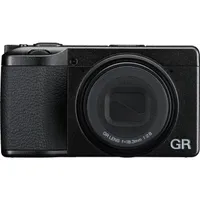
The most impressive part about the Ricoh GR IV series is how much advanced imaging tech is packed into a camera that looks like a basic point-and-shoot. No, the GR IV Monochrome isn’t basic, but to anyone unfamiliar with the photo industry, it looks like I’m just shooting with a simple compact camera.
The Ricoh GR IV series is arguably the most pocketable of large-sensor compact cameras, and the Monochrome version follows that same design.
I shot with the Ricoh GR IV Monochrome and the GR IV HDF at the same time – the only way I could tell the two apart is by looking either at the shortcut button at the back, which is for a red filter on the Monochrome and for a diffusion filter on the HDF, or looking for the darker GR logo on the front of the Monochrome. All three members of the GR IV series have a very similar but impressively small build.

The compact camera weighs just 262g (about 9.24 oz), including the memory card and battery. The camera is just 109.4mm or 4.3 inches wide. Even including the small grip, it’s an impressively slim 32.7 mm / 1.3 inches if you have the camera powered off. (The lens extends out a bit from the body with the camera on and ready to shoot.)
That makes the camera highly pocketable – impressive considering it’s hiding an APS-C sensor inside. Although, of course, there’s some risk to stashing a pricey camera inside of a pocket instead of a dedicated camera bag.

Which brings me to my next point: the Ricoh GR IV Monochrome isn’t weather-sealed. That’s one of the sacrifices made to create such a tiny camera. While a sealed camera would be larger, that makes it a bit less flexible for a camera that you carry nearly everywhere – except in the rain or dust.
Weather-sealing isn’t the only sacrifice for the small size. My two biggest annoyances? There’s no viewfinder, and the memory card is the microSD format. Photos are composed instead with the fixed, non-tilting LCD screen. It’s a bright screen, but it can be harder to see in bright sun than an electronic viewfinder.

The control layout feels well thought out for such a tiny camera. There are two dials to control manual settings, a locking mode dial, and a plus-minus toggle by the thumb for ISO or exposure compensation. There’s a dedicated shortcut button for the red filter, while others like macro mode and burst are built into the arrow keys.
Like the advanced camera that it is, there’s still a hot shoe slot at the top and a tripod mount at the bottom. The tiny size doesn’t leave much room for ports, but there is a well-hidden USB-C port. A small button on the opposite side puts the camera in video mode.
Ricoh GR IV Monochrome: Performance

The Ricoh GR IV series is known for its big sensor in a small design – it’s not known nor really designed for fast action. Ricoh doesn’t even list the burst speed among the official specifications, but it comes down to about 4 fps. This isn’t a sports camera.
But, if you understand what the Ricoh GR IV Monochrome is before picking it up – which is to say that it’s more for documentary and street photography – then the camera hits the mark.
I’ve used earlier GR III series cameras, and while the GR IV Monochrome’s autofocus speed isn’t going to break any records, there is a noticeable improvement. The face and eye detection works well, albeit it lacks animal eye detection entirely.

Image credit: Future

Image credit: Future

Image credit: Future

Image credit: Future
Autofocus locks on fairly quickly in good light. Indoors in low light, there’s a noticeable lag in the darkest corners, but the focus will still lock on if you place the focus area on a high-contrast area, like the edge of the object.
The continuous autofocus will drop a few frames – and in fact is tucked under the area modes rather than a separate setting. Similarly, in video mode, the autofocus is slow – but at least smooth – to transition. But again, this camera wasn’t built with action in mind.
Let’s get to what the GR IV Monochrome was built for then: black-and-white photographs. The Ricoh-Pentax brand is no stranger to colorless sensors, but this is the first time that a monochrome sensor has come to the GR series.
The sensor is designed specifically to pair with the camera’s built-in lens, which is an 18.3mm or 28mm in a full-frame equivalent. That’s a nice wide focal length for street photography and landscape captures – but you’ll see some of that wide-angle distortion if you snap portraits with it.


While the aperture is bright at f/2.8, wide-angle lenses aren’t really known for their bokeh. Images shot at f/2.8 still have some nice background separation, and points of light are rendered as smooth bokeh balls. For the most bokeh, the GR IV Monochrome does have a macro mode, which offers some nice flexibility for a compact camera.
While the GR IV Monochrome can’t see color, the camera still has several “color” profiles built in. I could choose whether I wanted a more standard look, or switch to softer contrast or higher contrast right in the camera.
One of my favorite features is the built-in red filter – it’s a longstanding tool for black-and-white photography that absorbs blue and green, but still lets red light hit the sensor. The red filter creates phenomenal contrast, particularly outdoors, where the blue skies will suddenly appear dark and dramatic.

No filter
Image credit: Future

With the red filter
Image credit: Future
Because it blocks some types of light, I also used the red filter as a sort of makeshift neutral density filter to take long exposures during the daytime. Of course, that’s a downside if you want to use the red filter indoors.
Between the different color profiles and red filter, the GR IV Monochrome has a very flexible range of light that it can capture. It’s capable of both dramatic, high contrast scenes, as well as softer, lower contrast scenes.
Ricoh GR IV Monochrome vs. GR IV HDF
One of the reasons to eliminate the color filter array rather than just use in-camera color profiles to capture black and white is to allow more light to hit the sensor. One of the benefits? Decreased noise.
To put that theory to the test, I tried the GR IV HDF at the same time that I rented the GR IV Monochrome and took similar photos across similar conditions. I couldn’t help myself: I took some shots in a black-and-white color profile on the HDF as well to directly compare with the Monochrome.


At ISO 12800, the noise coming from the GR IV Monochrome is much smaller and smoother, whereas the noise dots on the color GR IV appear much larger. Noise is noticeably much cleaner on the Monochrome than the GR IV HDF. There’s still noise that high, but it’s a far more pleasing noise that doesn’t distract from the photo, even zooming in. The noise feels the closest that I’ve gotten to pleasant noise on a digital camera rather than film.


I expected ISO 12800 to look better on the Monochrome, but I was blown away by the difference in bright light. The base ISO on the Monochrome is slightly higher at ISO 160, where the HDF can shoot down to ISO 100, but the black-and-white camera is far cleaner even at these low ISO settings.
The Monochrome’s smoother noise does give the photos the appearance of being slightly sharper than the color camera when pixel peeping. On the DNG files, I was able to lighten the shadows more in post than the images shot on the HDF, suggesting more flexibility in post, as long as you don’t want that flexibility to include colors.
Ricoh GR IV Monochrome: Verdict
The Ricoh GR IV Monochrome was my first experience with a colorless camera – and there was honestly a bigger difference in image quality than I expected next to a color camera. Noise tends to be more beautiful than distracting and less noticeable than on the color GR IV. I could recover a bit more shadows in post. And the built-in red filter is a phenomenal way to add contrast on a camera that doesn’t have the traditional filter threads.
Like the rest of the GR series, the GR IV Monochrome is impressively small. It’s a pocketable camera that comes without having to sacrifice sensor size or aperture.
I did miss having a viewfinder and weather-sealing, but advanced compact cameras with an APS-C sensor and a viewfinder tend to be significantly larger. The camera also isn’t built for action – and there are better options out there for fast bursts and snappy autofocus.
My biggest hesitation? There’s quite a price difference between the GR IV and the Monochrome. I’m having a hard time with the idea of paying more for a camera that can technically do less. But, as black-and-white cameras go, the GR IV Monochrome is actually one of the more affordable choices.
The Ricoh GR IV Monochrome is a niche camera – but for the photographer looking for black-and-white shots with lovely noise and a pocketable design, it’s an excellent choice.

Ricoh GR IV Monochrome: Alternatives