





Choosing the best camera for TikTok isn't quite as straightforward as you might think, as there really isn't a one-size-fits-all solution. It all comes down to the type of content you want to create and how you plan to shoot it. For some, a smartphone will be more than capable of getting the job done, offering convenience and simplicity without the need for additional equipment.
However, if you're looking to take your content to the next level, a dedicated mirrorless camera can deliver superior image quality, interchangeable lenses, and much greater creative freedom. Alternatively, if you're someone who enjoys capturing adventures, sports, or action-packed content, a compact action camera might be the perfect companion. With that in mind, I've put together a selection of cameras that can genuinely improve your TikTok videos without making the creative process more complicated than it needs to be.
Of course, TikTok has evolved considerably from its early days of people simply talking or dancing in front of their phones. Today, the platform is packed with everything from cinematic travel videos and food content to lifestyle vlogs, sports, and immersive POV footage. Having the right camera can make a noticeable difference, particularly when shooting in challenging lighting conditions or trying to achieve that more professional, polished look. Vertical video has also become an essential part of content creation, and thankfully, camera manufacturers have started taking this seriously. Many of the latest models now feature dedicated vertical shooting modes, framing guides, articulating screens, and user interfaces that make recording portrait-orientation content far more intuitive.
For this guide, I've focused on cameras and smartphones that offer a practical balance of performance, usability, and value for money, regardless of whether you're just starting your TikTok journey or looking to upgrade your existing setup. Every camera featured has been tested by the Digital Camera World team, meaning our recommendations are based on genuine hands-on experience rather than simply reading through a specification sheet. And while having a good camera certainly helps, lighting can be just as important when it comes to making your videos stand out. I'd also recommend taking a look at our guide to the best LED light panels and the best ring lights, as even a relatively inexpensive lighting upgrade can completely transform the overall quality of your content.
With over a decade of photographic experience, Louise arms Digital Camera World with a wealth of knowledge on photographic technique and know-how – something at which she is so adept that she's delivered workshops for the likes of ITV and Sue Ryder. Louise is also an expert on all things TikTok, and lends us her knowledge for this guide.
The best camera for TikTok in 2026
Why you can trust Digital Camera World Our expert reviewers spend hours testing and comparing products and services so you can choose the best for you. Find out how we test.
Best phone overall

The latest Galaxy flagship continues Samsung's hot streak of producing what are arguably the best camera phones around right now. The Samsung Galaxy S25 Ultra, its big offer for January, faces more competition than ever before from not just Apple and Google but the likes of Xiaomi, Nothing, Oppo, and more. Despite this ever-busier market, we'd say that Samsung's offering is still the best option for TikTok users.
It's an easy-to-use phone that produces excellent-looking footage that's ready to upload, but also if you prefer, you can take advantage of the new Pro Video mode, which allows you to capture Log footage that can be extensively colour-graded. The selfie camera, which most TikTokers will likely use most of the time, is generally excellent, benefiting from autofocus and holding up well when the light gets low.
Of course, as this is a 2025 phone, you will get lots of AI-powered features thrown at you. How useful these are is debatable to say the least, though there are some, like the AI Audio Eraser (for filtering out background noise in video recording) that could be useful for TikTok. Ultimately, though, this is just a slick, smart handset that shoots fantastic-looking video, and a TikTok user doesn't need a whole lot more than that.
Read our Samsung Galaxy S25 Ultra review for more details
Best iPhone

When it comes to creating content for TikTok, I still think the iPhone is one of the best tools you can have in your pocket, and the iPhone 18 Pro Max takes things to another level. Apple has continued to refine what was already an incredibly capable camera system, with three 48MP rear cameras, an improved 18MP Center Stage front camera, and a new variable-aperture main lens. However, it's the video capabilities that really make this phone stand out. Whether you're filming everyday lifestyle content, travel adventures, or something a little more cinematic, the iPhone 18 Pro Max delivers excellent image quality, accurate colors, and incredibly reliable exposure, making it easy to capture great-looking footage without having to think too much about the technical side of things.
For more ambitious TikTok creators, there is a seriously impressive amount of technology packed into this smartphone. You get 4K video recording at up to 120fps with Dolby Vision, excellent image stabilization, and professional recording options including ProRes RAW and Apple Log 2, giving you far greater flexibility when editing and color grading your footage. The upgraded A20 Pro chip also makes editing and exporting video incredibly smooth, while the large 6.9-inch OLED display provides plenty of room to review your clips before uploading them. Apple has even included four studio-quality microphones, which is particularly useful if you're recording spontaneous content without an external microphone. Of course, the biggest advantage is convenience, as you can shoot, edit, and upload your TikToks entirely from one device.
However, the iPhone 18 Pro Max certainly isn't cheap, and with prices starting at $1,299, it's a considerable investment if you're buying it purely for TikTok. Our testing also found that the new variable aperture doesn't make quite as much difference as you might expect, while those already using an iPhone 17 Pro Max probably won't find enough improvements to justify upgrading. Nevertheless, if you're coming from an older smartphone or want something capable of producing professional-looking videos without carrying around a dedicated camera, this is an outstanding option. In fact, its combination of excellent video quality, stabilization, powerful editing performance, and sheer ease of use makes it one of my favorite choices for TikTok creators who want the freedom to capture great content wherever they go.
Read our iPhone 18 Pro Max reivew for more details
Best budget phone

The Google Pixel 8a is one of the most cost-effective smartphones you can buy – a budget-friendly version of Google's previous flagship line. While it has only a double rear camera array rather than the triples and quadruples of Apple and Samsung flagships, it makes for an excellent option for TikTok. It records video at up to 4K 60fps, which is realistically more than enough for most TikTok purposes. As you might be aware, Google is going all-in on intelligent AI features for its phones, and video shooters benefit from Magic Editor and Audio Eraser, adding a few computational strings to their bows.
Google's smart processing helps bolster the camera's capabilities beyond what its hardware is capable of, and so while the Pixel 8a is not incredible in low light, it does a credible job nonetheless. The battery comfortable lasts a day of moderate use – if you're a dedicated scroller you may find yourself running short, but fortunately the charging is nice and quick
Read our Google Pixel 8a review for more details
Best camera overall

The Sony ZV-1F is tiny, only weighing 229g, which makes it a very pocketable camera for streaming and TikTok videos. It's a cheaper, beginner-friendly alternative to the popular Sony ZV-1 and Sony ZV-E10, but it's still got 4K/30p video, as well as 5x in slow-motion or 60x for hyper-lapse content.
The camera is simple and easy to use, and the body itself is made from recycled materials. The new ZV-1F offers a wide 20mm f/2 lens, which is fixed (so you can't change it) but better for fitting more people into the frame for group shots.
Read our Sony ZV-1F review for more details
Best stabilised camera

The DJI Osmo Pocket 3 is a gimbal camera built around a three-axis motorised staboliser, making it excellent for capturing handheld footage on the move. While it does represent a price jump from previous entry the Pocket 2, it adds a number of significant upgrades and features that make it worth the investment for TikTokers.
For one, the larger 1-inch sensor delivers improved low-light performance and dynamic range for overall better-looking video; while it's not up to the quality of the mirrorless cameras and premium compacts on this list, it's still pretty impressive. The DJI Osmo Pocket 3 also has a well-sized 2-inch screen that makes it easy to monitor what you're filming. What's more, the camera is well-optimised for shooting TikTok-friendly vertical video – the screen even rotates to facilitate it
Read our DJI Osmo Pocket 3 review for more details
Best wearable camera

The Insta360 GO cameras have been built around the concept of being small, light and wearable – equipped with a powerful magnetic mount for hands-free shooting. The third iteration in the series threw something new into the mix: an Action Pod housing that essentially converted the thumb-sized camera into a GoPro-lite. However, with middling 2.7K video, it was lagging significantly behind its contemporaries.
The Insta360 GO 3s, its successor, corrects this with much-improved video and photo quality, able to capture great-looking 4K at up to 30p. It's a good choice for TikTokers who want to capture 'slice-of-life' footage, but also want the option for GoPro-style waterproofing. It's nice and easy to use too, with an excellent app and intuitive UI.
The field of view is narrower compared to the standard action camera look, though for TikTok content which is delivered in vertical format, this is actually more of an asset than a drawback. The GO 3s still does have some limitations compared to the competition – the stabilisation system isn't the best, and it struggles even more in low light than a GoPro.
Read our Insta360 Go 3S review for more details
Best mirrorless camera

Sony's excellent vlogging camera makes for an ideal buy for anyone who wants to make their TikToks look a little better. The Sony ZV-E10 II is a mirrorless camera, meaning you can swap out Sony E-mount lenses at will, and it shoots excellent 4K video for a pretty reasonable price tag. While it does have a jack for an external mic, it's one of the few cameras where the built-in mics do a pretty reasonable job, augmented by the included clip-on windshield, which provides an easy way to block out unwanted noise.
There's no built-in stabilization, so you don't get the super-smooth effect of the DJI Osmo Pocket. However, having an APS-C sensor really expands your shooting versatility in different light conditions, and having an articulated screen makes it really easy to film from all sorts of different angles. This later version also improves upon the original ZV-E10, fixing many of the reservations we had, such as the crop on 4K video and the poor battery life. There's a revamped menu system that flips easily into a vertical orientation – great news for TikTok, as you'll be shooting in that orientation a lot.
Read our Sony ZV-E10 review for more details
Best waterproof camera

If you're someone who loves creating action-packed TikTok content, whether that's travel adventures, extreme sports, or immersive POV videos, the GoPro Hero13 Black is an absolutely brilliant option. GoPro has built its reputation on producing compact, rugged cameras that can go almost anywhere, and the Hero13 Black continues that tradition with impressive 5.3K video at 60fps, 4K at 120fps, and the ability to capture incredibly smooth slow-motion footage at up to 400fps in short bursts. You also get GoPro's excellent HyperSmooth 6.0 stabilization, which makes a huge difference when filming on the move, while its waterproof design means you can take it underwater to depths of 33ft (10m) without needing additional housing. For TikTok creators who want to capture content that would be difficult, or even impossible, with a smartphone, this is exactly where the GoPro comes into its own.
However, what really makes the Hero13 Black interesting is its versatility. The camera's 8:7 recording options are particularly useful for TikTok, allowing you to capture a taller image that can be cropped into vertical 9:16 footage without sacrificing as much of the frame. GoPro has also introduced its HB-Series interchangeable lens accessories, including ultra-wide, macro, and anamorphic options, alongside ND filters that can help you achieve more cinematic results. The camera automatically recognizes compatible lenses and adjusts its settings accordingly, which makes experimenting with different creative styles surprisingly straightforward. There's also a larger Enduro battery, the welcome return of GPS, and an optional magnetic mounting system that makes switching between shooting setups much easier. Whether you're filming from a helmet, mounting the camera to a bike, or capturing handheld footage on your travels, there's an enormous amount of creative potential here.
Of course, the Hero13 Black isn't perfect, and our testing found that its biggest weakness remains low-light performance. While footage captured in good lighting looks fantastic, with excellent detail, natural colors, and impressive dynamic range, the relatively small 1/1.9-inch sensor struggles when the light starts to disappear. It's also worth considering that many of the accessories that make this camera so appealing come at an additional cost, which can quickly add up. Nevertheless, for TikTok creators who prioritize action, adventure, and versatility over traditional talking-to-camera content, the Hero13 Black remains a fantastic choice. Its combination of outstanding stabilization, excellent video quality, flexible mounting options, and the ability to reframe footage for vertical platforms makes it a brilliant little camera for capturing exciting content that genuinely stands out.
Read our GoPro HERO13 review for more details
Best compact with a zoom

The G7 X Mark III was the first camera of its kind with a microphone input – vital if you want clean audio, not to mention the ability to live stream straight to YouTube and TikTok. This means that even if you’ve got an expensive cinema camera if you also have a G7 X Mark III you can create a fuss-free live setup without any expensive capture cards and a PC.
With its flip-out screen, the G7 X III also gives you a clear view of yourself when you shoot, and thanks to its 20.1MP 1-inch stacked CMOS sensor and Digic 8 processor it’s also able to capture great stills, so your stills can pop nicely too.
Read our Canon PowerShot G7 X Mark III review for more details
Best premium compact
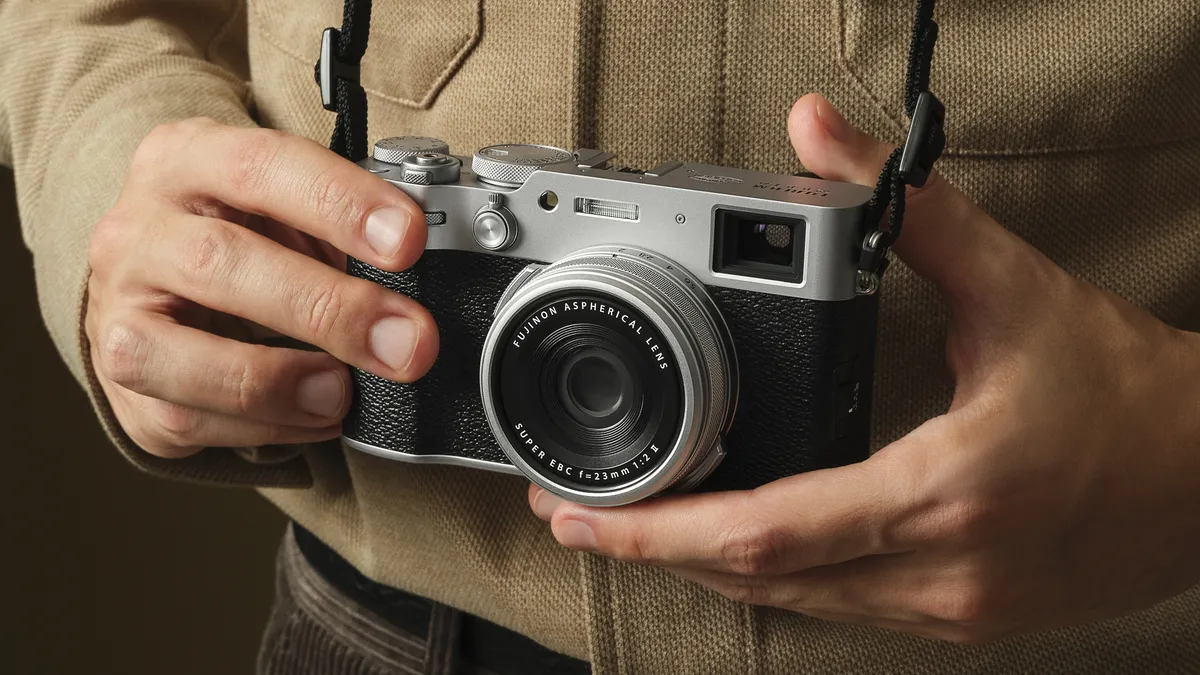
This is something of an anomaly on our list, a camera that's not just good for making content for TikTok, but also owes a lot of its popularity to TikTok. An explosion of interest in retro cameras capable of producing images that 'look like film' saw a huge spike of interest in this camera'a predecessor, the X100V, and this newer version has proven just as popular in the time since its release – to the point where you're going to have be patient and ready if you want to get hold of one.
Fujifilm's original X100 was the camera that sparked people's obsession with Fujifilm's retro-styled modern cameras. With the same exceptional build quality as all Fujifilm cameras in a small, pocketable version, the X100VI has the same 40MP X-Trans sensor as the likes of the X-T5. The X100VI is an advanced, APS-C fixed lens camera and is certainly aimed at enthusiasts, but it can be used for TikTok videos too. If somehow you get hold of one, you're not going to be disappointed.
Read our Fujifilm X100VI review for more details
Best wireless gimbal

The FeiyuTech Pocket 3 brings a fresh twist to the compact vlogging camera scene with its unique detachable gimbal head and magnetic base — a design that offers genuine flexibility and sets it apart from competitors like the DJI Osmo Pocket 3. Its significantly lower price tag is a clear attraction, though it does come with trade-offs. The camera’s image quality is serviceable but underwhelming, especially in low light, due to its smaller sensor. It also lacks pro-level features such as 10-bit log, advanced slow motion, and the extensive accessory range found in DJI’s ecosystem.
Still, the Pocket 3 has some surprising advantages. Battery life is excellent, the wide 16mm equivalent lens captures an immersive field of view, and the autofocus and face tracking are impressively responsive. The detachable gimbal opens up creative shooting options, and its wireless performance is more dependable than you might expect at this price point.
Handling isn’t flawless — the small screen, lack of weather sealing, and no external mic input mean it's not the most versatile choice for demanding shoots. But for casual creators and mobile vloggers, it’s compact, intuitive, and fun to operate in the right conditions.
While it won’t match premium rivals in terms of sheer image performance or pro features, the FeiyuTech Pocket 3 earns its place as an affordable, inventive tool for content makers who prioritize convenience, portability, and creative freedom.
If you're looking for a budget-friendly vlogging companion that dares to be different, the Pocket 3 is well worth a closer look.
Read our Feiyu Pocket 3 review for more details
How to choose the best camera for TikTok
The first thing to decide when choosing a camera for TikTok is whether you actually need a dedicated camera at all, or whether your smartphone will do everything you need. The best camera phones offer unbeatable convenience for TikTok, largely because you already carry one everywhere and can shoot, edit and upload directly within the app without adding extra steps to your workflow.
That said, there are plenty of dedicated cameras that are particularly well-suited to TikTok, including mirrorless cameras, compact cameras, and action cameras. Moving to a dedicated camera can give you noticeably more creative flexibility, whether that means swapping lenses, using genuine optical zoom or taking advantage of a larger sensor for stronger low-light performance and a more pronounced shallow depth-of-field effect.
Certain cameras also bring physical advantages that a smartphone cannot match. GoPro action cameras are built to withstand water, knocks and demanding environments, while DJI’s Osmo Pocket cameras use mechanical gimbal stabilisation to deliver exceptionally smooth footage while remaining small enough to carry almost anywhere. For creators shooting travel, sport, POV footage or more cinematic TikToks, those advantages can be just as important as outright image quality.
How we test the best cameras for TikTok
We've physically seen and reviewed every single camera and smartphone in this guide, to ensure that we can give you informed, honest, and in-depth buying advice. We've analyzed the design of each model, how easy it is to use for TikTok videos, and how the camera performs for video recording.
Find out more about how we test and review at Digital Camera World.
If you want to improve your presence online, you might also like the best cameras for streaming and the best cameras for vlogging

