
Smart telescopes are revolutionizing how we observe the night sky — offering app-controlled, automated stargazing without the steep learning curve. These modern telescopes have built-in cameras, so you don't have to peer through an eyepiece - instead, you look at a live image on the screen of your phone or tablet. As the connection between the telescope is wireless, you don't even need to stay outside to explore the night sky! Even better, since the first models appeared on the market from Vaonis and Unistellar five or so years ago, there are now some much more affordable options from companies like Zwo and Dwarflab to choose from.
Whether you’re a beginner or an enthusiast, this guide highlights the best options to get into astrophotography and astronomy with ease. We've found and reviewed all the best smart telescopes available, testing them all to bring you the most accurate buying recommendations for your needs.
Unlike the best telescopes for astrophotography, smart telescopes are easy for beginners to use. They use cutting-edge astrophotography techniques to locate faint objects in the night sky and then take long exposure images of them, stacking one on top of the other to remove noise, battle light pollution, and improve the image quality. The result? Colorful images of deep-sky objects like galaxies and nebulae that are next to impossible to see with even high-powered optical telescopes.
Our Top Picks

A major upgrade on the original, this compact smart telescope adds 4K imaging across two cameras and an EQ mode, making it a powerful yet portable all-rounder for beginners and enthusiasts alike.
Read more below

Those after the best possible image quality from a smart telescope, should invest in this high-quality product, which comes complete with the eyepiece.
Read more below

A premium, app-driven smart telescope that delivers consistently impressive deep-sky images with minimal effort, combining refined automation with an advanced mosaic imaging mode for a sleek experience.
Read more below

A statement design and a Nikon-made digital eyepiece make this a standout smart telescope that's ideal for use around the home.
Read more below

This is the most affordable smart telescope on the market, making small version of the S50 is hard to beat if you are on a limited budget.
Read more below

The smallest smart telescope available, this pocket-sized device is perfect for travel, offering automated imaging, EQ tracking and solar capability in an ultra-lightweight design.
Read more below

This mid-range smart telescope is the one to go for if you fancy getting involved in organized observing campaigns for comets and more with other Unistellar users.
Read more below

Jamie is Digital Camera World's astrophotography specialist. As the editor for www.WhenIsTheNextEclipse.com, he has a wealth of enthusiasm and expertise for all things astrophotography, from capturing the Perseid Meteor Shower, lunar eclipses and ring of fire eclipses, photographing the moon and blood moon and more. He has personally tested all the smart telescopes in this guide.
The best smart telescopes
Why you can trust Digital Camera World Our expert reviewers spend hours testing and comparing products and services so you can choose the best for you. Find out how we test.
Best overall

The arrival of the now-discontinued Seestar S50 in 2023 made smart telescopes affordable. The Seestar S30 Pro takes the next step by making them genuinely capable imaging tools.
At first glance, it barely looks like a telescope at all. Closer in size to a large telephoto lens, it’s designed for travel, something that would have been unthinkable for traditional astrophotography rigs just a few years ago. Yet once powered on and connected to a smartphone, it performs the same essential workflow as far larger systems: automatic alignment, object selection, tracking and live stacking.
What sets the Pro model apart is its imaging system. The jump to dual 4K sensors — one for wide-field views, one for telephoto detail — means more resolution, more flexibility and far greater potential for post-processing (thanks to its ability to export FITS files). The same goes for pro-grade EQ mode, though that requires the addition of an equatorial edge.
The longer you let it run, the better the results become, as stacked exposures gradually reveal faint structure and color, but there are limits. Its 30mm aperture restricts raw light-gathering power while planetary imaging remains basic, but overall it represents a clear shift in what a beginner-grade smart telescope can be. By simplifying astrophotography, the Seestar S30 Pro lowers the barrier to producing genuinely good images.
Read our full ZWO Seestar S30 Pro review.
Best for images

The eVscope 2 offers some of the most advanced features available in a smart telescope today. It may ship with an excellent quality backpack for taking to dark skies, but the eVscope 2 copes brilliantly with urban light pollution. Its Enhanced Vision (EV) images of faint galaxies, nebulae and star clusters can be viewed in the Unistellar app and shared as a PNG file complete with some basic information about the target. A 4.5-inch reflector telescope with a Sony IMX347 image sensor, eVscope 2 has 64MB storage and a 12-hour battery.
Unusually, the eVscope 2 has an electronic eyepiece. Made by Nikon, its micro OLED tech provides crisp, contrasty views of night sky objects with plenty of eye relief for glasses-wearers. It helps eVscope 2 bridge the gap between traditional observing and gives users a reason to be outside, but it also makes it easier to focus on the optics. Since it’s a reflector telescope, it will occasionally need collimating.
Read our full Unistellar eVscope 2 review.
Best for ease of use

If the sleek Vespera II made smart telescopes accessible, the newer Vespera Pro refines the concept into something closer to a fully automated observatory.
At its core, the experience is unchanged. You place it on a tripod, connect your phone, and within minutes it’s aligned itself, found the target, and begun capturing exposures. Like all smart telescopes, it stacks images over time, gradually revealing detail that would otherwise remain invisible to the eye.
The Pro’s upgraded sensor delivers noticeably higher resolution, while its CovalENS mode expands the field of view by stitching multiple panels together. It works a bit like creating a panoramic landscape image, allowing large objects such as the Andromeda Galaxy (M31) to be captured in full.
In practice, the Vespera Pro excels at deep-sky imaging. Nebulae, galaxies, and star clusters emerge cleanly even from light-polluted cities, especially when paired with optional filters from Vaonis designed to suppress light pollution and enhance specific wavelengths of nebulae imaging. Its ability to build multi-night stacks also makes astrophotography less like a single observing session and more like an ongoing project that improves over time.
There are trade-offs. Like most smart telescopes, planetary imaging is underwhelming, while the price is firmly in premium territory, particularly once accessories are added. However, the Vespera Pro offers a great build quality and an excellent app, which shouldn’t be underrated.
Read our full Vaonis Vespera Pro review.
Best for design

The Odyssey Pro is a simplified version of the Unistellar eVscope 2. Again, it has the advantage over other smart telescopes in that it can be used like a traditional telescope - as it has a Nikon-designed digital eyepiece, so you are not completely dependent on using your cellphone or tablet to see the night sky. This model is cheaper and lighter, though - and for that, you do sacrifice some resolution. However, its 4.2MP sensor was still capable of producing some great images in our tests - even in areas with significant light pollution.
Read our full Unistellar Odyssey Pro review
Best for price

The Seestar S30 is a compact, beginner-friendly smart telescope that brings deep-sky astrophotography within reach of anyone thanks to its low price. Controlled via an intuitive app, it auto-aligns, tracks and stacks images with ease. Its dual-lens system handles both solar, lunar and deep sky targets, and the framing mode captures stunning wide-field mosaics.
While limited in resolution and planetary detail, its portability, built-in filters, and powerful Sony sensor deliver impressive results for its size and price. With a travel-ready form, magnetic solar filter, and smart automation, the S30 is an excellent tool for photographers wanting to capture the cosmos without the cost, the bulk or the learning curve.
See our full ZWO Seestar S30 review
Best for portability

If most smart telescopes are designed to simplify astrophotography, the Dwarf Mini goes one step further by miniaturizing it. Small enough to slip into a camera bag — or even a large pocket — it barely feels like a telescope, yet the core experience remains familiar. As with all its rivals, you connect your phone, select a target, and the system aligns, tracks and stacks exposures automatically.
What makes the Dwarf Mini distinct is its dual identity. It’s not trying to compete with larger, higher-resolution instruments. Instead, it prioritizes portability and flexibility, making it ideal for travel, spontaneous observing sessions or supplementing a more advanced setup. Results won’t rival higher-resolution rivals, but they’re more than sufficient for sharing — and improve noticeably with longer integration.
A surprising feature is its equatorial tracking mode, which allows exposures of up to 90 seconds when properly aligned with Polaris. It also stands out for its versatility. With a built-in filter wheel and included solar filter, it can image the sun, moon and night sky straight out of the box — no extra accessories required. However, there are downsides, with that modest resolution paired with limited battery life and the need to supply your own tripod. Nevertheless, this travel-first smart telescope makes astrophotography possible anywhere, anytime.
Read our full DwarfLab Dwarf Mini review.
Best for science
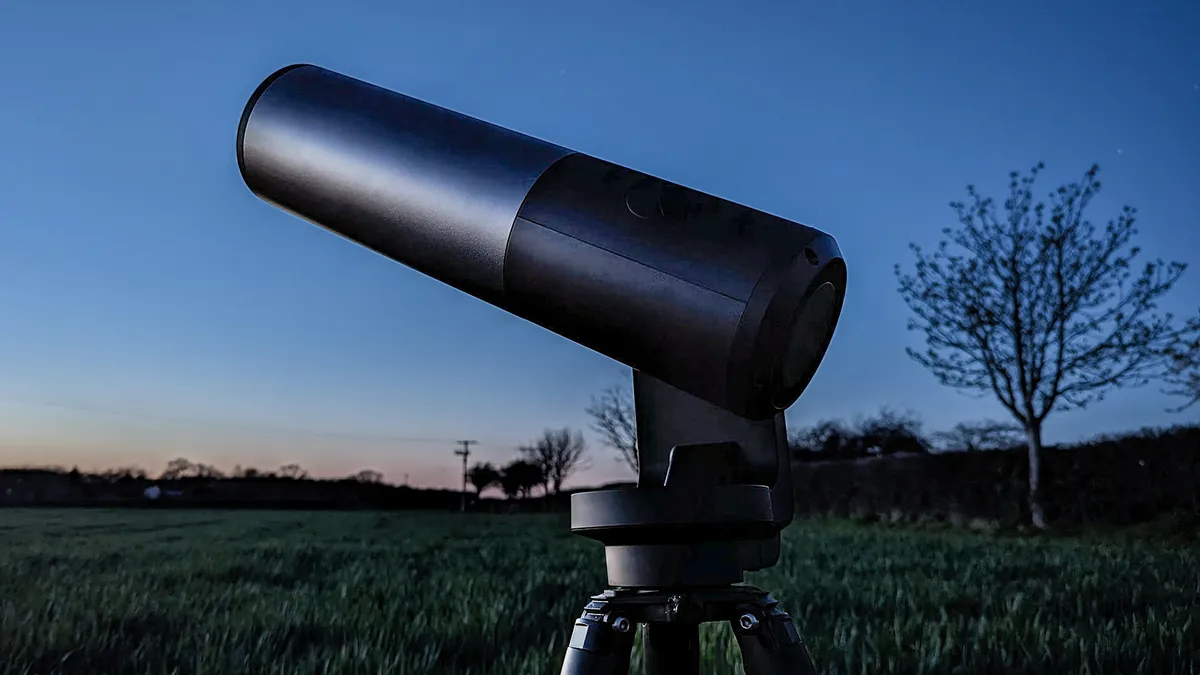
The eQuinox 2 is a lower-cost alternative to our top-rated Unistellar eVscope 2 — with the main difference being that this smart telescope doesn't have a built-in electronic viewfinder. As such, you need to view the night sky exclusively through your phone or tablet via a WiFi connection.
The resolution has also slightly decreased, but its 6.2MP sensor still ensures that it gives you better image quality than some earlier smart telescopes.
What impressed us most about the eQuinox 2 in our test is its ease of use. Once set up on its motorized tripod, the Unistellar app effortlessly allows you to locate any one of thousands of objects — and even take part in organized citizen science observing campaigns for comets, exoplanets and more. We did find that you do need to wait until you have a completely dark sky to get the best results for the setup - but we love that once it is set up and running, you can sit inside (or in your car) and control the telescope (which is very welcome on a cold winter's night!).
Read our full Unistellar eQuinox 2 review.
Common questions
What is collimating?
Telescope mirrors and lenses need to be aligned to give a nice, sharp image. The process of getting them aligned is known as collimation – which you can think of as an essential step, like having to tune a guitar before you play it. Collimating is usually only essential with telescopes that have mirrors in them, such as reflectors or catadioptric telescopes.
A great way to see if collimation is the problem is to point the telescope at a bright star and adjust the focus so that the star is out of focus and showing as a big blob. Look closely and you will see a bright outer ring surrounding a dark central disc. If the dark disc is not in the center of the bright ring, then the optics are not aligned, and you need to collimate.
The steps to achieve this depend on the telescope you have, so check out the manual or find the guide for your telescope online – and you should then be able to get nice sharp images.
You might also like the best lenses for astrophotography and the best star tracker camera mounts. Check out our astrophotography tips while you're here.
