
Digital Camera World Verdict
The ZWO Seestar S30 Pro is an enticing smart telescope for photographers curious about astrophotography who don’t want to invest in a complex traditional setup. Its upgraded 4K sensors, improved optics and new wide-field imaging modes make it a valuable step up from the original Seestar S30.
Reasons to buy
- +
Fits into a modest camera bag
- +
4K sensors upgrade
- +
8.3 MP images
- +
Wide-field and telephoto imaging
- +
User-friendly smartphone app
Reasons to avoid
- -
Relies entirely on smartphone app control
- -
Frequent data downloads
- -
+Poor planetary imaging
Why you can trust Digital Camera World Our expert reviewers spend hours testing and comparing products and services so you can choose the best for you. Find out how we test.
If you’ve been thinking about exploring astrophotography but are put off by the expense — and the usual requirement for telescopes, tracking mounts, cameras and laptops — the ZWO Seestar S30 Pro smart telescope may be exactly what you’re looking for.
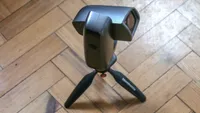
Small enough to sit comfortably in a camera backpack alongside a mirrorless body and a couple of lenses, the Seestar S30 Pro is closer in size to a chunky telephoto lens than a traditional telescope — but nowhere near as heavy.
Designed by Chinese imaging specialist ZWO, which has been making a name for itself in astrophotography accessories, the S30 Pro is an upgraded version of the original Seestar S30. Conceptually, they’re identical. Once powered on and connected to a smartphone via Bluetooth and WiFi, it automatically aligns itself to the night sky as it slews to your chosen celestial object, captures a series of exposures and stacks them to create colorful images — from galaxies, nebulae and star clusters to the moon and even the sun.
What makes the Pro model interesting for astrophotographers is its upgraded imaging system. While the original Seestar S30 used a 2MP Sony IMX662 sensor for Full HD resolution images, the S30 Pro introduces larger Sony IMX585 and Sony IMX586 sensors — both capable of capturing 8.3MP 4K images — for telephoto and wide-field imaging, respectively. That’s a big leap in detail — and there’s more. It’s also got an equatorial mode that puts the ‘scope in sync with Earth’s rotation, enabling longer exposures.
Although it requires an equatorial wedge ball head and polar-aligning, together with the jump in resolution, it helps make the Seestar S30 Pro the first pro-level portable smart telescope.

Specifications
Sensor |
Sony IMX585 1/1.2in (tele) / Sony IMX586 1/2.0in (wide) |
Resolution |
3840 × 2160 (8.3MP) |
Aperture |
30mm / 1.18 inches |
Focal ratio |
f/5.3 |
Focal length |
160mm / 6.3 inches |
Optics |
Quadruplet apochromatic lens with ED glass |
Storage |
128GB eMMC |
Connections |
USB-C, Bluetooth and WiFi |
Mount |
Alt-azimuth (EQ mode supported) |
Battery capacity |
6,000mAh |
Weight |
1.65 kg / 3.6 lbs |
Dimensions |
210mm × 140mm × 80mm / 8.27 × 5.51 × 3.15 inches |
Price & availability

ZWO’s Seestar concept was the first entry-level smart telescope to catch the zeitgeist with the release of the Seestar S50 in 2023. The more portable Seestar S30, priced around UK£419/US$399/AU$699, quickly became one of the most affordable smart telescopes available when it was released in 2025.
The Seestar S30 Pro is an effort to keep the same form factor but slightly upgrade the experience, with new sensors and improved resolution responsible for an uptick in price to US$599/£599/AU$820.
For astrophotographers who care about resolution and post-processing potential, the upgrade from a full HD sensor in the S30 to 4K sensors in the S30 Pro makes the latter far more appealing.

Build and handling
The Seestar S30 Pro is remarkably portable. Its compact design means it can easily fit inside most camera backpacks — something that would have been unthinkable for traditional astrophotography setups — though its carry case also comes with a shoulder strap.
Build quality is solid rather than luxurious. The main body uses a tough white plastic chassis paired with a small but very capable tripod. That tripod works well on a tabletop and is ideal for travel and wide-open spaces, but for use in the average backyard, you’ll likely want to mount the telescope on a full-size photography tripod. It’s got a 3/8-inch thread, but there’s a converter in the box to make it 1/4inch.
Alternatives


The device itself has very few physical controls — just a power button and a USB-C charging port. Everything else happens through the smartphone app. That’s a no-brainer in the short term, though there is always the nagging thought about how long app-based devices will last. After all, without the app, the Seestar S30 Pro is nothing; this likely isn’t a telescope you’re going to keep in the family for generations.
During testing, the app worked smoothly, though it occasionally informed us of large firmware updates and downloads for its built-in sky atlas. It’s worth setting it up at home before heading out to darker skies.
Performance


In the field, the Seestar S30 Pro performs impressively for such a compact and automated device. At night, the process is simple: place the telescope on its tripod, power it on, connect a smartphone and select a target from the built-in sky atlas. The telescope then plate-solves the stars, slews automatically to the chosen object, focuses and begins capturing exposures. Each image is stacked automatically, gradually revealing more detail as the integration time increases. The longer it runs, the cleaner and sometimes more colorful the final image becomes.
We tested it on a host of different objects, from the Pleaides (M45) and the Orion Nebula to the Leo Triplet and Bode’s galaxies and the Cigar galaxies. Happily, the Seestar S30 Pro can create FITS files for deep-sky objects, which astrophotographers can then export to image-stacking software. That’s what to do to reduce noise and maximize detail.
However, the S30 Pro still has limitations. Its 30mm aperture and alt-az mount restrict exposure lengths, which limits ultimate detail. Cue its EQ mode, which compensates for the Earth’s rotation. It necessitates the purchase of the Seestar TH10 Fluid Tripod Head (costing US$79) (or any equatorial wedge).
To use it, set the dial to your latitude and point it towards north, either using Polaris, the North Star, or just the compass on your phone. There’s then an in-app guide to fine-tune the positioning. Once completed, the app goes into EQ mode, enabling much longer exposures for objects.


If you want to image large areas of the night sky — either for large nebulae or for the Milky Way (or constellations) — there are two choices. Milky Way mode is the easiest and quickest, whereby the wide-angle camera takes images quickly, or the slow mosaic mode, during which the telephoto takes lots of smaller images and stitches them together. The latter, of course, is how to create higher resolution images.
Lunar imaging is very simple, while daytime imaging with the solar filter is straightforward, allowing quick captures of sunspots using the telephoto camera for close-ups.
ZWO Seestar S30 Pro: Verdict

The ZWO Seestar S30 Pro proves that astrophotography doesn’t need to involve complicated equipment or a huge financial investment. For photographers curious about capturing the night sky, it offers an incredibly simple way to start. Setup takes minutes, the automation handles the difficult parts, and the results can be surprisingly good with much integration time. Compared to the original Seestar S30, the 4K sensor, improved optics and expanded imaging modes make the S30 Pro a much more capable photographic tool, particularly for anyone interested in editing their images.
Features ★★★★★ |
Automated alignment and image stacking for beginners, with mosaic mode, EQ mode and FITS data for more advanced astrophotography. |
Design ★★★★☆ |
Compact, lightweight and travel-friendly — a telescope that genuinely fits in a camera bag — but also comes with an excellent tripod and carry case. |
Performance ★★★★☆ |
Simple to use and with an excellent app, it’s very quick to set up for some shots while advanced modes come with in-app help. |
Value ★★★★☆ |
With a strong balance of portability, accessories, automation and image quality, this smart telescope is both relatively affordable and excellent value. |
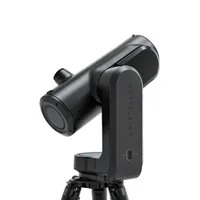
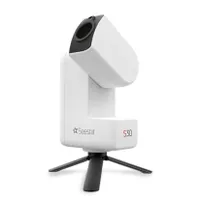
Check out our full guide to the best smart telescopes

