






Originally planned for 2023-2024, at $45,000 / £38,000, Hyperia aimed to act as a hybrid between a consumer smart telescope and a full-blown observatory.
When we first covered Vaonis' Hyperia back in 2021, it sounded almost mythical – a "domestic Hubble" promised for wealthy amateur photographers, carrying an eye-watering price tag and an ambitious feature list. Now, Hyperia is no longer a concept. It's real, refined, and significantly more expensive...
Officially revealed in its final form, Hyperia answers a question posed by Vaonis and Canon: what happens when you remove every limit?
The answer: a $99,000+ all-in-one digital observatory, built for museums, science centers, and also professional public outreach – and it may be the most ambitious imaging instrument ever aimed beyond traditional observatories.
Canon & Vaonis
Canon optics + Vaonis engineering: an alliance that changes everything

Hyperia marks a pivotal moment for Vaonis: a deep technical partnership with Canon. It's simple. Canon brings the optical DNA. Hyperia's optical system is built around a 150mm aperture and fast f/4 focal ratio, optimized to capture faint light with maximum efficiency.
Inside, 17 precision-engineered Canon lenses work as a single optical system, correcting distortion, chromatic aberration, and field curvature before light even reaches the sensor.
Each element is treated with Canon's most advanced anti-reflective technology: Air Sphere Coating. It minimizes internal reflections and preserves contrast.
The result is deep blacks, controlled highlights, and remarkably even sharpness from center to edge – critical for large-format astrophotography. This imaging is designed pixel-for-pixel, without compression or compromise.

Hyperia
With Hyperia, tracking, derotation, imaging, and processing are fully integrated into a single instrument. The dedicated app manages everything from planning and guided sessions to multi-night image stacking, object catalogs, and AI-assisted support – making Hyperia suitable for expert and public discovery and education.

Key features
1. Field Derotator: Perfectly aligned stars
Keeps stars motionless during long exposures, ensuring sharper and more accurate astrophotography.
2. Filter Drawer: Filters at your fingertips
Swap filters in seconds and adapt instantly to any sky conditions or imaging style.
3. Direct-Drive Tracking System: Precision in motion
Delivers ultra-smooth, silent, and backlash-free tracking. Up to 60°/s - Full rotation in 6seconds.
4. Full-Frame Back-Illuminated Sensor: A 45MP full-frame
3.30° × 2.20° field of view, capturing faint details with exceptional clarity and depth.
5. Aluminum Body: Engineered for endurance
A rigid and thermally stable aluminum structure designed to perform flawlessly in demanding environments.
6. Seamless Ground Mounting Plate: Stability built in
A clean, integrated base that mounts and levels instantly for vibration-free, hassle-free observing.
Price & Availability
Hyperia is available from $99,000 (approx. £73,480 / AU$147,240). Production is strictly limited, with pre-orders opening in January 2026 and deliveries expected in 2027. Find more info here.
Your Alternative
For most, Hyperia will remain a dream instrument. The good news? Vaonis also offers far more realistic products, like the Vaonis Vespera II.
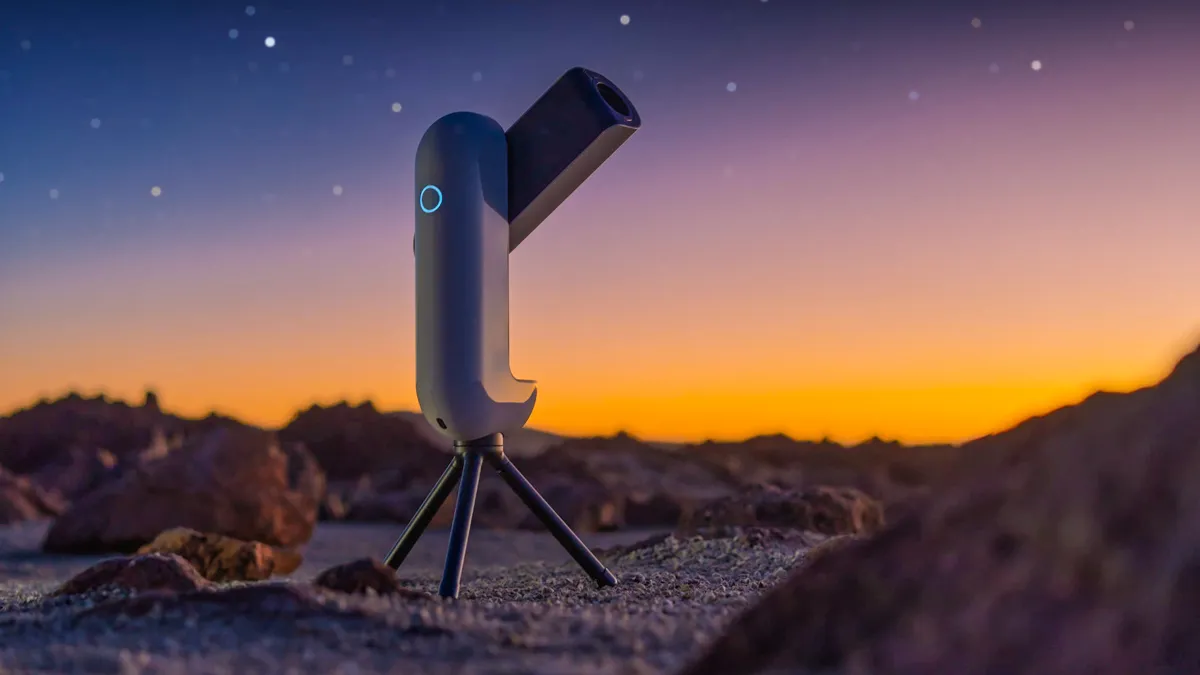
The Vespera II is compact, portable, and dramatically more affordable, available from $1,590 / £1,395/ AU$3,215.
It delivers automated deep-sky imaging with minimal setup. It's ideal for solo imaging, group sessions, and photographers curious about astrophotography without committing to observatory-level hardware.
Because, in the end, Hyperia shows what happens when you remove every limit and let engineering take over – and the six-figure price makes sure you don't forget it.
You might like...
Browse the best smart telescopes, best telescopes for astrophotography, and best star tracker camera mounts for astrophotography.

