





Don't care about 3D or VR? Neither did I – until Canon showed me what it's doing with the technology at the CP+ 2026 show in Japan. And I've honestly gone from being indifferent to genuinely being excited – and that's in large part due to how Canon has democratized this kind of imaging.
For starters, you don't need a special camera, lens or headset any more; thanks to an incredibly innovative implementation of Canon's Dual Pixel wizardry (yes, the same tech that powers your Dual Pixel autofocus) you can take a regular photograph on a standard EOS camera and lens and turn it into a 3D image.
This is just one of the multiple ways Canon has developed VR; take a look at my quick guided tour video below, which gives you an easy-to-digest overview of the company's exhibits being shown off in Yokohama:
Canon EOS VR
It starts off with Canon's EOS VR ecosystem – which will probably be the setup you're most familiar with, as it requires specific VR lenses and a headset in order to fully immerse yourself into the spatial video that is captured.
It's built around Canon's stereoscopic lenses: the full-frame Canon RF 5.2mm f/2.8L Dual Fisheye (compatible with the EOS R5, R5 Mark II, R6 Mark II, R6 Mark III, C400, C80 and C50), along with the APC-C tag team of the RF-S 3.9mm f/3.5 STM Dual Fisheye and the RF-S 7.8mm f/4 Dual (both compatible with the EOS R7, R50 and R50 V).
I had the opportunity to try the latest showcase of the technology, which involved interacting with multiple animal scenes involving dogs chasing a ball, cats going nuts over a catnip lollipop, a hedgehog being quite a bit less dynamic than the dogs and cats, and an owl being fed using a pair of tweezers.
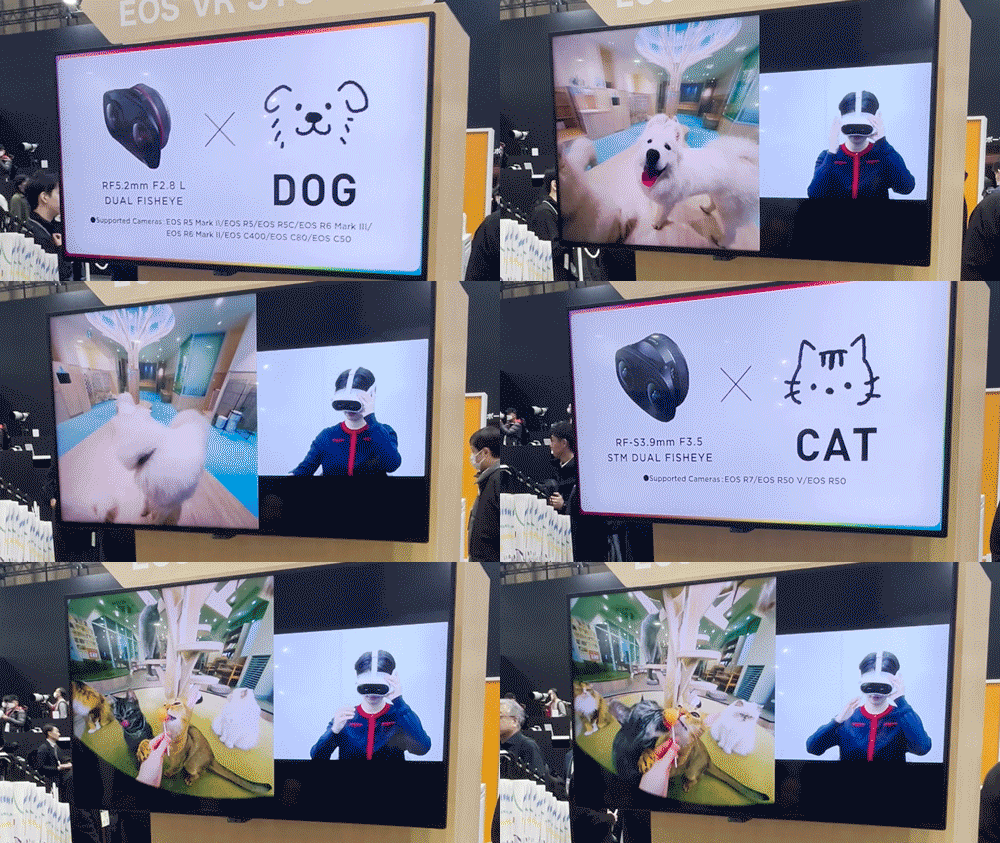


It's pretty cool to experience, but ever cooler when you consider that Canon is the only brand that offers these kinds of creation tools. The fact that dual-lens, same-sensor outfits like this are available to consumers is a grossly underappreciated fact.
Think about it: right now you can buy a RF-S 7.8mm f/4 Dual for $409 and an EOS R50 V for $569. So for less than a grand, you can start creating seriously impressive VR footage – that's an incredible proposition for anyone wanting to get in on the ground floor of the next frontier in video, or just anyone who wants to shoot some cool stuff.
But still, this is the traditional hardware-based entry point into 3D creation – and as affordable an entry point as it might be, there is still a cost involved. However, part of Canon's 3D strategy is to open the ecosystem to users without investing in dedicated equipment.


MReal x Dual Pixel 3D
This is where things get really clever, because it enables you to create 3D images without any dedicated 3D or VR hardware. No special glass, no special goggles, just a regular Canon body and lens – all thanks to the marriage of Canon's MReal (mixed reality) and Dual Pixel 3D.
Dual Pixel 3D is an evolved version of the technology I saw at last year's CP+, which uses the dual photodiodes of Canon's sensor technology to map the distance between the camera and subject in order to create a spatial image.
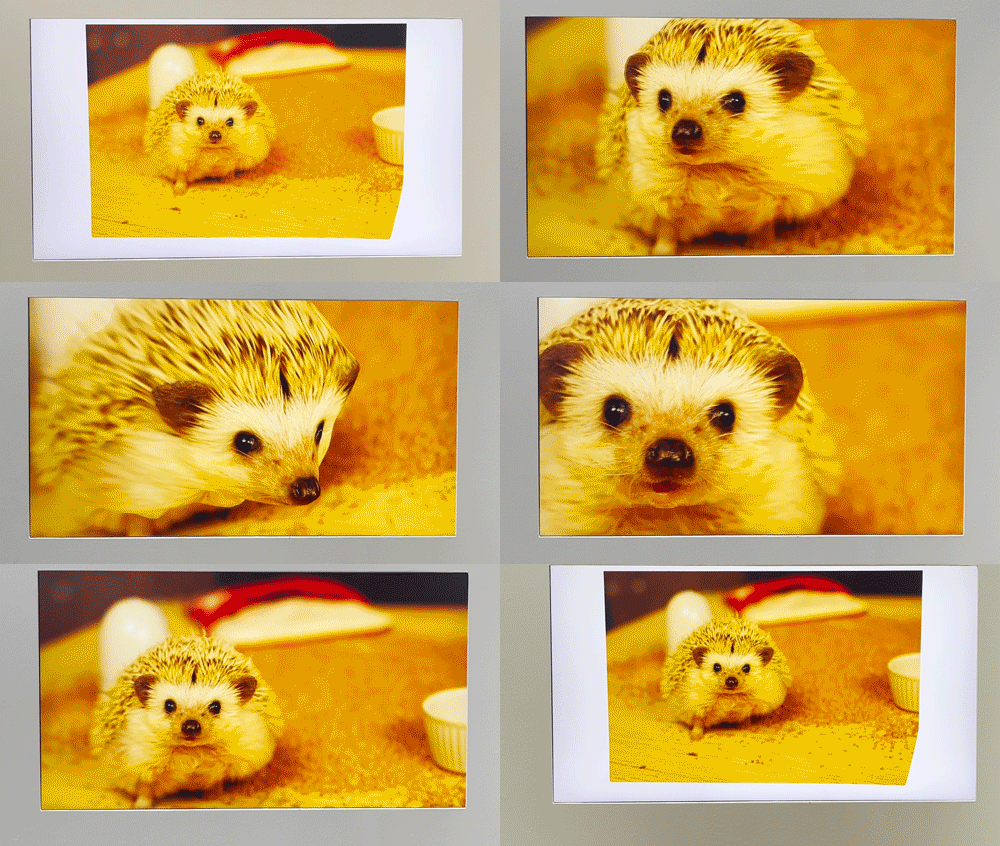
As you can see in the GIFs below, the image can be fully interacted with in all three dimensions. I tried this using a computer touchpad on a standard screen, and it's pretty eye-opening to consider how this kind of interaction could enhance your experience.
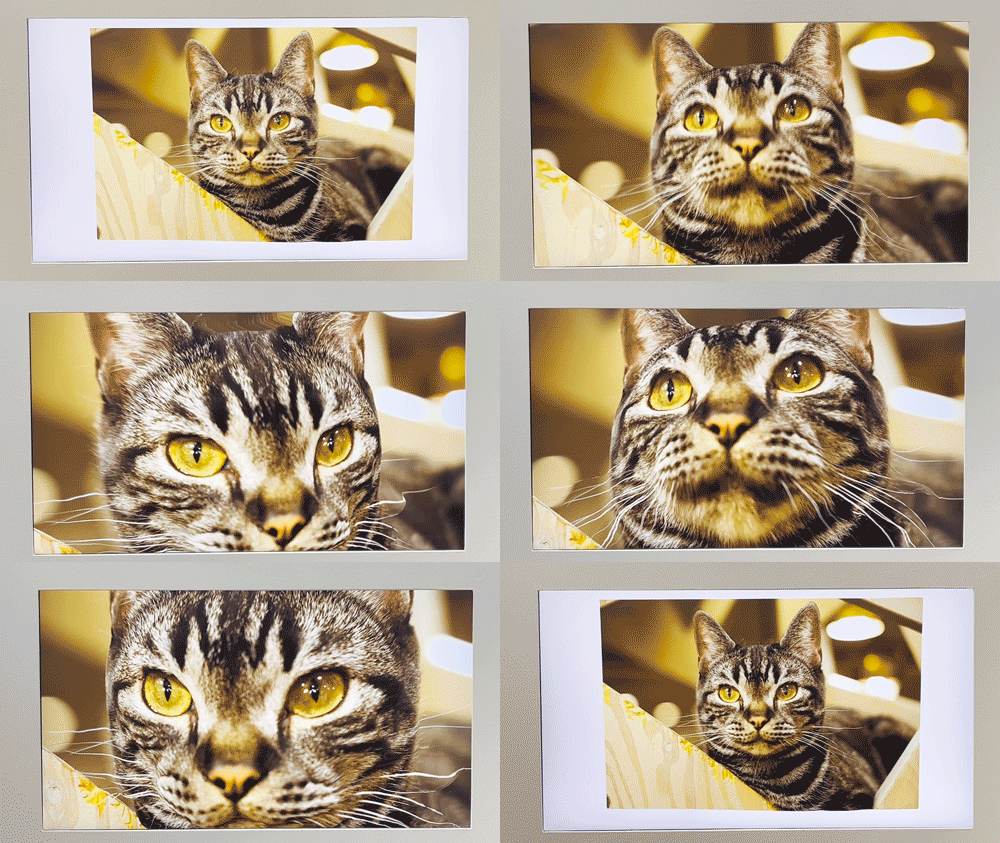

We've all spun around 3D models of products we want to buy on ecommerce websites, which gives a great idea of how goods look from all angles. However, Canon interest in 3D isn't just using it to encourage people to buy things from websites.
What if you could use the same technology to interact with photographs of your pets, or even your friends and family members? To that end, had a portrait booth set up at the show to demonstrate the potential next generation of family photos – photos where you can experience a three-dimensional, visceral memory of your loved ones.
As someone who has recently lost family members, the idea of being able to truly see the shape of their faces, to move around them and feel memories of them come to life, feels like an incredible application of 3D imaging.

MReal x Volumetric
Lastly, I experienced Canon's MReal tech working in tandem with its volumetric video advancements. If you're unfamiliar with volumetric capture, Canon first showed it off at CES 2021 and it was also rolled out at the Paris Olympics in 2024. In short, it tracks and maps a three-dimensional space in order for users and observers to view or interact with it.
Last year, Canon exhibited MReal in the form of a fencing duel. By wearing a headset, you could become part of that physical encounter and even view augmented reality-style annotations in the form of statistics and trajectory diagrams – like a cross between physically stepping into the duelling space, while a sportscaster uses a Telestrator to highlight the action.
Canon's CP+ 2026 exhibit married MReal and volumetric video with what I can only describe as a real-life version of Nintendogs – which you may remember as the animal simulation videogame that took the world by storm on the Nintendo DS console a couple of decades ago.
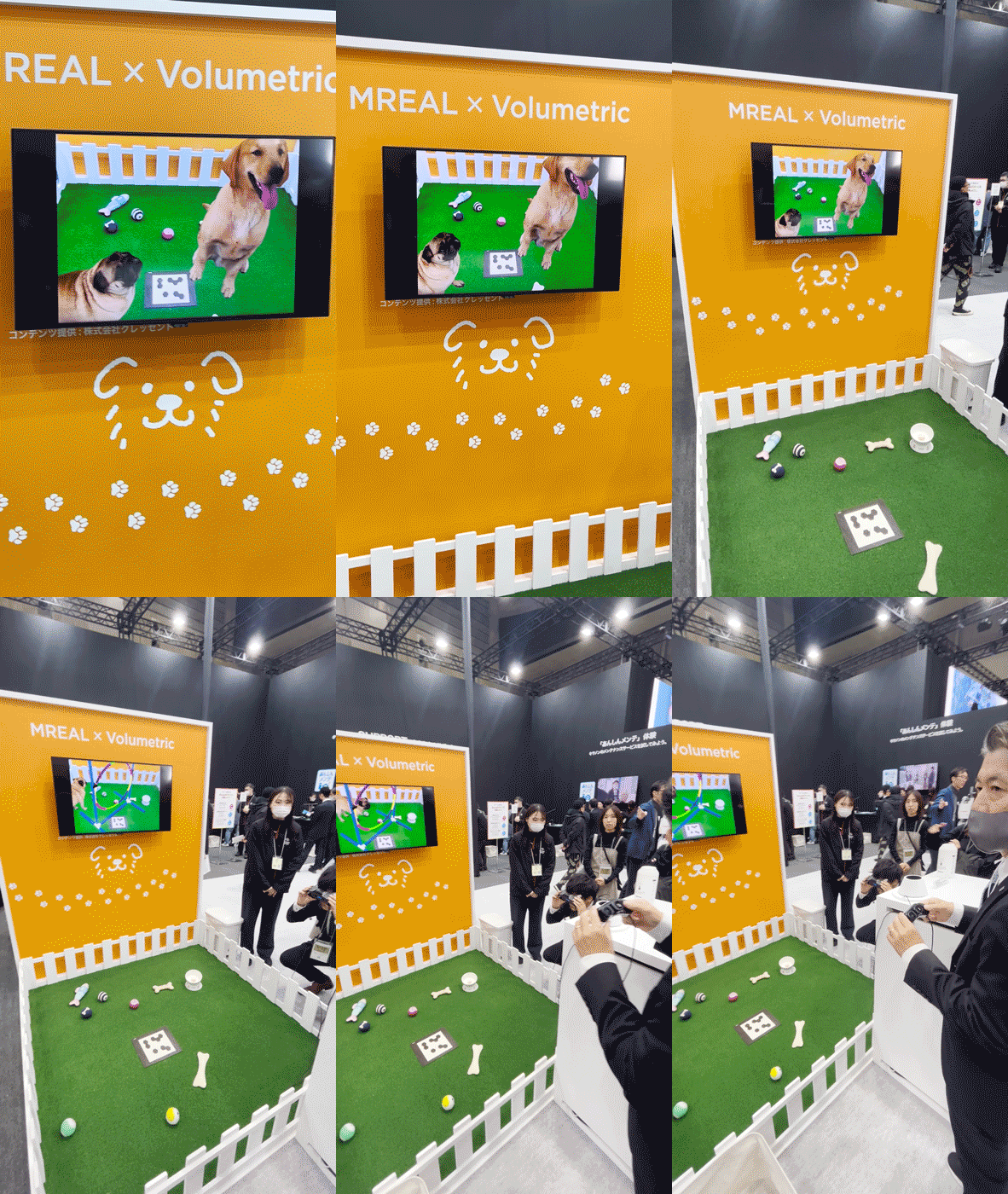
There was an empty doggy playpen full of toys – but it was only empty until you held a pair of Canon's MReal glasses in front of you, whereupon a couple of virtual pooches were spatially mapped within the area and started playing and performing tricks.
This was the first time I'd seen the MReal glasses, as opposed to the full headsets (which is what I wore for last year's demonstration of the tech). As someone who already wears glasses (and needs varifocals, at that), I'm not the biggest fan of having to wear a helmet with goggles that smoosh my specs into my face.
Unsurprisingly, I much preferred these "opera glasses"-style viewing devices, which can be comfortably held in front of you – though of course, the result isn't as immersive as a headset that fills your peripheral vision.


All three implementations of Canon's VR, 3D and MReal technology were pretty mindblowing – and gave a much better idea of how this kind of imaging can go beyond just being a showy tech demo to being something that genuinely enhances your enjoyment.
This, famously, is a hump that everyone from Oculus to PlayStation VR are still trying to get over. It's interesting that while gaming might seem like the most obvious avenue to exploit these experiences, I actually find the idea of more passive immersion in photo and video a much more valuable proposition.
I'm fascinated to see where this technology goes next – and, as I said in my hands-on with the Canon Analog Concept Camera, my hat is off to the manufacturer for being so bold in trying new things, beyond just churning out the same cameras and the same lenses that every other manufacturer makes.


You might also like...
See what else is happening at CP+ 2026, along with the best Canon cameras and best Canon RF lenses for non-VR photo and video.

