Digital Camera World Verdict
The Canon RF 14mm f/1.4L VCM looks and feels like a top-grade ultra-wide prime for both stills and video, delivering impressively sharp images with good control over distortion and flare. Its advanced optics, manageable weight, and hybrid-friendly controls team up with silent VCM autofocus. The lens is especially appealing for interiors, landscapes, and astro work, whether you're shooting stills, video, or both. The only real drawback is price, as the complex glass makes the lens notably more expensive than other primes in the 'VCM' range.
Pros
- +
VCM motor is completely silent and lightning fast
- +
Lightweight despite advanced optical construction and large aperture
- +
Iris ring for tactile aperture control
Cons
- -
Pricier than other VCM prime lenses
Why you can trust Digital Camera World Our expert reviewers spend hours testing and comparing products and services so you can choose the best for you. Find out how we test.
Canon’s hybrid RF lens family continues to expand, and the Canon RF 14mm f/1.4L VCM pushes that line into its widest territory yet. It's a very attractive proposition for stills photographers and for videographers - even more so for 'hybrid' shooters who need to mix and match both styles of shooting.
A 14mm prime with a fast f/1.4 aperture is an attention-grabbing combination on its own, but this lens packs in new elements and new technology, pitching for success in many and varied photographic genres. As such, the RF 14mm aims to be not just one of the best wide-angle lenses, but also one of the best lenses for landscapes and the best lenses for astrophotography, along with cityscapes, architectural interiors and more besides. All in all, it sets out to be a highly versatile ‘hybrid’ lens in every sense of the word.

Specifications
Lens mount |
Canon RF |
Lens construction |
18 elements in 13 groups |
Diaphragm blades |
11 |
Aperture |
f/1.4 – f/16 |
Minimum focus distance |
0.24m |
Maximum magnification |
0.11x |
OIS |
No |
Dimensions |
76.5 x 112mm |
Weight |
578g |
Price
Much like its VCM prime stablemates, the RF 14mm f/1.4L VCM is positioned as a premium L-series optic – with a premium price to match. It actually comes in at $2,599 / £2,399 / AU$3,799, which makes it substantially more expensive than any previous entry into Canon’s VCM lineup, costing almost $1000 more than the least expensive option. Indeed, the RF 14mm is firmly in pricey workhorse zoom territory, with a similar price tag to the Canon RF 15-35mm f/2.8L IS USM. Although not available in RF mount, the rival Sigma 14mm f/1.4 DG Art is much more affordable at $1,839 / £1,499 / AU$2,649.
Why so expensive? A significant factor is the inclusion of Canon's fluorite glass, which is renowned for being expensive to manufacture, and is usually reserved for its most premium professional telephotos.
Whether or not the RF 14mm is worth the money depends on how much you use this fairly niche lens. If you're a deadly serious enthusiast or professional astro or landscape creative who needs ultra-wide performance without compromise, then the 14mm f/1.4L VCM might well be worth the outlay – if you have deep enough pockets.
Design & Handling
The optical construction is built around 18 elements in 13 groups. Among these are three GMo (Glass Molded) aspherical elements designed to reduce sagittal coma flare, which is a major bonus for maintaining a regular shape of point light sources, such as stars.
The optical formula also incorporates a UD (Ultra-low Dispersion) element, a BR (Blue Spectrum Refractive) element, and a fluorite element to tackle chromatic aberration. Canon says this is the first time it has used fluorite in an ultra-wide lens, a material more typically reserved for high-end super-telephotos like the Canon RF 400mm f/2.8 and Canon RF 600mm f/4 optics. Coatings include Subwavelength Structure Coating and Super Spectra, both aimed at minimising ghosting and flare.

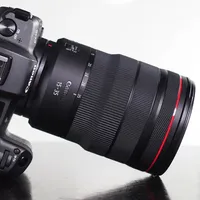
Despite the bright aperture and complex optics, the lens weighs just 578g. That makes it lighter than Canon’s 50mm and 85mm f/1.4 hybrid primes, and it sits within Canon’s 519g–636g weight window for the (current) hybrid prime range, which helps maintain consistent balance across gimbals and rigs. At 76.5 x 112mm, it’s slightly longer than other VCM primes due to the integrated hood, but still feels well matched to Canon’s mirrorless bodies.

It’s also lighter than the older Canon EF 14mm f/2.8L II USM – saving off 67g despite offering a full stop wider aperture. It is longer than Canon’s previous optic, but it is designed to slot perfectly into Canon’s VCM series of size-matched primes.
Looking further afield, there isn't a lot of direct competition. Compared to the Sigma 14mm f/1.4 DG Art lens for Sony and L-mount, Canon’s new optic is significantly smaller and around half the weight, with Sigma’s optic weighing a comparably whopping 1,170g and measuring 101.4 x 149.9mm.

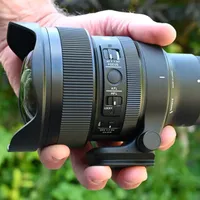
Aside from the built-in lens hood, this 14mm lens looks almost identical to the other lenses in Canon’s VCM prime series. The lens has a sizable manual focus ring, which is rubberized for easy grip, and turns smoothly – you can also adjust the behavior of the manual focus ring in more depth in the camera settings. The lens also includes Canon’s control ring up at the front of the lens, which again can be customized between a number of different settings.
Video users in particular will appreciate the iris control ring on the barrel, complete with a locking Auto setting for referring aperture control back to the camera body, although the aperture ring also works with stills photography, if that is your preferred method of controlling your settings.

I'm pleased that Canon has incorporated an Iris Lock switch into the design, for keeping the aperture ring in its Auto position. This can save a lot of heartache by ruling out accidental nudging of the ring from its Auto position. There's also an AF/MF focus mode switch, which saves time rummaging around in camera menus, and a custom function button, which you can assign to various functions via in-camera menus. AF-Hold is generally my favored option.

As I've mentioned, the optical element at the front protrudes beyond the casing. The lens therefore features a protective integral hood that can't be removed, and which hampers the fitment of front-mounted filters. That's certainly not uncommon among ultra-wide-angle prime and zoom lenses. As a substitute, the lens has a rear-mounted gelatin filter holder which is built into the lens mount. This solves the issue to some extent but doesn't cater to more exotic types of filter.

Performance
The first thing that hits you when you put the viewfinder to your eye is just how expansive the viewing angle of this lens really is. It’s pretty much as wide as it gets without going ‘fisheye’. Not just for sweeping landscapes and astrophotography, the angle of view is excellent for real estate and architectural interiors. The fast f/1.4 aperture can also come in really useful but vignetting looks quite severe when shooting wide-open, even with automatic in-camera correction enabled.

Despite the extreme angle of view, the 14mm f1.4's image distortion is remarkably well controlled. But don't get too excited - that's due to automatic in-camera correction for distortion, which can't be disabled in the menu system. The image below shows how the correction virtually eliminates any visible distortion.

Straight off the camera, image quality looks outstanding. Paired with the 32.5MP Canon EOS R6 Mark III, sharpness in the central region of the frame is excellent, and good out towards the edges. Chromatic aberrations are also very well supressed, even when I was shooting a lot of backlit subjects with a low and bright winter sun.

I have used a few of these hybrid lenses now, and I am still impressed every time with Canon’s VCM autofocus system, which is just so incredibly quick and absolutely silent. At 14mm, there isn't a whole lot of substantial pulling back and forth for the focus motor to do; combined with the Canon EOS R6 Mark III, focus was pretty much instantaneous.
The lens focuses down to 24cm, offering 0.11x maximum magnification. While it's a long way from macro, it is useful for exaggerated close-up perspectives with strong emphasis on the whole scene. It's definitely a fun angle to play with for some very unique close-ups.

The lens also exhibits tight control over flare. In the shot below, I attempted to angle the lens to create some lens flare, but the combination of coatings and elements managed to nip this in the bud.

Sample images
The following gallery of example images was shot in and around Wells Cathedral in the English county of Somerset. As you go through the sequence, you’ll notice that some of the images are in pairs, shot at both a medium aperture of f/5.6 and wide-open at f/1.4, so you can gauge any differences in sharpness, clarity and vignetting. All of the automatic in-camera corrections were enabled when taking the test shots – the correction for distortion cannot be disabled in the camera menu anyway.


Here's a few more sample shots, taken at Canon UK's HQ...


Lab Results
We run a range of lab tests under controlled conditions, using the Imatest Master testing suite. Photos of test charts are taken across the range of apertures and zooms (where available), then analyzed for sharpness, distortion and chromatic aberrations.
We use Imatest SFR (spatial frequency response) charts and analysis software to plot lens resolution at the center of the image frame, corners and mid-point distances, across the range of aperture settings and, with zoom lenses, at four different focal lengths. The tests also measure distortion and color fringing (chromatic aberration).
Sharpness:

Levels of center-sharpness are very good when shooting wide-open at f/1.4, upgrading to excellent if you stop down even slightly to f/2. As usual, and especially with ultra-wide-angle lenses, it pays to stop down to medium apertures for the best sharpness out at the edges and corners of the frame.
Fringing:

Technically, color fringing gets a little worse towards the edges and corners of the image frame as you narrow the aperture through its range from f/1.4 to f/16. Even so, fringing is well controlled and will generally be hard to spot in real-world images, even with automatic in-camera correction disabled.
Distortion: -9.7
As I’ve come to expect from Canon RF lenses for mirrorless cameras, especially wide-angle optics and those designed to be compact and lightweight, there’s extreme native distortion and the lens relies heavily on automatic in-camera correction, which can’t be disabled in menu settings.
Verdict
The RF 14mm f/1.4L VCM is undisputably a serious tool for photographers and filmmakers who want ultra-wide coverage without compromising on speed or quality. I’m very much impressed with the image quality that it delivers, albeit with considerable help from automatic in-camera corrections, especially in terms of distortion and vignetting. Native qualities include excellent sharpness and effective control over ghosting and flare.
The mix of advanced glass and relatively manageable weight make this a highly desirable lens for dramatic interiors, expansive landscapes and night skies. The hybrid-friendly controls and VCM motor also make this the perfect lens for videographers who need silent autofocus and stepless aperture adjustments on the fly.
The RF 14mm makes the most of a bunch of very advanced and highly technical glass elements, the only downside being that it’s a very expensive lens to manufacture, and ultimately to buy. It’s certainly quite a bit more expensive than other primes in Canon’s ‘hybrid’ line-up.
Features ★★★★★ |
Top features include blazingly fast yet silent voice coil motor autofocus, an aperture control ring and high-tech glass. |
Design ★★★★★ |
The lens is remarkably compact and lightweight for such a fast, ultra-wide-angle prime, with excellent build quality and handling. |
Performance ★★★★½ |
Fabulous image quality couples with that super-fast and silent autofocus system to give great performance, although the lens relies on automatic in-camera corrections. |
Value ★★★★☆ |
There’s no getting away from the fact that this is a very expensive lens, although the cost is justified by the build quality and features. |

Alternatives