
I recently came across a post on Instagram highlighting the evolution of Sony’s A7 range, and it’s made painfully clear that mirrorless cameras are becoming larger, like the 'bulky' DSLRs we traded in for them.
Looking at the image in the Instagram post, which shows all five generations of the A7 range lined up next to each other, you can see that the series has strayed quite a bit from the compact design of the first in the series.
Just look at how much fatter these cameras have become in the last 10 years:
In the early days of mirrorless, most models were genuinely lighter and thinner than their DSLR counterparts. Take the Sony A7, released in 2013, for example; it weighed just 17oz (475 grams), while the Canon EOS 70D, released the same year, came in at 26.6oz (755g).
But the new Sony A7 V? It weighs far closer to the 70D at 24.5 oz / 695g. Of course, that added weight comes with added features, as a lot has changed over the last ten years, but as mirrorless tech has advanced, some models have lost that weight advantage.
By 2022, which was when I was looking to upgrade from my Nikon D3500 DSLR camera to mirrorless, we were back to the so-called ‘bulky’ nightmare of the DSLR days. Nonetheless, I lapped up everything I read about DSLRs being too cumbersome and inconvenient. After all, I knew little about mirrorless cameras at this point, or photography in general, for that matter.
Today's mirrorless cameras have a wide range of sizes and weights. Some of them are heavier than DSLRs, some are lighter. But the battery life is notoriously worse, meaning you need to carry even more weight in the form of spare batteries.
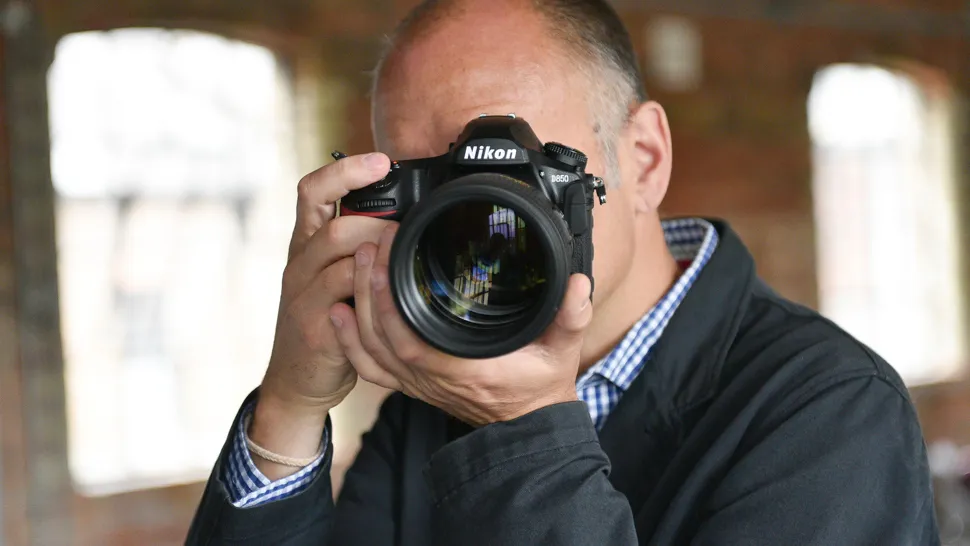
And for all this extra bulk, we don’t even get decent grip depth with mirrorless cameras as we did with DSLRs. I’ve held dozens of different mirrorless models, and not one has ever come close to feeling as snug and ergonomic as my old Nikon D3500.
Yes, there are a number of small and lightweight mirrorless bodies, like the Sony A7C II, the Fujifilm X-E5, the Panasonic Lumix S9, and the Canon EOS R8. But many of the pro-grade mirrorless bodies today focus on features, not size.
The reason to switch to mirrorless ten years ago was for a lighter kit, but the reason to switch today is for the latest tech. Obviously, the shift to mirrorless saw DSLRs fall behind specs-wise, and this inevitably would play the biggest role in weaning consumers off DSLR cameras.
Buying a mirrorless camera today isn't about size – it's about eye detection autofocus, fast burst speeds, the latest sensor tech, and in-body stabilization. But that doesn't downplay just how much manufacturers blew mirrorless cameras out of proportion back when the new technology was making headway.
Of course, the camera is only half the equation – lens selection matters too. The absence of a mirror allows designers to create smaller, shorter mirrorless lenses. But like the camera bodies themselves, don't automatically assume just because it's a mirrorless lens, it's lighter. Like camera bodies, some mirrorless lenses are heavier than similar optics made for DSLRs.
I would love to see mirrorless bodies revert to the ergonomic bliss we enjoyed with DSLR cameras, but as models become increasingly armed with advanced technology requiring more circuitry and battery juice, I doubt this'll happen for a while, if it ever does happen.
Either way, if you're looking to switch from DSLR to mirrorless and size is a big concern, don't automatically assume that mirrorless is lighter.
You might also like
See our take on the best mirrorless cameras and the best DSLR cameras to help you decide which technology to go with. Or, take a look at the best cameras for travel for more cameras with a compact design.

