







Digital Camera World Verdict
The OM System PEN is the finest PEN ever made. It retains the series' timeless design, along with key features like the Profile Control switch on the front, and adds things like IPX1 weather sealing, subject detection autofocus, 30fps Pro Capture and brilliant computational photography modes. Its 8-bit video specs are a bit basic, though you do get S&Q at up to FullHD 120p, but this is every inch a photographer's camera – down to the right-hand 'on' switch for from-the-hip street photography gunslinging. For just $999 / £849 you're getting one of the most beautiful cameras on the market that takes even more beautiful pictures, while also packing weather sealing, stabilization and an electronic viewfinder. This is the ultimate everyday carry – and a better camera than the mighty PEN-F.
Reasons to buy
- +
Great price
- +
Iconic looks
- +
Weather sealed
- +
Image stabilized
- +
Built-in viewfinder
- +
One-handed operation
- +
Computational photography
Reasons to avoid
- -
Limited native resolution
- -
Only 8-bit video
Why you can trust Digital Camera World Our expert reviewers spend hours testing and comparing products and services so you can choose the best for you. Find out how we test.
In my heart of hearts, I knew that the OM System PEN wasn't going to be a named successor to the Olympus PEN-F. But while it doesn't carry the "F", this new PEN is absolutely a spiritual successor to the PEN-F. And in every way possible – perhaps including its looks – it's a better camera.
I know that OM System can be a tough sell for some people, so let's quickly take an objective look at what the OM System PEN offers for the price.
For just $999 / £849 you get a camera that's weather-sealed, has in-body image stabilization (IBIS) and an electronic viewfinder (EVF), is loaded with pro features like 30fps Pro Capture, has computational photography tools like simulated ND filters (Live ND) and 80MP High Res Shot, has algorithmic autofocus (including astrophotography) and packs a stack of film-inspired picture profiles.
On top of all that, the OM System PEN is one of the best-looking retro cameras on the market. Seriously, aside from a sensor size prejudice, what's not to like about it?
Okay, there are a couple of things – like the 8-bit video, though honestly this is a stills-first camera to its core – but overall this is a frankly obscene amount of firepower in a camera that's sublimely small and effortlessly cool.
Take a look at my quick guided tour of the camera:
OM System PEN: Specifications
Sensor |
20.4MP four thirds Live MOS |
Crop factor |
2x |
Lens mount |
Micro Four Thirds |
Autofocus |
Hybrid phase / contrast detection, 121 points (all cross-type), focuses to -3.5EV |
Subject detection |
Human, animal (dog and cat) – photo only |
Image stabilization |
5.5 stops center, 4.5 stops corner |
Weather sealing |
IPX1 |
ISO range |
200-25,600 (exp to 64) |
Max video resolution |
4K 30p, FullHD 60p, S&Q FullHD 120p (all 8-bit) |
Max burst |
30fps electronic (20 JPEG / 20 RAW), 5fps mechanical (154 JPEG / 29 RAW) • 30fps Pro Capture |
Viewfinder |
2.36 million-dot OLED |
Rear screen |
3-inch, 1.04 million-dot, vari-angle touchscreen |
Memory |
1x SD UHS-I |
Connectivity |
Hot shoe, WiFi, Bluetooth, USB-C, Micro HDMI, microphone jack |
Battery |
BLS-7 (410 shots / 80 minutes) |
Dimensions |
125.8 x 74.5 x 43.3mm |
Weight |
393g with memory card and battery (344g body only) |
OM System PEN: Price & availability
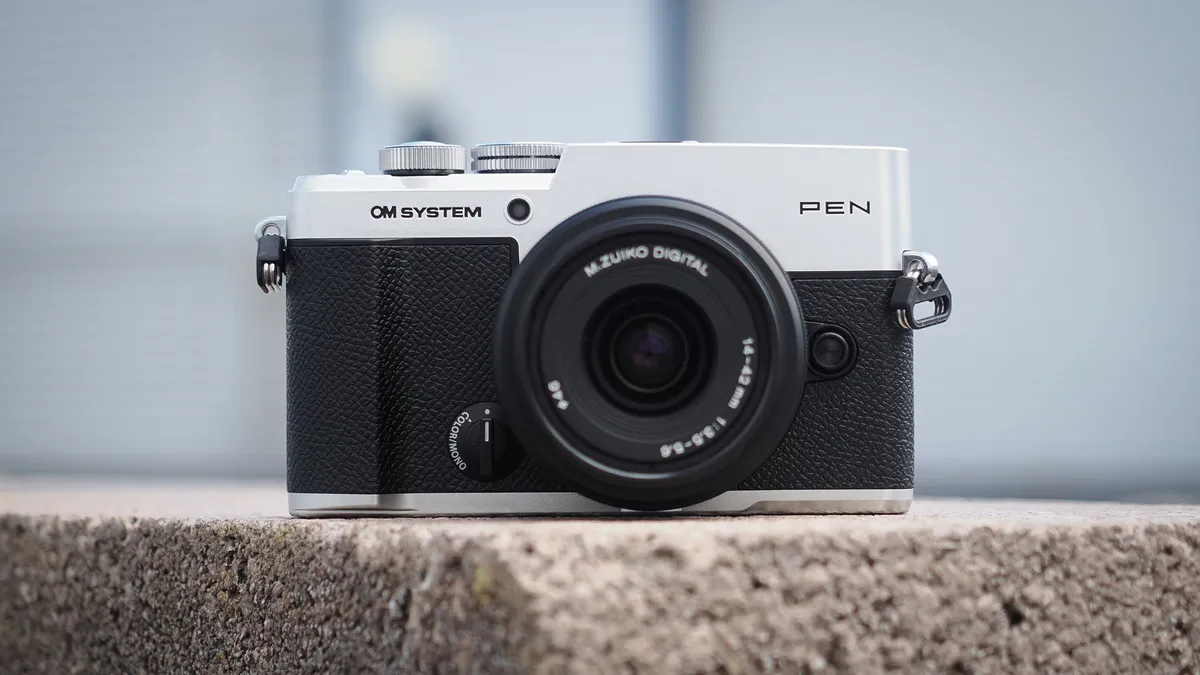
The OM System PEN will be available in both silver and black in late September / early October with a price tag of $999 / £849 / AU$1,499 body only.
It will also be available in a bundle with the new, weather-sealed OM System M.Zuiko 14-42mm f/3.5-5.6 III kit lens (a 28-84mm equivalent) for $1,099 / £949 / AU$1,799.
In the US and Australia, a double-lens kit that adds the M.Zuiko 40-150mm f/4.0-5.6 R lens (80-300mm equivalent) will also be available for $1,299 / AU$2,099.
For reference, Fujifilm's cheapest body with weather sealing, IBIS and an EVF is the Fujifilm X-T5 at $1,999 / £1,699, while Canon's cheapest is the Canon EOS R7 at $1,649 / £1,449. (Call me churlish, but I'm discounting the Panasonic Lumix G97 due to its primitive contrast-based AF system.)
OM System PEN: Build & handling

The OM System PEN is almost identical in size to the PEN-F, with handling that's very familiar all-round – from the rangefinder-like positioning of the EVF on the left shoulder to the presence of the Profile Control switch on the front.
While it doesn't boast the same premium heft and construction as the PEN-F (as in, don't expect a single block of milled aluminum), in the hand it drives much as the F did – only this time you have the benefit of IPX1-certified weather sealing and operation in environments from 32°F / 0° to 104°F / 40°C.
Another big upgrade from the PEN-F is the presence of a dedicated memory card door on the side of the body – rather than stowing the card in the battery compartment, which these days is a mark of entry-level cameras.
Another upgrade for many, and something that has been adopted from the Olympus PEN E-P7 (a brilliant 2021 camera that was only released in Europe), is the repositioning of the power switch to the right-hand side of the top plate.


This makes it possible to turn on and operate the camera one-handed, for quickfire street shooting – or, as my friend Emily from Micro Four Nerds calls it – "Festival Mode". I personally never use a camera this way, but I know how important it is for a lot of photographers.
Also making its way across from the E-P7 is the aforementioned Profile Control switch, rather than the full Creative Dial from the PEN-F.
This is a simple flip switch that enables you to access the picture profiles menu while shooting, giving you access to the Color and Mono profiles, along with Color Profile Control and general recipe settings. (The Creative Dial offered dedicated positions for Color, Mono, Art (Filters) and CRT – the Color Creator / Profile menu.)
The battery compartment at the bottom contains a brand new battery design for OM, the squat (almost square) BLS-7. CIPA rates the battery as good for 410 shots (or 80-130 minutes of video), but I've got well over 600 shots out of a battery before recharging.
OM System PEN: Performance

The OM System PEN embodies everything that I've always loved about the PEN family, dating all the way back to the original E-P1 in 2009 (which was Olympus' first ever mirrorless camera).
It's a quick, nimble camera with agile autofocus that enables you to react instantly to the world around you. Paired with the compact new M.Zuiko 14-42mm f/3.5-5.6 III kit lens, it's a weather-sealed and near-pocketable marvel – making this a truly take-anywhere, shoot anything, whatever the weather setup.
True to the PEN ethos, "as simple as pen and paper", this camera can be used as a straight-up point-and-shoot; stick it in auto or semi-auto and it's a fire-and-forget snapper that gives you great results. But the more you investigate the many magic tricks up its sleeves, the more you realize what a creative powerhouse this thing really is.
Like Fujifilm cameras, the OM System PEN is loaded with film-inspired picture profiles and a slew of Art Filters. So, if you want to level up your images, you can enable a profile or filter and effectively "pre-produce" your image – giving you gorgeous JPEGs, straight out of camera, with no need to tinker in post production.
Want to jazz things up even more? You can fine-tune these profiles or dive into the Color Creator to customize the presets or make your own photo recipes.

You can even upload and share these using the OI.Share app (which, for my money, is the best companion camera app on the market if for no other reason that it actually works – and is brilliant for transferring files and remote shooting).
Want to get even more creative? Use the CP button to unlock a suite of computational photography features, including Live ND – a software-powered set of neutral density filters, enabling you to shoot long-exposure movement shots without the need for physical lens filters.
Or how about High Res Shot mode, which enables you to capture 80MP RAW images for those moments when you want hyper texture and detail – but without being bogged down by the everyday bulk of a medium format camera.
Experiment with in-camera focus stacking, shoot a spot of astrophotography with Starry Sky Autofocus, try light painting with Live Composite, shoot fast action like a professional with 30fps Pro Capture (which records the 12 frames before you fully press the shutter, so you never miss the magic moment)…
There is so much creative potential packed into the OM System PEN that you will become a more versatile and more adventurous photographer almost by osmosis.

But there are, of course, some limitations. The biggest one, as is ever the case with OM System and Olympus cameras, is the resolution; while Panasonic has graduated to 25MP sensors, OM is still using trusty 20MP affairs (for reference, this is the same one found in the OM-5 Mark II).
Personally, this makes no odds to me. As I've said before, ad nauseum, this is more than enough resolution for anything shy of larger physical prints; I have magazine covers and double-page spreads shot on 20MP and even 16MP OM / Olympus sensors. And if you do need the extra pixels for printing, High Res Shot gives you 80 million of them.
Really, though, the biggest limitation comes in terms of video; given that this camera uses the OM-5 Mark II sensor, you can only shoot 8-bit video. And while the OM System PEN adds the subject detection AF (for humans and animals) that was sorely missing from the OM-5, it only works for stills – not video.
In short, this isn't a vlogging camera; it's a pretty pure photography camera. If you want to shoot a bit of video for social media, or you need to snag a bit of B-roll, it's ideal – but moving pictures are absolutely secondary to still images. But make no mistake, those still images are stunning.
OM System PEN: Sample images


OM System PEN: Lab tests
To judge how the OM System PEN performs in our lab tests, we've compared it to thee rival cameras that each cost around the same price, while also having a similarly compact form factor. The Nikon Z fc has a similar retro aesthetic to the PEN, as does the Fujifilm X-T30 III. The Sony A6400 may be a very old design now, but it's still in Sony's current mirrorless lineup and its body-only priced is in line with the PEN.
Resolution (line widths/picture height):

The PEN and the Nikon Zfc have pretty much the same megapixel count, and though the OM System camera has a smaller sensor than the Nikon it actually generates slightly sharper images at higher ISOs. It's surprising how close the PEN comes to matching the 24MP and 26MP cameras from Sony and Fujifilm when it comes to resolving fine detail.
Dynamic range (EV):

Dynamic range is a measure of a camera's ability to record extreme brightness ranges and still retain detail in the brightest and darkest parts of the scene. It's measured in EV (exposure values, or 'stops').
At low ISOs the PEN leads the pack for dynamic range, though it can't quite match the Nikon and Fujifilm cameras when you push past ISO800.
Signal to noise ratio (decibels):

This test compares the amount of random noise generated by the camera at different ISO settings as a proportion of the actual image information (the 'signal'). Higher values are better and we expect to see the signal to ratio fall as the ISO is increased.
The PEN ties with the Sony A6400 for noise levels at low ISOs, but demonstrates superior noise control at high sensitivities. But the X-T30 III's X-Trans 4 sensor is in a class of its own when it comes to low noise levels.
OM System PEN: Verdict
I've been waiting half a decade for this camera; it's the first new member of the PEN family since the E-P7 launched way back in 2021 (which, incidentally, was also the first camera released after OM System splintered off from Olympus).
Some will opine that the OM System PEN isn't a PEN-F II. And I hear that, because few people wanted a PEN-F II more than me. But I'll be absolutely honest – this camera pretty much is a PEN-F II in everything but name.
The image quality is better. The stabilization is better. The autofocus is leagues better. The video, while limited, is also way better. It's IPX1 weather-sealed. And it's stuffed to the gills with clever computational features.
Heck, it's arguably better looking, too – though I'm sure plenty of people will pick a fight with me over that one.
Truthfully? There is now precisely zero reason for me to pick up my PEN-F. This new PEN does everything the F could, just bigger, better, more.

In terms of function, this camera feels a lot like the OM-5 Mark II – though I'd argue that the PEN is actually better thanks to the addition of the Profile Control switch and especially subject detection autofocus (which was the only real weakness of the OM-5, though it does boasts slightly better sealing).
However, as much as I'm inclined to compare it to other OM offerings, my biggest takeaway is actually how the OM System PEN compares to the Panasonic Lumix L10. And I should preface this by saying that I love shooting with the L10.
But the PEN is smaller and lighter. It's weather-sealed. It has IBIS. It's got dual exposure dials. In other words, it ticks all the boxes that the L10 missed – and of course, you can also change the lenses. Sure, the L10 absolutely annihilates it for video, but let's be real – nobody is buying the Lumix primarily for video, and the same is true of the PEN.
I would argue that anyone considering the L10 would be better off (quite literally, where cash is concerned) opting for the PEN. Not only does it offer acres more creative capacity, you'll also struggle to outgrow it – unlike the Lumix, which will leave you wanting the moment you fancy trying macro or telephoto photography.
The OM System PEN is the best bang-for-buck body on the market (not to mention one of, if not the, best-looking) and without a doubt the best everyday carry camera available for photography purists.


