Digital Camera World Verdict
While it lacks the novelty of its shorter, wider sibling, the Z Fold 8 Ultra offers fewer compromises and a more polished software experience. If you're looking to get serious work done on the go, this is one of the best tools for the job. It's not a massive upgrade, but all the changes add up to make for one of the finest folding phones around.
Reasons to buy
- +
Super-slim and lightweight
- +
Upgraded ultrawide camera
- +
Better battery life & faster charging
- +
Less-visible crease
- +
Excellent performance
Reasons to avoid
- -
Telephoto needs an upgrade
- -
It's expensive
- -
Not as exciting as the Fold 8
Why you can trust Digital Camera World Our expert reviewers spend hours testing and comparing products and services so you can choose the best for you. Find out how we test.
Samsung changed things up in 2026. Rather than the usual Flip and Fold options, there's a new passport-sized fold in the mix. The new one is called the Z Fold 8, while the Fold 8 that we were all expecting is now called the Fold 8 Ultra.
Is it worthy of the Ultra title? That's debatable. It shares a lot of DNA with the Z Fold 7 that came before it, but there are a few upgrades to make it more appealing. We get brighter screens, a less visible crease, a faster processor, and a new ultrawide, to name a few.
Unfortunately, as with everything else in 2026, it's a little more expensive. Is the Z Fold 8 Ultra worth your hard-earned cash? I've been using it for the past week to find out.

Specifications
Screen |
6.5-inch 120Hz OLED (outer) 8-inch 120Hz OLED (folding) |
CPU |
Qualcomm Snapdragon 8 Elite Gen 5 |
RAM / Storage |
12+256GB / 16+512GB / 16+1TB |
Wide Main Camera |
200MP f/1.7 (1/1.3-inch) |
Ultra Wide Camera |
50MP f/1.9 (1/2.5-inch) |
Telephoto Camera |
10MP (3x) f/2.4 (1/3.94-inch) |
Front Camera |
2x 10MP f/2.2 |
Video |
Up to 4K60 |
Battery |
5000 mAh |
Operating System |
OneUI 9, Android 17 |
Size (HWD) |
158.4 x 72.8 x 8.9 mm (folded) |
Weight |
215g |
Price & Availability
The Samsung Galaxy Z Fold 8 Ultra starts at $2099 / £1899 with 12GB of RAM and 256GB of storage. The 512GB model also comes with 12GB of RAM for $2299 / £2069. The 1TB model is the only one that gets 16GB of RAM, and that costs a cool $2699 / £2319.
That's an increase of $100/£100 for the base model, when compared to the Z Fold 7, and an even bigger increase for the higher storage options. As always, the RAM shortage is to blame, but on the plus side, we didn't see any RAM downgrades for this generation.
It's a pricey phone, but it's nothing outlandish when compared to other folding phones - and it undercuts the upcoming Apple iPhone Duo, but not by a lot.
Design
The Samsung Galaxy Z Fold 8 Ultra looks almost identical to its predecessor, but that's not a bad thing. The Z Fold 7 was already one of the slimmest and best-looking phones on the market, so why fix something that isn't broken?
The newer model is marginally slimmer than the old one, but the difference is 0.1mm. That's about the thickness of a sheet of paper, so the difference is virtually imperceptible. It's also the same weight, so it feels about the same in your hand.

That said, it's probably the slimmest folding phone you can buy right now, and it's already lighter than the S26 Ultra. The days of chunky, cumbersome foldables are long gone.
As always, there's a range of new colours to choose from, and they're all fairly subtle and professional-looking. There's a lighter Cream option, alongside darker Graphite and Violet Shadow options. There's also Green Shadow, which is a Samsung store exclusive. I have the Violet Shadow model in for testing, which has a dark purple rear with a matte finish. It almost looks brown or burgundy in some lighting conditions.
In use, the biggest design change is with the way the Fold 8 Ultra opens. There's a new bevelled edge that makes it easier to get your thumbs in between the screens, and the magnets have been reworked to make it easier to open.
It's a tiny change, but it makes a big difference to an action that you perform several times a day. When I tried opening the Fold 7 and 8 Ultra back-to-back, the older model felt extremely cumbersome by comparison.

The other big change is with the folding screen. Samsung has changed the underlying structure, incorporating titanium layers for extra strength and flatness.
The result is Samsung's least noticeable crease ever. And while it's no match for the virtually creaseless Find N6, it's not worlds apart. Another thing that helps in this department is the fact that the screen now opens to be completely flat, whereas the previous model sat at a very slight V-shape. In use, you'll quickly forget the crease exists at all.
The folding screen looks better in bright conditions, too. There's a new anti-reflective coating that helps to reduce glare, and it can now reach up to 3000 nits at peak brightness. It also has a slightly higher resolution.
There aren't so many changes with the cover display, but it's also brighter. It can now reach the same 3000 nits, up from 2600.

A small oddity that I haven't seen many people mention is the fact that the Z Fold 8 Ultra only has space for a single SIM card in its tray. I'm not really sure why, but the smaller Z Fold 8 is the same way. No issue for me, but if you're rocking two SIM cards, it's worth knowing about.
The speakers seem unchanged, but they're still impressive, especially considering how slim the chassis is. And you still get the same IP48 rating for dust and water resistance. So, while it's fine around fresh water, you'll need to be very careful around sand.


Camera Performance
For the most part, the camera hardware is exactly the same as the Fold 7; the only upgraded camera is the ultrawide.
The new ultrawide has a 50MP resolution, up from 12MP, and a wider f/1.9 aperture, up from f/2.2. The sensor is also very slightly larger, but it's not enough of a change to make a practical difference.
The main camera still has a 200MP 1/1.3-inch sensor with a 23mm f/1.7 lens. It's very similar to the one found in the S26 Ultra, so we already know how capable it is.
The 3x telephoto is also very similar to the one in the S26 Ultra, but that's not such good news. It has a tiny 1/3.94-inch sensor, and a measly 10MP resolution. Unlike the candybar flagship, you don't get an extra telephoto to handle longer zooms.


Each screen has its own 10MP selfie camera, with no upgrades to speak of. As before, they get the job done handily, but they lack autofocus, and you'll get much more impressive results flipping the phone around and using the rear cameras. One of the perks of a foldable.
As the specs suggest, the main camera is the star of the show. It gives the best results in all lighting conditions, and it's noticeably sharper and more detailed than the other cameras. At night, the gap widens further, and the larger sensor provides the least noisy images of the trio, with a much higher shutter speed.
In most scenarios, I could barely tell the difference with the new ultrawide camera. Smartphone ultrawides never look the sharpest, and the extra resolution hasn't really changed that. Plus, despite having a wider aperture, the relatively small sensor doesn't handle dark conditions too well, so it's still best avoided in the dark.
That said, the ultrawide pulls double duty as a macro camera, and that's where this extra resolution comes into play. If you try to get too close with one of the other cameras, the camera app will switch to a cropped view from the ultrawide lens, and images from this sensor look noticeably sharper and more detailed than those from the Fold 7.


The telephoto is crying out for an upgrade. Of course, it's better than having no telephoto at all (like the Fold 8), but the low resolution means that cropping much further than the native 3x focal length reduces the image quality dramatically. The camera UI will let you push it to 30x, if you wish, but going past 6x or so looks atrocious. It's also pretty terrible in low-light conditions.
On the whole, images from the Galaxy Z Fold 8 Ultra have Samsung's signature look to them. You can expect sharp photos with wide dynamic range and fairly realistic colours. The images won't knock your socks off, but they're reliable and consistent.
If you want something with a little more personality, there's a range of customisable filters, or you can import an image you like and Samsung's AI will try to replicate the tones as a new filter. It's well worth playing with these effects, as otherwise, photos can tend toward looking a little bland. I need to give a shoutout to Samuel Nam, who made a great clone of Vivo's vintage filter for the S26 Ultra - it works just as well on the Fold 8 Ultra.

Image credit: Luke Baker / Digital Camera World

Image credit: Luke Baker / Digital Camera World
On the video front, there are a few more upgrades. You now get the APV codec, Samsung's answer to Apple ProRes that was introduced with the S26 lineup earlier this year. Plus, to handle these massive files, you can also record directly to an external SSD. Another handy addition is the ability to apply real-time LUTs for monitoring, as well as apply LUTs to your Log footage directly in the camera app.
The Z Fold 8 Ultra also gains horizontal lock recording mode and my FanCam, which can crop into a video to follow a specific person in an aspect ratio of your choice.

Phone Performance
The Z Fold 8 Ultra sports the Snapdragon 8 Elite Gen 5 chip, and it's a specially overclocked 'For Galaxy' edition. The 256GB and 512GB models both come with 12GB of RAM, while the 1TB model has 16GB. I tested the base model for this review.
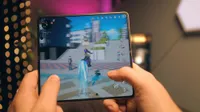
Unsurprisingly, it's a very quick phone. Navigating the OS is as smooth as can be, apps open in an instant, and you can multitask heavily without feeling any slowdown. Gaming performance is solid, too, but the thermals could be better.

Since Samsung prioritised slimness, there's no room for a vapor chamber in this phone, and that means it struggles to dissipate the heat during longer sessions with graphically intense titles. When running Wuthering Waves at maxed-out settings, frame rates will begin to dip after about 10 minutes.
The most annoying side effect is that Samsung dims the displays to keep the temperature down, which can be especially irksome outdoors. Of course, titles that aren't so demanding won't heat up the device as much, so you can enjoy long sessions on games like COD Mobile without worry.

This is one of the first Samsung phones to take advantage of silicon-carbon battery tech. So, while it's one of the slimmest foldables around, it actually has a relatively large battery. The 5000 mAh capacity matches the S26 Ultra. Impressive, considering it's lighter, slimmer, and folds in half. That said, Chinese foldables like the Honor Magic V6 and Oppo Find N6 are still miles ahead.
Charging speeds have been boosted, too. The Fold 8 Ultra charges at 45W with a wire and 20W wirelessly, up from 20W and 15W. This is a very welcome upgrade, and I was able to take the phone from fully dead to well over 60% charged in just half an hour.

On the software front, the Fold 8 Ultra runs One UI 9, Samsung's customised version of Android 17. If you've tried a recent Samsung flagship, you won't be in for too many surprises; it has a very familiar look and feel.
The default look isn't my favourite, but thankfully it's very easy to customise. Plus, if you install Good Lock, you can take the customisation to a whole new level and tweak just about anything.
My main gripe, as ever, is how messy One UI feels. It's loaded with all of Samsung's first-party apps, plus most of Google's, and a lot of them do the same thing as each other. Like, why would I use Samsung Wallet rather than Google Wallet? Or choose Bixby over Gemini?

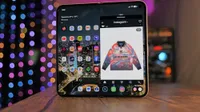
On the plus side, the multitasking is excellent; there are plenty of options to split your screen and resize each app, as well as floating window support. The UI always feels speedy, too, which I think is partly due to Samsung's animation style.
As we've seen for the past few years, Samsung is big on AI, and you'll find all manner of helpful tools littered throughout the OS. Some are powered by Google, like the new Notebook app, and Gemini and Circle to Search - both of which have expanded capabilities.

Samsung also overhauled its Now Nudge system to make better use of the folding display. If you're not familiar, Now Nudge pops up with helpful suggestions, like a prompt to add a calendar event when someone suggests meeting up. Now, it'll open the related app in a split-screen view on the folding display, which is quite convenient. Well, if it ever pops up, because I see these nudges so rarely, I kind of forget about the feature.
Final Verdict
The Galaxy Z Fold 8 Ultra isn't the same generational leap that the Z Fold 7 was, but the upgrades here are welcome ones. The smaller, wider Z Fold 8 may have hoovered up most of the excitement, but the Ultra feels more polished and refined as a whole. If you're looking for a serious productivity tool, I still think it's the best choice - it's just not quite as fun as its newer sibling.
To summarise what's new, you get brighter screens inside and out, a less noticeable crease, a more powerful chip, a new ultrawide camera, a bigger battery and faster charging. Nothing mind-blowing, but enough to make for a noticeably better experience overall. It's also more expensive, but that's par for the course in 2026.
I can't imagine any Z Fold 7 owners rushing out to upgrade, but for everyone else, this is a very compelling foldable that's a pleasure to live with.
Design ★★★★☆ |
It's almost identical to the Z Fold 7, but it's still one of the slimmest and best-looking foldables around. The crease is shallower; it's easier to open, and it unfolds to be completely flat, too. |
Camera Performance ★★★★☆ |
The cameras are dependable, especially the excellent 200MP main snapper, and the APV codec means it's a serious video-making tool. The ultrawide upgrade is minor, though, and the telephoto could be improved. |
Phone Performance ★★★★½ |
It's powerful enough to run the latest games, and the battery upgrades make a big difference. Great multitasking and tonnes of AI features make One UI excellent for productivity, and the software support terms are among the best around. |
Value ★★★☆☆ |
It's not a bargain, especially with the price hike, but that's a problem that's affecting the entire industry. Considering what's on offer and the pricing of the competition, it seems somewhat reasonable. |
Overall |
★★★★☆ |
Alternatives