Digital Camera World Verdict
The Canon RF 50mm f/1.4L VCM is more affordable than the RF 50mm f/1.2L USM, yet it’s only a third of a stop slower but is drastically lighter and more portable. At the other end of the scale, it's a bigger investment than the budget RF 50mm f/1.8 STM but offers substantially superior performance and is a bona fide professional optic. The super-wide f/1.4 aperture is great for anyone looking to shoot in low light or blur backgrounds with a shallow depth of field. The robust and reliable autofocus is smooth and silent, which combined with all-weather sealing makes this is an absolute workhorse lens for stills and video. The only real downside is the lack of optical stabilization – but arguably, as a pro lens, you'll be using it with a stabilized body anyway.
Pros
- +
Small, light and compact
- +
L-series weather sealing
- +
Uniform size with other hybrids
- +
Super wide f/1.4 aperture
- +
Fast and quiet VCM autofocus motor
Cons
- -
No optical stabilization
- -
Limited Iris ring compatibility for stills
- -
Rings are all fly-by-wire
Why you can trust Digital Camera World Our expert reviewers spend hours testing and comparing products and services so you can choose the best for you. Find out how we test.
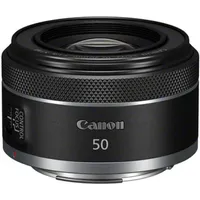
The Canon RF 50mm f/1.4L VCM isn't just a key member of Canon's lineup of hybrid lenses, it also completes the trifecta of RF nifty fifties – sitting between the budget RF 50mm f/1.8 STM and the top tier RF 50mm f/1.2L USM.
Everyone has been waiting for the Canon RF 50mm f/1.4L VCM, which has traditionally hit the price / performance sweet spot for 50mm shooters. However, with this hybrid optic, Canon has gone even further to make this a unique proposition for those who shoot video and who want a uniform range of interchangeable primes.
Not only is there an Iris ring to manipulate aperture, the VCM autofocus is snappy and near-silent, and the 50mm f/1.4 shares the same filter size and broadly the same weight and dimensions as the other f/1.4 hybrid primes – meaning you can easily share filters across the range, as well as cleanly swap without having to massively recalibrate gimbals.
For crop sensor shooters, the Canon RF 50mm f/1.4L VCM has an equivalent focal length of 80mm – making this a perfect portrait prime for RF-S bodies, especially if you want a weather-sealed companion for something like the Canon EOS R7.
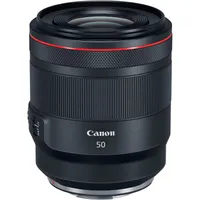
This is every inch the L-series optic that the red ring would suggest. Here's how it performs and compares to Canon's other nifty fifties.

Canon RF 50mm f/1.4L VCM: Price
The Canon RF 50mm f/1.4L VCM carries a retail price of $1,549 / £1,499 / AU$2,429.
Thar places it between the top-tier Canon RF 50mm f/1.2L USM at $2,599 / £2,449 / AU$4,099 and the Canon RF 50mm f/1.8 STM, which at $239 / £219 / AU$389 is the most affordable native lens in the RF lineup.
Another option, if you want a similar focal length and speed but without L-series performance or weather sealing, is the Canon RF 45mm f/1.2 STM – a brilliant budget alternative that clocks in at $469 / £479 / AU$699.
Canon RF 50mm f/1.4L VCM: Specifications
Mount |
Canon RF |
RF-S equivalent focal length |
80mm |
Image stabilization |
No |
Weather sealing |
Yes |
Focus |
Manual, automatic |
Control ring |
Yes |
Aperture ring |
Yes (for video – stills only for 2024 cameras and newer) |
Lens construction |
14 elements (2 aspherical (1 glass- molded), 1 ultra-low dispersion), 11 groups, 11 aperture blades, Air Sphere and Super Spectra coatings |
Aperture range |
f/1.4 - f/16 |
Close focus distance |
40cm |
Filter |
67mm |
Size (DxL) |
76.5 x 99.3mm |
Weight |
580g |
Canon RF 50mm f/1.4L VCM: Design & Handling

As noted, the Canon RF 50mm f/1.4L VCM is part of the brand's range of hybrid primes for the R system, which includes the RF 20mm f/1.4L VCM, the RF 24mm f/1.4L VCM, the RF 35mm f/1.4L VCM and RF 85mm f/1.4L VCM.
This outfit of video-friendly primes boast uniform size, weight and filter threads for harmonized handling and gimbal performance. As such, in the hand (and on the body) the the Canon RF 50mm f/1.4L VCM is virtually indistinguishable from its siblings.
They share the same 76.5 x 99.3mm size and 67mm filter thread, and largely the same weight with the 20mm at 519g, the 24mm at 515g, the 35mm at 555g, the 50mm at 580g and the 86mm at 636g.
This obviously achieves the aim of making them easily interchangeable for use with gumbals, filters and focus system, but it does mean that – end-on, at least – trying to pick the right one out of your camera bag is pretty impossible.
You'll probably want to label the front and rear caps with the focal length to distinguish them in the field. Likewise the lens hoods all fit each other so, unless you know the difference between EW-73G and ES-73 of the top of your head, you may run into issues differentiating them.

Unlike some of the other hybrids, the 50mm doesn’t have a rear filter holder – although this is more of a necessity for wider focal lengths (where front filters are liable to cause vignetting).
Again like its stablemates, it features a large focus ring, control ring and an Iris ring that can be engaged by an Iris switch. The Iris can be left at its ‘A’ setting, where aperture is set on the camera body, or manually rotated to a set value from the lens.
This works in video mode on all EOS R cameras perfectly, but for stills it only controls the aperture on cameras launched in 2024 onwards. (Canon previously told me it would like to expand compatibility further to "key" camera models in the future, but at this stage I don't expect backward-compatibility.)
Like Canon's other 50mm options, there is no optical stabilization in this lens – which means, if you need shake compensation, you'll need to pair this with an image-stabilized body. Though, in fairness, you're probably going to be using a pro lens like this on a pro body that does have stabilization, so this isn't really an issue.
Canon RF 50mm f/1.4L VCM: Performance

The Canon RF 50mm f/1.4L VCM employs separate USM and Voice Coil Motors, with the VCM driving heavier groups of glass elements inside the lens, resulting in a blisteringly fast autofocus operation that is also smooth and whisper-quiet.
One of the best features on this new lens is its super wide f/1.4 maximum aperture, which sucks in loads of light – handy for shooting in challenging illumination and keeping your ISO to a minimum, perhaps at a gig or concert, or even shooting stars for astrophotography.
It's also useful for blurring the backgrounds of portraits, as the wide aperture will create a super shallow depth of field, while the 50mm focal length provides a natural perspective, making this an excellent portrait lens for half- and three-quarter-length shots.
In terms of the bokeh – the quality and characteristics of the out-of-focus elements – like some of the other hybrid primes (particularly the RF 85mm f/1.4) the Canon RF 50mm f/1.4L VCM has quite swirly, vortexy, Petzval bokeh when shot wide open.
This reveals itself in busier backgrounds and can be very pleasing – but it can also quite distracting, if it's not an effect you're looking for, so just be aware of this characteristic if you're intending to shoot at f/1.4.

Speaking of the aperture, it’s worth noting that the more expensive and much larger RF 50mm f/1.2L has a maximum aperture that's only a third of a stop brighter. The bokeh is definitely smoother, and not quite so Petzval-y, but I think many shooters will be happy saving a considerable amount of money – not to mention bulk – going for the f/1.4 lens.
I was impressed with my shots taken on the 50mm f/1.4L. The center of the lens is pin-sharp, even shooting wide open. Comparing the in-camera JPEGs with the RAW files revealed a minor vignette at f/1.4, though this was pretty much imperceptible by the time I closed it down to f/4.
Aside from the minor vignetting, though, the corners of the frame are optically sound and there's no digital manipulation happening here – unlike my experience testing the RF 24mm f/1.4L, which relies quite heavily on in-camera tricks to push and pull pixels around correct distortion and remove quite a serious vignette from the RAW files.
General video performance with this lens is excellent. Autofocus is fast and faithful, focus breathing is incredibly well controlled, and manual focus is smooth and consistent – though some will lament that this is a fly-by-wire focus ring rather than offering true physical focus with hard stops.
Canon RF 50mm f/1.4L VCM: Sample images


Canon RF 50mm f/1.4L VCM: Lab results
We run a range of lab tests under controlled conditions, using the Imatest Master testing suite. Photos of test charts are taken across the range of apertures and zooms (where available), then analyzed for sharpness, distortion and chromatic aberrations.
We use Imatest SFR (spatial frequency response) charts and analysis software to plot lens resolution at the center of the image frame, corners and mid-point distances, across the range of aperture settings and, with zoom lenses, at four different focal lengths. The tests also measure distortion and color fringing (chromatic aberration).
Sharpness:

Center sharpness is nothing short of awesome, even wide open at f1.4, and remains so right through to f/11. However, you don't need to look too far off center to see a hefty reduction in sharpness at wider apertures. You really need to stop down to f/5.6 to get consistent sharpness across the whole frame.
Fringing:

Fringing is very well controlled at all apertures, never getting close to being visible in real-world shots.
Distortion: 0.62
The lens produces a touch of pincushion distortion, but not enough to be distracting.
Canon RF 50mm f/1.4L VCM: Verdict
The Canon RF 50mm f/1.4L VCM is interesting, because in many ways it's a more compelling lens than its bigger, bulkier, pricier f/1.2 brother.
Certainly for video, it's a no brainer. The 50mm f/1.2L USM is eminently impractical for videography due to its sheer size and heft. The 50mm f/1.4L VCM is infinitely more practical due to it being smaller and more compact, having a dedicated Iris ring, excellent focus breathing suppression and straightforward adaptability for follow focus units.
For photography, you pick your poison. Personally I would opt for the 50mm f/1.2L USM because it's bit more bokehlicious, a pinch less Petzval-y, and just that little bit faster when shooting in tough lighting. But it's close – and for most people, probably not worth the extra grand.
The rendering of the Canon RF 50mm f/1.4L VCM is beautiful and the difference in the shallowness of depth of field may be imperceptible to most. It's also, and I cannot state this enough, much smaller and lighter, making it way more practical – particularly on smaller and RF-S bodies.
While it's certainly a shame that the Iris ring only affects aperture when shooting video if you're using a pre-2024 camera, I don't think this is as much of an issue as others might.
Unlike, say, Fujifilm or Leica lenses, the RF system has never been built around manipulating the aperture using a ring. So the fact that it universally works for videography (where it's a much more fundamental feature) and isn't supported across the range for stills (where it's just a luxury) doesn't bother me.
For videographers, the Canon RF 50mm f/1.4L VCM is a no-brainer of a recommendation; for photographers, if you want more premium performance than the f/1.8 STM offers but don't want the price, size or weight of the f/1.2L USM, Canon has once again delivered the sweet spot optic you're looking for.
Should you buy the Canon RF 50mm F1.4L VCM?
✅ Buy it...
- You need a high quality 50mm lens for Canon RF mount with a wide f/1.4 aperture
- You like to shoot a mixture of photo stills as well as video
🚫 Don't buy it...
- You need the slightly wider aperture of the Canon RF 50mm F1.2L USM
- If you're on a super strict budget the Canon RF 50mm F1.8 STM is your only other option for RF mount
Alternatives