



Digital Camera World Verdict
The Sigma 85mm f/1.2 DG Art amply caters to my need for speed. I feel that the combination of 85mm focal length and super-fast f/1.2 aperture potentially serves as the holy grail for dreamy portraits with creamy bokeh. More importantly, the Sigma fully delivers on that potential, giving stunning image quality in all respects, backed up by fast and consistently accurate autofocus and pro-grade handling. It’s simply a phenomenal lens that’s great value for money.
Reasons to buy
- +
Portrait-perfect focal length
- +
Super-fast f/1.2 aperture
- +
Spectacular sharpness
- +
Delightfully dreamy bokeh
- +
High-end handling
Reasons to avoid
- -
Necessarily chunky
- -
Only two mount options
Why you can trust Digital Camera World Our expert reviewers spend hours testing and comparing products and services so you can choose the best for you. Find out how we test.
When it comes to prime time for portraiture, an 85mm focal length with a super-fast f/1.2 aperture is an aspirational combination. However, it’s one that doesn’t come cheap (or small). These lenses tend to be built for the most discerning professional portrait photographers, prime examples being the Canon RF 85mm f/1.2L USM and its even pricier sibling, the Canon RF 85mm f/1.2L USM DS with ‘Defocus Smoothing’, along with the Nikon Z 85mm f/1.2 S.
In fact, these lenses are in such a rarified atmosphere that neither Sony nor Panasonic even make 85mm f/1.2 lenses. The closest you can get in the Sony camp is the (still excellent) Sony FE 85mm f1.4 G Master II, but Panasonic doesn’t even make an ‘S Pro’ 85mm lens, the only 85mm prime being the Panasonic S 85mm f/1.8 which is a relatively slow, humble offering that doesn’t really bear comparison. Available in both Sony E (FE) and L-mount versions, the Sigma 85mm f/1.2 DG Art aims to be one of the best portrait lenses in the world.

Sigma 85mm f/1.2 DG Art: Specifications
Mount options |
Sony E (FE), L-mount |
Full frame |
Yes |
Autofocus |
Yes |
Image stabilization |
No |
Lens construction |
17 elements in 12 groups |
Angle of view |
28.6 degrees |
Diaphragm blades |
13 |
Minimum aperture |
f/16 |
Minimum focus distance |
0.84m / 33.1in |
Maximum magnification |
0.11x |
Filter size |
82mm |
Dimensions |
7x120mm / 3.4x4.8in |
Weight |
905g / 32oz |
Sigma 85mm f/1.2 DG Art: Price
Portrait perfection doesn’t come cheap. Let’s crunch some numbers. The Canon RF 85mm f/1.2L USM weighs in at $3,099 / £3,059 / AU$4,829 and the Canon RF 85mm f/1.2L USM DS ‘Defocus Smoothing’ edition is even pricier at $3,399 / £3,499 / AU$5,499.
From the Big N, the Nikon Z 85mm f/1.2 S will set you back $2,995 / £2,999 / AU$4,999, roughly the same as the regular version of the Canon lens. This trio of lenses makes the Sigma 85mm f/1.2 look outstanding value for money at $1,599 / £1,299 / AU$2,225. The bottom line is that the Sigma is less than half the price in some world regions and not much more than half the price in others.
Set your sights a little lower with an f/1.4 rather than f/1.2 aperture and there’s the Sony FE 85mm f1.4 G Master II at $1,950 / £1,799 / AU$3,099. The Sony is still pricier than the Sigma f/1.2 and is seriously undercut by its equivalent Sigma 85mm f/1.4 DG DN Art at $1,255 / £979 / AU$1,596.
Like the new f/1.2 lens, the Sigma f/1.4 is available in Sony E (FE) and L-mount versions and as I’ve mentioned, Panasonic doesn’t yet offer anything faster than an f/1.8 prime with an 85mm focal length.
Sigma 85mm f/1.2 DG Art: Design & Handling
Sigma is keen to point out that the 85mm f/1.2 DG Art is the smallest and lightest lens in its class. That’s all well and good, but you still need wide-diameter glass elements to suck in sufficient light for that super-fast aperture rating. The lens certainly doesn’t feel small or lightweight, measuring 7x120mm / 3.4x4.8in and weighing in at 905g / 32oz. By way of comparison though, the equivalent Canon RF and Nikon Z lenses are both over a kilogram, weighing 1,195g / 42oz and 1,160g / 41oz respectively. As they say at a certain UK supermarket chain, ‘every little helps’.

One factor in the moderately downsized, lighter-weight design is that the Sigma features no less than three aspherical elements in its optical path. This effectively reduces the total number of elements in the chain. Two SLD (Special Low Dispersion) elements are also featured, to enhance clarity and to suppress chromatic aberration. Even so, there’s still a lot of hefty glass to move around when focusing and 85mm f/1.2 lenses have historically suffered from slow and cumbersome autofocus systems.
The Sigma has relatively rapid autofocus, with not just one but two HLA (High-response Linear Actuators) assigned to the job. Again, the design is optimized for compactness, integrating eight of the lens elements as well as the aperture diaphragm assembly between the two autofocus motors, which Sigma says enables a significant reduction in size and weight.

Although autofocus will usually be preferred, due to the accuracy demanded by such a shallow depth of field at f/1.2, the lens has a large manual focus ring. As required by the type of autofocus system employed, the focus ring is electronically rather than mechanically coupled to the focusing mechanism. The L-mount version of the lens edges ahead of the Sony edition in this respect, adding switchable linear and non-linear focus ring control, where supported by compatible cameras, and also works with the Sigma USB Dock, sold separately.
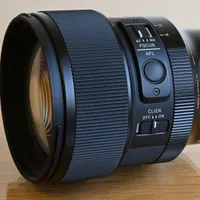
One thing (or rather three) shared between both mount versions of the lens is that they feature a physical AF/MF auto/manual focus mode switch. This enables quick and easy switching between modes without having to resort to in-camera menus. There are also dual, customizable AF-Lock buttons, positioned on the side and on the top of the lens barrel. This ensures easy, ergonomic access when using the lens for both landscape and portrait (upright) orientation shooting.

Another handling extra that many see as a ‘must-have’ is a dedicated aperture ring. The lens is actually optimized for high-end videography as well as for shooting stills, with minimal focus breathing.

Similarly catering to both disciplines of stills and video, there’s a physical click/de-click switch, so you can have precise one-third f/stop increments for stills and smooth, silent aperture transitions when shooting video.

One thing that I’m particularly pleased to see from a handling perspective is that Sigma has added an aperture ring locking switch. This enables you to lock the aperture ring in it’s Auto position for shooting in Program or Shutter-priority modes, and any other time you want to control the aperture direct from the camera body. To my mind, all too many lenses with physical aperture rings lack this locking switch, making it all too easy to nudge the ring from it’s Auto position to a really narrow aperture accidentally. You can almost guarantee this would happen at the worst possible moment in a time-sensitive shooting scenario.

Other little extras that I’d fully expect include a soft drawstring carrying pouch and a hood. The hood has a circular profile, common for 85mm lenses, and is a high-quality item featuring a ridged inner surface and a locking button.

The hood itself is long enough to ensure good additional resistance against ghosting and flare, as well as offering physical protection against knocks and scrapes to the front glass element.

Last but not least among the supplied accessories, there’s a front cap that has the usual pinch-style release mechanism. This makes it easy to fit or remove the cap with the hood mounted in its forward-facing orientation.

At the rear of the lens, the mounting plate is made from Sigma’s usual plated brass, complete with weather-seal gasket and gold-plated electronic contacts. Multiple weather-seals are fitted throughout the lens to ensure a dust/splash-proof build, giving good protection when shooting in adverse conditions or inclement weather.

Sigma 85mm f/1.2 DG Art: Performance
As a portrait lens, the Sigma 85mm f/1.2 DG Art is a spectacular success. Combined with the face/eye-detection autofocus systems of most modern cameras with which the lens is compatible, it gives an incredibly consistent hit rate for accuracy, coupled with sufficiently fast performance to track movement. On top of that, image quality remains sharp with plenty of fine detail, contrast and clarity, even wide-open at f/1.2. In our lab tests, the equivalent Canon and Nikon lenses proved a little sharper at f/1.2 but you’d be hard pressed to see any difference in real-world shooting.

Arguably every bit as important if not more so, the quality of bokeh is sensational. Defocused areas look buttery smooth at f/1.2 and the transition between focused and defocused elements looks entirely natural. The Sigma certainly delivers that elusive ‘3D pop’ in spades, making people and pets really come to life in two-dimensional images.

When stopping down, the immensely well-rounded 13-blade aperture diaphragm helps to maintain excellent quality for defocused areas within images, and really smooth bokeh disks. For comparison, the shots above and below were taken at f/5.6 and f/1.2.

Fast lenses can often exhibit axial/longitudinal chromatic aberration at their widest apertures, also referred to as ‘bokeh fringing’. This can occur across the entire image frame, giving rise to color fringing around high-contrast transitions just in front of or behind the plane of focus. Again, the Sigma performs really well in this respect, keeping the aberration to an absolute minimum.

Not just a one-trick pony, the Sigma performs equally admirably as a short telephoto lens for still life and product photography and for general shooting. If and when you want shots to be sharp from edge to edge and corner to corner, it can do that too, as demonstrated in the longer-distance shot below, of boats and residential apartments across the dock. This shot also shows the absence of unwanted lateral chromatic aberration, even at the extreme edges and corners of the frame.

There’s a slight touch of pincushion distortion but it really is very slight and will usually go unnoticed unless you’re shooting lab test charts or very straight-sided geometrical objects. And that’s with automatic in-camera correction disabled. Switch this on and the Sigma essentially becomes a distortion-free lens, as shown by the image below.

Sigma 85mm f/1.2 DG Art: Sample Images
I shot the following gallery of sample images at the floating harbor of Bristol Docks in the UK, during an afternoon of mixed but mostly sunny weather conditions. I’ve included images taken wide-open at f/1.2 as well as shots captured at a medium aperture setting of f/5.6.


Sigma 85mm f/1.2 DG Art: Lab Results
We run a range of lab tests under controlled conditions, using the Imatest Master testing suite. Photos of test charts are taken across the range of apertures and zooms (where available), then analyzed for sharpness, distortion and chromatic aberrations.
We use Imatest SFR (spatial frequency response) charts and analysis software to plot lens resolution at the center of the image frame, corners and mid-point distances, across the range of aperture settings and, with zoom lenses, at four different focal lengths. The tests also measure distortion and color fringing (chromatic aberration).
Sharpness:
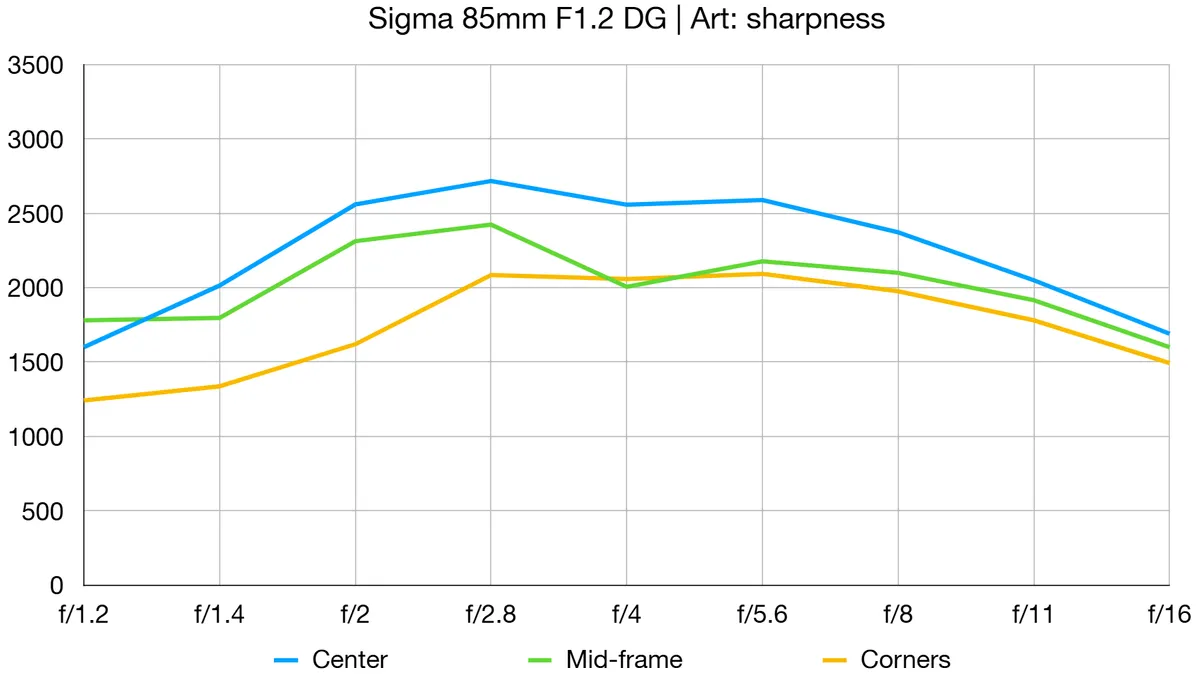
Center sharpness is spectacular in the f/2 to f/11 sector of the aperture range and holds up really well even at the widest aperture, considering it’s such a fast f/1.2 lens. Ultimately, the Sigma can deliver more than enough sharpness at f/1.2 for portraiture but it can be worth stopping down to between f/2 and f/11 if you feel the need to retain the absolute maximum of fine detail and texture.
Fringing:

Control over both axial and lateral chromatic aberrations is pretty epic at all aperture settings. Automatic in-camera correction tends to be available for the latter but really isn’t necessary.
Distortion: 1.14
There’s a touch of pincushion distortion but it’s generally hard to notice any distortion at all in real-world shooting. For effectively zero-distortion shooting, automatic correction is available either in-camera or at the editing stage.
Sigma 85mm f/1.2 DG Art: Verdict
I feel that the Sigma 85mm f/1.2 DG Art comes as close to portrait perfection as any lens in its class. That makes it a really top-class lens, combining its essential 85mm focal length with a highly desirable and super-fast f/1.2 aperture. It’s an aspirational, heady mix but one that’s more attainable than with Canon and Nikon equivalent lenses, in terms of purchase price. Although the Sigma lens is great value, there’s no skimping on extras. Handling exotica includes a dedicated aperture control ring with click/de-click and Auto-lock switches, along with two customizable function buttons and an AF/MF focus mode switch.
Most importantly, image quality is to die for, combining scintillating sharpness, clarity and bite with sumptuously smooth and creamy bokeh, and an entirely natural falloff between focused and defocused areas. All things considered, it’s top marks to Sigma for this epic new lens which is destined to become an instant classic. I just wish it was available in more mount options… Go ahead Sigma, make my day!
Features ★★★★★ |
Fab features include an f/1.2 aperture, 13-blade diaphragm, dual HLA autofocus, dedicated aperture control ring, click/de-click and Auto-lock switches, two customizable function buttons and an AF/MF focus mode switch. |
Design ★★★★★ |
Typical of Sigma Art lenses, image quality and performance are firmly at the top of the design criteria, but it’s also noticeably more lightweight than its direct competitors while still being extensively weather-sealed. |
Performance ★★★★★ |
Autofocus is impressively fast and consistently accurate for an 85mm f/1.2 lens, based on dual HLA motors. Image quality is absolutely stellar, combining spectacular sharpness with creamy bokeh and plenty of 3D pop. |
Value ★★★★★ |
This was always going to be an expensive lens to manufacture and that’s reflected in the selling price, but it’s still great value compared with its direct competitors, costing only around half as much as equivalent Canon and Nikon lenses. |
Overall |
★★★★★ |

Alternatives