







Digital Camera World Verdict
The Nikon Z5IIC is essentially a Nikon Z5 II with the viewfinder ‘hump’ lopped off. That means it’s an exceedingly capable camera at a competitive price. My biggest problem is that the lost viewfinder doesn’t make the camera as svelte and portable as you might think. This is still a chunky, full-frame Nikon, not an everyday carry. And yet, it’s a durable, premium-feeling camera with weather sealing, IBIS, and RAW video. It might be ‘casual’ by name, but there’s nothing casual about the Nikon Z5IIC’s capabilities. If you can live without a viewfinder and don’t mind a little heft, it’s a solid camera. If you like what you see but you want an EVF, you can always pick up the Nikon Z5 II.
Reasons to buy
- +
Durable, weather-sealed build
- +
IBIS
- +
Gorgeous image files
- +
Scene Modes
- +
Internal RAW video
- +
Nice silver color option
Reasons to avoid
- -
No viewfinder
- -
Bulky and heavy for a viewfinderless camera
- -
Low-res rear LCD screen
- -
No joystick
Why you can trust Digital Camera World Our expert reviewers spend hours testing and comparing products and services so you can choose the best for you. Find out how we test.
The Nikon Z5IIC launched following rumors of a Nikon camera without a viewfinder. While there were whispers of a fixed-lens full-frame compact camera and a stills-focused Nikon ZR, nobody could have predicted a ‘viewfinderless’ clone of the Nikon Z5 II.
Viewfinderless cameras have always been divisive. Photography purists cite the stability and sun-glare-free nature of shooting through the viewfinder as too crucial to pass up. But plenty of modern photographers ignore their EVF in favor of their mirrorless cameras’ rear LCD and a more dynamic method of shooting.
What works for you, works. But the big question I’ll be trying to answer is what benefits the Nikon Z5IIC’s viewfinderless design brings to the table. One such benefit is price. With reports of the Nikon Z5 reaching the end of its lifecycle, the Nikon Z5IIC could soon become the most affordable entry point into Nikon’s full-frame mirrorless lineup at $1,399.95 / £1,349 / AU$2,399 (body only).
And that entry point is exactly what Nikon is targeting. The ‘C’ in the camera’s name is supposed to represent ‘Casual’, which is why the Nikon Z5IIC is also the very first full-frame Z-series camera to feature Scene Modes.
I took the Nikon Z5IIC for a spin around the beautiful city of Bath to find out how its viewfinderless design fared in a street photography setting. Read on for a deep dive into the camera’s specs and to find out how it performed in real-world scenarios.

Nikon Z5IIC vs Z5II: Specifications
Nikon Z5IIC |
Nikon Z5 II |
|
Effective pixels |
24.5MP BSI CMOS (full-frame) |
24.5MP BSI CMOS (full-frame) |
ISO sensitivity |
Stills: 100–64000, (50-204,800 expanded) |
Stills: 100–64000, (50-204,800 expanded) |
Engine |
EXPEED 7 |
EXPEED 7 |
File format (Photo) |
RAW/JPEG/HEIF |
RAW/JPEG/HEIF |
Phase detection AF area |
Single-point AF: 273 points |
Single-point AF: 273 points |
Subject detection |
10 types |
9 types |
AF detection |
-10 EV |
-10EV |
Continuous shooting speed |
Electronic front-curtain shutter: 14 fps (CH+) |
Electronic front-curtain shutter: 14 fps (CH+) |
Vibration reduction |
5-axis in-body VR: Up to 7.5 stops |
5-axis in-body VR: Up to 7.5 stops |
Shutter speed |
1/8000–30 sec (extendable up to 900 sec) |
1/8000–30 sec (extendable up to 900 sec) |
Video frame size/frame rate |
4K 60p (cropped) |
4K 60p (cropped) |
Video compression |
N-RAW, H.265/264 |
N-RAW, H.265/264 |
Video recording mode |
N-Log, HLG, SDR |
N-Log, HLG, SDR |
Monitor |
3.2-inch, approx. 1040k-dot vari-angle |
3.2-inch, approx. 2100k-dot vari-angle |
Media slot |
SD (UHS-II) x1 |
SD (UHS-II) x2 |
Battery |
EN-EL15c (Rechargeable Li-ion) |
EN-EL15c (Rechargeable Li-ion) |
Dimensions (W×H×D) |
5.3 x 3.3 x 2.9 in (134 × 80.5 × 72 mm) |
5.3 x 4 x 2.9 in (134 x 100.5 x 72 mm) |
Weight (camera body only) |
19 oz. / 538 g (body-only) |
24.7 oz. / 620 g (body-only) |
Nikon Z5IIC: Price
The Nikon Z5IIC is priced at $1,399.95 / £1,349 / AU$2,399 (body only). Compare that to the Nikon Z5 II, which is typically listed around $1,599 / £1,499 / AU$2,699, and that’s a decent saving of around $200 / £150 / AU$300. But one thing I’ve had in mind is where the Z5IIC will end up. As time goes on, we could see that body-only price creep towards the $1,000 mark.
You can also opt to choose from various kits or bundles, such as the Nikon Z5IIC + Nikon Z 24-50mm f/4-6.3 ($1,699.95 / £1,609 / AU$2,949). This prime-sized zoom is a great choice for the camera’s viewfinderless design. While the Nikon Z5IIC + Nikon Z 24-200mm f/4-6.3 VR ($TBC / £2,049 / AU$3,699) might seem like a great all-in-one option, I’d be wary of any lens bigger than the Nikon Z 24-120mm f/4 S, which I used during my review.
When you stack the Nikon Z5IIC against the Panasonic Lumix S9 and Sony A7C II, it’s priced between them. Overall, I think it’s competitively priced given its specs and the economic challenges the consumer tech industry is currently facing.
Nikon Z5IIC: Design & Handling
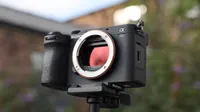
The Nikon Z5IIC largely follows the same formula as every other mainline Z-series camera: it’s solid, bulky, has a deep grip, and plenty of physical controls. The big difference is that it doesn’t have a faux pentaprism bump in which to house an electronic viewfinder.
It’s less bulky and inherently more ‘riggable’ than any other full-frame Z-series camera (Nikon ZR aside). This allows it to occupy marginally less space in a backpack, weigh marginally less in the hand, look marginally less professional and intimidating, and cost marginally less than its blueprint, the Nikon Z5 II. The big question I had when using this camera was: Is ‘marginal’ enough to warrant the downgrade in functionality?
I get it. Not every photographer wants to use a viewfinder, and there’s nothing wrong with that at all. If you’re prepared for bright, sunny conditions reflecting off the rear LCD and that doesn’t faze you, who am I to tell you otherwise? But the difference here is that the Nikon Z5IIC is a beefy, full-frame camera and that does change things.

Take the Panasonic Lumix S9 for example; a viewfinderless full-frame camera that’s roughly 135g lighter than the Nikon Z5IIC. That does make a difference. I’ve handed the Z5IIC off to various colleagues, and they’ve all been surprised by the same thing: its weight. The camera’s body weighs 538 g, which is a not-insignificant 82 g lighter than the Nikon Z5 II.
And yet, the way you handle a viewfinderless camera is just different. Peer through a viewfinder and you’ll instinctively cradle a larger camera with both hands, but viewfinderless cameras need to be held farther from the body. The Z5IIC might be lighter than the Nikon Z5 II, but I noticed its weight more.
That’s not to say the weight is a constant pain point, but it is a consideration. I used the camera with the Nikon Z 40mm f/2 and Nikon Z 24-120mm f/4 S. The latter is as heavy and bulky as I’d want to go for regular, handheld shooting. And even then, this is a relatively hefty setup for an everyday carry.

Use the Nikon Z5IIC for video, though, and the form factor isn’t an issue. Again, you tend to hold a camera differently when shooting video. Your forefinger doesn’t have to rest on the shutter button, meaning you can hold it in any way that feels comfortable to you. And of course, if you mainly shoot stills from a tripod, the form factor won’t be an issue at all, and most tripod users compose via the rear screen anyway.
Ultimately, the lack of a viewfinder won’t be a turnoff for everyone, but the size and weight of the camera could be. I recommend trying it on for size in your local camera shop before buying, and considering very carefully what lenses you want to use with it. A telephoto-friendly camera this is not.
A disappointing oversight from Nikon on paper is the Z5IIC’s rear screen. It’s actually lower resolution than the Nikon Z5II’s 2100k-dot screen (it’s 1040k dots). This really is a curious decision from Nikon and one that I can only assume was a budgetary measure. Still, you’d think the rear screen on a viewfinderless camera would be a core spec. And yet, despite my displeasure, if I’m going to be truly honest, I didn’t find this to be an issue out in the field. An oversight, yes, but not one that will impact the camera’s day-to-day usability.

Now that I’ve addressed the elephant in the room, let’s move on to some of the positives, of which there are plenty. As you’d expect from a mainline Z-series camera, the entire body feels solid. It’s built from magnesium alloy and durable-feeling plastics, while the grip is deep and covered in Nikon’s grippy leatherette.
It’s also weather sealed, and while I’m not going to leave a $1399.95 / £1,349 camera out in a downpour, the UK’s dreadful weather meant I spent a lot of time using the Z5IIC in light showers. I never advise letting any camera get saturated, but I felt entirely confident using the Z5IIC in wet conditions.
As per usual, Nikon has churned out a utilitarian device that’s built like a tank. But what’s unheard of from a mainline Z-series camera is that the Z5IIC comes in two colors. That’s right, it’s not just all-black with the classic red stripe; you can also opt for a silver variant. This paint job is only applied to the top plate, giving the camera a definite Sony A7C II vibe. Some of my colleagues think the silver looks plasticky, but as somebody who often moans about silver cameras looking cheap, I’d opt for the silver variant. Consider me a fan.

On the aforementioned top plate, you’ll find a fairly minimalist setup that’s functionally almost identical to the Nikon Z5 II. You’ve got a chunky mode dial that’s satisfyingly stiff, albeit slightly different to the Nikon Z5II’s in that it has only two U options instead of three. This is to facilitate the new Scene Mode icon (more on that later).
Like the Z5 II, there’s also a very handy Picture Control button. Simply tap it and use the rear command dial to scroll through 31 ‘looks’ which are applied to images in real time. The left side of the top plate is typically bare, but without the viewfinder bump, it might have been nice to have included an ISO or exposure comp dial.
Moving on to the rear, it’s standard fare except for the lack of a joystick. This is a real backwards step as far as I’m concerned. I can’t imagine it would have been an expensive addition. It simply means you’re forced to use the d-pad, which isn’t always as comfortable for your thumb, when holding the camera to accommodate its viewfinderless design. Thankfully, though, the buttons are solid and pleasantly spongy.


The Nikon Z5IIC has a single SD-card slot, which is a downgrade from the Z5 II. However, this isn’t a pro-grade camera, and if you’re a stickler for pro features, you’re going to want a viewfinder anyway. As such, I think this is a sensible cost-saving measure that won’t bother most, especially with the ever-increasing price of memory cards these days.
On the front of the camera, you’ve got two Fn buttons, which can be reached by extending your middle and forefinger from the grip, so they can be activated one-handed. And, like other Z-series cameras, the Z5IIC’s controls are highly customizable, so you can make the setup work for you.
The camera uses Nikon’s standard EN-EL15c rechargeable Li-ion battery. According to the CIPA Shot Rating, it’s rated for 350 shots, which isn’t much different from the Nikon Z5II’s 330-380. During use, I can confirm that the battery held up as well as could be expected. Any concerns you might have about the rear LCD always being on can be easily dispelled. Firstly, by getting into the habit of switching your camera off when not in use. And secondly, by the fact that a standard mirrorless is constantly switching between an EVF and a rear LCD, the power usage isn’t going to be much different.
Nikon Z5IIC: Performance
Nikon’s second-generation Z-series lineup consists of the Nikon Z9 at the very top of the pyramid, with varying degrees of tech trickling down to other cameras in the range. As such, all of Nikon’s cameras boast very solid core performances and the Nikon Z5IIC is no different.
In a world of high-megapixel sensors, you could look down upon the Z5IIC’s 24.5-MP sensor, but like all of Nikon’s full-frame image files, the stills you get from the Z5IIC really are top tier. RAW files stand up to generous cropping and are extremely pliable in post; they’re just an all-around treat to work with.
And if editing RAW files isn’t your thing, the Nikon Z5IIC is loaded with Nikon’s Picture Controls. Think Fujifilm Film Simulations, but not as good fresh from the box. Thankfully, Picture Controls can be edited so you can come up with your own ‘recipes’, and you can even download examples from other creators.

A fairly recent update that debuted on the Nikon Zf is Film Grain. This complements Picture Controls by adding retro film grain to images. Not only does it look the part, but the grain isn’t uniform, so each application is different. I tested this myself and can confirm that it does indeed hold up to scrutiny. You can customize the grain by choosing from three different sizes and seven different intensities. I wouldn’t recommend using everything maxed out, but the default settings do look very convincing.
Another feature that really lives up to the Nikon Z5IIC’s ‘Casual’ moniker is the presence of Scene Modes. The Z5IIC is the first full-frame Nikon camera to feature Scene Modes, and while that might not seem like a big deal, I think it’s a great addition. These modes are a great way for novice photographers to exercise a little creative agency beyond the one-size-fits-all Auto Mode.
There are 15 Scene Modes in total, allowing you to adapt quickly to a variety of shooting situations. For example, I photographed my dog using the Pet Portraits Scene Mode. The camera instantly opened up the aperture and switched to Animal-Detection AF, so all I had to do was compose my image and fire the shutter.

Similarly, I tried out Night Landscape and Autumn Colors; the camera instantly adapted to both scenarios, raising the ISO and opening the aperture in low light, and warming the image and boosting the saturation when capturing autumnal foliage. Picture Controls and Scene modes aren’t for everyone, but I think they fit the Z5IIC’s intended demographic and are definite selling points for the right photographer.
When it comes to autofocus, the Nikon Z5IIC performs very well. Sure, it can get a little stuck or confused at times, like any AF system, but provided you take the time to learn Nikon’s various modes, you’ll be well rewarded. I enjoy using 3D tracking, Wide-Area AF, and Single-Point AF, swapping between modes depending on the subject or scene at hand.
I own a Nikon Z8, and while the Z8 will certainly perform better in a side-by-side comparison, I didn’t find myself bemoaning the Z5IIC’s performance, which is high praise indeed. And of course, the Nikon Z5IIC has an autofocus mod con that currently no other Nikon camera has – not even the flagship Nikon Z9 – and that’s fish subject-detection.

Now, I initially found this quite the novelty, but in a world of ever-expanding AF algorithms, why not? I actually used to know a professional photographer who photographed fish for fish-keeping publications, and I’m sure he’d be very happy indeed with this development. It’s exciting news for underwater photographers, too, because put a camera with fish AF in an underwater housing and you’re golden.
Speaking of gold, I did my due diligence and found myself a fitting subject to test out this new autofocus mode. Thomas is a rescued fairground goldfish who resides in a local art studio owned by incredibly talented wildlife artist Jacqueline Byrne (@jacquelinebyrne.art). Jackie kindly allowed me to use Thomas as a model and I was pleased to find that the camera not only detected the goldfish’s body, but also locked onto his eyes.
It did struggle at times, but the conditions were challenging. Reflections and scratches on the tank glass, not to mention underwater foliage, and my need to shoot wide open in low light, all contributed. But fish AF works and isn’t quite the joke addition it may at first seem.

The Nikon Z5IIC’s form factor certainly lends itself to videography, and just like the Nikon Z5 II it boasts some decent specs. Arguably the biggest selling point is internal 4K 30p full-width RAW video. And while it’s nice to have, I always thought it was a little out of place on the Nikon Z5II, and I still think it’s a little out of place on the Nikon Z5IIC.
A lot of pro videographers don’t shoot RAW video. After all, it fills up storage as a pastime, creates increased internal heat, and is power-hungry in the edit. That said, it’s nice to have as an option. Although, a word of warning: make sure you’re using a capable SD card. The Nikon Z5IIC will only record RAW video on a memory card that’s over 32GB. And if your memory card isn’t fast enough, it’ll stop recording before time.
When it comes to overheating, ambient temperature and camera usage will always affect the outcome, but I shot 13 minutes of uninterrupted RAW footage in real-world testing without issue. The Nikon ZR is proof that Nikon knows how to build a camera that’s very hard to overheat, and while I cannot comment on long-term video usage due to my very short time with the camera, I don’t have any immediate concerns. I also shot some 4K video. As you’d expect, the autofocus performed well; just be aware that 4K 60p enforces a 1.5x (DX) crop.

Another video boon is in-body image stabilization. It’s not surprising given that the Nikon Z5II also has it, but it was a crucial inclusion because the Z5IIC’s direct competitors also have IBIS. What they don’t have is 7.5 stops of stabilization, with the camera beating the Panasonic Lumix S9’s 6.5 stops and the Sony A7C II’s seven stops. This is a great feature for photographers, too. I’d argue it’s essential for the Z5IIC given its viewfinderless design, because you’re not holding the camera up to your eye, which is the most stable shooting position.
While the lower-resolution LCD screen didn’t really bother me when shooting stills, I do think it matters more for video. Metering is such an important part of videography, and while you’ve got aids such as zebras and histograms, every little helps if you’re not resorting to an external monitor.
One thing I would suggest that any Nikon Z5IIC owner does is head into Menu>Setup>Monitor Brightness and set the latter to its maximum setting. This will reduce battery efficiency, but you’ll get a brighter and more visible screen. As a photographer, I lament the flip-out screen craze, much preferring a tilting screen, but the Nikon Z5IIC is a camera built to adapt to both worlds, and a flip-out screen is definitely preferable for video.
Nikon Z5IIC: Sample images


Nikon Z5IIC: Lab Tests
Nikon Z5IIC lab test data
For this test, we have compared the Nikon Z5IIC with its closest competitors, the Nikon Z5 II, Sony A7C II, and Panasonic Lumix S9
| Timestamp (ISO) | Nikon Z5 IIC () | Nikon Z5 II () | Sony A7C II () | Panasonic S9 () |
|---|---|---|---|---|
| 1 | 28 | 28 | 30 | 26 |
| 2 | 28 | 28 | 30 | 26 |
| 3 | 28 | 28 | 30 | 26 |
| 4 | 28 | 28 | 30 | 26 |
| 5 | 28 | 28 | 30 | 26 |
| 6 | 28 | 26 | 30 | 26 |
| 7 | 28 | 26 | 30 | 26 |
| 8 | 26 | 26 | 28 | 26 |
| 9 | 24 | 24 | 26 | 24 |
| Timestamp (ISO) | Nikon Z5 IIC () | Nikon Z5 II () | Sony A7C II () | Panasonic S9 () |
|---|---|---|---|---|
| 1 | 12.51 | 12.52 | 12.21 | 12.19 |
| 2 | 12.5 | 12.52 | 12.62 | 12.02 |
| 3 | 12.51 | 12.27 | 12.51 | 11.95 |
| 4 | 12.5 | 12.37 | 12.52 | 11.99 |
| 5 | 12.12 | 11.99 | 12.45 | 11.71 |
| 6 | 11.79 | 11.59 | 11.88 | 11.32 |
| 7 | 10.9 | 10.26 | 10.9 | 10.99 |
| 8 | 9.82 | 9.35 | 10.02 | 10.03 |
| 9 | 8.81 | 8.59 | 9.26 | 9.16 |
| Timestamp (ISO) | Nikon Z5 IIC () | Nikon Z5 II () | Sony A7C II () | Panasonic S9 () |
|---|---|---|---|---|
| 1 | 46.32 | 46.16 | 41.44 | 44.88 |
| 2 | 43.03 | 43.42 | 39.27 | 42.35 |
| 3 | 40.68 | 40.51 | 36.44 | 40.49 |
| 4 | 37.75 | 37.31 | 34.04 | 37.64 |
| 5 | 34.82 | 33.99 | 32.35 | 34.41 |
| 6 | 31.38 | 30.65 | 29.31 | 31.51 |
| 7 | 28.45 | 27.23 | 25.95 | 29.06 |
| 8 | 25.5 | 24.44 | 23.14 | 26.37 |
| 9 | 22.68 | 21.78 | 20.46 | 23.24 |

Nikon Z5IIC: Verdict
The Nikon Z5IIC is a tale of two halves. On the one hand, it has a slightly awkward design. On the other, its performance punches above its weight. I’m no stickler for always looking through the viewfinder, but the biggest benefit of viewfinderless cameras is their increased portability.
And yet, losing the viewfinder doesn’t impact the size and weight of the Z5IIC enough; it’s still a big lump. The upside of this is that it’s built like a tank and feels like a premium, weather-sealed product. I’m not saying the heft is a dealbreaker; just make sure you try it on for size before you buy.
Under the hood is where the camera really gains some ground. It’s a fantastic all-around performer, with great autofocus, gorgeous stills, solid video specs, and impressive in-body image stabilization. Plus, you get the rather unusual (if superfluous) bonus of RAW video.
Scene Modes is an unlikely standout for me. It really lives up to the Z5IIC’s ‘casual’ moniker and allows anybody to get creative with the camera from the offset. Picture Modes and Film Grain serve as the next step in creative agency, allowing you to apply ready-made or custom presets to your images in real time.
Finally, the Nikon Z5IIC is competitively priced. At $1399.95 / £1,349, it sits between the Sony A7C II and Panasonic Lumix S9. It’s not a cheap camera by any means, and I do wonder how appealing that price point is to its ‘casual’ target audience. But it’s got the specs of a more expensive camera.
Overall, I was ready to hate on the Nikon Z5IIC when it was announced, but I’ve been pleasantly surprised by how much I’ve enjoyed my limited time with the camera. That said, I wonder if its size and weight could be its undoing.
It’s too big to be an everyday carry, and I fear it may be too intimidating for its ‘casual’ target audience. I hope I’m proved wrong, because this is a well-built, exceedingly capable full-frame camera. Just like its blueprint, the Nikon Z5 II.
Design ★★★☆☆ |
I’m not sold on a viewfinderless design for a camera that’s this big and heavy, and the low-res LCD and lack of a joystick are disappointing. But it’s weather-sealed, very solidly built and comes with a nice deep grip. |
Photo Performance ★★★★☆ |
Gorgeous Nikon RAW files and accurate AF. The inclusion of Scene Modes makes it more accessible for newcomers, while Picture Controls and Film Grain are great ways to personalize images in-camera. |
Video Performance ★★★★☆ |
No open gate, but internal RAW video is impressive (if a little unnecessary). IBIS, 4K 60p (albeit cropped), reliable AF, a flip-out rear screen, and a riggable form factor are all solid video features. |
Value ★★★★☆ |
Sits between its closest rivals and will likely soon become the cheapest full-frame camera in Nikon’s mirrorless lineup. It’s not a cheap camera, but it’s competitively priced. |
Overall |
★★★★☆ |
Nikon Z5IIC: Alternatives

Check out our guide to the best mirrorless cameras, and our rundown of the best Nikon Z lenses

