Digital Camera World Verdict
I feel a bit like the Tamron 28-300mm f/4-7.1 Di III VC VXD gives with one hand and takes away with the other. It succeeds as an all-in-one ‘superzoom’ lens for travel and walkabout photography, being reasonably compact and lightweight. It also delivers generous telephoto reach to cover the distance. However, its wide-angle coverage is relatively limited and it’s only available in a Sony E-mount edition. Ultimately, the lens is a good all-in-one choice if you favor telephoto reach over wide viewing angles.
Reasons to buy
- +
Generous 10.7x zoom range
- +
Long telephoto reach
- +
Fairly compact and lightweight
- +
VXD autofocus, VC stabilization
- +
Weather-seals, fluorine coating
Reasons to avoid
- -
Limited wide-angle coverage
- -
Slow telephoto aperture rating
- -
Typical extending inner barrels
- -
Only for Sony cameras
Why you can trust Digital Camera World Our expert reviewers spend hours testing and comparing products and services so you can choose the best for you. Find out how we test.
I have a slight feeling of déjà vu, my mind drifting back to late 2014 and the launch of the Tamron 28-300mm f/3.5-6.3 Di VC PZD. It was a neat and tidy travel-friendly ‘superzoom’ lens for full-frame Canon and Nikon DSLRs, weighing in at 800g. It was designed and built before full-frame Canon and Nikon mirrorless cameras were even a glint in their parents’ eyes, although both were dabbling with APS-C format mirrorless systems. The lens became obsolete in the summer of 2018, when the writing was on the wall for DSLRs.
Fast-forward to 2024 and up popped the Tamron 28-300mm f/4-7.1 Di III VC VXD that I’m reviewing here. Physically shorter and only about three-quarters of the weight, it’s even more focused on being an all-in-one lens for walkabout and travel photography. Unlike some recent full-frame Tamron lenses, there’s no Nikon Z mount version and the 28-300mm is currently only made in Sony E-mount. The same applies to the equally travel-oriented Tamron 25-200mm f/2.8-5.6 Di III VXD G2.
The 28-300mm undercuts the 25-200mm for price (see below) but both lenses are a very similar size and weight. The tough question (and one that only you can answer) is whether you’d rather have the more expansive wide-angle coverage and faster aperture rating of the 25-200mm, or the greater telephoto reach of the 28-300mm. And while you’re trying to weigh up the pros and cons, there’s also the the Sony FE 24-240mm f/3.5-6.3 OSS to throw another spanner into the decision-making work. Long story short, the Tamron 28-300mm aims to be one of the best travel lenses as well as one of the best lenses for Sony cameras.

Tamron 28-300mm f/4-7.1 Di III VC VXD: Specifications
Mount options |
Sony E (FE) |
Full frame |
Yes |
Autofocus |
Yes |
Image stabilization |
Yes |
Lens construction |
20 elements in 13 groups |
Angle of view |
75.4 to 8.3 degrees |
Diaphragm blades |
9 |
Minimum aperture |
f/22-40 |
Minimum focus distance |
0.19m (W) 0.99m (T) |
Maximum magnification |
0.36x (W) 0.26x (T) |
Filter size |
67mm |
Dimensions |
77x126mm / 3x5in |
Weight |
610g / 1.3lb |
Tamron 28-300mm f/4-7.1 Di III VC VXD: Price
Stretching from moderately wide-angle coverage to seriously strong telephoto reach, the Tamron 28-300mm can take the place of two regular standard and telephoto zoom lenses, all on its own. If the performance is up to scratch, that makes it quite a bargain at $749 / £629 / AU$1,449. The more wide-angle and faster Tamron 25-200mm f/2.8-5.6 Di III VXD G2 is pricier to buy at $899 / £729 / AU$1,699.
As I’ve mentioned, the lens is only available in Sony E-mount, so another lens that bears comparison is the own-brand Sony FE 24-240mm f/3.5-6.3 OSS. This one comes in at $1,348 / £719 / AU$1,299, at the time of writing. That makes the Sony lens cost nearly twice as much as the Tamron in the USA but there’s less of a mark-up in the UK. Conversely, Sony lens is actually less expensive than the Tamron in Australia. Relative value for money has a lot to do with where you are in the world.
Tamron 28-300mm f/4-7.1 Di III VC VXD: Design & Handling
I really don’t think that an all-in-one ‘superzoom’ lens is a travel-friendly option if it’s big and weighty. I’d rather have a compact and lightweight standard zoom mounted on my camera and carry a fairly small telephoto lens in a bag, rather than walk around all day with a big, heavy camera and lens combo hanging around my neck. The Tamron clears that particular hurdle by measuring a modest 77x126mm / 3x5in and weighing in at a mere 610g / 1.3lb. In a nutshell, it’s easily manageable for the short haul, long haul and anything in between.
Despite the modest dimensions and weight, the Tamron packs a complex array of glass. There are 20 optical elements arranged in 13 groups, and these include three glass-molded aspherical elements, one LD (Low dispersion) element and one XLD (eXtreme Low Dispersion) element. The aim is to achieve good sharpness, clarity and color rendition with the minimum of unwanted aberrations like color fringing.

Another pointer to its compact, travel-friendly build is that the Tamron has a fairly small 67mm filter attachment thread at the front. I also think that if you’re traveling, you need to make the most of your shooting opportunities, whatever the weather. It’s therefore a good thing that the lens features multiple weather-seals. There’s also a fluorine coating on the front element to repel moisture and greasy fingermarks. And for when the sun shines, Tamron’s BBAR G2 (Broad Band Anti-Reflection, Generation 2) multi-coating is applied, to combat ghosting and flare.

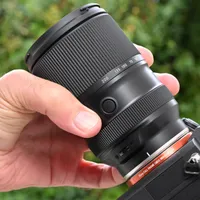
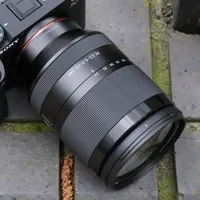
One of the factors that helps downsize the design is that the lens has a fairly slow long-end aperture, equating to f/7.1. I think that’s fair enough, as compactness is key for any travel lens. That said, typical of its breed, the Tamron superzoom is less compact the further you zoom towards its most telephoto setting, as the inner barrels extend by up to about 3 inches. You can see a graphical representation of this by comparing the two images above and below, taken of the lens at its shortest and longest zoom settings.

It’s highly likely that you’ll use the lens in autofocus mode pretty much all of the time, so it’s the zoom ring that gets pride of place towards the front of the outer barrel, and it’s much larger than the manual focus ring. Happily, it operates smoothly and effectively throughout its range. That’s an upgrade over some superzoom lenses that I’ve used in the past, the zoom rings of which felt quite jerky action and a bit stiff in places.

The autofocus system is a pretty high-end affair, based on Tamron’s VXD (Voice-coil eXtreme Drive) system. As such, it aims to deliver high-speed autofocus for snapping onto subjects and tracking them efficiently, in almost total silence. You can also expect smooth and silent autofocus transitions when shooting video. Typical of the system, the manual focus ring is electronically coupled to the motor, which is required for driving the necessary groups of elements even during manual focusing.

A little luxury is that the lens features Tamron’s ‘Focus Set’ function button on the side of the barrel. You can customize the action of the button using the Tamron Lens Utility software on a linked computer, using the lens’s USB-C port. Alternatively, you can use a smartphone app if you invest in the dinky little Tarmon-Link Bluetooth Module, which sells separately for around $50 / £59 / AU$80 and plugs into the USB-C port. Popular options for the Focus Set button include focus preset, A-B focus, focus range limiter, AF/MF focus mode selection and more besides.

There’s no dedicated AF/MF auto/manual focus mode switch, nor a switch for turning the VC (Vibration Compensation) optical stabilizer on and off. However, you do get a zoom lock switch. This helps to avoid the lens stretching out under the force of gravity while you’re walking around with your camera hanging off a strap. It’s a useful safeguard but another plus point is that the Tamron is much more resistant to zoom creep than some superzoom lenses. As such, you should be able to shoot at extreme upward or downward angles with your camera mounted on a tripod, without the zoom length changing of its own accord.

As I’d expect from Tamron, the lens is supplied complete with a hood. In this case, it’s an efficient petal-shaped hood with the typical bayonet-mount action, and can be reversed on the lens for compact stowage.

When mounted on the lens, the hood offers additional resistance against ghosting and flare, as well as giving physical protection to the front optical element against the knocks and scrapes that are easily picked up when traveling. Indeed, my review sample had some scrapes on the outer surface of the hood, which is massively preferable to scratches on the front glass element.

Some lenses have USB-C ports built into their mounting plates. That’s all very well if you don’t mind separating the lens from the camera body to gain access to the port. As I’ve mentioned though, this lens is compatible with the Tamron-Link Bluetooth Module which requires the USB-C port to be accessible when the lens is mounted. As such, the port is situated on the side of the barrel near the rear.

Although built for lightness, the lens does feature a metal rather than plastic mounting plate, which feels solid and sturdy. The mounting plate also features a weather-seal gasket, and there are other weather-seals positioned throughout the lens.

Tamron 28-300mm f/4-7.1 Di III VC VXD: Performance
I’ll kick off this performance section of the review with a look at autofocus and optical stabilization. Throughout my testing, using the lens with a Sony A7 III, I found that the voice-coil motor autofocus system was really fast, virtually silent and consistently accurate. It works very well for both stills and video capture, and the same goes for the ‘Vibration Compensation’ system.
Optical stabilization is a worthwhile inclusion, despite all but the first generation of Sony Alpha full-frame cameras featuring IBIS (In-Body Image Stabilization). Optical or ‘in-lens’ stabilization tends to work better than IBIS at long telephoto focal lengths. Moreover, the compact and lightweight build of the lens also makes it appealing for use with Sony A6000-series APS-C format cameras, on which it has a powerful ‘effective’ zoom range of 42-450mm. Most of the back-catalog of these APS-C cameras don’t feature IBIS, so optical stabilization is even more crucial. A neat trick in the lens’s VC system is that it calls on AI-learned evaluation when shooting video in the 28-100mm section of the zoom range, automatically switching between tripod, handheld, walking, panning, tilting and diagonal shifting modes.

A big performance factor is the zoom range itself. Designed primarily for full-frame Sony cameras, the wide-angle potential is relatively limited, compared with the Tamron 25-200mm f/2.8-5.6 Di III VXD G2, and the difference is very clear to see. Conversely, you get 1.5x more telephoto reach, which is great news for action, sports, wildlife, birding and any other shooting scenario in which you need to cover a lot of distance. For visual reference, the images above and below were shot of the same subject from the same position, using the shortest and longest zoom settings. As you’ll see, there’s quite a stretch!

Sharpness is often one of the most talked-about performance factors of any lens, and it’s a facet that ‘superzoom’ lenses have historically struggled with. The relatively big zoom range has often come with a compromise in terms of sharpness. Relatively recent designs for mirrorless cameras tend to be much improved and sure enough, the Tamron delivers satisfying levels of sharpness throughout its entire zoom range. In real-world shooting, the sample I used proved pretty sharp right out to the edges of the image frame, throughout the entire zoom range.

The lens has a comparatively pedestrian aperture rating, shrinking from a modest f/4 to a fairly sluggish f/7.1 as you extend throughout the zoom range. Even so, you can still gain a fairly tight depth of field, especially at greater zoom settings, thanks to the long focal lengths on offer. Typical of Tamron lenses, the quality of bokeh is nice and smooth. A bigger issue is that you might often need to bump up your camera’s ISO setting to enable sufficiently fast shutter speeds for freezing motion, when shooting under dull lighting conditions.

As I’d expect from a superzoom lens, the Tamron suffers from noticeable barrel distortion at its shortest focal length, and pincushion distortion throughout the longer section of the zoom range. Color fringing can also be noticeable but both of these aberrations can be taken care of by automatic in-camera corrections, or when processing RAW quality files with software that has the requisite lens profile. Unlike with many modern lenses designed for mirrorless cameras, automatic correction for distortion isn’t ‘forced on’, so you get the choice of whether or not to use it.
Tamron 28-300mm f/4-7.1 Di III VC VXD: Sample Images
The following gallery of example images was shot in and around Bristol Docks, commonly referred to as the Floating Harbour, in South West England. Some of the images were shot in pairs, taken of the same scene from the same position, to demonstrate the relative field of view when using the shortest and longest zoom settings. Others in the sequence are standalone shots taken at a variety focal lengths.


Tamron 28-300mm f/4-7.1 Di III VC VXD: Lab Results
We run a range of lab tests under controlled conditions, using the Imatest Master testing suite. Photos of test charts are taken across the range of apertures and zooms (where available), then analyzed for sharpness, distortion and chromatic aberrations.
We use Imatest SFR (spatial frequency response) charts and analysis software to plot lens resolution at the center of the image frame, corners and mid-point distances, across the range of aperture settings and, with zoom lenses, at four different focal lengths. The tests also measure distortion and color fringing (chromatic aberration).
Sharpness:


Center sharpness is excellent at 28mm, even wide open; an especially impressive result when you remember this is a superzoom lens. Even at longer focal lengths sharpness remains consistently good, and is so at all apertures.
Inevitably you can't have it all with a focal range this wide, and its corner sharpness that gets compromised. Levels of sharpness here are mediocre at shorter focal lengths, and only get worse as you zoom in. You'll need to stop down to f/11 to get the best sharpness across the entire image frame, but an aperture this narrow won't always be practical at long focal lengths.
Fringing:

The lens controls aberrations very well - they never become visible in real-world shooting, regardless of focal length or aperture.
Distortion:

As with many modern lenses for mirrorless cameras, the 28-300mm relies heavily on in-camera distortion correction. When disabled, you'll see fairly obvious barrel distortion at 28mm, transitioning quickly to a similar degree of pincushion at 100mm and beyond.
Tamron 28-300mm f/4-7.1 Di III VC VXD: Verdict
Decisions, decisions. I’m drawn to the powerful telephoto reach of the Tamron 28-300mm f/4-7.1 Di III VC VXD. It’s ideal for countryside walks or going on safari, when you want a lens that can capture general landscape shots as well as zooming in to frame distant wildlife. The same applies to urban photography, where you might want to shoot fairly wide cityscapes as well as zooming in on details small or far.
The Tamron also works pretty well for action and sports photography, aided by very fast and consistently accurate autofocus and effective optical stabilization, although the relatively slow long-zoom aperture can be frustrating. Back on the plus side, levels of sharpness are satisfying and overall image quality is very impressive for a superzoom lens, even at both extremities of the zoom range.
Build quality is good, with multiple weather-seals and the lens is refreshingly compact and lightweight. There’s no problem with carrying it around all day and using it as a walkabout or travel lens. My only real disappointment is while the extra telephoto reach is great to have, wide-angle potential is relatively limited. You can certainly shoehorn a lot more into the image frame with the Tamron 25-200mm or Sony 24-240mm superzoom lenses (see ‘alternatives’ below).
Ultimately, the 28-300mm is a good choice if you want an ‘all-in-one’ lens that majors on telephoto reach. It’s keenly priced and good value for money, but it’s a bit of a shame that it’s only available for Sony camera.
Features ★★★★½ |
Top of the features list is the generous 10.7x zoom range, backed up by voice-coil autofocus and optical image stabilization. |
Design ★★★★½ |
The design favors telephoto reach over wide-angle coverage, with a compact, lightweight and weather-resistant build. |
Performance ★★★★½ |
The Tamron shows just how far ‘superzoom’ lenses have come in the past few years, delivering pleasing levels of sharpness throughout its entire zoom range, even when shooting at the widest available apertures |
Value ★★★★½ |
The lens is very good value for money in the UK and USA, but pricier than the equivalent Sony FE 24-240mm lens in Australia. |
Overall |
★★★★½ |

Alternatives