







Digital Camera World Verdict
The Vaonis Vespera 3 is a beautifully designed smart telescope that produces sharp, colorful images of galaxies, nebulae and star clusters, even from light-polluted skies. Its improved optics, excellent tripod and much longer battery life make it a worthwhile upgrade over the Vespera 2. However, its high price, awkward controls and expensive optional filters keep it from perfection.
Reasons to buy
- +
Sharp, colorful deep-sky images
- +
Excellent adjustable tripod
- +
Outstanding battery
- +
Multi-night imaging
Reasons to avoid
- -
Very expensive
- -
Filters cost extra
- -
Slow initial alignment
- -
No EQ mode
Why you can trust Digital Camera World Our expert reviewers spend hours testing and comparing products and services so you can choose the best for you. Find out how we test.
I’ve reviewed enough smart telescopes to know that a bigger sensor or more megapixels doesn’t necessarily make a better astrophotography machine. That’s especially true of the Vaonis Vespera 3, which has the same 50mm aperture and 8.3-megapixel Sony IMX585 sensor as the Vespera 2 launched in 2024. On paper, then, it’s difficult to see why anyone would pay substantially more for this new model.
Happily, there’s a convincing answer — its images are noticeably better, and almost everything about the telescope feels a tad more refined. That’s perhaps not surprising. Vaonis has established itself at the premium end of the smart telescope market — and to underscore its focus on the high end, it recently announced the Vaonis Atlas, a new premium modular smart telescope system due to go on sale in 2027. Either way, it’s been producing elegantly designed instruments that automatically locate, photograph and track astronomical objects. Instead of looking through an eyepiece, you choose what to photograph in the Singularity smartphone app and watch the image improve as the telescope collects and combines exposures.
Yes, the Vespera 3 is a candidate for photographers interested in trying astrophotography without investing in a conventional telescope, tracking mount, and dedicated astronomy camera, but this is not the route to save money — it’s all and only about convenience and time-saving. Its largely automated approach is very different from a traditional imaging setup.
I’ve always liked the Vespera concept. The Vespera 2 was one of the most enjoyable smart telescopes I’d used, producing excellent results without demanding much technical knowledge. However, its short battery life and rather inadequate optional tripod sometimes made it feel less sophisticated than its appearance suggested. The Vespera 3 addresses both problems. More importantly, its new optical system appears to extract considerably more from a camera sensor that hasn’t changed elsewhere.
Vaonis Vespera 3: Specifications
Sensor |
Sony IMX585 CMOS |
Resolution |
8.3MP (3840 × 2160 pixels) |
Pixel size |
2.9µm |
Aperture |
50mm / 1.97 inches |
Focal ratio |
f/4.9 |
Focal length |
245mm |
Optics |
Flat-field apochromatic refractor, four lenses in three groups |
Storage |
115GB internal |
Connections |
Wi-Fi, USB-C |
Mount |
Motorized alt-azimuth |
Battery |
Up to 11 hours (manufacturer claim) |
Dimensions |
140 × 149 × 268mm / 5.5 × 5.9 × 10.6 inches |
Weight |
11 lb/5kg telescope and 13 lb/6kg with tripod |
Tripod |
Included adjustable aluminum tripod, up to 91cm tall |
Vaonis Vespera 3: Price
The Vaonis Vespera 3 launched in April 2026 at $2,490 / £2,199/ AU$4,699. That’s a substantial investment in a telescope with a 50mm aperture. For comparison, the Vespera 2 launched in 2024 at $1,690, though that historical price isn’t necessarily what you’ll pay today.
The difference becomes more striking when you consider the competition. The ZWO Seestar S50 Pro costs around $2,990/ £2,599/ AU$5,599. That extra outlay buys a higher-spec 12.5MP camera sensor, making it a further upgrade option for anyone willing to spend this much.
Vespera 3 itself includes a substantial adjustable tripod, which was an optional purchase with the Vespera 2. Its much longer battery life, increased storage and five-year warranty also help explain the price — but it is expensive. To make things worse, the solar, light-pollution and dual-band filters are separate purchases, so the total cost can climb further. You’re paying not only for the photographs it takes, but also for the design, build quality and convenience of using it.
Vaonis Vespera 3: Design & handling
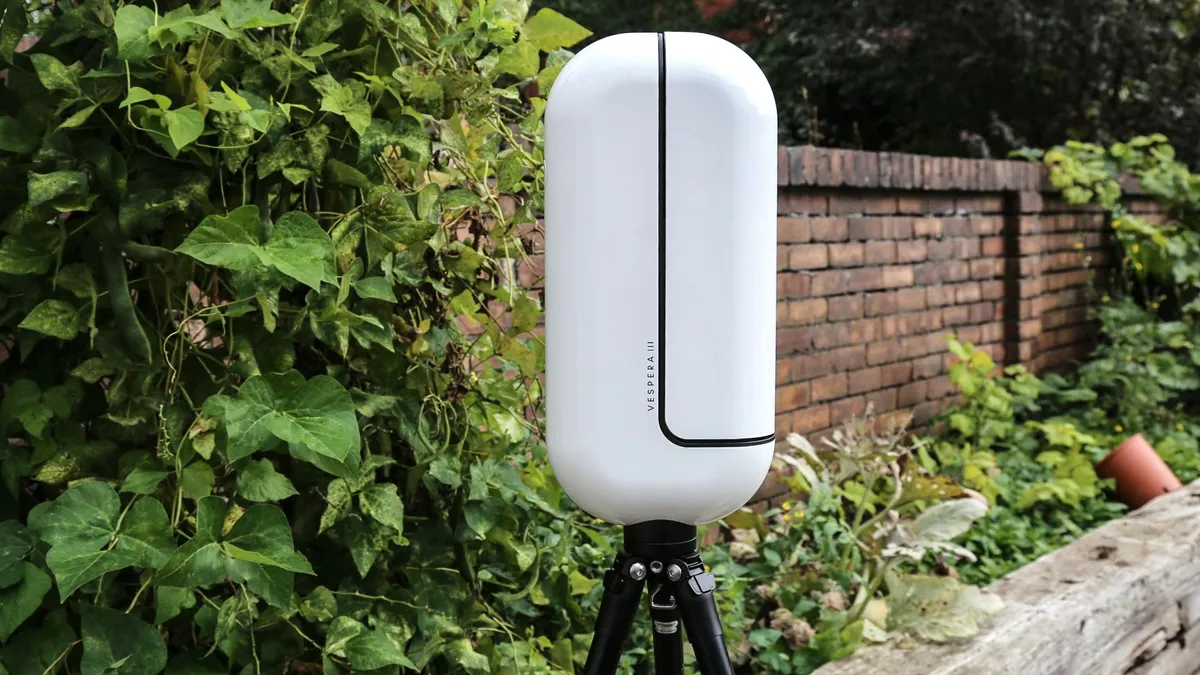
The Vespera 3 looks and feels like a luxury product. Its smooth, curved white body is beautifully finished, and when switched off, the optical arm folds neatly into the chassis. There’s very little to suggest that this sculptural object contains a motorized telescope and an astrophotography camera.
At 11 lb/5kg, it’s not something I’d casually throw into a camera bag. That’s part of the distinction between the Vespera and cheaper smart telescopes — it’s more substantial, but also feels considerably more sophisticated. But permanent.
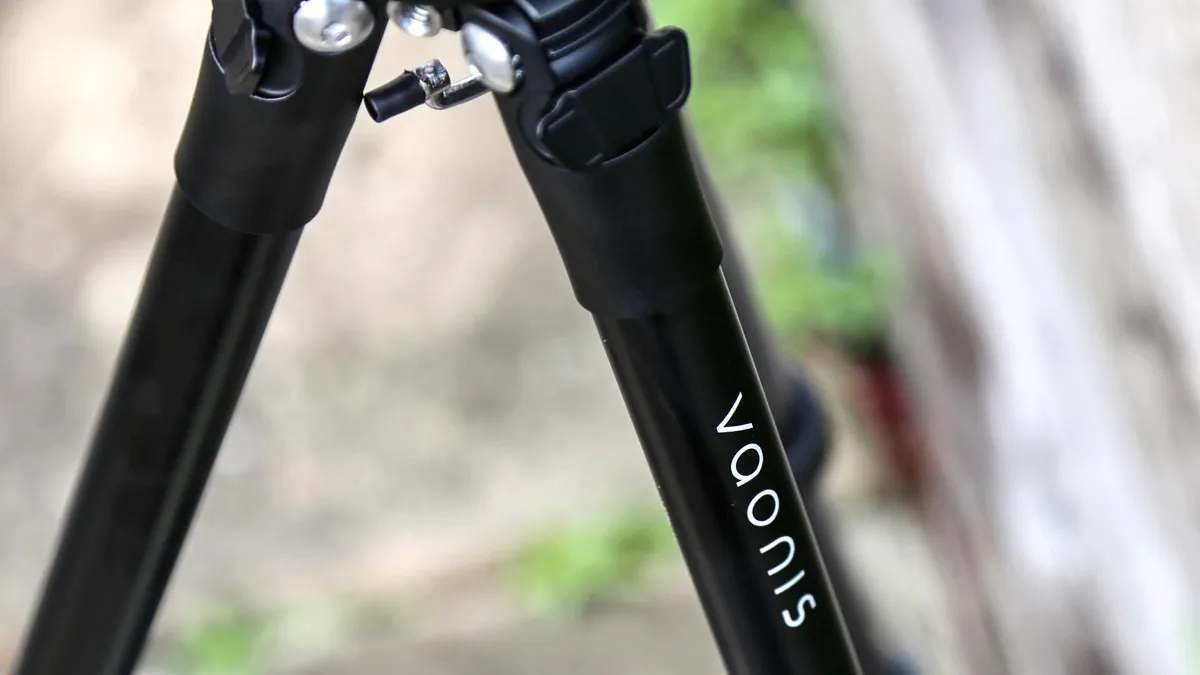
The biggest physical improvement over the Vespera 2 is the tripod. I found the previous model’s short tripod frustrating, so I was delighted to discover that the Vespera 3 comes with a much taller, adjustable aluminum model. It feels impressively stable and makes positioning the telescope far more practical.
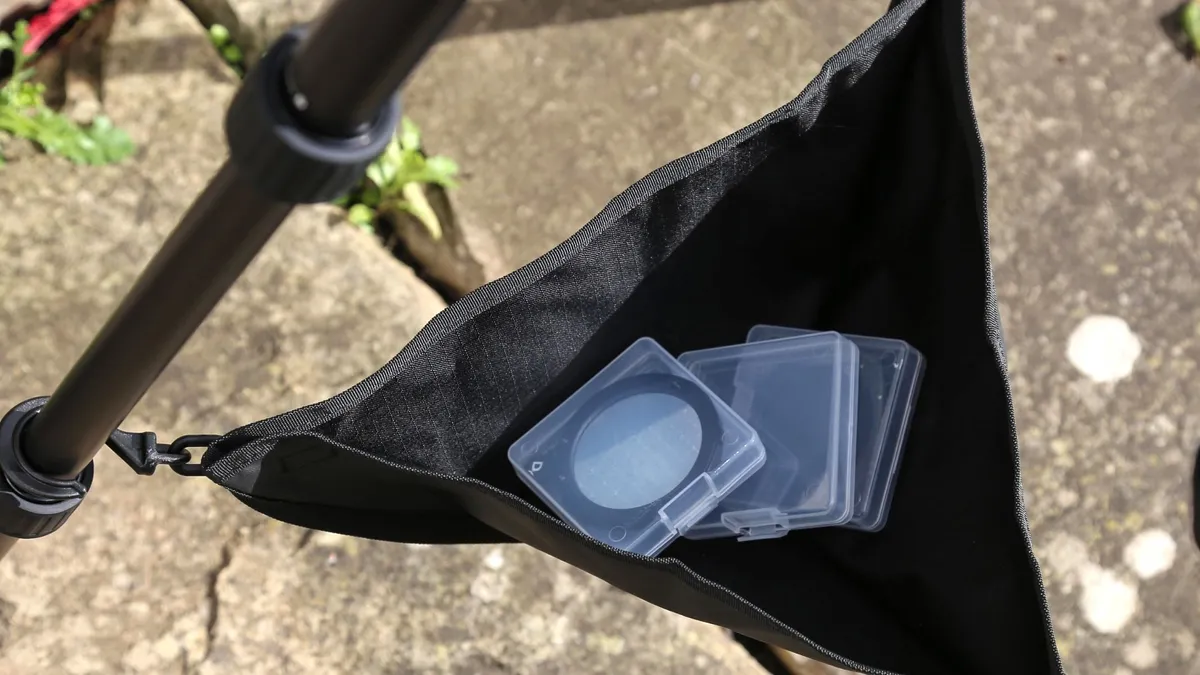
There’s also a clever little fabric canopy that hooks between the three tripod legs. It’s effectively an accessory shelf, providing somewhere to put filters or other small items while observing. You certainly won’t need it for a portable power bank because the built-in battery on the Vespera 3 is said to last 11 hours. It comfortably outlasted every observing session. It’s a dramatic improvement over the Vespera 2’s four-hour battery. This is exactly how I think a premium product should behave — battery life becomes irrelevant. Its generous 115GB of internal storage is another practical improvement over the Vespera 2’s 25GB, and it also includes an integrated anti-fog system and hygrometer.
Not everything about its physical design is as successful. I found the touch-sensitive power button strangely confusing. A soft blue or green light provides little reassurance about whether the telescope is actually on or off, and on several occasions the most reliable way to check was to look for its Wi-Fi network on my phone.
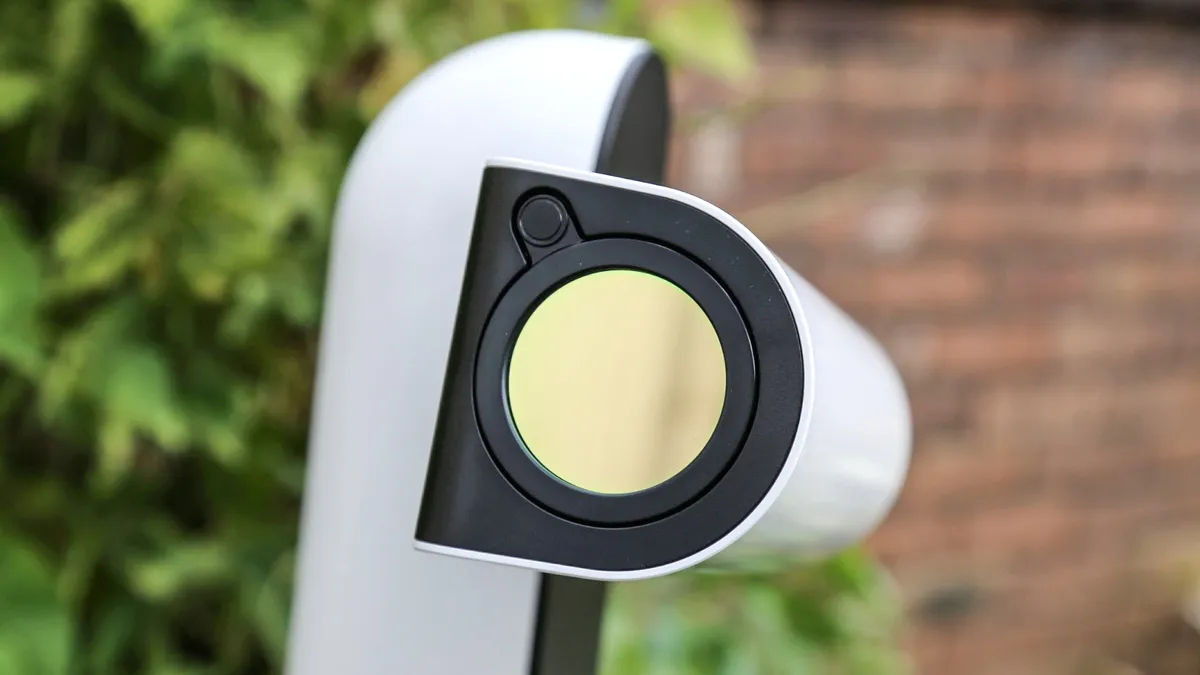
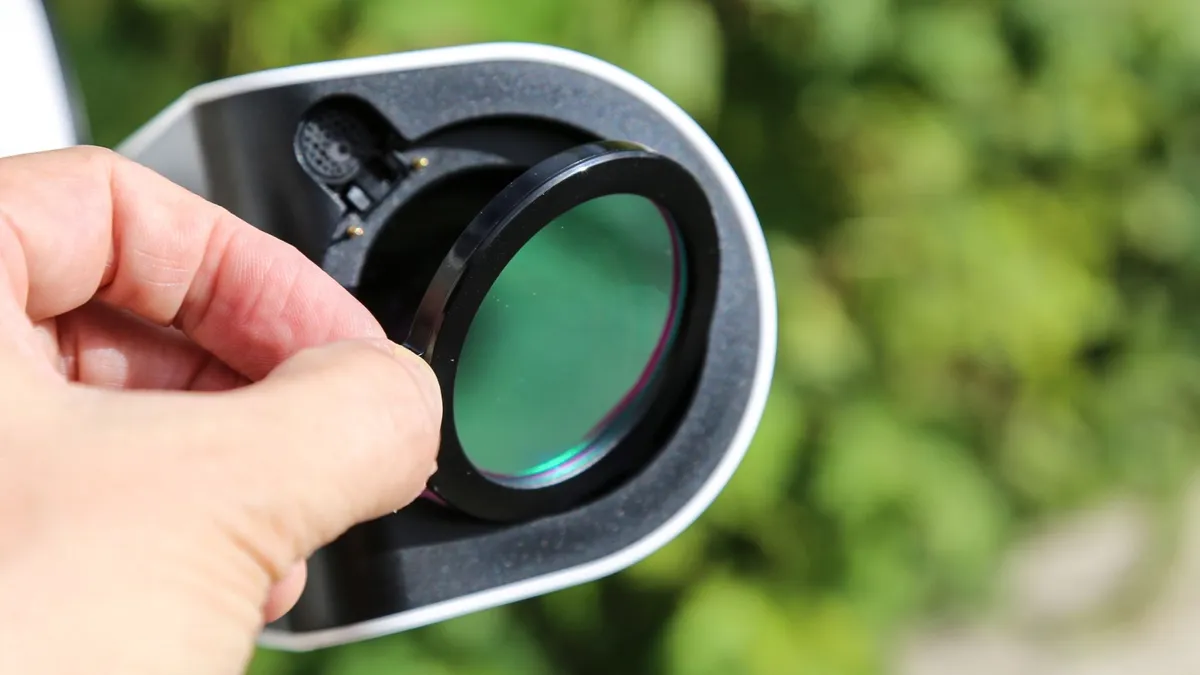
Changing filters is another compromise. Unlike the Seestar S50 Pro, which has built-in imaging filters, the Vespera 3 requires you to buy and fit its optional filters individually. That’s expensive and less convenient when switching between targets — and sometimes means you have to think about what you’re about to shoot before you open the app. There is one advantage, however. I could lift the Vespera’s optical arm while it was switched off to change a filter, whereas the Seestar’s arm locks into its parked position.

Vaonis Vespera 3: Performance
The Vespera 3’s most interesting specification is the one that hasn’t changed. Like the Vespera 2, it uses a Sony IMX585 CMOS sensor producing 3840x2160-pixel images. Its 50mm aperture is unchanged, too. Vaonis has instead concentrated on the optical system, introducing a flat-field apochromatic design with four lenses in three groups, including two extra-low-dispersion elements. The focal length has shortened slightly from 250mm to 245mm, giving it an f/4.9 focal ratio rather than f/5. There’s also improved internal baffling designed to reduce unwanted reflections from nearby light sources. For something that could well be used just outside the back door, or on a balcony, that’s a wise addition.

All of those changes sound modest, but the resulting images proved to be clean, sharper and colorful. The color palette was particularly pleasing, with a richness that made the images feel more polished without needing extensive work afterward.
The Andromeda Galaxy (M31) provided one of my most revealing tests. I could make out its characteristic dark dust lanes after approximately 10 minutes of imaging. In my experience with the Seestar S50 Pro, comparable detail took closer to an hour to become apparent.
That’s a striking difference, although it’s important not to treat it as a controlled comparison under identical conditions. Sky transparency, light pollution, processing, and other factors can all affect how quickly detail emerges. Nevertheless, the result immediately demonstrated what I liked about the Vespera 3. It produced an attractive, detailed photograph without requiring me to spend a long time adjusting settings or processing files.

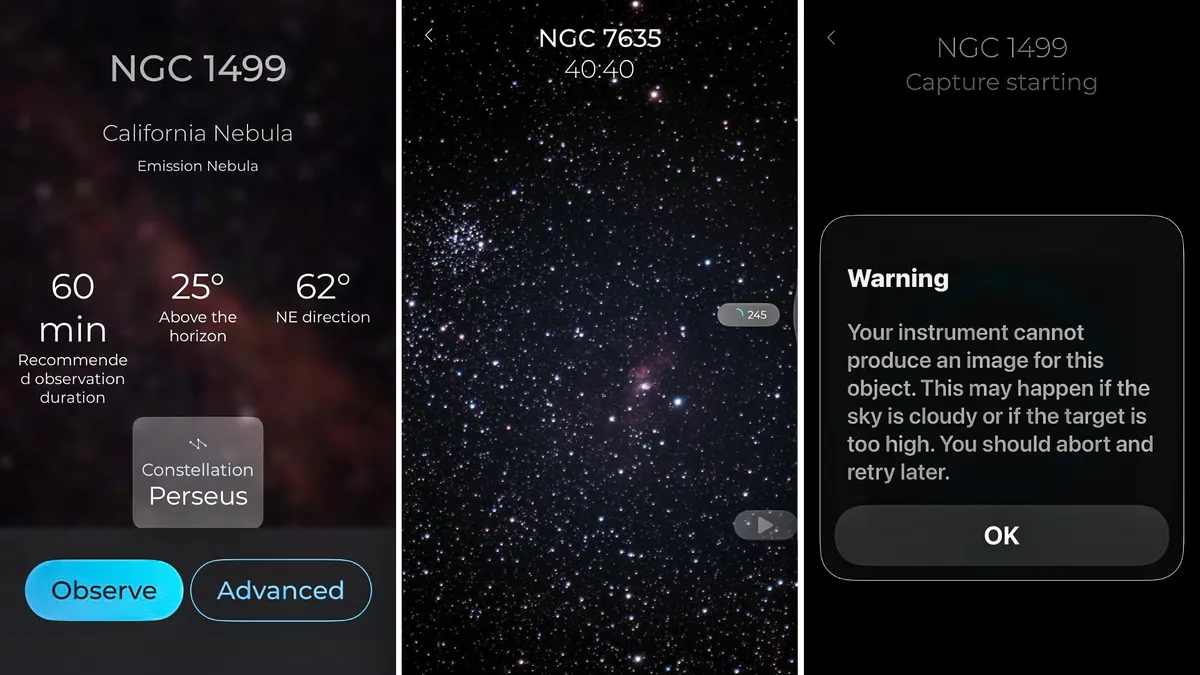
I also used the Vespera 3 to photograph the Bubble Nebula (NGC 7635) and California Nebula (NGC 1499), returning to both targets over multiple nights to add more data (Vaonis calls it PerseverENS). These are useful tests because they demand more patience than a bright star cluster. PerseverENS also suits the realities of astrophotography, especially when clouds or limited observing time make it difficult to spend several uninterrupted hours on one target.

Particularly useful for nebulae is the Vespera’s CovalENS mosaic feature, which is a long-winded, but effective, way of imaging objects larger than the camera’s native field of view. It can produce mosaics of up to 24MP.
The Vespera 3 handles star identification, alignment, focusing, tracking and image stacking automatically, though it could be faster. The Singularity app displays a percentage to indicate progress, but I still found the process rather long-winded — over five minutes.
The Vespera 3 also lacks an equatorial tracking mode, which some cheaper smart telescopes now offer. Its alt-azimuth mount is perfectly capable of producing impressive automated images, but photographers wanting greater flexibility for long-exposure imaging may well find that omission disappointing.

The sun is another worthwhile target, although the solar filter must always be properly fitted before pointing the telescope towards it. It isn’t included as standard. It does a good job with the moon, too, though since it needs to calibrate against the stars before each observing session, capturing the moon in a blue sky proved tricky.
Vaonis Vespera 3: Verdict

The Vespera 3 is a genuine improvement over the Vespera 2. Its images are sharp, colorful and impressively clean, while the upgraded tripod and long-lasting battery remove two of my biggest complaints about the previous model. I particularly enjoyed being able to return to challenging deep-sky objects over several nights without worrying about running out of power. It also feels expensive in the best possible way. The design, construction and overall presentation are a cut above most cheaper smart telescopes.
Unfortunately, it feels expensive in the other sense, too. The lack of built-in filters and EQ mode is disappointing at this price, while the slow startup procedure and confusing power button slightly take away from an otherwise polished experience.
For someone who wants the most affordable route into astrophotography, the Seestar range is where to look first. However, for photographers who value beautifully rendered images, excellent construction and a telescope that’s a pleasure to own, the Vespera 3 offers something distinctly more luxurious.
Features ★★★★☆ |
Excellent multi-night imaging, mosaic capture, generous storage and battery endurance, although built-in filters and EQ mode are missing. |
Design ★★★★½ |
Beautiful construction and an outstanding included tripod, slightly undermined by the confusing touch-sensitive power button. |
Performance ★★★★½ |
Sharp, colorful, low-noise deep-sky photographs make excellent use of the unchanged 8.3MP sensor. |
Value ★★★☆½ |
A genuinely premium instrument, but significantly more expensive than capable alternatives, particularly once optional filters are added. |
Check out our full guide to the best smart telescopes

