




Here at Digital Camera World we've lab tested almost every own-brand lens made in the last 20 years for consumer DSLR and mirrorless cameras. We’ve amassed a vast database of how they score in terms of sharpness, chromatic aberration, and distortion. This data is presented in every lens review we publish, but rarely do we compare lenses from different brands with each-other.
This is because if you've invested in the Nikon Z system, for instance, you're probably not going to care if a Canon 50mm lens is sharper than your Nikon 50mm - you're tied into Nikon, regardless. However, for the sole purpose of your (and my) intrigue, I've scoured our database to find the sharpest lens from every major own-brand lens manufacturer, with the aim of seeing which comes out on top.
These lenses have been selected solely on their outright highest sharpness score recorded in the center of frame, at whatever focal length / aperture setting the lens was set to. I'm only featuring medium format and full-frame lenses, as even the sharpest APS-C and Micro Four Thirds glass isn’t sharp enough to rival the six lenses here.
And if you're curious to know the sharpest Sigma or Tamron lens, don't worry: I'm already working on a 'part 2' follow-up, comparing six of the sharpest aftermarket lenses we've lab tested.
Center sharpness

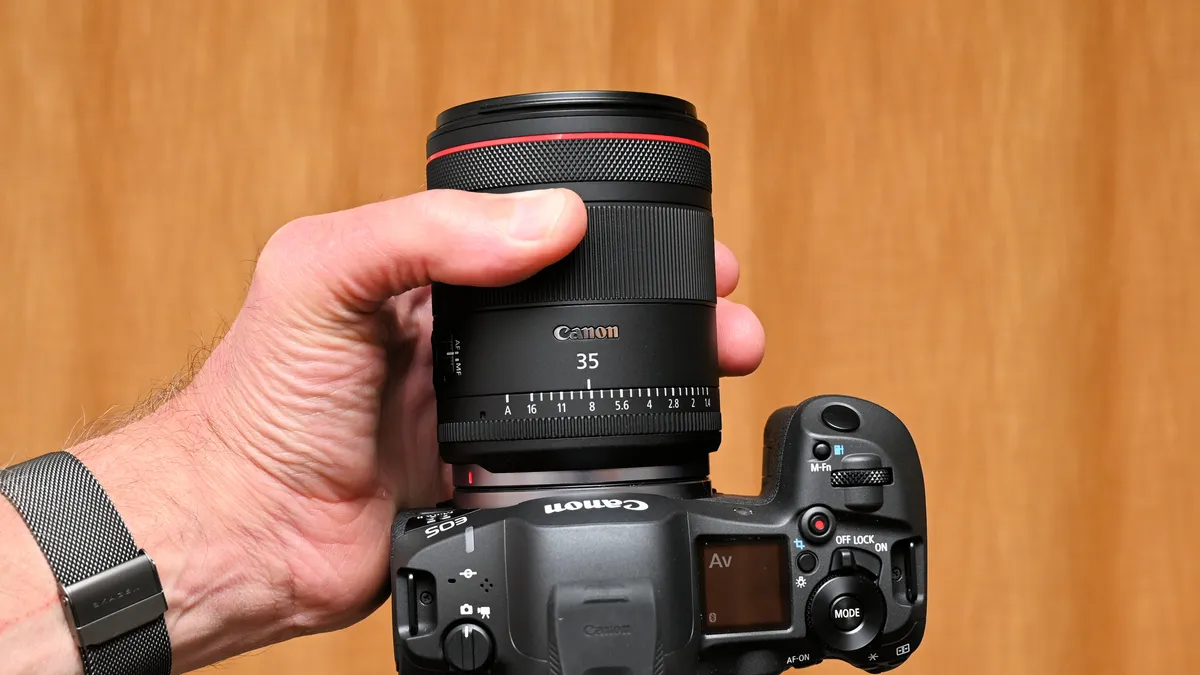
Representing Canon is the Canon RF 35mm F1.4L VCM. With a peak center-frame sharpness score of 2804 recorded at f/2, it's the sharpest Canon lens we've ever tested. Though it may not seem particularly impressive next to some of the other lenses here, it is consistently sharp through to f/8, and as we’ll see later, it’s also sharp right across the image frame.
Our sharpest L-mount lens is the Panasonic Lumix S PRO 50mm f/1.4. With a peak sharpness of 3077 at f/2, it beats the Canon RF 35mm F1.4L VCM, and it maintains noticeably superior sharpness through most of its aperture range.

Sony's G-Master lenses are legendary for their uncompromising optical quality. The FE 50mm f/1.4 GM is the sharpest G-Master prime we've tested, but it's narrowly beaten by the incredible Sony FE 50-150mm f/2.0 GM with a score of 3489 at 70mm, f/2.8. For a zoom lens to be even sharper than an already exceptional prime is both rare and an extraordinary engineering achievement. A prime lens can be optimized for the highest possible sharpness at a single focal length, whereas a zoom has to be sharp across an entire focal range; a much tougher challenge. While the FE 50-150mm f/2.0 is sharpest at 70mm, it also maintains excellent sharpness throughout its focal range. This is an awesome piece of optical design.

Nikon has produced many great S-line lenses for its Z-mount system, but the sharpest by a whisker is the Nikon Z 85mm 1.2 S: it's exceptionally sharp between f/1.2 and f/5.6, but peaks at f/2.8 with a score of 3569.

Full-frame mirrorless cameras have brought with them a wide range of new, super-sharp lenses, but for the absolute sharpest lenses available today, you need to step up to medium format. We've tested several Hasselblad XCD lenses that outperform all the full-frame optics in this comparison, but it’s the Hasselblad XCD 90V that's the sharpest of all, and the second sharpest lens we've ever tested, from any brand. Its score of 4148 at f/4 is simply awesome.

And our winner... the sharpest lens we've ever tested is… drumroll... the Fujifilm GF 110mm F2 WR LM! As you can see though, this and the Hasselblad XCD 90V are very closely matched, with the GFX lens only winning on account of its marginally higher sharpness score at f/4 - 4215, to be precise. At f/5.6 and beyond, you won't see any difference in sharpness between the two lenses in real-world shooting.

Corner sharpness

The corner sharpness results largely follow a similar order to the center sharpness ranking, with the two medium format lenses out in front, being pretty much tied at all apertures. There are some differences with the full-frame lenses though. The most significant is how the Nikon Z 85mm f/1.2 goes from being top dog for center sharpness to bottom of the pack for corner sharpness. That's not to say it’s soft, but remember this is a lens designed for portraiture, where the priority is for your sitter to be in sharp focus, in front of a blurred background. Corner sharpness was, understandably, not a priority for Nikon's engineers. Conversely, where Canon hasn't gone all-out for peak center sharpness with the RF 35mm F1.4L, it comes good with consistently high sharpness across the whole image frame. But the biggest surprise here is how well the Sony FE 50-150mm scores for corner sharpness. It comprehensively beats all the full-frame prime lenses: a staggering achievement, and proof that a well-sorted zoom lens needn't come with any sharpness compromises.
Testing methodology
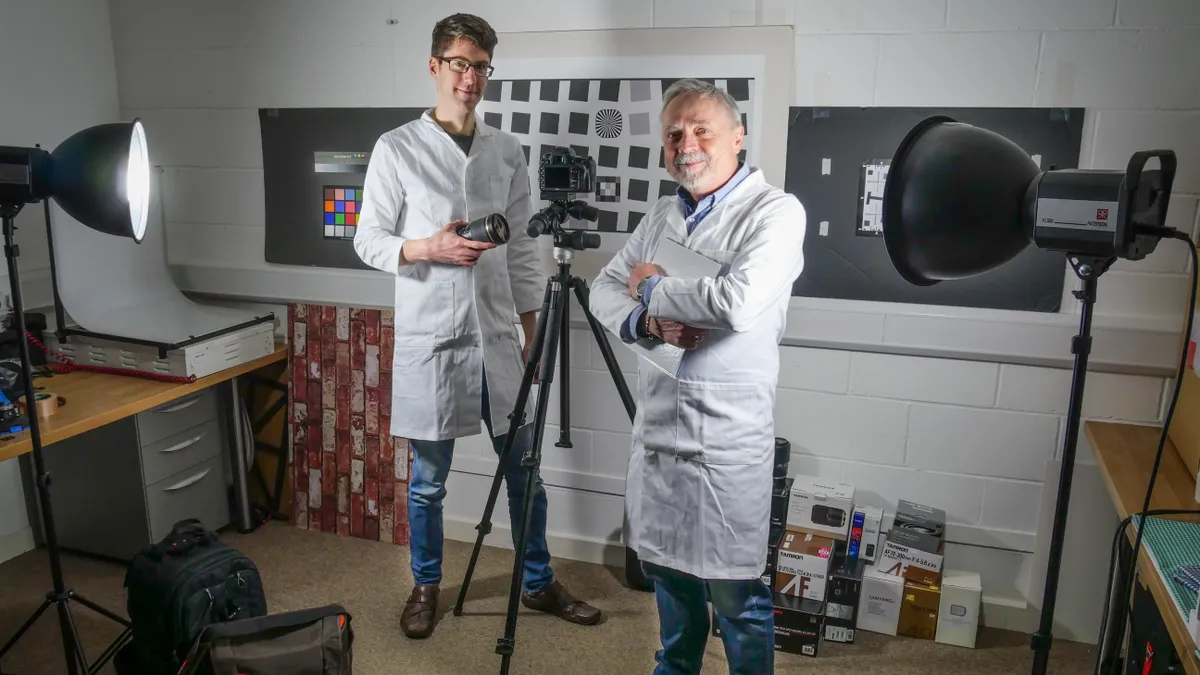
Under both graphs you'll see I've listed the camera body on which each lens was tested. Our image analysis software measures lens resolving power in terms of line widths / picture height – a measurement widely used in lens and camera resolution testing, and one which measures how finely a camera and lens combination can resolve detail relative to the vertical height of the image frame. This system helps us ensure that our lens sharpness scores are influenced as little as possible by the resolution of the camera body used for the lens testing. In other words, just because the medium format lenses have been tested on 100MP cameras, this shouldn't be the reason they score higher than the full-frame lenses - it's the glass itself that’s sharper.

Finally, are we claiming here that the sharpest lens is also the best lens? Certainly not. A great photo isn't defined by how sharp it is. The biggest variable in capturing a compelling image isn't the lens, or even the camera; it's you, your eye for composition, and your ability to choose the perfect moment to press the shutter release. What I'm presenting here is simply a technical comparison for your entertainment and curiosity.

