Digital Camera World Verdict
The VTech KidiZoom Duo FX is a confident evolution of a camera that already ranked highly in our guide to the best kids’ cameras. It delivers usable photos, robust build quality, and a huge range of playful features, but its toy-first DNA, particularly the inclusion of games and reliance on AA batteries, often works against its role as a camera.
Reasons to buy
- +
Ergonomics
- +
Image quality
- +
Lots of features
- +
Selfie camera
Reasons to avoid
- -
Unnecessary features
- -
No rechargeable battery
- -
Slow start-up
Why you can trust Digital Camera World Our expert reviewers spend hours testing and comparing products and services so you can choose the best for you. Find out how we test.
The VTech KidiZoom Duo FX is the latest iteration in VTech’s long-running KidiZoom camera line, and it is the direct successor to the KidiZoom Duo 5.0, a model that has previously ranked highly in our guide to the best kids’ cameras. This new FX version builds on that foundation by adding more features, updated games, expanded creative tools, and additional camera modes.
It’s important to establish context early. VTech is a toy manufacturer first, not a camera brand, and that is immediately apparent in both the design and feature set of the Duo FX. Rather than being a stripped-down camera for children, such as the Kidamento Model K, this is a hybrid device: part camera, part video recorder, part audio toy, and part games console. It’s aimed at children aged three and up, and the question it raises is whether all of those elements enhance the experience of photography or distract from it.
I took the KidiZoom Duo FX on a trip to Bath with my three-and-a-half-year-old daughter to see how it performed in real-world use.

VTech KidiZoom Duo FX: Specifications
Photo resolution |
8MP main camera, 2MP selfie camera |
Video |
Yes |
Lens |
Fixed (4x digital zoom) |
Selfie camera |
Yes |
Flash |
Yes |
Waterproof |
No |
Battery capacity |
4x AA batteries |
Storage |
Internal 150MB and optional Micro SD up to 32GB (not included) |
Dimensions |
6 x 16 x 11 cm |
Weight |
590g |
VTech KidiZoom Duo FX: Price and Availability
The VTech KidiZoom Duo FX is widely available in both the UK and the US from major retailers and online stores, including Amazon. Pricing typically sits around £59.99 / $49.99, placing it among other photo-first kids’ cameras on the market.
At this price point, you’re paying for breadth of features rather than photographic performance. It’s positioned as an all-in-one entertainment device that includes a camera, rather than a camera-first product with a few playful extras.
VTech KidiZoom Duo FX Design & Handling
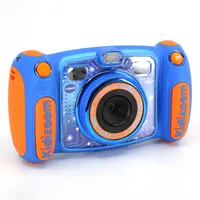
Physically, the KidiZoom Duo FX is exactly what you would expect from a camera designed by a toy manufacturer. It is chunky, brightly coloured (blue or pink), and clearly built to survive drops, knocks, small spills, and the general chaos of being handled by young children. The plastic construction feels thick and durable rather than flimsy, and the included wrist strap is a small but important addition for day trips and busy environments.
Around the camera body, you’ll find a headphone jack, a Micro USB port (used only for image transfer, not charging), and a microSD card slot on the base that enables storage expansion up to 32GB. The reliance on internal storage out of the box is fine, but it’s worth noting that the microSD card is not included.
One of the defining physical features is the dual viewfinder system. The camera has two optical viewfinders aligned for both eyes, which on paper sounds like a charming, child-friendly touch. In practice, however, these do not accurately reflect what the camera is capturing, and there are no framing guidelines. As a result, the rear screen becomes the primary method of composition, which somewhat undermines the usefulness of the viewfinders.
Button placement is generous; perhaps too generous. The rear of the camera is populated with numerous buttons controlling different modes and features. While this offers flexibility, it can also feel overwhelming, particularly for children at the younger end of the target age range.
The shutter button sits comfortably on top, alongside a dedicated button for the selfie camera, which is easy to reach and encourages switching perspectives without digging through menus.

The KidiZoom Duo FX features two fixed lenses: an 8MP main camera and a 2MP selfie camera. As expected, the main camera does the heavy lifting with a handy 4x digital zoom and a forward-facing flash.
The selfie camera is clearly lower in quality, but still perfectly serviceable for its intended purpose: playful self-portraits and video clips rather than detailed stills.
A particularly engaging physical feature is the lens ring surrounding the main camera. This allows the user to cycle through colour profiles and creative filters, including black and white, sepia, and various colour effects, directly on the lens itself. It’s a smart, tactile design choice that encourages experimentation and mirrors the physicality of “real” cameras in a way children can easily understand.


VTech KidiZoom Duo FX: Performance
For a children’s camera, the photographic performance is better than expected, particularly in good daylight. The 8MP sensor produces images that, while lacking sharpness and fine detail, are more than usable for viewing, sharing, and printing small keepsakes.
On our day trip to Bath, the camera handled bright outdoor scenes surprisingly well. Colors are bold, contrast is strong, and while highlights can blow out and shadows lose detail, the images successfully capture moments rather than technical perfection. That, ultimately, is the point.
Kids’ cameras are not about producing gallery-worthy photographs; they are about the process of seeing, framing, and pressing the shutter. In that sense, the KidiZoom Duo FX succeeds. There is something refreshing about watching photography stripped back to curiosity and play. It's a reminder that even seasoned photographers could benefit from letting go of technical obsession.
Startup time, however, is slow. Turning the camera on requires patience, which can interrupt spontaneous moments. This is particularly noticeable when compared to the instant readiness of smartphones.

On paper, the feature list is extensive; in practice, not all of it feels equally valuable.
Filters, frames, animated overlays, and AR effects are immediately engaging and encourage playful experimentation. Facial recognition and live effects work reliably, adding a sense of magic for younger users.
However, the sheer volume of modes, from panoramic photos to voice recording and music playback, means that many features feel like novelties rather than tools that will see sustained use. After the first few outings, it’s easy to imagine most children gravitating towards just two things: the main camera and the built-in games.
This leads to one of the camera’s biggest drawbacks. The inclusion of games is a double-edged sword. While they undeniably add value as a toy, they also compete directly with the act of taking photos. On a long car journey, the temptation to play games can easily drain the batteries before you even arrive at your destination.
The decision to power the KidiZoom Duo FX with four AA batteries is, frankly, frustrating. There is no internal rechargeable battery, and the USB-C port cannot be used for charging. This makes it difficult to ensure the camera is fully powered for a day out.
Adding to this is the lack of a clear battery indicator. It’s entirely possible to arrive at your destination only to find the camera has insufficient power after being used for games en route. For a device intended to document outings, this feels like a significant oversight.


VTech KidiZoom Duo FX Verdict
The VTech KidiZoom Duo FX is a thoughtfully designed, highly engaging kids’ camera that delivers on fun, durability, and accessibility. Its camera and video features are genuinely good for the price, and the physical design encourages hands-on experimentation.
That said, its toy-first approach, particularly the inclusion of games and the reliance on disposable batteries, sometimes undermines its role as a camera. For parents who want a device that prioritises photography above all else, this may feel like a compromise. But for children, it offers a playful, confidence-building introduction to image-making, and in many ways, that’s exactly what it’s meant to be.

You might also like...