
Fujifilm is without a doubt the hottest camera brand on social media right now, and with good reason. While Nikon, Canon and Sony have all been busy cramming the very latest specs into an array of boundary-busting modern marvels, Fujifilm has refused to compete. Instead, it’s doubled down on what it does best. Small, attractive retro-themed mirrorless and compact cameras.
No other camera has embodied the brand's cornering of the market quite like the Fujifilm X100VI. This little compact boasts oodles of character and a high-res 40.2-MP APS-C sensor. It’s a joy to use, small enough to carry around everywhere, and just about the most charming-looking device on the market. And it’s so popular that it’s famously difficult to get hold of even two years after its release.

Availability issues and a comparatively high RRP has meant that many photographers have turned to the back catalogue of Fujifilm X Series cameras available on the used market in order to experience that Fuji magic for themselves. Unsurprisingly, this has wildly inflated used prices; even Fujifilm cameras over a decade old have become sought after for their trendy aesthetic and ability to deliver the Fuji look.
What is the Fuji look?
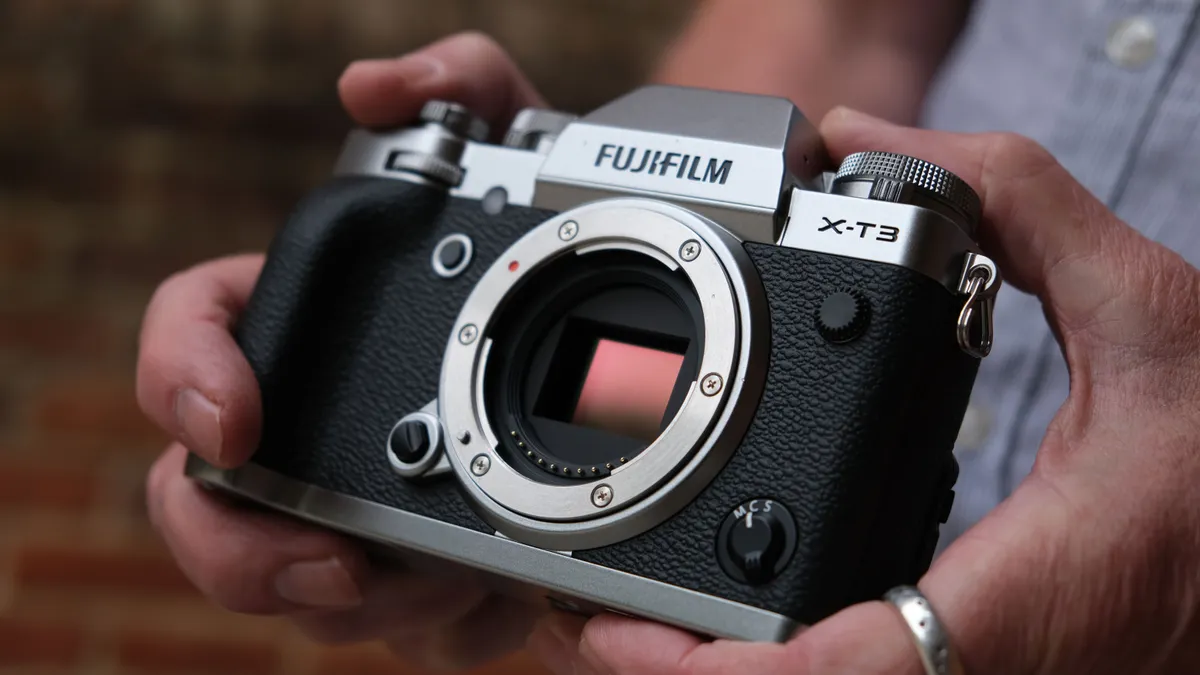
Fujifilm fans will wax lyrical about the brand’s color science. And while I’ll stop short of calling it the best in the business, it’s definitely gorgeous and definitely stands out in comparison to other camera manufacturers.
What makes Fujifilm’s color science so unique is its series of X-Trans sensors. Or more specifically, the proprietary X-Trans color filter array that it uses instead of the more common Bayer filter that’s present on most other cameras.

But here’s the catch: not all Fujifilm X Series cameras have an X-Trans sensor. A good example is the Fujifilm FinePix X100. The first camera in the brand’s hugely successful X100 series of compact cameras, culminating at the aforementioned Fujifilm X100VI, was launched in 2010 with a Bayer filter array. It wouldn’t be until its successor, 2013’s Fujifilm X100S, that the series would get its first X-Trans sensor.
The FinePix X100 isn’t the only Fujifilm X Series camera to feature a Bayer filter. You can also add the entire Fujifilm X-A series, Fujifilm’s short-lived entry-level mirrorless series – this consisted of the Fujifilm X-T100 and Fujifilm X-T200 – the Fujifilm XF10 compact camera, and the Fujifilm X Half.
To confuse matters further, some Fujifilm X Series cameras feature EXR sensors, which differ slightly from standard CMOS sensors with Bayer filters and Fujifilm’s X-Trans sensors. These are the Fujifilm X10, Fujifilm XF1 and Fujifilm X-S1. Some may tell you that the Fujifilm FinePix X100 has an EXR sensor, but this is a confusion due to it having an EXR image processor.

To be clear, I’m not saying you have to avoid Fujifilm X Series cameras without X-Trans sensors. I’m simply making you aware that if you’re besotted by the Fuji look that’s all over Instagram and you want a faithful alternative on a budget, consider the sensor before you buy a Fujifilm X Series camera.
You’ll even find variations within the X-Trans sensor. For example, the 16-MP X-Trans I was only ever present in the Fujifilm X-E1, Fujifilm X-M1 and Fujifilm X-Pro1, but is considered by some Fuji fans to possess the best color science of any X-Trans sensor and a decidedly filmic look.
A word on Film Simulations

Another key ingredient for the Fuji look is Fujifilm’s much-celebrated Film Simulations. While these have become a Fujifilm X Series staple, they actually predate the series, having been introduced in 2003 on the Fujifilm FinePix F700.
However, if you’re in the market for an older Fujifilm X Series camera, make sure you check what Film Simulations it features before you buy, just in case you have a favorite. I say this because the number of Film Simulations tends to grow with each new generation of X Series camera.
For example, the aforementioned Fujifilm X-Pro1 might be revered for having gorgeous color science, but it features comparatively few Film Simulations to the latest crop of Fujifilm X Series cameras. The most egregious omissions arguably being Classic Chrome and Classic Negative.
You might also like...
For the latest and greatest from the X Series and more, check out the best Fujifilm cameras. If you're sold on the aesthetic but want to know what else is about, here are the best retro cameras. And here's why the Fujifilm X-M5 finally delivers on the compact promise of the mirrorless camera.

