Digital Camera World Verdict
The Ray 120c aims high and hits its target. It showcases what Amaran is capable of in terms of power, colour accuracy and overall design. The kit includes everything you need to get shooting, including light modifiers and a natty case to store it all. The interface is nicely crafted too and using the Ray is a joy but it's the performance that really sells things. The Ray’s output far exceeds what you’d expect from a light of this size and it does so with a comprehensive variety of modes and effects.
Reasons to buy
- +
Excellent build quality
- +
Powerful output for size
- +
Accurate colour production
- +
Compact, all inclusive kit
Reasons to avoid
- -
Bowens mount gets hot
Why you can trust Digital Camera World Our expert reviewers spend hours testing and comparing products and services so you can choose the best for you. Find out how we test.
The market for lighting is pretty saturated, with options for all levels of budget and with an astounding variety of capabilities, so you’d think that advances in the tech might be done with. To an extent, there is some truth in that, with lights now mostly being all LEDs and with a fairly predictable range of intensities, but that’s only a part of the picture. Size, weight, and heat are large elements of lighting, as are other features like effects, the interface, and overall user experience, and it is here that companies seem to be putting their focus.
Amaran lights come in all shapes and sizes, with the 120-watt models being very popular, so what has Amaran done with this new model, or is it just a rehashing of previous offerings? Well, I have used and own many lights, from a range of developers, so I was keen to discover what, if anything, is better about the Ray 120C.
Amaran Ray 120c: Specifications
Power |
120 watts |
Power input |
Mains or USB-C |
Modifier mount |
Bowens |
Output |
6850lux at 1m |
Colour accuracy |
CRI 95+ |
Amaran Ray 120c: Price
At around $255 / £255 at the time of writing, the Ray 120 falls into the more affordable range of lights, making it perfect for small studios, indie filmmakers, and creators, but it’s even more of a good deal when you consider it ships with a case, a softbox with diffusion and grid, as well as a handgrip. It’s available now from most common video and photography resellers.
Amaran Ray 120c: Design & Handling
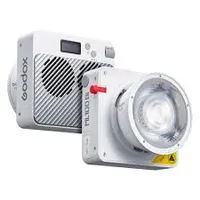
You’d be forgiven for thinking this might be a rehoused, slightly updated version of older lights, but the Ray is actually a completely new device, and it feels it in every way. The casing itself is a very high-quality plastic that looks and feels great. The body is very slim too, at around an inch thick, plus the bowens mount, it can easily fit into spaces other lights can’t. It’s also IP56 rated, meaning you don’t need to fret if the weather changes on a shoot. Oh, and if you are shooting away from mains power, you can keep the Ray alight with a USB-C cable, either from Amaran’s own battery grip or using the supplied handle, which has space for the power brick or a battery bank, held in place by a hefty rubber strap. I’ve been using this on a light stand indoors too, with the power brick held in place there. The AC in is threaded too, so no anxiety about pulling on the cord for accidental cutoffs.
Mounting the light is well catered to, with both a 3/8th and 1/4 20 combo with Arri locating pin holes and Amaran’s Ace E lock, which the supplied handle uses.
To get set up, you can either dive straight in using the onboard controls or you can pair it with the Amaran app, which is done automatically if your phone has NFC, via a single tap, which works flawlessly, and I hope more devices start doing this.

There are a few controls on board, but the interface is very well designed. A power, back, and confirm button are all that’s needed, paired with the scroll wheel, which sits on the corner for easy access from different angles. This wheel sounds like a gimmick, but in real-world use is one of the nicest I’ve used. It has haptics built in, and when making small adjustments, it feels like a regular clicking control knob, but when you want to make larger adjustments, or scroll to the start or end of a range, give it a firmer spin, and it acts like a motorised pot, spinning freely. You can either let it run its course or touch it at any point to stop it. It’s very intuitive and is one of those quality of life details that makes more difference than you might imagine.
The Ray has a small colour screen for navigating menus and changing settings. It’s bright and clear and easy to read in all conditions.
The front face has the large COB, which has Amaran’s new light engine (more on that later) surrounded by a standard Bowens mount for your modifiers. This does get pretty hot when the light is on, and there’s a warning suggesting the use of gloves.
Lastly, the rear face has the vents for the fan, which is nearly silent. Even in smart mode.
The Ray 120c is well built, with excellent handling and some really nice touches that do make a real difference. I’ve been using an older Amaran 120 light for interiors, which I’ve been very happy with, but the new Ray 120c is a huge upgrade in terms of handling and, as you’ll see, performance.
Amaran Ray 120c: Performance
Let’s start with the menus. A double click of the power button turns the light on, and within a second, the menu appears. You get both icons and text on a horizontally scrolling menu, a press of the confirm button opens up the sub menu, and the back button takes you up a level. The haptic scroll wheel changes settings and highlights menu options. All very quick and easy.
Of course, you can also use Amaran’s app to control the light, as well as set up groups and scenes, etc. The app is very stable and logically laid out, and it’s great to have options for various setups.
The actual COB and its output are all new here, too, not a repackaged legacy light, and it makes some significant improvements upon previous generations. The new OmniColor light engine has more individual colours to start with, making it far more accurate in terms of colour reproduction, so matching lights or daylight is much better. With an SSi in the upper 80s, it’s a good deal more accurate than the low 70s I get from the last generation. This may not seem massive, but in use, it makes a big difference, outputting far more natural colours, and if that’s not enough, say you're using modifiers that skew the hue a little, there is an option for green/magenta tint too.
Then there’s the power. The Ray 120c may be rated at the same wattage as previous 120 lights, but the output in lux is almost double, at 6,850 lux at one meter. That’s an impressive number and enables the Ray to take on jobs that would have previously meant much more powerful lights, plus the weight, size, heat, and power consumption they bring with them.

The Ray has a number of operational modes from CCT to CCT+, which widens the range to 1,800k to 20,000k, to RBG and HSI.
Noise can often be a problem with lights on set, as fans come on as the lights warm up. The Ray has a silent mode, which throttles the output to 20%. That might sound too limiting, but when you consider the output it’s capable of, that isn’t too bad. That said, when set to smart mode and the fan does come on, it is almost imperceptible even a couple of feet away, so unless you mount it right next to your microphone, you should be fine.
For studio shooters who prefer to have lights set up for regular use, there is a mode on a single switch to do this, which is handy to have. I also noticed that the wireless range is really impressive and very stable, even at a maximum of 80 meters
The size of the Ray 120c, even with the included 30cm softbox attached, makes it ideal for smaller spaces, or for traveling with, and considering what it offers, I’d suggest this over pretty much any other light.

Amaran Ray 120c: Verdict
There's really not much to complain about here. The modifier mount gets a bit hot, which is the only sticking point, and that's not even close to a deal breaker. The Ray 120c does exactly what you want of it, plus more, all with ease of control, plenty of modes, and extra tools to help it sit in any workflow. The build is great, the interface intuitive, and the output is better than the price would suggest. Highly recommended.
Features ★★★★★ |
Comprehensive set of features, even including NFC for pairing |
Design ★★★★☆ |
Other than a very hot Bowens mount the design is great. Clear, simple and accessible |
Performance ★★★★★ |
Output is both accurate and more than you’d expect from such a portable source. |
Value ★★★★★ |
Excellent value for money, with everything you need included |
Alternatives