Digital Camera World Verdict
The Meike 85mm f/1.4 Mix II is even better than its sibling AF 85mm f/1.8 SE II that I reviewed a couple of months previously. And so it should be, it costs more than twice the price. Even so, both Mark II lenses are standout value for money and I love the excellent image quality and all-round performance of the ‘Mix’ f/1.4 lens, as well as its exotic handling characteristics and solid build quality. It’s a properly good portrait prime for Nikon Z, Sony E and L-mount cameras.
Reasons to buy
- +
Excellent sharpness
- +
Beautiful bokeh
- +
High-end handling
- +
Bargain price tag
Reasons to avoid
- -
Only one function button
- -
Not fully weather-sealed
- -
Necessarily chunky
- -
Naturally pricier than f/1.8
Why you can trust Digital Camera World Our expert reviewers spend hours testing and comparing products and services so you can choose the best for you. Find out how we test.
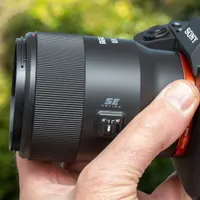
Meike operates out of Hong Kong, manufacturing budget-friendly photo and cine lenses, plus a variety of accessories. A low-budget case in point that I reviewed a couple of months ago is the Meike AF 85mm f/1.8 SE II, which is a basic yet capable portrait prime for Nikon Z, Sony E and L-mount mirrorless cameras. A few months before that, I reviewed the Meike 35mm f/1.8 Pro AF, which has more exotic handling, akin to the ‘Mix’ lens that I’m covering here.
As expected, the Meike 85mm f/1.4 Mix II is bigger, heavier and more expensive than its 85mm f/1.8 partner, being nearly twice the weight and more than twice the price. Even so, it’s more compact and lightweight than the original f/1.4 lens, boasts smoother and quieter ‘Hyper STM’ autofocus, and claims better sharpness that can do justice to the ultra-high-resolution Sony A7R VI with 67MP under the hood. The same applies to the highest-resolution Nikon Z and L-mount cameras.
The Mark II also has a shorter minimum focus distance of 0.81m compared with 0.98m, and is billed as having better resistance to flare. All in all, there’s a string of upgrades that aim to make the Mark II one of the best the best portrait lenses for mirrorless cameras. And if you happen to think that lenses are a black and white issue, the Meike is actually available in a variety of black and white colorways.

Meike 85mm f/1.4 Mix II: Specifications
Mount options |
Nikon Z (FX), Sony E (FE), L-mount |
Full frame |
Yes |
Autofocus |
Yes |
Image stabilization |
No |
Lens construction |
15 elements in 11 groups |
Angle of view |
28.3 degrees |
Diaphragm blades |
11 |
Minimum aperture |
f/16 |
Minimum focus distance |
0.81m |
Maximum magnification |
Unspecified |
Filter size |
77mm |
Dimensions |
85x110mm / 3.3x4.3in |
Weight |
650g / 23oz |
Meike 85mm f/1.4 Mix II: Price
The Meike 85mm f/1.4 Mix II launched in mid 2026 with a price tag of $569 / £429 / AU$826. Not only faster than the Meike AF 85mm f/1.8 SE II ($229 / £190 / AU$410), it’s also much more exotic in terms of handling characteristics, with the look and feel of a properly pro-grade lens. As such, it seems standout value in the exalted company of portrait primes like the Sony FE 85mm f/1.4 G Master II at $1,948 / £1,799 / AU$2,999 and the Sigma 85mm f/1.4 DG DN Art at $1,290 / £979 / AU$1,500. However, high-end Chinese takeaways include the superb Viltrox AF 85mm f/1.4 Pro for Nikon and Sony cameras, at a more budget-friendly $598 / £569 / AU$919.
Meike 85mm f/1.4 Mix II: Design & Handling
There’s nothing wrong with the cost-cutting Meike AF 85mm f/1.8 SE II but advanced handling exotica only extends to an AF/MF focus mode switch. As I’ll come to shortly, the ‘Mix’ lens that I’m reviewing here has all sorts of handling finery, but let’s start with the glass. Compared with the original f/1.4 lens, the Mark II has two fewer elements but they’re arranged in three extra groups, comprising 15 elements in 11 groups in total. Those include three ED (Extra-low Dispersion) elements, three HR (High Refractive index) elements and one aspherical element, along with multilayer coatings.
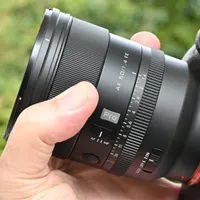
The Mark II is marginally smaller and noticeably lighter than the original lens but has the same 77mm filter thread. The front takes up almost all of the available space and looks of an imposing size, typical of a pro-grade 85mm f/1.4 lens.

85mm prime lenses are often considered to be ‘portrait primes’, as the focal length enables a natural working distance for portraiture, and the slight telephoto compression of perspective can be flattering. With so many of the latest cameras featuring highly advanced face/eye-detection autofocus with continuous tracking facilities, autofocus is generally the order of the day. The Mark II features a new quieter and smoother ‘Hyper STM’ autofocus system, but the electronically coupled manual focus ring works with smooth precision, and it’s comfortably large and grippy.

Switching between autofocus and manual focus modes is courtesy of a switch on the side of the lens barrel, which I much prefer to delving into camera menus to make the change. There’s also a customizable function button, which I tend to use for AF-hold. I often think that twice as much is twice as good, enjoying dual function buttons on the side and top of a lens, so they fall naturally under the thumb in both landscape and portrait orientation shooting. The Meike only has a single function button, but it’s positioned on the diagonal and remains within easy reach in both shooting orientations.

Next up on the pro-grade handling wish list is a physical aperture control ring. This is very much present and correct, with one-third f/stop click steps available for stills, plus a click/de-click switch that enables smooth and silent aperture transitions when shooting video. The aperture ring itself is positioned in time-honored fashion towards the rear of the lens, and has a grippy textured surface. The iris that it operates is very well-rounded, based on 11 diaphragm blades, enhancing the quality of bokeh when stopping down from the widest aperture of f/1.4.

You might think it’s just a little thing but I’m absolutely delighted that the lens features a locking button for the A (Auto) position of the aperture ring. Maybe I’m just clumsy but I get frustrated with the vast majority of modern lenses that have an aperture control ring but no locking switch or button. I find it all too easy to nudge the ring from its Auto position to the narrowest end of the aperture range, at which point I’ll suddenly be shooting at an aperture that I really didn’t want. The Meike’s Lock button effectively puts a stop to this.

The supplied hood has a circular rather than petal-shaped profile and feels of good quality, complete with a ridged inner surface. It fits to the lens with the traditional bayonet-style attachment, and can be reversed for compact stowage. As I’d expect with a short telephoto lens, fitting the hood in business orientation adds noticeable length but also gives physical protection the front glass element against bumps and scrapes.

Going from front to back, the mounting plate of the lens is made from sturdy metal rather than plastic. It features a rubber weather-seal gasket to reduce the risk of moisture and dust entering through the joint between camera body and lens. However, Meike doesn’t claim comprehensive weather-sealing for the lens. The mounting plate also hosts a USB-C socket for applying firmware updates, if and when required.

Meike 85mm f/1.4 Mix II: Performance
It’s a tall order but I like my portrait primes to be sharp and blurry in equal measure. I’m after crystal clear detail in the eyes, along with soft and dreamy bokeh for defocused areas. The Meike delivers on both counts, with impressive sharpness and resolving power for fine detail and texture, even when shooting wide-open at f/1.4, along with smooth and buttery bokeh. The f/1.4 aperture enables a really tight depth of field, which effectively isolates the subject by blurring the background, as well as helping to create the visual effect of ‘3D pop’.

One of the tests that I often run for portrait lenses is to shoot a phrenology head in my back garden. The results give good indications of sharpness and the quality of bokeh for defocused areas. Moreover, ‘fast’ lenses often suffer from axial/longitudinal chromatic aberration at the widest apertures, also known as bokeh fringing. This displays as color fringing around high-contrast transitions, just in front of and behind the plane of focus. The black lines and writing on the white porcelain of the phrenology head are a good test for this as well.
As you’ll see in the following gallery of shots, taken at aperture steps from f/1.4 down to f/8, the Meike performs very well in all these respects, and the 11-blade aperture diaphragm also helps to maintain a circular appearance for bokeh disks caused by bright spots when stopping down.


Although often labelled as a ‘portrait prime’, an 85mm lens certainly isn’t a one-trick pony. It can be equally useful for still life and product photography, and for any time you simply need a short telephoto focal length to cover a bit of distance. The Meike works well for long shots, with excellent sharpness and clarity, along with minimal distortion and color fringing.

Getting back to portraiture, although it can be beneficial for creative effect when shooting other subjects as well, the 85mm focal length gives a slight compression in perspective. It’s demonstrated in the shot below.

Naturally, with a tight depth of field on offer, the accuracy and consistency of autofocus becomes hugely important. I’m happy to report that the lens performed very well in these respects, throughout my testing.
Meike 85mm f/1.4 Mix II: Sample Images
The following gallery of example shots was taken at the Floating Harbour in the English city of Bristol. I used varying subject matter with a mix of wide and medium aperture settings, to demonstrate the qualities of the lens in differing shooting scenarios.


Meike 85mm f/1.4 Mix II: Lab Results
We run a range of lab tests under controlled conditions, using the Imatest Master testing suite. Photos of test charts are taken across the range of apertures and zooms (where available), then analyzed for sharpness, distortion and chromatic aberrations.
We use Imatest SFR (spatial frequency response) charts and analysis software to plot lens resolution at the center of the image frame, corners and mid-point distances, across the range of aperture settings and, with zoom lenses, at four different focal lengths. The tests also measure distortion and color fringing (chromatic aberration).
Sharpness:

Sharpness is excellent in the center of frame, even wide open, and stays so as you move towards the corners. Only in the corners themselves does sharpness start to drop off, but it's only noticeable at larger apertures, and not distractingly so.
Fringing:

Lateral chromatic aberration is negligible, even out at the extreme edges and corners of the image frame, and will generally go unnoticed with automatic in-camera correction disabled. Axial/longitudinal chromatic aberration is also minimal, even wide-open at f/1.4.
Distortion: 0.9
There's a hint of pincushion distortion, but it should only be apparent when shooting geometric subjects, and even then it won't be distracting.
Meike 85mm f/1.4 Mix II: Verdict
Features ★★★★★ |
Smart features include a dedicated aperture control ring, click/de-click switch, aperture lock button, customizable function button and an AF/MF focus mode switch. |
Design ★★★★½ |
The design is very ergonomic and build quality feels pretty solid but full weather-sealing isn’t claimed, just a weather-sealed mounting plate. |
Performance ★★★★½ |
Autofocus is fast and consistently accurate, while image quality combines excellent sharpness with beautiful bokeh and minimal unwanted aberrations. |
Value ★★★★★ |
For a fast 85mm f/1.4 lens with such a rich feature set, sophisticated design and good build quality, it’s great value for money. |

Alternatives