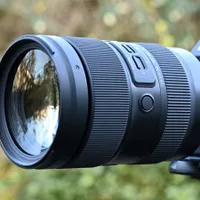





Digital Camera World Verdict
I wish the Tamron 35-100mm f/2.8 Di III VXD had been around a couple of decades ago. I used to do a fair bit of wedding and event photography, and it would have come in enormously useful. I say ‘enormously’ but the biggest attraction of the lens for this type of scenario is that it’s amazingly compact and lightweight, while offering a really useful zoom range with a relatively fast and constant f/2.8 aperture. Size and weight are important factors if you’re shooting all day long and into the night. Image quality and all-round performance are highly impressive and the Tamron is great value at the price. It’s a keeper!
Reasons to buy
- +
Versatile zoom range
- +
Constant f/2.8 aperture
- +
Relatively compact and lightweight
- +
Robust, weather-sealed build
Reasons to avoid
- -
-No aperture control ring
- -
Physical extension with zoom
- -
No optical stabilization
- -
Some reliance on auto corrections
Why you can trust Digital Camera World Our expert reviewers spend hours testing and comparing products and services so you can choose the best for you. Find out how we test.
Often referred to as ‘trinity’ lenses, wide-angle, standard and telephoto zooms with a constant f/2.8 aperture throughout the range typically include 14-24mm, 24-70mm and 70-200mm focal lengths respectively. They’re relatively ‘fast’ in terms of aperture rating, compared with f/4 zooms and those with a narrower and variable aperture rating that shrinks as you extend through the zoom range.
There’s a catch, however, in that trinity zooms tend to be big, heavy and expensive to buy. But that’s no longer the whole story. So-called ‘alternative trinity’ lenses have become popular, which generally have a slightly different zoom range but retain an f/2.8 constant aperture. Tamron was an earlier pioneer of these trend-setting lenses, including the Tamron 17-28mm f/2.8 Di III RXD wide-angle zoom, Tamron 28-75mm f/2.8 Di III RXD G2 standard zoom and Tamron 70-180mm f/2.8 Di III VC VXD G2 telephoto zoom, the last couple now being in their G2 (Generation 2) editions.
And there’s more! Although they don’t have a constant f/2.8 aperture, Tamron set about creating lenses with a more generous 35-150mm zoom range. These are ideal for wedding and event photography, as well as for general shooting. First up was the Tamron 35-150mm f/2.8-4 Di VC OSD for Canon and Nikon DSLRs, followed by the properly fast but still variable-aperture Tamron 35-150mm f/2-2.8 Di III VXD, available for Nikon and Sony mirrorless cameras.
The newer Tamron 35-100mm f/2.8 Di III VXD that I’m reviewing here comes in the same Nikon Z and Sony E mount options as the 35-150mm f/2-2.8 lens. It doesn’t stretch so far into telephoto territory, but builds a constant-aperture design into a much more compact, lightweight and affordable package, aiming to be one of the best wedding and event photography lenses. It’s potentially also one of the best alternative trinity zooms for people who prefer extra telephoto reach to greater wide-angle coverage.

Tamron 35-100mm f/2.8 Di III VXD: Specifications
Mount options |
Nikon Z (FX) Sony E (FE) |
Full frame |
Yes |
Autofocus |
Yes |
Image stabilization |
No |
Lens construction |
15 elements in 13 groups |
Angle of view |
63.4-24.4 degrees |
Diaphragm blades |
9 |
Minimum aperture |
f/22 |
Minimum focus distance |
0.22m (W) 0.65m (T) |
Maximum magnification |
0.3x (W) 0.17x (T) |
Filter size |
67mm |
Dimensions |
81x122mm / 3.2x4.8in |
Weight |
570g / 20oz (approx) |
Tamron 35-100mm f/2.8 Di III VXD: Price
What price a trinity standard zoom lens? The latest own-brand examples from the likes of Canon, Nikon and Sony cost around $2,500, so they certainly don’t come cheap. Now in its second generation, the Tamron 28-75mm f/2.8 Di III RXD G2 was something of a game-changer for Sony mirrorless cameras, the G2 also being available in Nikon Z mount. It has a slightly different zoom range but is much more lightweight and affordable, at around $849 / £649 / AU$1,599. Indeed, Nikon liked the original version of the lens so much that it remade it and badged it as its own, the Nikon Z 28-75mm f/2.8 costing around $1,049 / £889 / AU$1,599. By the way, I prefer the Tamon G2 lens out of the two.
Naturally, the Tamron 35-100mm shifts the zoom range compared with all of the above, but retains a similar pricing to its sibling 28-75mm lens, at $899 / £799 / AU$1,499. That’s not much more than half the price of the bigger and heavier Tamron 35-150mm f/2-2.8 Di III VXD, which sells for around $1,699 / £1,499 / AU$2,799 (look out for generous discounts in Australia). Whichever way you look at it, the new 35-100mm looks like it could be a proper bargain, if its performance is up to scratch.
Tamron 35-100mm f/2.8 Di III VXD: Design & Handling
I’ve done a fair bit of wedding photography and covered events from corporate gatherings to equestrian shows and competitions. One thing they all bring to the party, so to speak, is the risk of missing important, unrepeatable shots because you happen to be swapping between different lenses on your camera when a crucial moment pops up. The more I think about it, this is actually a potential problem that applies to many shooting scenarios and different types of photography. My usual solution is to use two camera bodies with a different type of lens on each, but that’s an expensive and cumbersome way of doing things.
The biggest attraction of this Tamron lens, as far as I’m concerned, is its combination of 35-100mm zoom range with a relatively fast and constant f/2.8 aperture rating. The zoom range works really well for weddings and events, from scene-setting and group shots to individual portraits. Some might feel that the wide-angle coverage at 35mm is a bit limiting for group shots but I wouldn’t go any wider, otherwise people towards the edges of the image frame are in danger of getting their heads stretched.

The Tamron has a fully internal focusing mechanism, but it does physical stretch in length as you sweep from the shortest to the longest focal length. Frankly, I’d expect nothing less in a lens with a 35-100mm zoom range. In fact, I’m surprised that the physical extension is as small as is it, equating to about three-quarters of an inch. You can see how that looks in practice by checking out the images above and below.

The advantage of shooting a lengthy wedding or other event with a single camera body and lens (for at least most of it) is somewhat negated if the lens in question is big and heavy. The Tamron 35-150mm f/2-2.8 Di III VXD that I mentioned earlier isn’t massive but it’s quite weighty at 1,165g or about 41oz, and can feel a bit of a lump after a couple of hours of shooting. The 35-100mm that I’m reviewing here is a relative lightweight, at just under half the weight of its sibling, tipping the scales at 1,165g / 20oz.

Diving deeper into the autofocus system, it’s of Tamron’s VXD variety, powered by Voice-Coil Extreme-Torque Drive. As such, it’s very rapid yet virtually silent in operation. There’s a big range on offer as well, as the focusing distance comes down from infinity to just 0.22m (8.7 inches) at the wide-angle end of the zoom range, and 0.65m (25.6 inches) at the telephoto end. This gives you a maximum magnification ratio of 0.3x (wide) and 0.17x (tele), so the lens is capable of pretty extreme close-ups.

The lens is based on 15 optical elements arranged in 13 groups, including three glass molded aspherical elements, two LD (Low Dispersion) elements and one XLD (eXtreme LD) element, aiming for optimum resolution and clarity with minimal aberrations. Tamron’s proprietary BBAR G2 (Broad Band Anti-Reflection) and nano-structure eBAND (Extended Bandwidth and Angular Dependency) coatings are added to minimize ghosting and flare.

There’s no dedicated aperture control ring but the lens does feature a customizable function button and 3-way custom settings switch. I tend to use the function button for AF-hold but plenty of other options are generally available from the host camera’s menu system. Using the Tamron Lens Utility and optional Tamron-Link Bluetooth adapter (see below) you can assign aperture control to the lens’s focus ring, as well as setting up focus points for automatically transitioning between them.

Various custom settings are available thanks to compatibility with the Tamron Lens Utility, which you can download onto your computer and then connect the lens using a USB-C cable. Alternatively, you can buy the tiny Tamron-Link Bluetooth adapter for around $50 / £59 / AU$80, which plugs into the lens’s USB-C port and enables wireless connectivity with a smartphone app, giving the option of custom settings and remote control of the lens.

The lens comes complete with a petal-shaped, reversible hood that has the usual bayonet-fit arrangement. You also get front and rear lens caps, the front one having a pinch-style mechanism that can be operated even with the hood is attached in its forward-facing orientation.

There are multiple weather-seals incorporated in the design, including a rubber gasket on the metal mounting plate. Overall, build quality feels solid and robust, despite the lightweight construction of the lens.

Tamron 35-100mm f/2.8 Di III VXD: Performance
Performance of the autofocus system in the Tamron 35-100mm f/2.8 Di III VXD lives up to its billing, with very fast and virtually silent operation of the Voice-Coil Extreme-Torque Drive system. I also found that autofocus was consistently accurate during my tests, and well able to keep up with moving subjects in conjunction with face/eye-detection AF modes.


The 35-100mm zoom range is very useful in practice, and the lens maintains excellent sharpness and clarity throughout. There’s no optical image stabilization, or ‘Vibration Compensation’ as Tamron calls it. That’s not really an issue with Nikon and Sony full-frame mirrorless cameras, which all feature IBIS (In-Body Image Stabilization) apart from the original first-generation Sony Alpha 7 series cameras. However, the omission of VC is a disappointment if you want to use the lens on an APS-C format Nikon or Sony camera, which mostly lack IBIS. It’s still a tempting option, as the lens has an ‘effective’ zoom range of 52.5-150mm on an APS-C body, neatly covering standard to medium telephoto focal lengths. The shots above and below show both extremities of the zoom range on a full-frame camera.
Naturally, image quality is never just about sharpness. The opposite comes into play, especially with relatively ‘fast’ lenses that can deliver a tight depth of field for isolating subjects against a blurred background. I’ve always thought that fast Tamron lenses tend to deliver very pleasant bokeh, and this one reinforces my opinion. The lens can’t compete with really fast primes with aperture ratings of f/1.2 to f/1.8, but it’s still capable of a pretty tight depth of field at f/2.8, especially towards the long end of the zoom range and when shooting close-ups.

Another performance bonus as far as I’m concerned is that the compact, lightweight build for an f/2.8 zoom adds versatility in practical terms. It puts travel, street and walkabout photography on the agenda, where the fast autofocus system enables you to react quickly to spontaneous moments.

The application of Tamron’s BBAR G2 and nano-structure eBAND optical coatings enhance the inherent design of the lens in terms of minimizing ghosting and flare. The example shot below was taken ‘against the light’ on a sun-soaked beach, just to prove the point.

Distortions and color fringing are technically present but of a low order and well within the remit of automatic in-camera corrections. Unlike many modern lenses designed for mirrorless cameras, especially those that aim to be compact and lightweight, the Tamron doesn’t rely on automatic correction for distortion being ‘forced on’ and you can disable it in camera settings if you wish.
Tamron 35-100mm f/2.8 Di III VXD: Sample Images
The example shots in the following gallery were taken at the English seaside (or at least Severn Estuary) town of Weston-Super-Mare in the county of Somerset. Some of the photos are in pairs, taken of the same scene from the same vantage point at the shortest and longest zoom setting, and there’s also a triplet that includes an interim focal length, to give an idea of the overall zoom range. I also used a variety of medium and wide aperture settings, the latter to show the lens’s ability to deliver a fairly tight depth of field.


Tamron 35-100mm f/2.8 Di III VXD: Lab Results
We run a range of lab tests under controlled conditions, using the Imatest Master testing suite. Photos of test charts are taken across the range of apertures and zooms (where available), then analyzed for sharpness, distortion and chromatic aberrations.
We use Imatest SFR (spatial frequency response) charts and analysis software to plot lens resolution at the center of the image frame, corners and mid-point distances, across the range of aperture settings and, with zoom lenses, at four different focal lengths. The tests also measure distortion and color fringing (chromatic aberration).
Sharpness:


Sharpness in the central region of the image frame is exemplary throughout most of the zoom range, even when shooting wide-open at f/2.8. Towards the long end, it pays to stop down to apertures of between f/4 and f/8 for premium sharpness, which also maximizes sharpness towards the edges and corners of the frame. Overall though, sharpness is very impressive.
Fringing:

Color fringing is very minimal across the entire image frame, at all apertures and focal lengths. You’d be hard pressed to see any lateral chromatic aberration even at the extreme edges and corners of the frame, with automatic in-camera correction disabled.
Distortion:

There’s a little barrel distortion at the most wide-angle zoom setting of 35mm, whereas pincushion distortion can be quite noticeable in the 50-100mm sector of the zoom range. Even so, the Tamron relies less on automatic in-camera correction for distortions than many modern lenses designed for mirrorless cameras.
Tamron 35-100mm f/2.8 Di III VXD: Verdict
I’m often a big fan of an ultra-wide-angle perspective, which is off-limits with this lens. But the sacrifice is one that’s well worth making if I can get a 35-100mm zoom range from a single lens, complete with a constant f/2.8 aperture rating. For weddings and event photography, it could well be the only lens you really need, especially as it can take pretty extreme close-ups as well (I’m thinking wedding rings and the like).
What’s more remarkable is that the desirable zoom range and fairly fast aperture are shoehorned into such a compact, lightweight and easily manageable build, complete with weather-seals. I found that I can shoot for hours on end without the Tamron literally becoming a pain in the neck. It also works a treat for street, travel and walkabout photography, the long end of the zoom range covering more distance than a typical standard lens.
Although small and light, there’s no skimping on performance. The lens has excellent sharpness and clarity and very good control over distortion, color fringing, ghosting and flare. The VXD autofocus system is another big plus point, being really rapid and virtually silent in operation. Okay, so the Tamron doesn’t have a dedicated aperture control ring or optical stabilization, but it does have a customizable function button and 3-way custom settings switch. And most Sony and all Nikon full-frame mirrorless cameras have IBIS anyway. All in all, the Tamron 35-100mm is a fabulous lens at a bargain price, and gets top marks from me.
Features ★★★★½ |
High-end features include a customizable function button and 3-way custom settings switch, but there’s no optical image stabilization nor a dedicated aperture control ring. |
Design ★★★★★ |
The design does a brilliant job of shoehorning such a big zoom range and constant f/2.8 aperture into such a compact and lightweight construction, complete with strong, weather-sealed build quality. |
Performance ★★★★★ |
Sharpness and clarity are excellent, throughout the entire zoom range and even when shooting wide-open at f/2.8. Color fringing, distortions, ghosting and flare are all well controlled and autofocus is super-speedy. |
Value ★★★★★ |
For a constant-aperture zoom lens with such a useful 35-100mm range, the Tamron is absolutely excellent value for money. |
Overall |
★★★★★ |

Alternatives