



Digital Camera World Verdict
At the heart of the Lume Cube Studio Panel Lighting Kit is a pair of well-built, 10-in LED light panels that emit a bright, even beam. Onboard controls are simple and effective, while a responsive remote allows you to control them from afar. I’m not a fan of the plasticky Tilt Mounts, and the barn doors don’t seem overly robust, but the light stands boast surprising quality. Overall, this is a great-value kit for a home studio or a content creator who needs a portable setup, providing you with everything you need from the box.
Reasons to buy
- +
Well-built panel
- +
Nice lighting stands
- +
Comes with remote control
- +
Attractive and bright beam
- +
Simple controls
- +
Can run via AC power
Reasons to avoid
- -
Cheap Tilt Mount
- -
Barn doors could be hardier
- -
Not compatible with Lume Control app
- -
Lack of RGB features
Why you can trust Digital Camera World Our expert reviewers spend hours testing and comparing products and services so you can choose the best for you. Find out how we test.
The Lume Cube Studio Panel Lighting Kit is a portable two-light setup built around a pair of bicolor LED panels that boast Lume Cube’s Edge-Lit technology. The California-based Lume Cube has made a name for itself within the content-creation sphere thanks to a plethora of well-regarded lighting solutions, including the RGB Tube Light Mini, RGB Panel Pro 2.0 and, of course, the product that started it all, the Lume Cube (now in its second generation).
If you’re looking for the best photography lighting kit, the Studio Panel Lighting Kit is designed to cater to those looking for an affordable, portable, and continuous-lighting setup. And while flash is unmatched in terms of power and arguably control, continuous lighting is favored for its flexibility in both photo and video uses, as well as its simple what-you-see-is-what-you-get workflow.
I’ve reviewed plenty of Lume Cube products over the years and regularly use Lume Cube lighting for toy and product photography. So, I was extremely excited to get my hands on the Studio Panel Lighting Kit and see how it fared on test.

Lume Cube Studio Panel Lighting Kit: Specifications
Color temperature range |
2700K – 7500K |
RGB color options |
N/A |
CRI rating |
96+ |
Brightness |
2,100 lux at 0.5m, 1800 lumens |
Battery |
Lithium, 80 mins (100% brightness) |
Mount |
1/4-in thread |
Connectivity |
Remote control |
Connections |
AC power connector |
Size (1x light panel only) |
W 10.5 x H 7.4 x D 1.0in (depth) |
Weight (1x light panel only) |
1.54 lbs (700g) |
Stand height |
18 to 70in |
Lume Cube Studio Panel Lighting Kit: Price


The Lume Cube Studio Panel is available in four packages: Studio Panel, $149.99 (approx £110/AU$212), Single Studio Panel Lighting Kit, $219.97 (approx £162/AU$311), Studio Panel Lighting Kit, $399.99 (approx £295/AU$565), Studio Panel 3-Point Lighting Kit, $599.99 (approx $442/AU$848). Each kit comes with a remote and enough Tilt Mounts and power adapters to match the number of lights. With that in mind, the Studio Panel features a single light (no barn doors), the Single Studio Panel Lighting Kit features a single light and stand, the Studio Panel Lighting Kit features two lights and two stands, and the 3-Point Lighting Kit features three lights and three stands.
This is roughly what I’d expect for a Lume Cube product. The company sits somewhat in the middle ground in terms of pricing and quality. You can find panel lights for much cheaper on Amazon, but don’t expect to receive the same amount of light or hardware quality. I bought a Raleno Video Light a few years ago, which I still use, and it cost me around £55 (approx $75 / AU$106) for the panel, mount, and adapter. The Lume Cube Studio Panel is far superior in terms of both build and light quality.
Lume Cube Studio Panel Lighting Kit: Design & Handling


As mentioned, the Lume Cube Studio Panel occupies something of a middle ground in terms of LED lighting solutions. It looks like a lot of the cheaper LED panels you buy on Amazon, but comparing it to my own Raleno panel, it’s not only superior in terms of the light it produces, but it’s built better, too. It’s much more solid in the hand.
And that extends to the lighting stands, which can be set from 18 to 70in tall. I was expecting some very cheap stands for the price, but was pleasantly surprised by how robust they are. They could do with a little bit of tightening in places, but overall, they’re good quality and a step up from a cheap, unbranded lighting stand.
The legs can be positioned in a wide stance, too, so there’s no fear of the light toppling (not that the light panels are particularly big and heavy). I wouldn’t rate them for arduous outdoor use, but they’ll suffice on reasonably flat ground, and you could always use a beanbag or counterweight to make them more stable. I would, however, suggest caution in wet or sandy locations because these stands are not built to withstand rugged conditions.

The biggest disappointment is the Tilt Mount. It’s serviceable, but the largely plastic construction makes it feel cheap. This is evident when tightening both the tilting axis and the screw that connects to the light panel. In both instances, they never feel 100% tight; as such, they’re prone to overtightening. The latter is particularly frustrating, because it uses a small plastic wheel that’s difficult to tighten/untighten. This is the only component I’d want to upgrade within the kit.
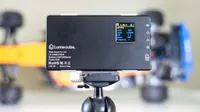
The panel itself is nice and solid, as are its physical controls. I’ve been slightly critical of Lume Cube’s physical controls in the past, but I’m pleased to say that I like the Studio Panel’s controls. In a world where electronics tend to have tiny switches or small buttons that you have to long-press, a simple, sizable on/off switch is very welcome. The color temperature and brightness wheels are similarly simple and get the job done, too.
The roughly 1.5-inch LCD screen is clear enough, and the usual battery indicator, which shows how long the light will last at its current brightness, is always useful. Apart from the single Studio Panel, the rest come with barn doors. They’re plasticky like the tilt stand, and I’m slightly concerned they could begin to sag after constant use, but they serve a purpose. They can also be easily removed since they just clip on/off the panel.


I like the remote control. It feels decent quality for what it is and is certainly a nice addition to have. The power adapter is what you’d expect at this price range. I found the lead to be long enough for home studio use, but you’ll need to pair it with an extension lead in a larger studio setting.
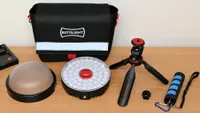
The final item is the carry bag, which is only included in the Lighting Kit and 3-Point Lighting Kit. It’s a surprisingly nice bag for the price range. The outside is made from a durable canvas-like material with a little padding on the inside to keep everything safe. You would want to shove loads of heavy kit on top of it, but it’s great for carrying the lights to and from a shoot in dry-ish weather.
However, while it has provision for everything within the two-light Lighting Kit, the 3-Point Lighting Kit inexplicably comes with the same bag, so you’re left with nowhere to stow the third light and its accessories. Even if you’re just using the lights in a home studio, it would be nice to have the option to pack them away in the bag. Because this is a review of the standard two-light kit, I won’t be marking it down, but if you are considering purchasing the three-light kit, this is a substantial oversight as far as I’m concerned.
Lume Cube Studio Panel Lighting Kit: Performance

The first thing I noticed when I turned on the Lume Cube Studio Panel is how bright it is in comparison to my other LED panels. This is presumably down to Lume Cube’s proprietary Edge-Lit technology. Each Studio Panel features 200 inward-facing LEDs with a built-in diffuser. According to Lume Cube, this provides “perfectly balanced light that’s powerful but soft with even coverage.” And I have to agree. The panel emits an attractive beam that can be ramped up without ever feeling overly harsh.
It’s important to note that while the light is powerful enough for some limited daytime outdoor uses, I wouldn’t recommend it for regular outdoor use. For starters, you cannot compare a 10-inch LED panel to a powerful strobe light. This isn’t a light that’s going to compete with the sun, nor is it a light you’ll want to position too far away from your subject (due to dropoff). It’s also not rugged enough for regular outdoor use.
The stands are good quality, but I wouldn’t want to be using them regularly on wet, muddy, or sandy surfaces. And while the 80-minute battery life at full power is decent, a light like the Rotolight Anova PRO 3 would be a more suitable outdoor choice because it has a removable battery, so you can bring spares on the shoot. If the Lume Cube Studio Panel runs out mid shoot and you’ve no access to a power supply, you’re stuffed.
What the Lume Cube Studio Panel does have in its favor is its portability. If you’re an outdoor content creator looking to carry around a light panel as an emergency light source for when the sun begins to dip, conditions are flat and overcast, or when it begins to get dark, and you want to squeeze out a few more shots, I think the Studio Panel could provide the solution.

In a controlled, indoor environment, the Studio Panel really comes into its own. I shoot a lot of product photography using my Raleno Video Light and a few smaller Lume Cube lights, and the Studio Panel Lighting Kit immediately bested my setup and slotted effortlessly into my workflow.
The beam is more than powerful enough for product photography, given that the lighting is often placed closer to the subject. However, you can certainly use the kit to light human subjects in a controlled environment.
You get a versatile kelvin range of 2700K – 7500K and a CRI rating of 96+, so you’ve plenty of color temperature wiggle room, and you can be sure that your subject is illuminated accurately. Some might be disappointed by the lack of RGB colors and special effects present in other Lume Cube lights, such as the RGB Panel Pro 2.0 and Tube Light Mini. And while a more feature-rich light wouldn’t be unwelcome, something I really like about the Studio Panel is its simplicity.
In a world where most tech strives to do more, the Lume Cube Studio Panel is simple in both its feature set and execution. The panel’s three controls make operation a breeze, and the remote control is a fantastic extra that’s simple to use and super responsive. You can set up to 9 channels. To set a new channel, you hold down the ‘CH’ button on the panel, wait for the ‘CH’ on the LCD screen to flash, and then use the color temperature wheel to cycle through the channels.

And if you’re really set on colorful lighting, the presence of barn doors means that you can easily attach colored gels if you want to. Having barn doors is a nice addition, providing extra control, but as mentioned, I do worry that they might loosen over time. Already, they don’t lie completely flat over the lighting panel when stowed.
That said, it’s a shame the Studio Panel isn’t compatible with the Lume Control app. I tend to operate my lights via the on-board controls anyway, but I do think the app works very well and is a useful asset to have. I’m sure Lume Cube’s intention was that the remote fills that gap, but for existing customers who have a large number of Lume Cube lights, this does feel like an unnecessary omission.
Another boon for simplicity’s sake is that these lights can be run via mains power. I totally get why ultra-portable LED lighting solutions don’t come with an AC adapter – it defeats the purpose – but there’s nothing worse than settling into a photography session only for a light to run out of juice.
Having the option to use an AC adapter reduces so much hassle. If you forget to charge the device or the shoot is taking longer than expected, you simply don’t have to worry. This speeds up your workflow, too. When I’m using my smaller lights, I’m constantly switching them on and off to conserve power, but with the Studio Panel plugged into the mains, I don’t have to worry.
Lume Cube Studio Panel Lighting Kit: Verdict
If you’re looking for an LED panel lighting kit that you can rely on, long term, then the Lume Cube Studio Panel Lighting Kit is a great shout. Not only does it come with everything you need to get started, fresh from the box, but the meat of the setup – light panels and stands – are great quality for the price. The kit is let down a little by a pair of cheap lighting mounts and while the barn doors fare better, I’m not convinced they’re built to last.
Still, what really counts performs well. The LED panels emit strong, even beams of light and while you could be disappointed by the lack of RGB features, the unbloated feature set makes each light easy to set up and use. And I like that. I am disappointed by the lack of Lume Control app support, but the decent remote control does at least half-fill that gap.
I wouldn’t rate these lights for rigorous outdoor use. For starters, they’re not really powerful enough, and secondly, they’re clearly not built for rugged outdoor use. However, that’s not to say that on-the-go content creators can’t make use of them outside in a pinch. I’m also pleased that they run on AC power. This really elevates them to studio status, and while they run on batteries, the ability to plug them in and not worry about losing a light mid-shoot is a huge boon.
Features ★★★★☆ |
Not as feature rich as some of Lume Cube’s smaller LED panels, but this results in a straightforward and fuss-free light. However, it is a shame there’s no Lume Cube app support. |
Design ★★★★☆ |
The light panel and stand get a thumbs up from me. However, the plastic Tilt Mount leaves a lot to be desired and while the bag is decent quality, it’s remarkable that the three-light kit only features a two-light bag. |
Performance ★★★★★ |
Emits a strong, even beam. Both the physical controls and the remote control are responsive. |
Value ★★★★☆ |
Lume Cube products tend to occupy the middle ground when it comes to price, but that’s reflected in the quality of the products. |

✅ Buy this if...
- You want an affordable LED light panel with everything you need to get started from the box.
- You’re a content creator who requires a versatile, constant lighting solution that’s affordable and portable.
🚫 Don't buy this if...
- You want a powerful outdoor lighting solution that will compete with the sun.
- You want a rugged light that can withstand outdoor conditions and is suited to prolonged use far from a power outlet.
Alternatives