
Compact cameras are well on their way to being a trend of the year, if not the decade – but as a camera expert, I think there are some compact cameras that are too small. There, I finally admitted it: Some compact cameras are too compact.
Point-and-shoot cameras are seeing a resurgence as pocketable cameras that can go anywhere. Some of them are just a means of getting off smartphone screens, while others have larger sensors and better zooms than the cameras already in most pockets.
I’ve tried cameras of all different shapes and sizes as a journalist in the photo tech industry. But sometimes I grab a small camera, and I regret not grabbing my mirrorless instead.

Small cameras leave nothing for my fingers to wrap around, leaving my hand in an ergonomically awkward position that ends up leaving me with an ache in my wrist after long shoots.
This is especially true among compact mirrorless cameras. Mirrorless is meant for swappable lenses, and some of the heavier lenses – the bright portrait primes and the telephoto sports and wildlife optics – make the camera so front-heavy that a grip is a must-have.
There’s a sweet spot in camera size that makes a camera portable yet still comfortable to hold. I think exactly where this sweet spot is depends on a few factors, like the size of your hands and the lens that you are using.
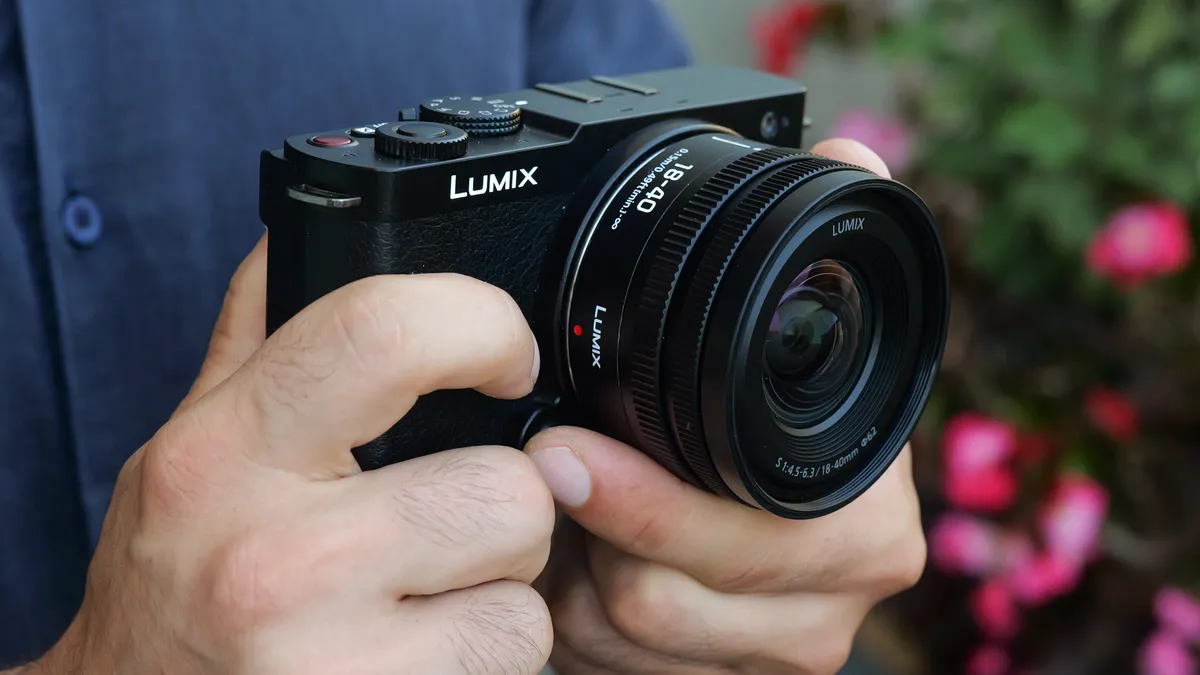
Even just a small bump to wrap my fingers around helps. I don't mind how tiny the Ricoh GR IV HDF is because there's enough to wrap my hands around. I thought it was more comfortable than the tiny mirrorless Panasonic Lumix S9 that has a boxy design.
How long the camera spends in your hand matters as well. I don’t mind smaller cameras for snapshots because I’m not shooting for hours on end, and I’m tucking the compact camera back into a pocket when I’m not shooting. My OM System Tough TG-7 doesn’t have much grip, but I don’t mind because it’s not in my hand for hours at a time.
However, I’m seeing a new trend emerging for cameras that aim to be both compact and comfortable to hold. A key example? The GoPro Mission 1 ILS, the smallest yet mirrorless camera with 8K open gate. But the upcoming GoPro mirrorless looks more like a slightly larger Hero13 than a mirrorless camera.

GoPro’s solution? A point-and-shoot grip that gives the camera enough girth for the hand to wrap around. When creators need to mount on a gimbal or a drone, fit in tight spaces, or rest atop any number of mounts, that small size is a must. But GoPro’s point-and-shoot grip aims to make it possible to have a camera that’s tiny yet adaptable for handholding.
GoPro isn’t the first to try this either; Insta360 has a few, including one for the Ace Pro 2, and third-party accessory companies like SmallRig have a number of grips and options for converting action cameras to point-and-shoots.

Third-party grips are another option for aiding mirrorless cameras with a less-than-ergonomic grip. I recently added a grip to my mirrorless, and it’s not only more comfortable, but it also added a secondary hot shoe slot that I can use to add an action camera to shoot behind-the-scenes video.
Camera design is all about balance. I love shooting with smaller, lighter gear – but if that camera is too small and too minimalist to have a grip, it’s either spending more time in my pockets than in my hand – or getting an add-on grip.
You may also like
Take a look at the best mirrorless cameras for travel or the best compact cameras.

