

Digital Camera World Verdict
The Blackmagic Pyxis 12K takes the box-camera concept to another level, dropping the Ursa Cine 12K’s flagship sensor into a compact modular body. It may look like the 6K version, but its imaging is in a different league, delivering stunning 12K capture or beautifully detailed 8K and 4K downsampling with Blackmagic’s trademark color science. It isn’t an easy camera to live with. Power draw is heavy, battery life is short, the fan is louder than the 6K model, and the lack of internal ProRes may slow fast-turnaround workflows. But if you’re willing to rig it properly, the Pyxis 12K offers image quality that comfortably punches above its price point.
Reasons to buy
- +
Superb 12K sensor ideal for downsampling to 8K/4K
- +
Excellent skin tone reproduction and highlight retention
- +
Vertical UI rotation makes social deliverables easier
- +
Outstanding value, including a full license to DaVinci Resolve Studio
Reasons to avoid
- -
Significant battery power consumption
- -
Audible fan noise in quiet environments
- -
No internal ProRes recording options
Why you can trust Digital Camera World Our expert reviewers spend hours testing and comparing products and services so you can choose the best for you. Find out how we test.
Blackmagic’s Pyxis 12K arrives as one of the most compelling cinema cameras of the moment, packing a full-frame 12K RGBW sensor and wide 16-stop dynamic range into the same compact, modular body that made the Pyxis 6K so popular.
However, this new camera isn’t just about resolution for its own sake – the huge 12,288x8040 sensor provides filmmakers with serious creative flexibility, whether you’re chasing maximum detail at 12K or downsampling to richly detailed 8K and 4K, which benefit from Blackmagic’s signature color science and tonal response.
At roughly the same physical size as its 6K sibling, the Pyxis 12K feels instantly familiar, yet the performance leap inside is dramatic. Dual CFexpress slots, multiple mount options, and deep integration with the Blackmagic ecosystem (including DaVinci Resolve workflows) position it as a versatile tool for narrative, commercial, and high-end indie production alike.
That said, this sensor’s capabilities demand careful rigging and infrastructure – from power and cooling to media and post-processing – making the Pyxis 12K a camera that rewards planning as much as creativity.

Specifications
Lens mount |
L-mount |
Sensor |
Full frame CMOS, 12,288 × 8040 (12K) |
ISO |
800 Native, 200 – 25,600 Selectable |
Dynamic Range |
16 stops |
Viewfinder |
N/A |
Screen |
4" HDR touchscreen |
Storage |
Dual CFexpress Type B slots; USB-C external recording |
Battery |
Sony BP-U batteries or 2-pin Lemo 90W PSU |
Dimensions |
5.94 × 4.69 × 4.17 in / 15.1 × 11.9 × 10.6 cm |
Weight |
3.5 lb / 1.6 kg |
Price
Release date and price The Blackmagic Pyxis 12K is available now, with a body-only price of approximately $6,595 (subject to fluctuations due to tariffs) / £4,320.
Design & Handling
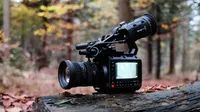
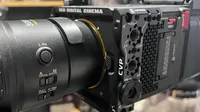
Physically, the Pyxis 12K shares the rugged, machined aluminum box design of the 6K model. It is dense, feeling every bit of its 1.5kg weight, and is clearly designed to be the brain of a larger rig rather than a handheld unit. I tested the L-Mount version, which I found versatile for adapting to PL glass (using a Fotodiox adapter with built-in variable ND) or using native L-mount lenses.


The most significant operational difference is power management. The 12K sensor is "hungry." In my endurance testing, a standard Sony BP-U35 battery lasted only 35 minutes. Even larger third-party BP-U100 equivalent batteries provided just over an hour of recording time. Users stepping up from the 6K or Pocket lines must account for this; a V-mount plate and high-capacity bricks are practically mandatory for a full day of shooting.
I’d be surprised if anyone who is seriously considering the Pyxis 12K does not already rely on V-lock batteries for their rigs. They’re generally a better solution that gives peace of mind for longer periods of filming. As someone who shoots in a studio a lot of the time, I’m also grateful for the ability to run the camera from DC power via its 2-pin locking LEMO connector. It accepts a voltage range between 12V and 18V and will run even without a battery connected.

In terms of audio inputs, the Pyxis features a single mini XLR connector for pro mics, which is switchable between mic and line-level with phantom power delivery. It also has a 3.5mm stereo input for smaller microphones or other stereo line-level sources, like an AUX cable.
Performance
While the Ursa Cine 12K is built for speed, the Pyxis 12K trades some frame rate capability for compactness, generally topping out at half the frame rates of its larger sibling. However, readout speeds are impressive where it counts. While the full 12K Open Gate (up to 40fps) readout sits in the 24ms range, dropping to 8K results in much faster readout speeds of under 12ms, minimizing rolling shutter artifacts significantly.
Above: 4K sample footage show on the Pyxis 12K
A notable omission for some professional workflows will be the lack of internal ProRes recording. It can record ProRes to SSD, however and DaVinci Resolve now supports ProRes media natively. Internally, the Pyxis 12K records exclusively in Blackmagic RAW. While BRAW is efficient, the inability to quickly offload ProRes 422 files for fast-turnaround clients is a missing convenience.
On the positive side, the lack of IBIS is mitigated by Blackmagic’s gyro data. In my testing, applying gyro stabilization in DaVinci Resolve took seconds and effectively smoothed out handheld micro-jitters, making the footage look properly stabilized.

The image quality is the Pyxis 12K's raison d'être. As with previous Blackmagic cameras, the skin tone reproduction is pleasing and natural across a wide variety of complexions, requiring very little work in post to look "right". The highlight rolloff is equally impressive, contributing to a distinctively filmic image.
I did observe some banding artifacts in the skies in certain high-contrast shots, particularly when shooting in 8K/4K modes. Perhaps a potential side effect of the compression or sensor readout. However, I found this was easily rectified in DaVinci Resolve by switching the color management lookup table interpolation from "Trilinear" to "Tetrahedral," which smoothed out the gradients immediately.
Low-light performance is solid, this camera handles shadow detail admirably, though without a second base ISO, you are reliant on the camera's native ISO 800. Pushing to ISO 1600 or 3200 introduces minor noise, but it is organic and easily cleaned up with Resolve's noise reduction.
Given the amount of detail this camera can pick up, I would say for the most attractive look - particularly when filming faces - you’ll want to lean on soft manual or “characterful” lenses to counterbalance the camera sensor’s inherent sharpness.
Verdict
The Blackmagic Pyxis 12K is a fascinating proposition: it effectively places the heart of the Ursa Cine 12K - one of the most sophisticated sensors on the market - into a significantly smaller and more affordable body.
For many, 12K might seem like overkill. However, the true strength of this camera lies in its ability to downsample. Shooting in 12K or the 9K Super 35 mode yields incredibly rich 8K and 4K images, often retaining slightly better dynamic range in the highlights than shooting in the lower resolution modes directly. I found the "sweet spot" to be the 8K 3:2 (open gate) mode at 8:1 compression; it offers a manageable balance of file size and image fidelity while still benefiting from the sensor's downsampling capabilities.
This camera is a dream for cinematographers who need maximum resolution for VFX plates, or reframing flexibility via open-gate 3:2. Just like the 6K model, the UI is intuitive, and thankfully, the Pyxis 12K also features vertical menus when turned on its side for social deliverables.

Given its colossal resolution, the chassis has to work hard to support this camera’s sensor. The fan noise is definitely more noticeable than on the 6K model, which is something to consider for quiet narrative work. I hadn’t noticed it during my first couple of days with the camera, but later that week, I filmed a sound bowl meditation class, and I had to switch cameras because the fan was intrusive in such an intentionally sound-sensitive setting. Furthermore, the absence of a dual base ISO - with the camera limited to a single native sensitivity of ISO 800 - means users lose that "safety net" gain circuit found in other cameras for extreme low light. That said, Davinci Resolve - which typically costs around £225 / $295 - comes free with this camera and makes light work of reducing the impact of noise in most plausible, real-world use cases.
Ultimately, this is a camera that benefits from building it out. At the very least, I would highly recommend picking it up with the fantastic Pyxis Monitor EVF Kit. You cannot treat it like a run-and-gun hybrid; it needs a rig, substantial batteries, and plenty of storage. But if you feed it what it needs, the image quality is virtually indistinguishable from cinema systems costing three times as much.
Alternatives
How I Tested
I tested the Pyxis 12K on a variety of professional shoots, including a series of monologue shooting days with actors, a product video, a promotional shoot for a wellness company, and run-and-gun street capture. I paired the camera with Viltrox Cine lenses, a Laowa 8-15mm Probe lens, and the Sigma 24-70mm f/2.8, which was provided with the camera by Blackmagic. My endurance testing involved running the camera continuously to drain standard BP-U35 and BP-U100 batteries, and I verified workflow speeds using Angelbird 2TB and 1TB CF Express Type-B cards.

