Let's just get this out of the way – there's no objective best camera for video. Which video camera is right for you is going to depend on what you want to shoot it for, not to mention your own experience levels and budget. As such, we've compiled this list of eight very different options to give you as much choice as possible.
A mirrorless camera is a great choice for video, but an action camera can be too. So can a compact camera, a camera phone, or even a drone. Our expert reviewers have tested all of these, and I've aimed to pick the best of each type. They all work in different ways and serve different purposes.
Don't worry though – video doesn't have to be difficult. Don't be put off by all the accessories, technical terms, or complex-sounding techniques. Everyone has to start somewhere, and as long as you're shooting, you're learning. Check out our guide to the best cinema cameras if you want if you're looking for something more high-end – otherwise, let's get started!

Gareth is the Reviews Editor at Digital Camera World, and the person in charge of approving all the latest camera-related tech. With several years of experience as a photographer and videographer, shooting for some household names, he has learned a thing or two about working with cameras and the photography industry. Outside of this, expect to find him cycling around London, or deep in a Netflix binge.
Best camera for video: our top picks

Mirrorless cameras are the most popular choice for serious video shooting – offering you an interchangeable lens system that means you can pick the right lens for what you are shooting.
Read more below

If you're looking for a great camera that can capture all the action on your latest adventures then the DJI Osmo Action 6 is now the best choice - outshading the GoPro Hero 13 Black.
Read more below

Canon's latest PowerShot doubles down on video and vlogging features, with a large 1.4-inch sensor, 16-50mm focal range, log video, ND filter and a fantastic integrated microphone.
Read more below

A high-spec camera in a drone small enough to be used safely (and legally) in most places makes this an ideal first drone and often the only one you'll ever need.

The Insta360 'X' series has been refined over several generations, and now is sharp with 8K resolution, snappy and responsive, plus – crucially – easy to use with excellent software that'll suit fun users and serious creators.
Read more below...

The iPhone 17 Pro Max brings higher frame rates in 4K to the party, while also retaining great video features from previous generations like ProRes recording. It's big and expensive, but worth it.
View more options ↴

If you want a compact camera that's great for video, but also not too shabby at taking stills either then the X-S20 from Fujifilm is the best versatile camera on this list.
Read more below

The big advantage of a camcorder is that it comes with a big zoom built-in - making it great for subjects such as sport. Another plus is that the form factor is custom-made for videomaking.
Read more below
Best camera for video
Why you can trust Digital Camera World Our expert reviewers spend hours testing and comparing products and services so you can choose the best for you. Find out how we test.
Best overall


Mirrorless cameras are the most popular choice for serious video shooting – offering you an interchangeable lens system that means you can pick the right lens for what you are shooting.
The Panasonic Lumix S5 IIX is our pick for videographers. A successor to the Lumix S5 II, it takes the bones of that hybrid mirrorless camera and adds a suite of video-friendly features. There's an extensive list of recording format options, all with 10-bit colour, as well as a huge choice of compression formats. It can go live anytime, streaming wired and wirelessly, and you can shoot directly to a solid-state drive via USB-C.
As we found in our review, the stabilization on the Lumix S5 IIX is also truly in a class of its own. Sure, conventional wisdom says that video shooters don't really need in-camera stabilization, since they'll always use a gimbal, but if you are caught without one and need to capture run-and-gun footage, the Lumix S5 IIX is capable of providing a level of stability that's not a million miles off.
The hybrid autofocus is also excellent, making use of phase-detection and boasting 779 AF points for speed and accuracy. With the L-mount for lenses, you have a generous choice of Panasonic, Sigma and Leica-made optics – they're not the cheapest, but then again, neither is the Lumix S5 IIX itself.
Essentially, if you can dream it, the Lumix S5 IIX can shoot it, and that makes it a slam-dunk as our pick for the best camera for video overall.
Read our full Panasonic Lumix S5 IIX review
Best action camera

This is a spectacular, video-first powerhouse for creators - and maintains DJI as the new masters of the action camera, having stolen GoPro's crown a year or two back. While it retains the rugged durability of its predecessor, the Action 6 focuses heavily on cinematic performance, introducing a groundbreaking first for action cameras: an adjustable aperture. For videographers, this grants creative control over depth of field and exposure, eliminating the traditional compromise between sharp focusing and low-light video performance.
DJI has further elevated its filmmaking credentials by integrating a massive new 1/1.1-inch square CMOS sensor, first used in the Osmo 360 360° camera. This ultra-large sensor yields two massive advantages for video production: it captures exceptionally clean, noise-free low-light footage for night vlogging, and its square aspect ratio allows creators to effortlessly re-frame footage from vertical to horizontal in post-production with zero loss in quality. While the GoPro Hero 13 Black offers a near-square sensor, its smaller surface area cannot match the nighttime clarity and flexibility delivered here.
Serious creators will appreciate the dual high-quality OLED touchscreens for perfect framing from any angle, seamless compatibility with DJI’s wireless microphone system, and long-lasting 1950mAh batteries. Wrap all of that into a body that is waterproof to 20m without a case, and you have the ultimate action camera for serious video creation.
Read our full DJI Osmo Action 6 review for more details
Best compact
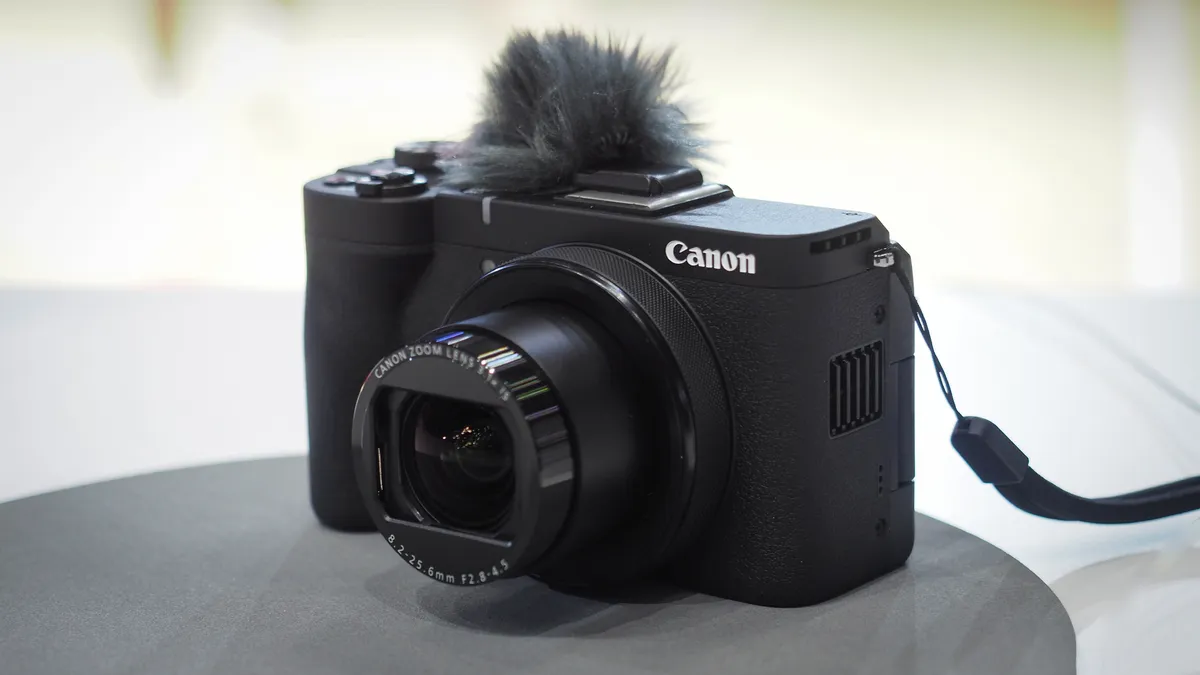
Canon's previous generation of compacts (led by the PowerShot G7X Mark III) was immensely popular with content creators, and after a seven-year lull we've got the latest iteration – and it's tailor-made for vlogging and video.
The Canon PowerShot V1 boasts everything a creator could want: a large 1.4-inch sensor (about the size of a Micro Four Thirds sensor) capable of 4K 60p (cropped) and oversampled 4K 30p (from 5.7K) footage, built-in ND filter, a large and impressive microphone with wind muffler, log video, image stabilization…
The PowerShot V1 is essentially Canon's equivalent to the Sony ZV-1 II, and betters it in almost every way. If you want a convenient on-the-go camera with everything, you can't go far wrong with the V1.
Read our full Canon PowerShot V1 review for more
Best for aerial video

This drone's predecessor, the DJI Mini 3 Pro, had a massive effect when it arrived in May 2022 – it redefined what DJI was doing with the ultra-light category, bringing some collision sensors and a 4K 60fps camera which could physically rotate to vertical mode (a feature still not equalled by much bigger craft).
Under 18 months later, the Mini 4 Pro finished the job, making the collision sensors omnidirectional (all-round) and adding 10-bit D-Log M video and waypoint programmable flights while keeping under the magic weight. It can also do HDR at a full 60fps rather than the 30fps limit of the Air 3 Pro.
The Mini 4 Pro also sports DJI's updated O4 radio system which offers up to 20km (over 12 miles) of theoretical range or, more importantly, top-notch reception in sensible operational distances. The updated DJI RC 2, as seen with the DJI Air 3, is an option, which feels very pro in hand, giving the choice of a model with a screen to save the (fairly minimal) fuss of connecting a phone). In some markets (such as the USA) there is also a choice of batteries if you don't mind pushing the weight limit, meaning you can go from the already decent 30 minutes to over 40 (again, always take these with a pinch of salt – it depends on conditions and flying style). You should note, though, that the drone will know about the weight change, and can alert authorities.
Read more: DJI Mini 5 Pro review
Best for 360 video

When I tried this camera, I knew immediately it would find itself as my top choice for a 360 camera. It's a great choice for people like me who own a 360 camera but want more resolution, and an equally sensible choice for anyone getting into 360-degree photography for the first time, whether their goals are serious content creation or fun.
A couple of things set the camera apart. A big one is the Insta360 software, which is comfortably ahead of the offerings from others at the moment. As well as an excellent phone app (iOS/Android), there is an Insta360 Studio for Mac/PC and plugins for Premiere and Final Cut Pro so creating content can happen almost immediately for social, or in careful detail later. The AI subject tracking is excellent too.
The headline feature here is the 8K resolution (although that's available on the X4 too), and the processing power which delivers it. The boost makes for significantly better quality, especially when zooming into video in the edit. It also provides a lot of other upgraded resolutions, like single action camera mode at the crucial 4K60fps threshold, as well as features like bullet time now at 5.7k/120fps.
Other refinements exist too, like the removable lens covers which make the device extra rugged (but these now cost extra) and the ability to connect microphones.
See my full review of the Insta360 X5
Best phone for video

The debate over whether smartphones can produce professional-grade video footage has long been over – they most certainly can. Movies and TV shows have been shot using iPhones and other smartphones, and while a client may still not be impressed if you show up to a shoot with a phone, the devices we all have in our pockets have proved their mettle for video a thousand times over. If you primarily shoot video for social, it makes sense to do it on a phone for sheer ease, and or our money, the best you'll get is Apple's flagship, the iPhone 17 Pro Max.
With headline stats of 4K and 120fps for its main camera, iPhone 16 Pro Max already sets itself apart from its predecessor, which maxed out at 60fps. This gives you new scope for capturing luscious slow-motion. Elsewhere, once again you can capture and export ProRes footage to maximise detail and quality, and there's also a capable digital zoom in Cinematic Mode.
Video from this phone simply looks brilliant. Our reviewer dinged the latest iPhone on a few points, criticizing its poorly placed Action Button and slightly buggy UX, but he couldn't fault the video. This is the best you'll get in terms of smartphone video right now, and be warned, it's priced as such.
While Android phones are often cheaper, a further benefit of choosing an iPhone for video is that third-party manufacturers prioritize making accessories specifically for them, like cases, gimbals, clip-on lenses and that kind of thing. Plus, because iOS is a single platform, apps like Instagram and TikTok are optimized primarily for it, which generally leads to fewer issues with compression ruining the quality of the content you upload.
For more read our full iPhone 17 Pro Max review.
Most versatile camera

In our field test, the Fujifilm X-S20 proved to be an outstanding camera for a wide range of users. It offers an intuitive and user-friendly experience, with straightforward controls that make it easy for anyone to pick up and start shooting.
The camera's fully automatic modes are impressively effective, allowing even beginners to capture high-quality images and videos effortlessly. Despite its small and compact design, the X-S20 is packed with power, featuring a processor capable of 6K video recording and advanced subject recognition tracking, which is usually found in more expensive models.
This makes the Fujifilm X-S20 an excellent choice for photography enthusiasts, content creators, and vloggers alike, as it caters to various needs with versatility and reliability. While the price is slightly higher than the previous version, the significant improvements and enhanced capabilities justify the cost, offering a mirrorless camera that exceeds the expectations of most users.
Whether you're upgrading from an older model or stepping into the world of mirrorless cameras for the first time, the X-S20 delivers exceptional performance that’s hard to beat.
Read our Fujifilm X-S20 review to find out more
Best camcorder

Camcorders peaked in popularity in the 1990s, but it is a mistake to think they don't have their advantages for videomaking in the modern era. Unlike mobile phones or mirrorless cameras, camcorders have huge built-in zooms - making them great for shooting sport, wildlife and current affairs. What's more they are designed for the needs of the moviemaker - so the electronic viewfinder and the screen fall naturally to your eye and eyeline.
The Canon HF G70 is one of the best camcorders around right now with an impressive 20x zoom that will take you from 29mm wideangle to 600mm telephoto using the motorized rocker switch so you can frame up each shot as tightly as you need it.
Read our full Canon Vixia / Legria HF G70 review
How to choose the best video cameras
In this guide, we've elected to cover a broad range of camera types, and that's the first decision you're going to have to make when it comes to choosing a video camera. So, let's narrow it down:
Mirrorless cameras are the best general-purpose option for anyone who wants a flexible platform to shoot video. Our top pick, the Lumix S5 IIX is a mirrorless camera, as is the Fujifilm X-S20.
Action cameras excel at capturing footage in extreme conditions, whether underwater, on a muddy racing track, or at the mouth of a volcano! They also excel at capturing POV (point of view) footage as they can easily be mounted to a person or vehicle. The GoPro Hero13 Black is the best around, in our view.
360 cameras, as the name implies, can capture 360-degree footage, which is great for producing VR or interactive 360-degree video. However, their real appeal is that you are recording in two directions at once - so you can edit between the different views. For example, you can record yourself talking, and what you are looking at simultaneously.
Smartphones are perfectly capable of capturing brilliant footage these days, and if you're going to be uploading the majority of your content to platforms like TikTok and Instagram, a smartphone can be the ideal way to streamline your workflow.
Compact cameras offer a similar form factor to mirrorless cameras, but with a fixed lens that can't be changed. This means they tend to be simpler, more portable and often cheaper than the combined cost of a mirrorless camera and a lens, with the downside of reduced versatility. Some, like the Canon PowerShot V1, are optimised for vloggers.
Camcorders aren't as popular as they once were, but can still be a cheap and effective way to capture video footage without needing to rely on your phone – and the major appeal is that most have big zoom lenses.
Drones, of course, capture aerial footage. While it's unlikely that a drone will be your only or primary video camera, having the capacity to introduce airborne shots into your projects can be a real asset for any videographer.
How we test the best video cameras
We test cameras both in real-world shooting scenarios and, for DSLRs and mirrorless cameras, in carefully controlled lab conditions. Our team of reviewers have tested hundreds of different cameras, of different types - and for us we are looking for great looking video footage, something that is designed well so that its features can be used easily, and something that offers good value compared to its rivals.
Our lab tests measure resolution, dynamic range, and signal-to-noise ratio for mirrorless cameras. Resolution is measured using ISO resolution charts, dynamic range is measured using DxO Analyzer test equipment and DxO Analyzer is also used for noise analysis across the camera's ISO range. We use both real-world testing and lab results to inform our comments in buying guides. Action cameras, phones, compacts and camcorders are assessed using our field tests alone, but footage is assessed by our expert reviewers in a variety of different lighting conditions.
Frequently asked questions
Do I need 4K video?
Every camera in this guide is capable of shooting 4K video, with some offering even higher resolutions. 4K refers to the maximum level of detail recorded—roughly 4,000 pixels across, though the exact number varies. While many viewers still watch content on lower-resolution screens, shooting in 4K isn’t essential, but it does offer benefits. Higher resolution gives you more flexibility to crop footage during editing without losing quality and helps future-proof your content as display technology continues to improve.
Some cameras even support 6K recording, capturing nearly 6,000 pixels in width for even greater detail. However, all of these cameras can also record at lower resolutions, such as 1080p (1920x1080) or 2K, which can reduce file sizes and allow for higher frame rates—perfect for achieving smooth slow-motion effects.
Are DSLRs good at shooting video?
Most modern DSLR cameras can shoot video, and the best models do it well. However, due to their design, mirrorless cameras are better suited for video recording, making them the preferred choice for most creators—especially beginners.
Both DSLRs and mirrorless cameras offer the advantage of interchangeable lenses, allowing you to select the perfect lens for your subject. However, this also means the lens is a separate purchase, and in many cases, it can cost as much as the camera body itself.
Isn't my phone good enough to shoot video?
Recent smartphones can capture high-quality video, and some are even used professionally. However, their compact size and shape aren’t ideal for serious videography. They also offer fewer lens options compared to mirrorless cameras with interchangeable lenses or camcorders with powerful built-in zooms, limiting creative flexibility.
You might also like the best laptops for video editing and the best video editing monitor. These are the best video tripods.

