
GoPros are built to capture moments that normal cameras can’t – surfing, skiing, cycling, vlogging, diving. Anything where a phone would be fragile or awkward. The latest GoPro Mission 1 Pro is the company's best yet - offering a much bigger sensor than older models and pro video features such as the ability to shoot open gate at 8K.
Choosing a GoPro is more difficult for a couple of reasons, though. For one thing, as our best action camera guide shows, there are alternatives. GoPro as a company is capable of making serious missteps, and it's important not to confuse the brand and the camera type (as many people confuse Hoovers and vacuum cleaners).
These days GoPro offers a range of cameras – different sizes and values better suited for different situations. Sometimes slightly older models are even better suited, while others had flaws, as this guide reveals.
Oh, and remember as you read my words, I'm an enthusiast who wants more features all the time. It's still true GoPro, as a company, didn't just create the action camera market, and offer some of the best waterproof and underwater cameras but innovates in related areas too – 360 cameras is one GoPro can take real pride in too.
Plus that history also brings with it a rich ecosystem; the best GoPro accessories mean that whatever your activity, there is likely a shooting solution. That is a lot of reasons to find the right GoPro for you, and that's what this guide is all about!

Adam has been obsessed with looking at cameras and gadgets for his whole life, and has written several bestselling books including The Drone Pilot's Handbook (he is our resident drone expert too). He owns and travels with action cameras, and tests as many as he can get his hands on.
The best GoPro camera in 2026
Why you can trust Digital Camera World Our expert reviewers spend hours testing and comparing products and services so you can choose the best for you. Find out how we test.

✅ Premium cinematography: the 1-inch image sensor is good in all lights, and 10-bit HDR is on offer.
✅ You want a responsive system: New GP3 processor with neural engine makes for a much less laggy user experience than cheaper GoPros.
❌ You want the smallest action cam: It is chunkier than other GoPros
❌ You want it cheap: It is the most expensive GoPro
The new Mission series are the best GoPro cameras we have ever seen – not least because of the big 1in-type sensor that puts up there ahead of recently-launched rivals.
Currently there are two models in the range – the Mission 1 and the more powerful Mission 1 Pro – with a third promised that will be very different, with fully interchangeable lenses, but as a result won't be waterproof.
Shooting at up to 8K60fps or 30fps with open gate on a 1-inch image sensor means this is a camera that can cope in low light. It has a new faster processor, which opens the door to features like subject tracking in vlogging mode. There is also everything you'd find on a GoPro Hero Black before, but this time 10-bit log recording and 50MP stills.
Boosting all that is a range of accessories – cages, microphones and the like – designed to make it easier to use the camera in a vlogging or cinema context. The batteries also last longer than previous GoPros (while the camera can still accept the older ones if you have them – a nice touch).
The GoPro Mission 1 is very similar to the slightly more expensive GoPro Mission 1 Pro – but doesn't have 8K open gate video and doesn't has slightly fewer slow-motion frame settings.
Read my full review of the GoPro Mission 1 Pro
✅ You want to record your speed
✅ For the easy and creative lens mod system
❌ If you're not wedded to GoPro's brand, the best GoPro alternatives are better in low light
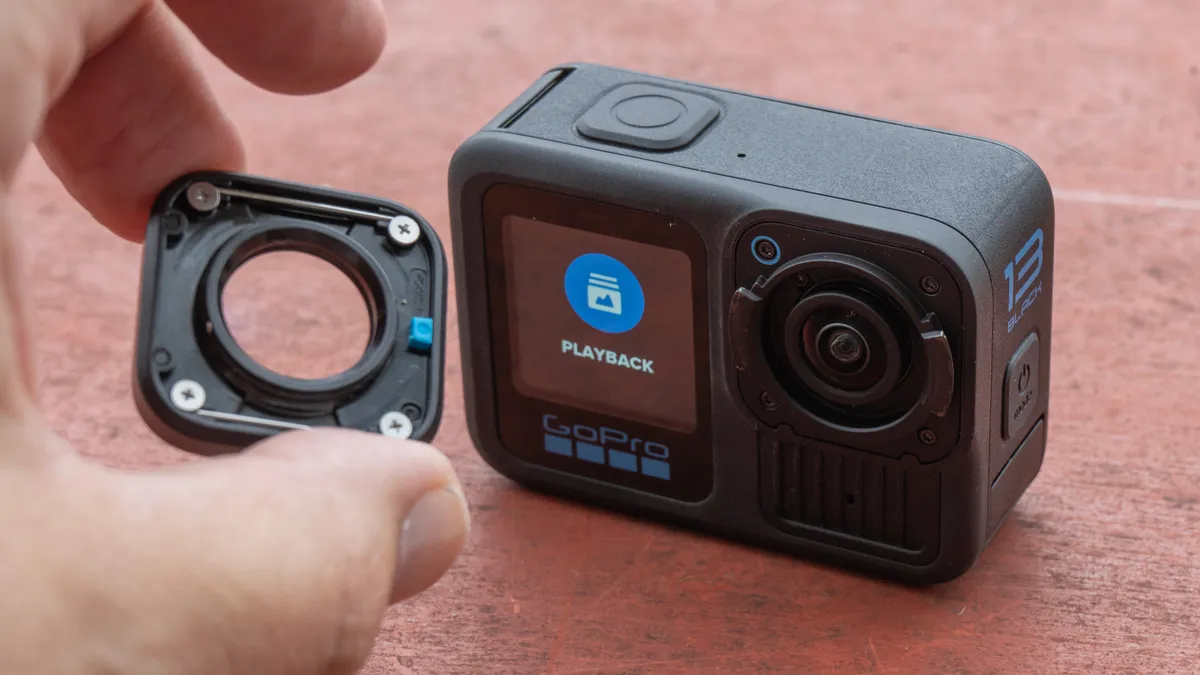
Last year's GoPro Hero 12 was almost insulting to the company's customers. Sure, timecodes and bluetooth microphone compatibility with Apple's AirPods arrived, but the world's most famous action cam took away its ability to measure the speed of the action – the GPS – and did nothing to improve the camera's performance in low light. That made us (and a lot of other people) recommend the previous generation as the better GoPro, or DJI's Action 4 as the better camera.
If it's performance in lower light you're looking for, GoPro still isn't playing ball – check out the (cheaper and better) DJI Action 5 Pro. But if it's great video in daylight and all the good stuff GoPro is known for – including GPS – then there have been really big changes – for the better – to this device.
GoPro has added a super high frame rate burst (up to 15 seconds, presumably, before the processor/buffer can't cope any more) which can give you up to 400fps, though it's only 720P so it doesn't look amazing; great in a social media post though.
More importantly for most situations, the re-designed GoPro doesn't just look cooler – it is literally cooler, not overheating so soon so it can record longer at 4K. Previous GoPros often overheated and switched off much sooner, so 'continuous' record times are significant (but thus does come at the cost of a new Enduro battery – the 10% larger 1900mAh which isn't compatible with the old one.
On the base the fold-out mount grips are still there which makes the GoPro easy to mount in traditional systems, but they are now magnetic. GoPro – admittedly late to the magnetic mount party – has cleverly created one that's easier to line up because it works both ways around.
The party piece, though, is that GoPro's clip-in filter/lens mod system has been upgraded to sense the attachment (again, not backwards compatible), so the software seamlessly adapts to a wide-angle lens, a ND filter, or even an anamorphic adapter. Now that's cinematic!
Best value GoPro


✅ GPS built in despite lower pricing
✅ 5.3K resolution video at 60 fps
❌ You don't get the new lens mod system
The GoPro Hero 11 was still our recommendation for best GoPro for most people when the 12 was, theoretically, top of the line. Now the 13 has come along it is, finally, better – technically – but only if the things that matter to you are battery life, the magnetic mount, some more obscure frame rates, timecodes, microphones, and the swappable lenses.
The actual image sensor is the same size, so it performs as "well" as the Hero 13 in low light. That isn't especially well, so you'll need to ask yourself whether you do your action in the daylight, or whether you should be looking at the other best action camera guide!
You still get top-notch image stabilization, great-looking video (until things do get dimly lit or dark), and some fun modes like light painting. The Hero 11 Black remains an excellent addition to the line, and the Hero 11 Black's 8:7 aspect ratio image sensor is also a standout highlight for content creators. Able to shoot in 5.3K resolution, 8:7 video at up to 30fps, its footage can be losslessly cropped to create new 4K portrait, landscape, and square clips from a single video.
On top of 8:7 video, the Hero 11 Black captures 5.3K resolution video at 60 fps, 4K resolution video at 120 fps, or 2.7K resolution at 240 fps. You can also grab 27MP stills from 5.3K video. Overall this is particularly appealing to folks who use multiple social platforms.
Read our full GoPro Hero 11 Black review for more details and GoPro Subscription explained: what you get, and is it worth it?
Small GoPro

✅ Unlike many ultra compact cameras, it has a screen
✅ Beautiful design
❌ Really light on features
❌ No in-camera image stabilization
OK, I'll be straight, this is a tough GoPro to like if you're used to the strengths of the main 'Hero Black' models – but that's not exactly what it's for, so you have to decide what you need.
In exchange for the (gorgeous, in my view) very small and light form factor, GoPro have thrown out all the usual functionality except simple 4K video (4K 30 at that), stills, and slow-mo. No timelapse, no hyperlapse, no night modes or any such usefulness. Even more significantly, no in-body image stabilization. If you want the video made smooth, you need to do it in post (in the Quik app).
That is a terrible experience if you're in a rush with a lot of footage and are used to the premium that comes with the Hero Black and, I promise, you'll hate it.
In exchange, though, you get a camera so small and light you can put it on your cycle helmet and the helmet doesn't want to slide sideways from your head or require you do it up unnaturally tight. That's a big deal for me.
Also, unlike some tiny cameras, there is still a color screen.
It really hammered it home to me how light the feature set was when GoPro announced they'd added 4:3 video mode to this camera as a firmware update, thereby offering more immersion, but – if you are in the market for a small GoPro and don't want to pay the full price – then this will often do the job (just don't expect good EIS).
UPDATE: Check out the version with the built-in LED light, called the GoPro LIT. (Spoiler: At the moment, it's a bit of an extra cost for the light...)
Read our full GoPro Hero 2024 review for more details
Best for 360

✅ You want to shoot without aiming the camera
✅ Quik software refreshed
❌ You're just looking to try 360 tech for the lowest spend.
For a few years, GoPro seemed to have developed and played a starring role in consumer 360 cameras, but after the original Max (or MAX – I'm never sure how shouty and capitalized GoPro want it), the company had done something worse than gone a bit quiet. They'd kept promising the update and not delivered it.
This is the promised update, and it's still very new, and, as you might expect, I have very little by way of complaint. The company seems to have kept a close eye on the growing competition in the field, while not losing sight of what is most important to
Sure, I'm not entirely sure I'm convinced by what they call 'True8K', but the image from this camera, especially in decent light, impresses against other 360 cameras. Usability is reliable, and the body is rugged to the point that anyone can swap a cracked lens if needed, in the field if it came to it.
Personally, this is one of the cameras that has impressed me most from GoPro in recent years because it leans hardest into consumer's needs. Usability hasn't been forgotten, either, and some higher-end features have been hidden in a 'Labs' mode for those willing to risk getting their hands dirty – everyone else can just enjoy a higher-spec, better camera that doesn't need pointing!
Read our full GoPro MAX 2 review for more details
Best value small GoPro

✅ Refreshed 2025 version of the Max
✅ Quik software refreshed
❌ Low 5.7K resolution is behind 360-degree competitors
For a long time the GoPro Hero Max was an awkward spot on the product list, a device desperately in need of an update it had been eclipsed by competitors at the top of our best 360 camera guide.
Before the Max 2, the interim solution was the Max (2025 model), which gives you a choice of 8K and premium specs (seriously my advice is to go for the Max 2 if you can) or something of a relative bargain for those looking ot get the experience at a lower cost.
The 2025 version of the 5.6K Max (1) has some minor software updates, giving it four digital focal lengths, horizon levelling, HyperSmooth stabilization, and ProTune video editing software.
It also gained some minor but notable physical updates – but only to bring it closer in line with normal products of this era – specifically better battery behaviour, a universal 1/4-20 screw mount so you can use a normal selfie stick (almost essential for 360-degree shooting), and, crucially for the modern world, a USB-C charging socket.
It still isn't even the best 360-degree camera from GoPro, but it is sometimes to be found for a pretty good price.
Read our full GoPro MAX review for more details
FAQs
Are there any alternatives to GoPro?
Yes! GoPro, like Walkman before it, has become the de facto name for a product category, but others offer good alternatives. GoPro has competition in both of its core areas – when it comes to 360-degree cameras, you can where the Max 2 fits in against others in our 360-degree cameras guide while when it comes to the classic 'GoPro' style action camera, there are other companies which have concentrated more on photographically interesting premium action cameras – prioritising vlogging or low light capability. Check our whole best action camera guide to see the broader possibilities.
What is the point of having GPS in a GoPro?
By including a GPS sensor in a GoPro (or any) camera, it can record its exact location all the time while it records video. This can be used to work out how quickly the camera is moving and even to create cool animated effects you can add to your videos like speedometers, which are an easy for viewers to understand your speed.
I – and many action camera journalists – were very critical of GoPro removing the GPS sensor in the Hero 12 camera (why you don't often see it as a recommended earlier generation from me unless it's discounted). GPS was a feature present in the Hero 11, and back in the 13. It has not been widely copied by competitors, and is a really cool niche feature for speed nuts.
How do you test GoPros and other action cameras
Since testing an action camera is a lot more about the action than measuring lens specifics, we like to take them out and try some activities. Using them while cycling, on location for capturing video (in varying lighting), and even on drones. We think it is important to use the device in real world scenarios to experience how easy the GoPro is to use and see how features like image stabilization cope with different tasks. Our expert reviewers include Jamie Carter and Adam Juniper who both have many years of experience with these devices (Adam once owned a GoPro Hero 2, and has experimented with a lot of GoPro alternative action cameras too).
Compare today's prices

