Digital Camera World Verdict
I really like that the Manfrotto ONE Photo tripod inherits many of the design innovations from the ONE Hybrid edition that I’ve used previously. The most notable is the EXTEND system that enables you to extend or retract each of the legs with just a single flip-action clamp. That can save a whole bunch of time, compared with endlessly loosening and tightening many clamps, especially for travel tripods that often feature four or five sections per leg. The pivoting center column is another hit as far as I’m concerned, and the ONE is tough and robust, ideal for everything from studio work to the great outdoors. I’m mostly very much impressed, but some of the best extras are sold separately.
Reasons to buy
- +
Strong and sturdy
- +
Fast ‘XTEND’ leg adjustments
- +
Q90 pivot center column
Reasons to avoid
- -
No carbon fiber version
- -
Pretty chunky and heavy
- -
No XCHANGE included
Why you can trust Digital Camera World Our expert reviewers spend hours testing and comparing products and services so you can choose the best for you. Find out how we test.
Think tripods, and Manfrotto is a name that trips off the tongue. The legendary Italian company set out to make some of the best tripods on the market in the 1970s, and is still one of the best and most innovative manufacturers in its field, half a century later. As if to ram home the point, the company launched the Manfrotto ONE Hybrid Tripod and 500X Fluid Head kit in the fall of 2025. I tested this new tripod kit at length and found that it gave solid, stable support, while living up to its ‘hybrid’ claims of being very versatile, enabling quick and easy swapping between stills and video capture with speed and ease.
That’s all very well, but as photographers, we haven’t all become ‘hybrid’ content creators just yet, and I hope it stays that way. For those of us who specialize in stills, or shoot still images exclusively, the ONE Hybrid Tripod is more complex than necessary, and that added complexity comes with an inflated price tag, forcing you to pay for stuff you don’t need. Enter the pared-down ONE Photo Tripod, aiming to give photographers what they want at a keen and more affordable price. With that in mind, it aims to be one of the best tripods for photographers, instead of doubling up as one of the best tripods for videographers to boot.

Manfrotto ONE Photo tripod: Specifications
Material |
Aluminum |
Folded height |
65.5cm / 25.8in |
Maximum operating height |
164cm / 64.6in |
Minimum operating height |
10cm / 3.9in |
Pivot center column |
Yes |
Weight |
3.1kg / 6.9lb |
Load rating |
12kg / 26.5lb |
Sections per leg/center column |
3 / 1 |
Maximum leg section diameter |
N/A |
Locking leg angles |
3 |
Feet |
Rubber pads (interchangeable) |
Case/bag included |
None |
Manfrotto ONE Photo tripod: Price
When it comes to pricing, please indulge me a moment while I set the scene. A set of Manfrotto ONE Hybrid aluminum legs will set you back $500 / £375 / AU$900, or a pricier $720 / £539 / AU$1,250 if you trade up to carbon fiber. Add the Manfrotto 500X Fluid Head and the complete aluminum or carbon fiber kits cost around $680 / £519 / AU$1,200 or $880 / £669 / AU$1,500, respectively. Suffice it to say, they get pretty pricey, pretty quickly.
The ONE Photo legs are only currently available in aluminum but by shedding some of the ‘hybrid’ components that are more necessary for leveling the legs and swapping between different heads, the price comes down to a relatively affordable $329 / £269 / AU$675. Again, kits are also available so you can add either the Manfrotto XPRO Ball Head or Manfrotto XPRO 3-Way Head, for a total price of $515 / £399 / AU$999 for either option. There are considerable savings to be had.
Manfrotto ONE Photo tripod: Design & Handling
Travel tripods are all the rage nowadays, and I’ve tested plenty of the best travel tripods on the market over the last few years. Sure enough, I like the way they fold down to such conveniently compact dimensions and are so easy to carry around, but setup tends to be a genuinely time-consuming chore. Take a travel tripod with 5-section legs and a 2-section center column, for example. This requires loosening and retightening up to 14 individual twist- or flip-action clamps. And then you have to go through the whole process again to pack the tripod away afterwards. By stark contrast, the Manfrotto ONE Photo couldn’t be quicker and easier to use.
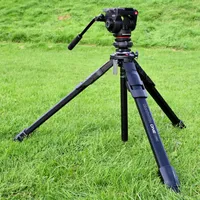
The big trick in the design is that the ONE Photo features Manfrotto’s new XTEND system. It’s broadly similar to the mechanism in each of the legs of the Manfrotto 504X Fluid Video Head with 635 Fast Single Leg Carbon Tripod that I tested a few years ago. The killer feature is that there’s only one single flip-action clamp in each leg. Flipping the clamp open or shut releases or locks all three of the sections in the leg, making it lightning fast to extend them for use and retract them again when your work is done.

Playing all the angles, it’s similarly quick, simple, and intuitive to engage any of the three lockable angles for each of the legs. Each leg has a sliding lever at the top, which you can operate with your thumb to give instant access to any of the 20, 50, or 81.5 degree leg angles on offer. Wider angles from the vertical are advantageous for low-level shooting, not only lowering the head but also giving greater stability with less risk of the tripod toppling over if it gets accidentally knocked. Using different legs at different angles can also be helpful when shooting on tricky, uneven terrain and for working around obstacles.

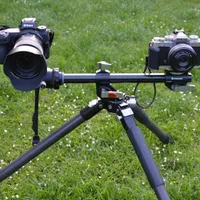
Okay, so the inclusion of multiple locking leg angles certainly isn’t an innovation and has been featured in most tripods for many years now. Many recent tripods have also featured a pivoting center column. Even so, the relatively new Q90 system in the ONE Photo tripod is supremely simple to use. Release the center column locking screw, raise the column to its maximum height, press a button at the bottom, and hey presto, you can flip it through 90 degrees for use as a horizontal boom. Why would you want to? Well, it’s great for ultra-low-level shooting as well as for macro photography. It’s also really useful for shooting with ultra-wide-angle or fisheye lenses, so that the tripod feet don’t creep into the shot.

Weighing in at 3.1kg / 6.9lb and measuring 65.5cm / 25.8in when folded, I certainly wouldn’t class the Manfrotto ONE as a travel tripod. It’s relatively big and chunky, but with that comes a beefy 12kg / 26.5lb maximum payload rating. Another interesting feature of the design is that the leg sections all have a rounded rectangular profile, rather than being circular, designed to keep unwanted flexing to a minimum, thus maximizing rigidity and resistance to vibrations.

Other design flourishes include Manfrotto’s Easy Link system, based on a threaded connection socket with anti-rotation protection. This is for adding accessories like a microphone, monitor and photographic lighting, either directly to the tripod or via an extending, adjustable arm.

There’s also a neat bubble level to help with leveling the legs. Situated on the spider of the tripod, the bubble level is built into a holder that you can rotate through an entire 360 degrees, so it’s easily visible from any angle. Down below the spider, a weight hook is built into the tripod, so you can hang some ballast to add stability without hampering the action of the pivoting center column.

Naturally, you might already have a perfectly good tripod head that you want to use with the legs. There’s a mounting platform with a circular base that has a fairly standard 60mm / 2.4in diameter. And if you don’t have something suitable, the ONE Photo tripod is available as a complete kit with either the Manfrotto XPRO 3-Way Head or Manfrotto XPRO Ball Head. They’re among the best pan and tilt heads and the best ball heads, respectively.

As I mentioned at the start, the money-saving opportunities in the ONE Photo Tripod and complete kits are thanks to some of the more ‘hybrid’ oriented features being stripped out. For example, leveling the tripod legs rather than just leveling the camera is most important if you’re going to be panning while shooting video rather than stills. The ONE Photo Tripod, therefore, doesn’t include the leveling component and modular center column that you get with the ONE Hybrid kits.

You also don’t get the XCHANGE quick-release system that’s included with the ONE Hybrid kit, for quickly and easily swapping between a video head and a photographic head. Even so, the XCHANGE unit is available to buy separately and, for my money, I think it’s well worth it if you have multiple photographic heads. For example, you might want to swap between one of the best ball heads, 3-way heads, geared heads, and gimbal heads, depending on what you’re shooting and how you’re shooting it.

The XCHANGE system is like a quick-release system for swapping between heads, rather than just mounting your camera or lens to a particular head. It costs around $54 /£39 / AU$89 for a complete kit plus $22 / £16 / AU$43 for additional CHANGE Plates. The way it works is very similar to the excellent but now-discontinued Manfrotto Move Quick Release Catcher System that I’ve tested in the past, enabling you to fit or remove a head with a simple twist of the locking ring.

One thing that does follow through from the ONE Hybrid Tripod is that the supplied feet are interchangeable. You can therefore swap out the default rubber pads for metal spikes, the latter being more suitable for loose ground and soft surfaces.
Manfrotto ONE Photo tripod: Performance
For many photo opportunities, timing is everything. There’s no point in ensuring the best possible image quality by using a tripod if the moment has passed by the time you’ve finished setting it up. A key performance benefit of the Manfrotto ONE Photo is that it’s so massively quick to deploy. Not only is it relatively rapid to adjust the overall height, but also to level the legs using just one locking/release clamp per leg, which works with all of the incumbent sections.

Naturally, being able to set up a tripod quickly is a moot point if its rigidity isn’t up to muster. The rectangular-profile leg sections pay dividends here, and I found the Manfrotto to be entirely stable and rigid in use, right up to its maximum height with the center column fully extended. Aluminum sometimes gets a bad press for being less resistant to vibrations than carbon fiber, but I found the ONE Photo to be at least as good as many leading carbon fiber tripods in this respect, and better than some.

Manfrotto ONE Photo tripod: Verdict
I’d sort of assumed that the Manfrotto ONE Hybrid tripod got its ‘ONE’ title for being a single tripod that worked equally well for shooting stills and video. The ONE Photo has made me think again, as it’s more of a stills specialist but is nevertheless ‘one’ tripod that works equally well in the studio, out on the road, and pretty much anywhere and everywhere I’d want to use a tripod. And of course, there’s that innovative ‘one’ locking clamp per leg that acts on all three of its sections.
The main advantages, to my mind, are the relatively speedy setup and pack-away times, coupled with rock-solid support. Neat extras include the 90-degree pivoting center column, the accessory attachment system, and the interchangeable feet. For my personal requirements, I wish that the XCHANGE quick-release system were included with the legs and as part of either of the kits that include a ball head or 3-way head. However, that’s just because I personally like to shoot with different types of head in different situations. It actually makes more sense to be able to buy into the XCHANGE system as an optional extra, if and when you want to actually use it.
All in all, both of the full Manfrotto ONE Photo kits and the legs on their own are great buys, but I’ll be interested to see if Manfrotto subsequently launches a more luxurious carbon fiber option.
Features ★★★★★ |
Useful features include ‘XTEND’ legs that are relatively quick and easy to set up, the Q90 pivoting center column system and multiple leg angles. |
Design ★★★★½ |
It’s a clever design that takes most of the time and effort out of using a tripod, and it’s really well engineered and finished, although there’s currently no carbon fiber option. |
Performance ★★★★★ |
Performance is excellent, combining speedy setup with superb stability and resistance to flexing and vibrations. |
Value ★★★★☆ |
The legs on their own as well as the complete kits with ball or 3-way heads don’t come cheap, but stripping out some of the non-essential ‘ONE’ components drives down the price. |

Alternatives