Digital Camera World Verdict
The Panasonic Lumix DMS1 is tiny, light, and brilliantly neat, with no dangling cables, no extra battery to think about. Its directional modes work well and make it far more flexible than a typical on-camera mic, and 32-bit float recording is a useful backup for clipped audio. For Lumix fanatics, this might be the best jack-of-all-trades microphone you can get, but with zero compatibility beyond a handful of the latest Lumix cameras, it is an expensive microphone that only really makes sense if you are fully committed to Panasonic’s ecosystem.
Pros
- +
Compact and very light
- +
No-cable hotshoe setup
- +
Six useful pickup modes
- +
32-bit float and backup recording
Cons
- -
Panasonic-only compatibility
- -
Quite expensive
- -
Looks a little odd
- -
Specialist mics can sound better
Why you can trust Digital Camera World Our expert reviewers spend hours testing and comparing products and services so you can choose the best for you. Find out how we test.
Panasonic has been steadily building out Lumix to appeal directly to content creators, pushing the latest video tech like open gate, and easy-to-use LUTs. Now, Lumix is adding a new audio option for run-and-gun creators – Lumix DMW-DMS1 – its most content creator-friendly microphone yet.
Rather than being just another generic on-camera microphone, this is a dedicated digital "shotgun" mic designed specifically for compatible Lumix cameras, with audio and power both handled through the hotshoe.
Panasonic says it is built to deliver high-quality sound, advanced functionality, and a compact design, and on paper, it certainly ticks the right boxes. It offers a newly developed 10mm microphone array, six directional modes, wind-noise reduction, and support for 32-bit float recording.
The DMS1 feels aimed squarely at solo filmmakers who want something a little more adept than a specialist mic, but far cleaner and easier to use than multiple mics, an external recorder, or a full XLR rig. But is it a case of jack-of-all-trades, master of none?

Specifications
Launch Price |
$399 / £349 / €399 |
Microphone type |
4-channel electret condenser microphone array |
Directional modes |
6 selectable modes |
Recording |
Up to 96kHz/24-bit linear or 96kHz/32-bit float, with 4-channel modes |
Connection |
Hotshoe only, with power and digital audio passed from the camera |
Compatible cameras (as of Mar 2026) |
Lumix S1II, S1IIE, S1IIR, S5II, S5IIX | GH7 and G9II support planned |
Dimensions |
45.0 x 63.7 x 73.7mm |
Weight |
Approx. 100g |
Included accessories |
Windscreen, pouch |
Price
The Lumix DMW-DMS1 launched in March 2026 at $399 / £349 / €399. That price gives me some pause. On the one hand, it earns that pricetag with impressive features like a multi-capsule design, six pickup modes, 32-bit float support, and a very polished cable-free setup that third-party mics cannot really match.
On the other hand, there are other microphone options around this price or below it that offer outstanding audio, and most of them will work across a much wider range of cameras, recorders, and even phones.
Therefore, I do think the DMS1’s value depends heavily on how invested you already are in Lumix. If you are, the premium cost feels more justified; however, if you might record using any other device, even occasionally, then you might want to look elsewhere.
Design & Handling
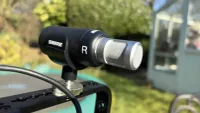
It took me a little while to get used to the DMS1's slightly unusual look; it's not a classic shotgun mic profile. The mic array juts out of the top in an upside-down cone, or I think it maybe looks a little like a flower. It's unusual, but that said, it's also small and discreet enough that it doesn't really command much attention.
The entire mic is incredibly compact at just 45.0 x 63.7 x 73.7mm, and it weighs just 100g. In use, I didn't really notice the added weight, and it barely affected the balance of the camera at all. I could also take the mic on and off a gimbal (in my case, the Hohem MT3 Pro) without having to recalibrate. However, if you use a cage on your camera, this might affect how you can use the DMS1, as you have to use it in the camera hotshoe for power and data transfer.
But that is important, as the squeaky clean setup is the DSM1's biggest strength. The hotshoe connection supplies both power and transfers audio to the camera, but that means there are no cables trailing out of the side of the camera, nothing to snag, and no blocked ports, which makes the whole thing feel tidier and far simpler to use.
The big kicker, though, is that the design’s elegant simplicity comes at a cost: the hot-shoe only connectivity effectively locks the mic exclusively to compatible Panasonic cameras (and even then, only a select group of the latest models).
This means there is absolutely no broader compatibility – no line-in, no USB-C, and no Bluetooth – as with no internal battery, power must come from the camera body. That is fine if Panasonic is your whole workflow; less so if you switch between brands or occasionally record on devices like phones or a laptop for recording a voiceover.

Panasonic has struck the right balance of controls between the pro and casual user. The directional mode buttons are grouped on the rear and are very easy to switch between, with a soft blue backlight highlighting the quick mode you're in. The buttons also require a little double press, which means you're less likely to switch modes mid-recording.
The more advanced audio settings sit on the side; these controls look a lot more like the ones you might find on a more professional XLR mic, which might be intimidating for casual users, but thankfully, the options here aren't too overwhelming to get your head around.
The controls themselves are a little on the small side, but I found the switches flick-able with a fingernail. The controls are also covered with a transparent shield, which helps prevent accidental changes.
In the box, Panasonic also includes a windscreen and a pouch, and I appreciated that the pouch is designed to fit the microphone even with the windscreen attached, which, for some reason, with other brands, isn't always the case.

Performance
In use, the DMS1 is very good. Panasonic’s six directional modes are the headline feature; these cover Forward Cardioid, Stereo, Wide Stereo, Forward Supercardioid, Rearward Supercardioid, and Bidirectional Supercardioid, and I found each mode genuinely very good.
The large-diameter 10mm array and beamforming system offers great clarity and directionality, and broadly speaking, the mic does deliver clean, excellent audio with a nice sense of control over what you are capturing.

However, it's not that it beats every dedicated microphone. My overall feeling is that the DMS1 is a great jack-of-all-trades, but perhaps master of none.
Panasonic markets it as a digital shotgun microphone, but for really strong isolation, I got better clarity from my Rode shotgun mic. Likewise, when it came to recording my voice in unpredictable scenarios, I still preferred a good wireless lapel mic setup. My DJI Mic 3 gave me more freedom to move around the camera without having to worry about what pickup pattern I was in, depending on where I was relative to the mic.
However, that's not really the point of the DMS1. The fact that you can handle a wide range of situations from a single compact unit with excellent audio can outweigh the limitations. It really depends on what you need a microphone for and just your preferred way of shooting.

The mic is also packed with more advanced features that are genuinely helpful both to pros and to newbies.
Wind cut and noise reduction are effective. 32-bit float support on selected compatible bodies is a real advantage for unpredictable recording environments, and Panasonic’s backup recording modes are the kind of thing that can save a take when levels are not quite where you thought they were.
These are things that are a slight learning curve to build into your workflow, but once you to can prove invaluable.
Verdict
Hats off to the Panasonic Lumix DMW-DMS1 design, it might look a little odd, but it solves a very real problem for shooters keen to avoid a spaghetti mess of cables – it's light, it's incredibly quick to mount, and it’s very easy to operate. The directional recording modes are genuinely useful and have impressive sound quality. For solo creators who film in diverse situations, this could be the only on-camera microphone you need.
However, whether this is the right mic for you depends on how you shoot. I found voice isolation stronger on my dedicated cardioid shotgun mic, and wireless mics still suited my setup better as they gave me more freedom to move around.
The most significant catch though is system lock-in. If you shoot exclusively on a compatible Panasonic body, the seamless integration is superb. However, if you like to mix brands or want one microphone to move between multiple devices, including phones or laptops, I think third-party options remain the smarter buy.
Features ★★★★★ |
The six directional modes, 32-bit float support, backup recording and hotshoe-powered design make the DMS1 capable for such a small on-camera microphone. |
Design ★★★★☆ |
I really like the compact, cable-free design and thoughtful controls, even if the microphone’s shape looks a little odd and its system-locked approach limits its appeal. |
Performance ★★★★½ |
The DMS1 sounds very good and is usefully versatile, but it might not quite replace dedicated mics for some shooters. |
Value ★★★½☆ |
The DMS1 makes the most sense for committed Lumix users with the latest cameras; outside that ecosystem, broader-compatibility rivals are easier to justify – and can cost much less. |
Overall |
★★★★☆ |
Alternatives