
The Nikon Z5IIC is Nikon’s first camera launch in over a year, and as the name suggests, it’s a variant on the Nikon Z5II, which was Nikon’s entry-level full-frame camera. But now that mantle has been taken by the Z5IIC. Does the ‘C’ tagged onto the end of the name of the original camera suggest a more ‘compact’ form factor, or does it perhaps signify ‘choice’? A bit of both, as it turns out.
It is, essentially, a Z5II without a viewfinder: a full-frame 24.5Mp camera aimed at videographers, photographers who chiefly use tripods and the rear screen to compose their scenes (such as landscape or still life photographers), and those migrating from smartphones, who have never used or see the point of viewfinders. That lack of a viewfinder offers two distinct advantages.
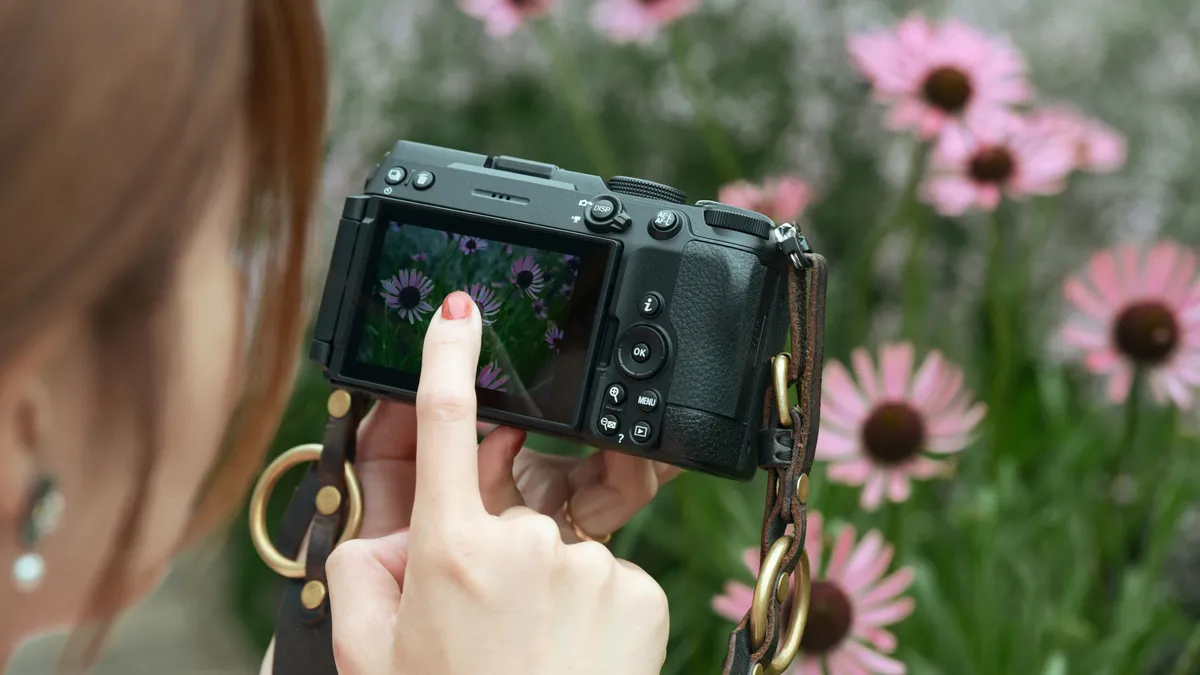
First is a lower price point. Nikon’s electronic viewfinders are sophisticated and expensive components, packing a high-resolution screen and a chunk of precision Nikkor glass into a crisp, responsive display for a lag-free view of the world.
Removing this has enabled Nikon to launch the Z5IIC at a very reasonable $1399.95 / £1,349 / AU$2,399, compared to today’s typical Z5II selling price of $1,599 / £1,499 / AU$2,699, thereby saving around $200 / £150 / AU$300 (and this is the launch price, let’s not forget, which is bound to fall over time).
Second, the camera has a more compact and lighter form factor. The Z5IIC weighs in at 537 grams, as opposed to around 700 grams for the Z5II, and with no viewfinder bump on the top, the camera is squatter and more pocketable. It does retain the deep grip for comfortable handholding, though.

The camera is available in two colour schemes: an all-black version, or a black body with a silvered top section, which gives the camera a retro vibe (though not quite as retro as the Nikon Zf). Both these colorways are available at launch (rather than one following later down the line, which has been the case with other Nikon cameras with different color options).
The headline specs are the same as in the Z5II. At the heart of the camera is the powerful EXPEED 7 processor. There’s the same 24.5-megapixel full-frame sensor, which offers superb dynamic range, great color rendition, and exceptional low-noise performance, with a top ISO setting of ISO64,000 for stills and ISO51,000 for video.
The maximum burst rate is 14fps using the mechanical shutter to shoot Raw or JPEG images, or a blistering 30fps using the electronic shutter, though only JPEGs are available in this mode. Other goodies include a vari-angle touchscreen, in-body image stabilization to enable steady handheld shooting at up to 7.5 stops slower-than-normal shutter speeds, and a rugged magnesium alloy frame with weather sealing to allow you to keep shooting in inclement conditions.
You also get access to Nikon Imaging Cloud, with which you can upload your photographs over the airwaves, download imaging recipes to customize the look of your shots, and keep the camera's firmware updated automatically.
Z5IIC Specifications
Effective pixels |
24.5 MP |
ISO sensitivity |
Stills: 100–64000, Lo 1.0, Hi 1.7 |
Engine |
EXPEED 7 |
File format (Photo) |
RAW/JPEG/HEIF |
Phase detection AF area |
Single-point AF: 273 points |
Subject detection |
10 types: People, birds, dogs, cats, cars, bicycles, motorcycles, trains, airplanes, fish |
AF detection |
-10 EV |
Continuous shooting speed |
Electronic front-curtain shutter: 14 fps (CH+) |
Vibration reduction |
5-axis in-body VR: Up to 7.5 stops at the center and 6.0 stops at the periphery / Focus point VR |
Shutter speed |
1/8000–30 sec (extendable up to 900 sec) |
Video frame size/frame rate |
4K 60p (cropped) |
Video compression |
N-RAW (Normal), H.265/264 |
Video recording mode |
N-Log, HLG, SDR |
Hi-Res Zoom / Digital zoom |
Yes |
Monitor |
3.2-inch, approx. 1040k-dot vari-angle |
Viewfinder magnification |
Approx. 0.80x |
Media slot |
SD (UHS-II) ×1 |
Connectivity |
Wi-Fi (2.4GHz, 5GHz) / BT |
Nikon Imaging Cloud |
Yes |
Interface |
USB-C 3.2 Gen 2, HDMI-D, external stereo microphone jack, Remote Cord / headphone jack (compatible with MC-DC3 Remote Cord) |
Dimensions (W×H×D) |
Approx. 134 × 80.5 × 72 mm (5.3 × 3.3 × 2.8 in) |
Weight (camera body only) |
Approx. 537 g (1 lb 3 oz) |
Introducing Fish AF!
While there is little difference in the specs, aside from the lack of a viewfinder, the new camera does have one new feature that is not found on the Z5II, or any other Nikon camera, for that matter. It is the first to have a specialized Fish AF tracking mode.
Just as Bird AF mode is distinct from the Animal AF mode and locks onto avian subjects, this new mode is specifically designed to lock onto aquatic subjects and is sure to be popular with marine photographers, for whom a viewfinder-less camera is particularly ideal, given that using the rear screen is the only practical way to compose when underwater. Nikon has said that it has no plans to make its own aquatic housings, but it’s a sure bet that companies such as Nauticam and Ikelite will provide watertight cases for the camera.

In addition to Fish AF mode, the camera has all the Face, Animal, Vehicle – and so on – tracking modes found in other Z-series mirrorless cameras, bringing the total to 10 in all. I’m sure that, over time, this new Fish AF mode will make its way to other cameras in the range via firmware updates, but for now the Z5IIC is the only camera to have this autofocus mode.
Make a scene
The camera also borrows a feature from the Nikon Z DX APC-S sensor models, such as the Z50 II. It is the first full-frame camera to support Scene modes: beginner-friendly modes designed to make it easy to dial in the appropriate settings for whatever subject you're shooting without the need to think about the best aperture, shutter speed, and focus mode settings yourself.
There are options for food photography, landscapes, portraiture, wildlife, pets, sports, low-light portrait, and so on. This further reinforces that Nikon is aiming this full-frame camera at beginners as well as enthusiasts.

Vlogger's delight
This isn’t the first Nikon full-frame camera without a viewfinder; that honor goes to the Nikon ZR. But while that camera, which is based on the Nikon Z6III higher up the line, is a specially video-focused model, with an oversized 4-inch monitor and the ability to record 120fps 4K video, the Z5IIC is more of an all-rounder that is suited to bloggers, influencers, and more casual movie-making; its video tops out at 4K 60fps as opposed to the ZR’s 4K 120fps.
Video-friendly features include in-camera Raw recording, a product review mode (where the camera automatically switches focus from the presenter to objects shown to the camera and back again), and the ability to use imaging recipes to give video a filmic look, including those developed by RED, the professional video camera maker that Nikon acquired and developed the ZR in conjunction with.

When I reviewed the Nikon Z5II, I found it to be the ideal full-frame camera for the majority of us, offering a great feature set that will suit all but the most demanding photographers at a more affordable price point than Nikon's more professionally oriented cameras.
The Z5IIC looks sure to offer the choice of the slimmed-down version of that camera to a whole new generation of photographers looking to make the move from smartphones and compacts, who want the image quality that only a full-frame sensor can offer, the flexibility of interchangeable lenses, and all without the steep learning curve that most ‘serious’ cameras demand.
Z5IIC image gallery


The Nikon Z5IIC will be available in October. As well as the body-only price of $1399.95 / £1,349 / AU$2,399, it will be available bundled with the Z 24-50mm f/4-5.3 standard zoom kit lens for $1699.95 / £1,609 / AU$2,949.
Other kit bundles will be available in different territories, including with the Z 24-200mm f/4-6.3 VR superzoom in the UK and Australia for £2,049 / AU$3,699, or the high-spec Z 24-70mm f/4 S in the UK for £1,879.
In Australia, there are a couple of alternative lens options: the Z 40mm f/2 bundle retails at AU$2,899, while the camera plus the Z 24-105mm f/4-7.1 goes for AU$3,049.
Not made your mind up? See our guides to the best Nikon cameras and best cheap mirrorless cameras.

