



Digital Camera World Verdict
I’ve always had soft spot for superzoom lenses and the Tamron 25-200mm f/2.8-5.6 Di III VXD G2 proves that optically, this class of lens isn’t as ‘soft’ as it used to be. One of the new breed of one-hit wonders for mirrorless cameras, it can genuinely replace a pair of standard and telephoto zooms, making it a great solo lens for travel and walkabout photography. With V3 firmware, it can also make a good stab at macro shooting. My only disappointment is that it’s only available for Sony E-mount cameras, with no other mount options.
Reasons to buy
- +
Generous zoom range
- +
Good image quality
- +
Quick autofocus
- +
0.5x macro facility
- +
Weather-sealed
Reasons to avoid
- -
Dual extending inner barrels
- -
No AF/MF switch
- -
No optical stabilization
- -
Only for Sony cameras
Why you can trust Digital Camera World Our expert reviewers spend hours testing and comparing products and services so you can choose the best for you. Find out how we test.
So-called ‘superzoom’ lenses that stretch from generous wide-angle coverage to respectable telephoto reach used to get a bad press. It was often said that the huge overall zoom range came with an ‘inevitable’ compromise in image quality, and that this type of lens was lacking in sharpness either at the short end or the long end of its zoom range, or both, or even throughout the entire zoom range. That’s arguably true of most superzoom lenses designed back in the day, for film SLR and DLSR cameras, compared with some of the best separate standard and telephoto zooms. To use an audio analogy, it was a bit like comparing an all-in-one music center with top-quality hi-fi separates.
But times change and technology moves forward, often at quite a pace. Thanks to the latest research, development and manufacturing techniques, and the greater design freedom enabled by most mirrorless cameras compared with their DSLR forebears, there are now some seriously strong superzoom performers on the market. A case in point was the Tamron 28-200mm f/2.8-5.6 Di III RXD, which I personally praised for its compact, lightweight and travel-friendly build, relatively fast aperture rating and impressive image quality, at least for a superzoom lens.
However, I also criticized the previous Tamron 28-200mm for its relative lack in wide-angle coverage. That’s been put right by the replacement Tamron 25-200mm f/2.8-5.6 Di III VXD G2 that I’m reviewing here, which aims to be one of the best travel lenses and the best lenses for Sony cameras. However, as with the previous Tamron lens, the newcomer is still only available in a Sony E-mount edition.

Tamron 25-200mm f/2.8-5.6 Di III VXD G2: Specifications
Mount options |
Sony E (FE) |
Full frame |
Yes |
Autofocus |
Yes |
Image stabilization |
No |
Lens construction |
18 elements in 14 groups |
Angle of view |
81.7-12.3 degrees |
Diaphragm blades |
9 |
Minimum aperture |
f/16-32 |
Minimum focus distance |
0.16m (W) 0.8m (T) |
Maximum magnification |
0.52x (W) 0.26 (T) |
Filter size |
67mm |
Dimensions |
76x122mm / 3.0x4.8in |
Weight |
575g / 20.3oz |
Tamron 25-200mm f/2.8-5.6 Di III VXD G2: Price
The Tamron 25-200mm costs around $899 / £729 / AU$1,699, in both of its Nikon Z and Sony E mount versions. That stacks up pretty well against the own-brand Nikon Z 24-200mm f/4-6.3 VR, which has a slower aperture rating but includes optical stabilization, lacking in the Tamron lens, the Nikon selling for around $947 / £897 / AU$1,679. That’s a bit of a moot point as unlike many of other Tamron’s recent lenses, the 25-200mm is only available in Sony E-mount and there’s no Nikon Z-mount version.
Sony’s closest equivalent own-brand lens is the Sony FE 24-240mm f/3.5-6.3 OSS which again is slower but adds optical stabilization, as well as having a larger overall 10x zoom range. Surprisingly, the Sony is considerably pricier than the Tamron in the USA, but tends to be less expensive than the Tamron in the UK and Australia, coming in at $1,248 / £719 / AU$1,299.
Tamron 25-200mm f/2.8-5.6 Di III VXD G2: Design & Handling
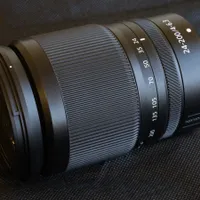
The Tamron 25-200mm isn’t what I’d call a ‘compact’ lens, looking physically quite long even at its shortest zoom setting. However, it’s reasonably slim and lightweight, with a 67mm filter attachment thread and vital statistics of 76x122mm / 3.0x4.8in and 575g / 20.3oz. Handling feels very natural, with a large zoom ring at the front and a small focus ring at the rear.

Typical of recent Tamron lenses, the 25-200mm is smartly turned out with a satin black finish. White lettering and numbering is clearly visible even in very dull lighting conditions although like the vast majority of modern lenses, it lacks a focus distance scale.

The focus mechanism is fully internal, so the front element neither extends nor rotates during focusing. The latter is a bonus when using rotation-dependent filters like circular polarizers. However, typical of superzooms and various other classes of zoom lenses, the Tamron physically extends as you make your way though the zoom range. While it’s shortest at 24mm, its dual concentric inner barrels cause the lens to grow in length by about 60mm / 2.4in, by the time you reach full extension at the longest 200mm focal length.

The zoom control ring itself is large and grippy, with a ridged rubberized surface. Again, it’s clearly marked with white numbering at plenty of focal lengths along the way, comprising, 25, 35, 50, 70, 100, 135 and 200 millimeters. You might feel a little niggled that the lens doesn’t quite zoom out to a more conventional 24mm but in practice, it makes very little difference. The zoom action itself is smooth and precise without any stiffness or jerky spots – more on that in a moment.

As is often the case with autofocus lenses, the manual focus ring is relatively narrow. Situated towards the rear of the lens, it almost looks a bit of an afterthought but works well enough, being electronically coupled to the autofocus motor. The arrangement is very typical of modern lenses designed for mirrorless cameras. The only real downside is that if the autofocus motor fails, you lose the ability to focus either manually or automatically, so you basically can’t focus at all. Let’s hope that never happens.

The autofocus motor itself has been upgraded, compared with the previous Tamron 28-200mm lens. As such, the new lens features a VXD (Voice-coil eXtreme-torque Drive) motor, which is extremely rapid for stills, complete with sufficient agility to track fast-moving subjects, while also enabling smooth and virtually silent autofocus transitions when shooting video. The new lens also features a customizable function button on the left side of the barrel, which is typically assigned to autofocus-lock.

There’s no AF/MF auto/manual focus mode switch on the lens so if you want to make the change, you’ll have to dip into your requisite camera menu. There is however a zoom lock switch, which you can use to lock the zoom mechanism at its shortest focal length. This avoids the risk of the lens physically extending while you’re carrying it around, hanging off the camera. Some superzoom lenses that I’ve used suffer very badly from zoom creep but I’m happy to report that the Tamron didn’t exhibit any zoom creep at all during my testing, even when shooting vertically upwards or downwards using a tripod.

The lens comes complete with a petal-shaped hood. As usual, its reversible for compact stowage and fits via a bayonet-action mechanism. Given the extravagant zoom range of the lens, it’s naturally more effective at shorter focal lengths than at the long end.

The lens comes with front and back caps, the front one of which has the typical pinch-action style for releasing it. This makes it relatively easy to fit or remove the front lens cap even when the hood is fitted in its front-facing orientation.

A USB-C port positioned near the rear of the lens is a connectivity bonus. You can use this to connect the lens to a computer and apply firmware updates or customization, using the free Tamron Lens Utility app. Another option is to splash out on the optional Tamron-Link Bluetooth adapter (sold separately), which plugs into the socket and enables you to use Tamron’s mobile app with the lens.

The last word for design and handling goes to the metal mounting plate at the back. This features gold-plated electronic contacts, plus a weather-seal gasket to avoid the ingress of dust and moisture through the joint between camera body and lens. Further weather-seals are incorporated into the design and fitted along the entire length of the lens around critical joints.

Tamron 25-200mm f/2.8-5.6 Di III VXD G2: Performance
When it comes to performance, sharpness is often regarded as the main hurdle for superzoom lenses. The Tamron impresses throughout its entire zoom range, with the ability to resolve fine detail and texture, from its most wide-angle focal length all the way to its most telephoto setting. That’s backed up by good clarity, contrast and crispness, giving images a very clean and tidy look.

The outright zoom range itself isn’t exactly class-leading but it’s very powerful nonetheless. To give a feel for what’s on offer, the photos shown above and below were taken at the minimum and maximum focal lengths of 25mm and 200mm respectively, of the same subject shot from exactly the same position. The only difference is a flick of the wrist to alter the zoom setting.

The Tamron isn’t a ‘fast’ lens but its aperture rating of f/2.8-5.6 is certainly faster than that of many competing superzoom lenses. With good close-up potential (which I’ll come to next) and long zoom settings on the menu, it’s fairly easy to attain a tight depth of field and the quality of bokeh is pretty nice.

As if the lens wasn’t already versatile enough, there’s 0.5x macro magnification on offer for extreme close-ups. I was somewhat skeptical when reading that firmware V3 enabled closer focusing in the 25-70mm sector of the zoom range, thus enabling greater macro magnification of 0.5x or more. As it turned out, my sample of the lens came with the original firmware V1, so I was able to test it, then apply the firmware update via the USB-C port, and retest it. The following pair of shots demonstrate how much extra macro magnification you can get at a focal length of 70mm, with the later firmware version.

Here’s the maximum magnification on offer at a zoom setting of 70mm with the original firmware V1.
Image credit: Matthew Richards

After updating the lens to firmware V3, this images shows how much extra macro magnification is available.
Image credit: Matthew Richards
Performance is also good in the speed and consistent accuracy of autofocus. I’m also impressed that color fringing is of quite a low order and easily within the remit of automatic in-camera correction. And unlike many modern lenses designed for mirrorless cameras, the Tamron isn’t hugely reliant on automatic in-camera correction for distortions, which isn’t ‘forced on’ in the relevant camera menu. Here’s another pair of shots taken at the shortest and longest zoom settings, of the same scene.

Here’s another graphic representation of the Tamron’s overall zoom range, this wide-angle shot taken at 25mm.
Image credit: Matthew Richards

And as with the earlier example, this second shot was taken of the same scene from the same position, at 200mm.
Image credit: Matthew Richards
The only slight upset as far as I’m concerned is that the lens lacks an optical image stabilizer, especially as Tamron’s ‘Vibration Correction’ system typically works extremely well. You could argue that all but the first versions of Sony Alpha full-frame mirrorless cameras have IBIS (In-Body Image Stabilization) but optical stabilization tends to work better at telephoto focal lengths. Another factor is that the reasonably compact size and weight of the lens make it perfectly viable on Sony’s APS-C format mirrorless cameras, on which it has a useful ‘effective’ zoom range of 37.5-300mm. The majority of these cameras don’t feature IBIS, so you end up with no stabilization at all.
Tamron 25-200mm f/2.8-5.6 Di III VXD G2: Sample Images
The following gallery of sample shots was taken at the East Somerset Railway in the South West of England. It’s a delightful historic railway that’s run as a charity by a friendly bunch of volunteers, and is well worth a visit. Weather conditions were pretty dreadful during my outing with the Tamron, being rainy and overcast with very flat lighting, and thus presenting a proper challenge to the lens. But hey, if you’re buying a travel lens for the journey, you can’t guarantee the weather.


Tamron 25-200mm f/2.8-5.6 Di III VXD G2: Lab Results
We run a range of lab tests under controlled conditions, using the Imatest Master testing suite. Photos of test charts are taken across the range of apertures and zooms (where available), then analyzed for sharpness, distortion and chromatic aberrations.
We use Imatest SFR (spatial frequency response) charts and analysis software to plot lens resolution at the center of the image frame, corners and mid-point distances, across the range of aperture settings and, with zoom lenses, at four different focal lengths. The tests also measure distortion and color fringing (chromatic aberration).
Sharpness:


The Tamron 25-200mm proves that you don’t have to compromise sharpness with one of the latest designs of ‘superzoom’ lens. Levels of sharpness are very convincing across the whole image frame, and throughout the entire zoom range. Sharpness does drop off a little at the longest end zoom setting, and towards the extreme edges and corners of the frame at the widest available apertures, but that’s only to be expected.
Fringing:

Color fringing is negligible even at the edges and corners of the frame in the 25-50mm sector of the zoom range. It becomes progressively a little more noticeable in the 100-200mm sector but remains of a low order and is easily within the remit of automatic in-camera correction.
Distortion:

There’s fairly strong barrel distortion at the most wide-angle focal length of 25mm, and noticeable pincushion in the 50-200mm sector of the zoom range. However, automatic in-camera correction is on hand to give virtually distortion-free results – something that many mirrorless lenses rely upon.
Tamron 25-200mm f/2.8-5.6 Di III VXD G2: Verdict
Rightly or (more probably) wrongly, I’ve been a sucker for superzoom lenses ever since I bought my first DSLR and became worried about dust landing on the image sensor with every lens swap. True to its breed, the Tamron 25-200mm f/2.8-5.6 Di III VXD G2 cuts down the need for swapping lenses to an absolute minimum, as it’s incredibly versatile, and then some. It’s a first-class travel lens with a huge zoom range that stretches from generous wide-angle coverage to serious telephoto reach, so you can adapt to almost any shooting scenario with a flick of the wrist (a twist of the zoom ring) rather than changing lenses. And therefore you only have to pack and carry a single lens when traveling or going on walkabout.
On top of that, the V3 firmware update enables closer focusing throughout the 25-70mm sector of the zoom range, delivering 0.5x or more macro magnification. That puts ultra-close-up photography on the map for this well traveled lens, further adding to its versatility. And unlike a number of 0.5x macro zoom lenses I’ve used in the past, the Tamron delivers impressively sharp, crisp macro images.
More importantly, this Tamron delivers very good sharpness and all-round image quality throughout its entire zoom range for general shooting, backed up by fast and consistently accurate autofocus. I wish it was available in more mount options than just Sony E, and I feel that the omission of optical stabilization is mildly disappointing but overall, it’s one of the best superzoom lenses on the planet at a very competitive price.
Features ★★★★½ |
Strong features include an expansive 25-200mm zoom range with a relatively fast aperture rating, fast voice-coil autofocus, a 0.5x macro facility and a customizable function button. |
Design ★★★★½ |
The design is suitably lightweight and easily manageable yet extensively weather-sealed, ideal for a travel lens. Typically, however, it stretches quite noticeable at longer zoom settings. |
Performance ★★★★½ |
It’s not the sharpest lens in the world but the Tamron is nevertheless impressively sharp for a superzoom lens with consistently accurate autofocus and very good overall image quality. |
Value ★★★★½ |
It costs around the same as the Nikon Z 24-200mm lens and is either more or less expensive than the Sony FE 24-240mm depending on where in the world you live. |
Overall |
★★★★½ |

Alternatives