Digital Camera World Verdict
A technical marvel, a thing of beauty, but a compromise hard to accept for those who want to capture zoom photos and videos, the iPhone Duo will massively improve some aspects of my workflow but leave me disappointed from time to time.
Reasons to buy
- +
Beautiful, eye-catching design will drive jealousy (if that's your thing).
- +
Unique features for photographers using the dual displays.
- +
AI smile detection
Reasons to avoid
- -
No tele camera feels a big step down from the 3-camera iPhone Pro series.
- -
Apple's pricing seems difficult to accept next to other foldable phones.
- -
Some aspects of the first generation software need a little polish (ideally from 3rd party developers)
Why you can trust Digital Camera World Our expert reviewers spend hours testing and comparing products and services so you can choose the best for you. Find out how we test.
The iPhone Duo, Apple's first folding phone, is probably the most significant new phone from Apple since the line divided into Pro and standard models in 2019. The the division was was all about offering a premium camera spec, so it was easy for me – and photography and video creators – to understand the distinction. This time it's very different.
The iPhone Duo is clearly now the top of the tree in pricing and desirability terms, but is it actually the phone that you should want? That's what I've been deciding since mine arrived.
Spoiler: the answer is going to be different depending on your needs. For example, if you like to carry an iPad Mini to review your work, but you do most of your photography on a 'real' camera, you might find there is an advantage – even a cost saving here.
For those who prefer to do their photography on their phones, the compromises (and, believe it or not, advantages) are going to involve weighing more complexity...

Adam has been working with big names to publish books, videos, podcasts on photography for over two decades. O've that time I've steadily come round to using Apple gear but – a fact for the geeks – my first serious computing was done on the Acorn Archimedes, the computer from which Apple 'discovered' the ARM processor. I've been testing Apple phones for some years, and I've had every iPhone since the first, and I'm also big fan of portable tech – reviewing drones, action cameras and more when I can spare a moment from managing the DCW schedules.
Price
The iPhone Duo starts at a shockingly expensive at $1,999 / £1,999 / AU$3,499 with 256GB storage, rising to $3,199 / £3,199 / AU$5,899 for the maximum 2TB tier. Personally I'd suggest the 512 or 1TB are the way to go.
By comparison a brand new iPhone 18 Pro Max – with a telephoto camera and a variable aperture – comes in at $1,299 / £1,299 / AU$2,299 for the 256GB tier, and the current (at time of the Duo's launch) mid-tier iPhone, the iPhone 17, is less than half the price of the Duo at $899 / £899 / AU$1,399.
Looking beyond the Apple sphere, the Samsung Galaxy Z-fold, a similarly-sized passport fold from the company, is priced a little lower at $1,899 / £1,699 / A$2,699.

iPhone Duo Specs
Display peak brightness |
3000 nits |
Display dimension |
5.4-inch (Outer cover) / 7.6-inch (Inner folding) 120Hz ProMotion |
Storage options |
256GB, 512GB, 1TB, 2TB |
RAM |
12GB |
Processor |
A20 Pro chip (2nm) |
Rear cameras |
48MP Main + 48MP Ultra-wide |
Front/Selfie cameras |
12MP TrueDepth (Outer screen) / 4MP Under-display (Inner screen) |
Battery |
4,883 mAh dual-battery system |
Dimensions and weight |
Folded: 11.3mm thick / Unfolded: 5.2mm thick | Weight: 254g |

iPhone Duo: Build and handling
I've been using iPhones since the start, and it won't surprise you at all that I've found this the most significant change since then. For younger readers the switch to my iPhone, by the way, was a matter of getting used to a touch screen instead of physical buttons, which was a big change! New to me was pinch-zoom and all sorts. Even the 2MP still-only camera felt like a step up from most phones of the day.
As an iPhone user, though, I've not risked switching my main phone account to phone until now. I've tried them, been impressed in some respects, but never enough to switch from iOS.
The upshot is that, by switching, I've got Apple's new version of iOS and the device to experience all at once – and both need to work.
The good news is that, as you'd expect, first impressions are excellent (I don't seem to be one of the unlucky few who had a cracked screen).

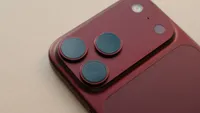
The handset itself, when closed, looks a little like a sawn-off hybrid of the iPhone Pro Max (the same kind if width) and the shiny metal edges of the iPhone X generation. Except, of course there are two layers!
If you've seen an iPhone Air you'll know what I mean (and I'll feel good about my suspicion that it was 'just half a folding phone').
As a right-handed user, my thumb sits very naturally on the protruding TouchID scanner. A little lower down is the camera button, while the volume controls move from where your instinctive press is (the left hand side), because that is now the hinge, to the top.
The 4 main apps (task bar?) is on the right, and just above it is room for a new round battery and signal graphic that, er, I'm sure I'll get used to, and, finally, at the top right a round punch hole camera. It's a lot smaller than the notch and looks elegant since Apple have opted for the passport design with rounded corners opposite the hinge.

iPhone Duo's camera features
I knew that the iPhone Duo came with one fewer main camera than I was used to, but there are some other aspects of the camera system which were new to me.
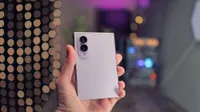
For example, the iPhone Duo lets you open it and use the main 7.6-inch (1878 × 2670 pixel) display to shoot and the outer display will now face your subject. Some, like my wife, love this feature as an opportunity to check their look before I shoot.

The option to fold the camera, put it down, step back and let the AI decide on the perfect moment to grab a shot is actually pretty cool. I tried it with mixed results, though once I realised that if I opened the phone nearly all the way I could rest it on a surface and use the main camera, the Duo Preview and the AI 'Smart Take' to get an idea of what it might capture.
As you may imagine, things like the peace sign help the AI, but the most important thing to do is be sure you're looking at the right lens (with the device at an obtuse angle, you'll have sight lines to both the main cameras and the punch-out selfie camera on the outer display).
iPhone Duo: Main camera performance
The main camera system consists of two 48MP cameras, a main 26mm EFL 'Fusion Lens' with a fixed f/1.6 aperture and hybrid focus pixels, and a 13mm f/2.2 wide angle lens that supports macro.
In so far as there is any telephoto, there is a center crop of the 26mm EFL which digital zoom will extend all the way to 10x zoom (but remember the 10x is only working with 12MP at 2x, and the results were exactly as bad as I anticipated.
The camera does boast optical image stabilization, though, so if you're not looking to shoot subjects at longer distances, and don't need a variable aperture, things should be fine.
For me, I'm coming from an iPhone 17 Pro Max, and I did regularly use the tele lens, but of course there were no variable apertures on any of the three cameras and that never posed an issue for me.


Next are a couple of very telling comparisons between the iPhone 17 Pro Max and the iPhone Duo (swipe between). In essence the A20's extra power might give the iPhone Duo a slight edge when it comes to the computational photography for portraits, but there is nothing that the lack of a 200mm efl lens can do when it comes to telephoto.




Overall, though image quality is impressive where you'd expect it. I don't feel it's a step backward – save for the telephoto – from the generation that impressed me most, and whether the variable aperture really offers much more is open to doubt too.

Video footage I captured also seemed to cope well with complicated lighting conditions and that, in essence, is what iPhones – including it seems the Duo – are good at: color science.
Just as before, this phone makes it easy to pick up and take a photo of the scene you can see, from face to sunset.
That said I found some things frustrated me personally that I'm going to keep testing – the speed that the focus point changed its mind in Cinematic Mode video, for one, was dizzying. It's great to have fast AF, but for a cinema shot you're also likely to want a focal point!
iPhone Duo: Selfie camera performance (outer)
The outer selfie camera is the better of the two selfie cameras, though at 12MP it is still a step down in resolution from both the Pro Max and (perhaps more surprisingly) the iPhone Air!
The pictures I took generally seemed to get color tones about right, though perhaps exaggerated imperfections in skin with a bit too much saturation, and the image sharpening really seems to go to town on my beard and hair in general. Apple's software accentuates skin pigmentation at this resolution for some reason, so if you're proud of your frekles this is your lucky day, but, to be fair, this was also true of the 17 Pro Max.

iPhone Duo: Selfie camera performance (inner)
The 1824 × 2432 pixel inner front camera is, in its way, a technical marvel, seeing as it can 'through' a screen. But the results are, inevitably, not the quality you hope for.
The 4MP pic here is comparable at first glance to the one we shot with the outer camera, but detail isn't as clear (not that I'm especially upset about that given what it did to my skin). Where the inner camera struggles more is when you're indoors – darker environments, pinpricks of light coming from lamps etc. do seem to create a halo effect.


Overall verdict
It's not easy to sum up this device in one go because, for the first time in a while, it isn't a matter of slow perfection and of polish but of compromise. In fact the elegant styling refinements seem to suggest a phone that isn't first generation, but after living with it as my main phone, certainly has some oddities.
Some of those are just the inherent strangeness of changing form factor, so my advice there is to go into that open minded. You're going to need to get used to things you expected to – bigger screens, deciding when to open it and the like – and you're also going to find little niggles that go with that.
The keyboards seem a little more sensitive to me, or less, depending on which way round I'm using the phone and there are a lot of ways to be doing that. If you're using it open you might also rotate it a bit and then be surprised to find the lock button somewhere inconvinient. My personal tip is to make sure you register both the thumb and first fingers with both hands with TouchID as soon as possible.
In my first days of use, I found the cameras very limiting, but a week on I'm already seeing merit in the things you can only do on this. Side-by-side multi-tasking is useful for social promotion, and a bigger matte screen is great (indoors anyway) for browsing photos. The A20 processor blasts through things and at the end of each day I'm always surprised to find a good chunk of battery (generally about 40%) left even if I've been using it a lot.
I can only imagine that a combination of the familiarity that comes with time and taking advantage of unique features will prevail for me, despite the camera compromise, but that's because I'm a tech nerd and I'll see it as an opportunity to use other cameras more often too. At the same time I might get some more pictures of my beautiful wife who is was usually fond of the photos I capture on my iPhone 17 Pro Max, but could definitely be persuaded by the opportunity to use the dual-screen preview.
Is this a great overall camera phone? No. Is it great for portraits? Yes. Is it a brilliant device for a photographer to have with them? Definitely. Ideally all those would be a yes, but it's a great start.
Features |
You don't earn five stars here without a telephoto lens, and Samsung have managed it in a foldable. Despite this huge failing, everything else I want is here including battery life and multi-tasking (sure, there might be more complex alternatives, but the side-by-side is easy to understand). |
Design |
In terms of looks and feel, Apple has nailed it. The choice of matte inner display that nearly conceals the fold, the glorious shiny edges. |
Performance |
In terms of processor power, I didn't find the A20 pausing for a thing in my tests, despite some of Apple's very intensive graphics. Computational image treatments are great, too, and smooth, but some skintones are a degree off perfect. |
Value |
Honestly Apple are asking a lot of money here. Sure they've made a folding phone feel like this year's tech even though it's hardly new, but it's still a big ask, especially as the minimum memory configuration feels a little stingy at 256GB. Perhaps you could sell your iPad Mini toward the cost? |
iPhone Duo Alternatives