Digital Camera World Verdict
The Vivo X300 FE is a handsome compact phone with cameras that punch above their weight. Vivo's excellent image processing and picture styles are a highlight, and while the X300 FE can't keep up with the rest of the X300 lineup, it's still capable of great shots. The main issue is the ultrawide camera, which just isn't very good. At the right price, though, it could be a tempting option.
Reasons to buy
- +
Compact size
- +
Solid camera performance
- +
Teleconverter support
- +
Great battery life
- +
40W wireless charging
Reasons to avoid
- -
Weak ultrawide camera
- -
No Log video recording
Why you can trust Digital Camera World Our expert reviewers spend hours testing and comparing products and services so you can choose the best for you. Find out how we test.
Last year's Vivo X200 FE left me wanting more. It wasn't a bad phone, and it could take great photos, but it didn't feel like a proper flagship, despite being on the higher end of the pricing scale.
Now, the Vivo X300 FE has arrived, and it's looking much more tempting. This model gets a healthy upgrade to the Snapdragon 8 Gen 5 chip, adds fast wireless charging support, and even supports Vivo's excellent external teleconverter lens.
It's a smaller handset, similar in size to the Galaxy S26 and iPhone 17 base models, but it doesn't skimp on the specs, with a bright display and a massive battery inside. If you're not keen on carrying a mammoth Ultra flagship, but you still want some of that Vivo magic, this could be a good bet.

Specifications
Screen |
6.31-inch 120Hz OLED |
CPU |
Qualcomm Snapdragon 8 Gen 5 |
RAM / Storage |
12GB + 256GB / 512GB |
Wide Main Camera |
23mm 50MP f/1.57 1/1.56-inch |
Ultra Wide Camera |
15mm 8MP f/2.2 1/4-inch |
Telephoto Camera |
73mm 50MP f/2.65 1/1.95-inch |
Front Camera |
50MP f/2.0 1/2.76-inch |
Video |
Up to 8K30 / 4K120 |
Battery |
6500 mAh |
Operating System |
Origin OS 6 (Android 16) |
Size (HWD) |
150.8 x 71.8 x 8.2 mm |
Weight |
190g |
Price & Availability
The Vivo X300 FE came as a bit of a surprise, launching alongside the X300 Ultra in global markets. As usual, European availability is a little limited, and this one isn't coming to the UK or the US.
Vivo tells us it will be available soon in Spain, Austria, Hungary, and Poland. As well as Asian markets, the UAE, Saudi Arabia, Brazil, India, and Pakistan.
At the time of writing, Vivo hasn't been able to share the European pricing, but some sources say it'll be equivalent to around $730 when it finally lands on shelves next month.
Design
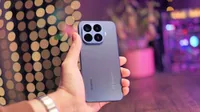
The design of the Vivo X300 FE reminds me of the iPhone Air, with its elongated camera bar shoved all the way to the top of the frame. However, don't be fooled, this isn't a particularly slim phone. At 8.2mm thick, it's decidedly average.
What is impressively slim is the camera bump. It only protrudes from the rear panel by a few millimetres, and since it's up at the top, it's well out of the way when you're holding it. It also feels surprisingly well-balanced, despite this configuration. I can imagine this setup working well with a MagSafe-compatible case.

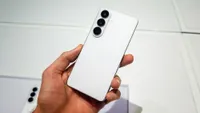
I have the Mist Purple version in for testing, which has a very pale lilac rear panel and silver siderails. There's also a white model, complete with a shimmering finish, and darker black and green versions, if you'd prefer something a little more professional-looking.
The phone comes with a basic silicon case in the box, with an opaque matte finish that's color-matched to the phone. I also got a charger and a charging cable with my sample, although I'd imagine that will vary from region to region.
The phone has the usual volume rocker and power button combo on the right-hand side, and there are no additional buttons. Vivo has been a little inconsistent in its approach. The X200 Ultra had a Camera Control-clone, the X300 Pro had an Action Button-clone, while the latest Ultra and FE have neither.
The phone benefits from IP68 and IP69 water and dust resistance. This means it's protected against full submersion, as well as blasts from jets of hot water. So, if you drop your X300 FE at a car wash, it just might live to tell the tale.

One of the defining features of this phone is its size. If you prefer a smaller handset, you're sure to enjoy this. It has a 6.3-inch screen, basically the same size as the base model Galaxy S26, iPhone 17, and Xiaomi 17. It feels much more comfortable in your pocket, and it's much easier to reach the top of the display if you have smaller hands.
Speaking of the display, it's quite impressive. It can reach up to 5000 nits of brightness output in certain conditions, and I never had trouble seeing when out in the spring sunshine. It also has a smooth 120Hz refresh rate, and it's an LTPO panel, which means it can dip down to 1Hz to conserve battery when displaying a static image.
The colours look vivid and accurate, and fairly slim, symmetrical bezels complete the flagship screen experience. I can't help but wish the selfie camera cutout was a little smaller, but hey, it's a lot less intrusive than Apple's pill-shaped void.

Camera Performance
The camera stack on the Vivo X300 FE is largely unchanged from last year. There's still a 50MP main camera with a 1/1.56-inch sensor, a 50MP 3x telephoto camera (1/1.95-inch), and a rather disappointing 8MP ultrawide with a tiny 1/4-inch sensor.
The only real upgrade is that the main camera now has a slightly wider aperture; it's f/1.57, up from f/1.9, which might help slightly in low light conditions.


Of course, another big change is that the phone is compatible with Vivo's 200mm external teleconverter lens, but unfortunately, I wasn't able to test that. I did have a look through the options in the camera app, and just like its bigger siblings, the teleconverter works across all modes. So, you'll be able to shoot RAW, high-res, or even use portrait mode filters with the external optics.
If you're not so keen on carrying external lenses, the video shooting upgrades might get you more excited. You can now capture up to 8K 30 fps or 4K 120 fps on the main lens. Meanwhile, the telephoto and selfie cameras max out at 4K 60 fps, and the ultrawide is stuck at 1080p 30 fps. I love to see 4K120 becoming more prevalent on affordable devices; it makes such a huge difference for slow motion.
The camera app is largely the same as it is on Vivo's pricier handsets. This means you get the same awesome filters and picture styles, including Zeiss-approved color tuning and bokeh simulations. You can really elevate your photos by playing around with these options. I have become particularly fond of the "Humanistic" street photography mode, which makes the UI look more like a vintage camera, and lets you adjust the film simulations and save them as presets.


You also get a lot of professional settings, including the ability to manually control things like ISO and shutter speed, as well as the option to shoot in RAW. One big difference between this phone and the rest of the X300 lineup, though, is that there's no Log option in video, which I found very disappointing. Vivo has a really good Log profile, and I can't think of a reason why it would be excluded here.
Photo performance is very good on the whole, but this phone has the same limitations as its predecessor. The ultrawide just isn't very good; it really falls apart at night, and it doesn't have autofocus, so it's not very versatile.


The telephoto looks great, but the design of the optics means it doesn't have great macro capabilities. Of course, that's not a massive issue in itself, but with the rest of the X300 lineup excelling in telemacro shooting, this one stands out as a weak performer.
The selfie camera, on the other hand, is a highlight. It has autofocus, so shots always look super sharp, and the ample 50MP resolution means you can take very high-quality images when the light is on your side.


The main camera also offers very strong performance in all lighting conditions. The relatively large sensor and wide aperture mean it's by far the best lens in low light, and Vivo's excellent image processing makes portraits look stunning.
The Vivo X200 FE featured the Aura-light bi-color ring flash that's present on most Vivo V-series phones, but with this model, you get a more traditional single color LED flash. It might not be as flattering for videos, but it works really well for photography. The flash adapts to the focal length you're shooting at, so you'll get a more concentrated flash when using the telephoto, and a wider, more diffused flash for main camera close-ups.
Phone Performance
The Vivo X300 FE is powered by the Qualcomm Snapdragon 8 Gen 5, which is not to be confused with the Snapdragon 8 Elite Gen 5 found in the X300 Ultra. It's a powerful chip, and a healthy upgrade over last year's Dimensity 9300+, but it's not on the same level as the top flagship devices. It's paired with 12GB of RAM and either 256GB or 512GB of storage.
In use, the phone feels flagship-level. It's super speedy, and no matter what I was trying to do, the phone kept up and remained snappy throughout. It's only in benchmark scores, and while playing demanding games, the performance discrepancy becomes apparent. Hardcore gamers may want to look elsewhere, but for everyone else, this handset is more than capable.

The chipset is helped along by Origin OS 6, Vivo's customised version of Android 16. It has a focus on smoothness and efficiency, and it shows. The animations are always smooth and speedy, which makes for a delightful day-to-day experience.
It's also super customisable and has tonnes of gorgeous-looking themes to choose from. There's definitely an Apple influence on the aesthetics, which is very obvious when you see the lock screens with super-sized clocks and Vivo's Dynamic Island impersonation. But they look great, and they're functionally quite useful, so I'm not complaining.


Vivo has extended the software support terms; it's now offering 5 years of major Android OS updates and 7 years of security patches for this model. They're not industry-leading figures, but they're respectable and mean that the X300 FE will remain useful until at least 2033.
The X300 FE has a 6500 mAh battery, which is the same capacity as last year's model, and oddly, larger than the X300 Pro and Ultra (at least in Europe). I would have loved to see an upgrade in capacity, but honestly, the FE doesn't really need it, because the battery life has been excellent throughout my testing.
Despite plenty of screen-on time and camera use, the X300 FE easily lasts me around a day and a half per charge. If I'm more careful, two days on a charge is a possibility, too.
To make matters even better, the X300 FE charges very rapidly. It supports up to 90W speeds with a wire, which will take the phone from dead to 100% charged in just over half an hour. It also adds wireless charging for the first time and boasts up to 40W speeds using Vivo's official wireless pad.

Final Verdict
The Vivo X300 FE is a compact handset with a charming design that's sure to appeal to anyone looking for a smaller phone with quality snappers. I have really enjoyed using it, and while the cameras aren't quite on par with the rest of the X300 lineup, they're still impressive - and I often preferred shots from the X300 FE over similar snaps from the S26 base model.
As for whether it's worth buying, it all depends on the pricing. The cost of Vivo's global models often varies significantly between regions, and my opinion rests on how big the price gap is between this and the standard X300.
The X300 is almost exactly the same size as the FE, but the cameras are much more versatile, and the video capabilities are a big step-up, too. If it won't cost you much more, then it's the obvious choice. However, if the X300 FE is significantly cheaper, then it's a great option, just don't expect too much of the ultrawide camera.
Alternatives