

Digital Camera World Verdict
In one fell swoop, the Mission 1 Pro answers all of my main worries about the GoPro cameras – though it adds a new one: price. If you can afford it, and don't mind the very slight size bump, then the specs and the reality of the image quality are hard to dispute.
Reasons to buy
- +
8K60 recording
- +
10-Bit color log recording
- +
460fps (16x) slow mo (or 960fps burts)
- +
Much faster UX than previous GoPros
Reasons to avoid
- -
Premium price
- -
Not the smallest action camera
- -
No in-built memory (Micro SD card needed)
Why you can trust Digital Camera World Our expert reviewers spend hours testing and comparing products and services so you can choose the best for you. Find out how we test.
GoPro is the name almost everyone associates with action cameras, but for those in the know, there is a bit more to it than that.
GoPro as a company has several product lines, and the traditional ‘GoPro’ – the action camera everyone thinks of under that name – is a sub-brand known as the Hero Black, now in its thirteenth generation.
The company has been very open about the demands that success has placed on the Hero Black camera; it still needs to be rugged, but filmmakers are starting to demand features like high resolution,
That’s where the Mission 1 series came along; a new ‘premium’ tier concentrating on the specs that people like me – photographers and video makers – are obsessed about.
The Mission 1 Pro, the camera I am testing, is the higher-spec of the first two cameras with built-in lenses (but a clever adaptor system). The third, which will come a little later, is a slightly different proposition – with a fully interchangeable lens system.
The key question – has GoPro done the right thing by, well, listening to requests from folk like me, and is it worth the investment?
GoPro Mission 1 Pro: Price
The Mission 1 Pro is $699.99 MSRP and $599.99 at GoPro.com for existing GoPro subscribers – that’s $100 more than the non-Pro version of the Mission 1, and notably more expensive than the Hero 13 Black, which will remain on sale, but is arguably the most compelling in terms of features.
GoPro are also creating a number of bundles – a Grip Edition ($779.99), Creator Edition ($1,099.99), and, coming later, an Ultimate Creator Edition $1,199.99.
GoPro Mission 1 Pro: Specs
| Row 0 - Cell 0 | GoPro Mission 1 |
GoPro Mission 1 Pro |
Resolution / Frame rate |
8K/30fps (or 4K120 "Open Gate") |
8K/60fps (or 8K30 + 4K120 "Open Gate") |
Slow Mo |
4K/120fps |
4K/240fps |
Stills resolution |
8192 x 6144 (50MP) |
8192 x 6144 (50MP) |
Waterproof |
20m / 66ft |
20m / 66ft |
Image sensor |
1-inch |
1-inch |
Weight |
212g |
212g |
GoPro Mission 1 Pro: Build and handling
If you’ve held one of the recent GoPro Hero Black cameras, the Mission 1 and Mission 1 Pro will not hold too many surprises for you. The essentials are very similar; a robust camera that gives an immediate feeling of confidence, with a waterproof door at one end.
That door is home to the battery, the USB-C port, and the MicroSD card slot (there is no additional onboard memory, unlike some competitors).

The battery supplied is a new 2150mAh “Enduro 2,” which is 13% more capacity than the Hero Black battery; however, the Enduro 1 battery will fit into the same slot, simply delivering slightly less life – good news for those who already own a GoPro.
The Enduro 2 batteries also boast a fast-charging tech which flies along, topping up about 80% in 20mins in my test.
Much like the tried-and-tested Hero Black, the camera design features a touchscreen at the back and an additional screen at the front next to the lens so selfies can be composed.
It isn't always easy to see this screen behind the lens protector, but it's only really a composition tool.

The lens itself is bigger, allowing for the 1-inch sensor that exists beneath it, and is cupped with a large rubber surround providing drop protection. This can be removed and pushed back into place reasonably easily. Moreover, the glass element that covers the lens can also be removed by twisting the mount, much like the Hero 12 Black and later, though of course it’s a different fitting.
This means it’s possible to easily replace a damaged cover, or fit lens adaptors, and these will identify themselves to the GoPro so it adjusts its settings accordingly – making it very easy to get the best possible results from attachments. From a user perspective, this is a little like the way a serious camera communicates with interchangeable lenses, though in fact it is one way; there is no focusing or adjustment taking place in the removable attachments.

It is especially ironic, though, given that the ILS version of the camera in this range (due in Q3 this year) has no means of identifying the lens attached, so focus adjustments will have to be entirely manual. That camera, though, is really more likely to be used for some specialist applications.

At the base of all these cameras is GoPro’s hinged doors, again as seen on previous Hero models. These have effective magnetic clips, which I certainly trust, for example, on the top of my cycle helmet. They fold out of the camera body, though, to replicate the traditional GoPro clip and which can survive even more extreme environments. The combined design remains excellent, and copes with the weight.

GoPro has added a new processor chip, the GP3, which offers more power than its predecessor. That is evident throughout the user experience, which just feels a lot less laggy than older GoPro cameras.
It has also been put to use with features like Subject Tracking, a video tuning mode for Dive that color-corrects automatically, and some processing in low-light images. Sport POV and Vlog are among others.

Stills photographers will appreciate the arrival of a grip (a little like the Insta360 one), and this is bolstered by the 50MP stills option as well as the standard 12, but it is in wide only because it uses the whole sensor. More usefully it's possible to take control of all the key exposure settings if you feel so inclined – though it's worth noting that there is no adjustable aperture, unlike the DJI Osmo Action 6.
The need for it on a camera this side is a matter for debate, of course, but in any case it is one less moving part!
GoPro Mission 1 Pro: Performance
When they handed the device to me to begin my early testing, the GoPro team explained that their imaging philosophy was not about creating excessive processing, even though there is now the capability of neural processing on board.
I think that is well evidenced in the very naturalistic-looking footage the camera produced in its default settings, though it wasn't always able to make perhaps the choice I'd have preferred about exposing for me in selfie / vlogging situations.
It was great to have the option of 10-Bit color, which is recorded with the new GP-Log2
Stills were genuinely impressive and I can see myself using this as a rugged compact camera, though it is a shame that the zoom has to be adjusted on the touchscreen.
As the adjustable visualizer below shows, the camera's built-in software has a great handle of very difficult light – better, arguably, than my Sony a7iii. The GoPro is wider than the 28mm option (as far as the kit lens on my Sony would offer), so took in even more bright and dark areas, yet


The GoPro also offers a 50MP image which it described as 'W' (presumably 'wide') yet didn't seem to offer me any alternatives, I'm guessing because it was using every available pixel. Again, though, at default settings while the image is even wider than the standard photo mode, it handles the color in a way which feels more or less spot on despite the very harsh light.

The upshot is that the footage from the camera looks natural and can reasonably be intercut with other cameras.
To my eye, that is especially true of the low light mode, which is slightly less aggressive than some alternatives from DJI and Insta360. This might be a matter of personal preference – the more cinematic choice, perhaps? – but I think many will appreciate this approach. Moreover it's nice to finally have a GoPro that can compete in the low light territory at all.
GoPro Mission 1 Pro: Overall verdict
The camera produced some of the best footage I've ever seen from an action camera, and, for a company that has been languishing a little behind DJI and Insta360 in terms of the specification race, reaching that point seems like a significant achievement.
I genuinely feel like I've been experiencing a camera built with a philosophy much closer to mine, and that's a joy. I'd rather spend a little bit more to have the option of amazing frame-rate slow motion or really convincingly sharp 8K than spend nearly as much for something that cuts corners. Perhaps that's because I don't want to do the action in question too many times – and because I see these cameras taking over a lot of other jobs.
Catering for filmakers it is not without issues, of course. The camera is physically bigger, but that is addressed by GoPro's other smaller and lighter cameras (or perhaps some of the competition!) I would also argue that I still don't love a business model that seems to make subscription unavoidable, but at least there is a significant discount on the camera.
Some will wait, no doubt, for the micro 4/3rds swappable lens, but that won't be waterproof. This camera seems to me, for now, to be the cinematic best that cameras this rugged can actually be, and I love it.
Features ★★★★★ |
The ability to capture stabilized 8K video is impressive enough, but throw in features like the fast slow-mo |
Design ★★★★☆ |
The GoPro design is rugged, and practical, retaining all the standard connectors and adding compatibility with GoPro mics. It is a little odd that the menus disable key features (like Open Gate) by default, but it's easily changed. |
Performance ★★★★★ |
Long-time GoPro users will love the performance; the neural processor on-board improves low-light, but the image is not problematic. There is still 'thinking time' after each shot, but it is rarely an issue – while the images are stunning. |
Value ★★★★☆ |
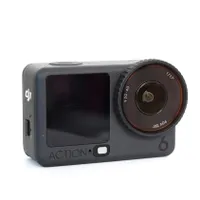
This is the camera's most difficult argument. The DJI's Action 6 has a slightly smaller sensor, but a variable aperture and built in storage, and comes in at about 2/3 the price. |
Alternatives
How I test
I think the best way to get to know a camera is to take it out and use it, and that applies to action cameras especially. The Mission 1 Pro arrived in an especially sunny time and I've mostly been doing walks, so I imagine I'll be adding some additional thoughts when it cools enough for me to feel safe on my bike.

