
When I first assembled my list of the best Canon RF lenses back in 2018 (when the EOS R system launched) things looked very different with a list dominated by premium-priced optics, with no options for APS-C cameras. Today, the best Canon RF lenses comprise everything from top-tier L-series lenses to affordable third-party glass, with full-frame and APS-C both equally catered to. Especially now that Sigma and Tamron are licensed to make APS-C autofocus lenses!
I've included the APS-C equivalent focal lengths for each suggestion, so you know how the lenses will perform on your camera. For more on the differences between RF and RF-S lenses, and whether you should choose full frame or APS-C optics for your camera, read the RF vs RF-S lenses section below.
Personally, if I could only have one RF lens for my camera, it would be the Canon RF 50mm f/1.8 – the brilliant little nifty fifty that's tiny, affordable and takes great images. Everybody's needs are different, though, so here's my list of the best Canon RF lenses based on what you shoot. And since there's so much choice, I've included an honorable mention for every category!

I was a day one adopter of the EOS R system, and I've used every RF lens that Canon has launched since then – as well as exotic and unusual optics from third-party brands. I've bought, sold and shot with the best Canon RF lenses for the past six years, so I can give you honest, first-hand experience of what's worth getting.
The best Canon RF lenses list
Why you can trust Digital Camera World Our expert reviewers spend hours testing and comparing products and services so you can choose the best for you. Find out how we test.
Best Canon RF standard zoom

The workhorse lens for most professionals, the 24-70mm trinity zoom picks up the baton from the older EF version and improves it in pretty much every way.
A top feature is the relatively fast and constant f/2.8 aperture, which enables creative control over depth of field as well as enabling you to shoot in challenging lighting conditions. And, thanks to the weather sealing, in challenging weather conditions as well.
The 5 stops of image stabilization enable you to keep your shots steady, even at longer focal lengths and working with slow shutter speeds. There's no focus breathing, either, making this a brilliant lens for hybrid shooting and dedicated videography.
Read more: Canon RF 24-70mm f/2.8L IS USM review

Features ★★★★☆ | Top features include USM autofocus and optical image stabilization but there aren’t really any fancy frills. |
Design ★★★★☆ | Compared with some pro-grade lenses on the market, this one looks a little basic and dated in its design. |
Performance ★★★★☆ | Performance is mostly excellent but corner-sharpness is a little underwhelming. |
Value ★★★★☆ | The selling price is pretty steep, even for a pro-grade trinity zoom lens, making it less than the best value for money. |
Best value Canon RF wide-angle zoom

One of the great things about the Canon EOS R system is that it includes a lot of very affordable non-professional lenses which are also rather good. The Canon RF consumer lenses are significantly cheaper than those from other brands. This makes the ultra-wide Canon RF 15-30mm f/4.5-6.3 IS STM especially effective.
This would make a great lens for travel, interiors and landscapes, combining very wide angles of view with lightweight build with a very competitive price for a full-frame lens of this type. It even has image stabilization built in, which will be an advantage on EOS R system cameras that doesn't have IBIS. The maximum aperture is a little limited at f/4.5-6.3, but it's easy to forgive that given this lens's price and portability.
Read more: Canon RF 15-30mm f/4.5-6.3 IS STM review


Features ★★★★☆ | Desirable features include 5.5-stop optical stabilization and a customizable control ring. |
Design ★★★★☆ | It’s good overall but there are no weather-seals and the hood is sold separately. |
Performance ★★★★★ | There’s fast autofocus performance and excellent image quality, boosted by automatic in-camera corrections. |
Value ★★★★★ | It’s great value for an own-brand Canon RF lens with this kind of performance. |
Best Canon RF telephoto zoom

Professionals and serious amateurs with a good chunk of change behind them should take note of this member of Canon’s holy trinity of lenses. Designed to be taken anywhere, it’s considerably smaller than any 70-200mm EF counterpart and is comparatively lightweight, too, all the while retaining excellent weather sealing to protect it from the elements.
This fast L series telephoto zoom appeals to many types of photographers, whether favoring landscapes, portraits, or even concert/gig photography where light is minimal and often inside. This lens shoots it all easily thanks to five stops of hybrid IS and a fast f/2.8 aperture.
Read more: Canon RF 70-200mm f/2.8L IS USM review

Features ★★★★☆ | Top features include optical stabilization, super-fast autofocus, a constant f/2.8 aperture and all the handling extras you could wish for. |
Design ★★★★☆ | The telescoping design raises a few eyebrows but the lens is effectively weather-sealed. Unusually, it’s not compatible with Canon’s RF Extenders (teleconverters). |
Performance ★★★★★ | The design of the lens might be unconventional but there’s absolutely nothing wrong with its image quality and all-round performance. |
Value ★★★★☆ | Typical of Canon’s L-series RF lenses, this one is very expensive to buy but still pretty good value. |
Best value Canon RF telephoto zoom

The fast burst speeds and powerful AF tech of recent EOS R system cameras make them great for sports and wildlife photography, and Canon has and ideal lens for this, even if you're on a tight budget. The Canon RF 100-400mm f/5.6-8 IS USM has a 4x zoom range, which is great when shooting subjects at varying sizes and distances, and while the maximum aperture range is modest, especially at 400mm, this helps keep the lens light and portable – and affordable too.
There's no weather sealing, so if you do expect to be standing in rain-soaked fields for hours on end waiting for wary wildlife, it might be wise to save up for one of Canon's premium L-series telephotos instead. But for casual animal or sports fans, this is a terrific 'starter' lens to help develop a hobby.
Read more: Canon RF 100-400mm f/5.6-8 IS USM review


Features ★★★★☆ | Powerful telephoto reach with 5.5-stop stabilization and fast Nano USM autofocus are key features. |
Design ★★★★☆ | This telephoto zoom is certainly lightweight and manageable but doesn’t feature weather-seals. |
Performance ★★★★★ | Image quality, autofocus and stabilization are all highly impressive, making this lens a great performer. |
Value ★★★★☆ | It’s good value at the price but the ‘optional’ lens hood is a pricey extra. |
Best Canon RF lens for travel

With a massive 24-240mm range, this is the lens to go for if you want to carry just one RF lens in your bag – but you still want to be able to shoot things that are both close and far away, from portraits and interiors to landscapes, architecture and even some wildlife.
This isn't one of Canon's L-series lenses, so there's no weather sealing. And, like with all superzoom lenses, there is some compromise on image quality. However, I was still impressed with the results – especially since in-camera corrections help to avoid major aberrations.
The lens also benefits from fast and accurate autofocus and 5 stops of image stabilization – something I definitely appreciate when shooting all the way at 240mm, especially at slightly slower shutter speeds when balancing the narrow apertures.
For anyone who likes to shoot with minimal kit instead of carrying multiple lenses around with you and having to keep changing them, this option may be very welcome indeed – and it won't weigh you down too much.
Read more: Canon RF 24-240mm f/4-6.3 IS USM review


Features ★★★★★ | Top features include a monster 10x zoom range with super-fast Nano USM autofocus and highly effective optical image stabilization. |
Design ★★★★★ | The design is sufficiently compact and lightweight to make this the ideal travel zoom lens for EOS R system cameras. |
Performance ★★★★★ | Image quality and all-round performance are especially good for a ‘superzoom’ lens, redefining what’s possible with this sort of lens. |
Value ★★★★★ | The lens can genuinely replace both a standard zoom and a telephoto zoom in one convenient package, making it great value at the price. |
Best Canon RF lens for street photography

For my money (literally, given that I bought one!) this is one of the best-value and most versatile lenses for the RF mount. First and foremost, the 35mm focal length is perfect for street photography – and a 35mm f/1.8 is considered the classic lens for street shooting. While this is effectively 54mm on APS-C cameras, the "nifty fifty" is also a popular option for the genre.
It provides an entirely natural viewing perspective that also works well for landscape and architectural photography, and environmental portraits where you want to include the subject's surroundings. The f/1.8 aperture enables faster shutter speeds in dim lighting, which is great for moody street scenes – and can even get you a bit of subject separation.
On top of that, the lens has a short 0.17m minimum focus distance that enables 0.5x macro shooting. That's not true macro (unlike the Canon RF 100mm above), but I always find this to be a great lens for capturing close-up details.
Add in a hybrid 5-stop stabilizer that corrects for x-y shift in addition to the more usual angular vibrations, and I think this is the most interesting of the more affordable RF lenses that Canon has produced.
Read more: Canon RF 35mm f/1.8 IS Macro STM lens review


Features ★★★★★ | Useful features include optical stabilization, a fast f/1.8 aperture rating and even a 0.5x macro facility. |
Design ★★★★☆ | Compact but sturdily built, the design is perfect for walkabout photography, although the lens lacks weather-seals. |
Performance ★★★★★ | Image quality is lovely, while autofocus is fast and assured and stabilization works well. |
Value ★★★★☆ | This lens is reasonably priced but, as usual, you’ll have to buy the hood as an ‘optional extra’. |
Best value Canon RF lens
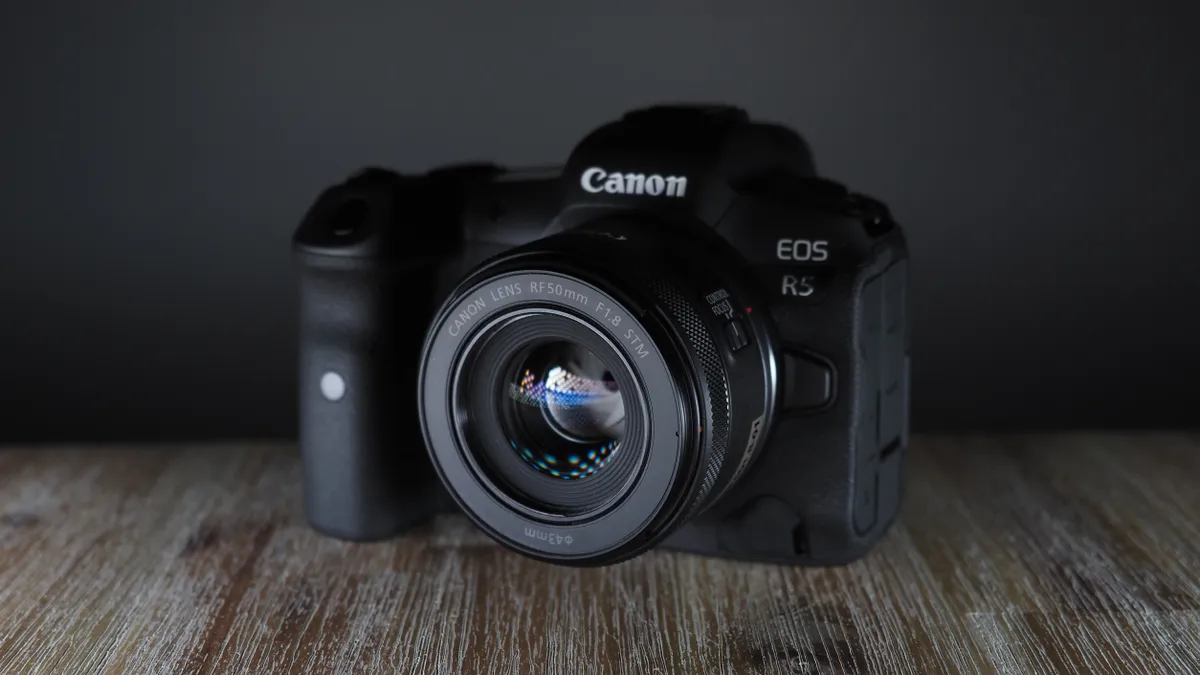
One of the cheapest Canon RF lenses is also one of the best! It's on the front of my camera so much that it's become my de facto body cap – but a body cap that takes amazing stills and video, with a versatile focal length that covers almost every eventuality, meaning my camera is always ready to pick up and start shooting.
You've probably heard that the "standard" 50mm field of view is similar to how the human eye sees the world, making this lens perfect for everyday shooting, travel and street photography, half-length portraiture and more.
(Bear in mind that, on an APS-C body, the focal length is 80mm – which makes it perform like a portrait lens rather than a standard lens.)
The fast f/1.8 aperture offers two big upsides. Firstly, it opens nice and wide to enable your camera to gather tons of light – meaning it's great for working in low light conditions.
And secondly, it delivers dreamily shallow depth of field for those blurry backgrounds and cinematic scenes.
I love that this is such a compact lens, too, as it enables me to keep my setup nice and small – ideal for my everyday carry camera, or when keeping your setup light and lean.
Read more: Canon RF 50mm f/1.8 STM review


Features ★★★★☆ | The feature set is pretty basic but includes STM autofocus and a switchable focus/control ring. |
Design ★★★★☆ | I love the compact and lightweight yet robust build of this lens but it lacks any weather-seals. |
Performance ★★★★☆ | It’s not up to the standard of Canon’s top L-series lenses but punches well above its weight for image quality. |
Value ★★★★★ | The bargain basement price of this lens makes it a no-brainer for both full-frame and APS-C format EOS R-system cameras. |
Best value Canon RF wide-angle lens
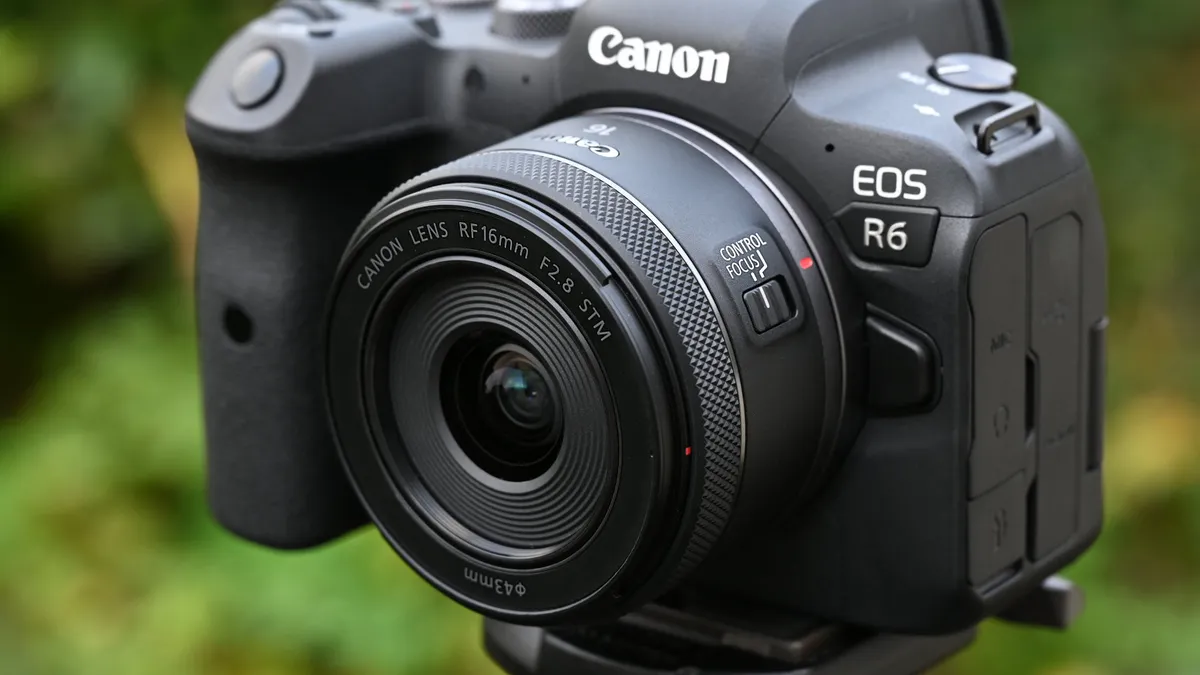
For ultra-wide shooting using a prime lens with autofocus, Canon's 16mm f/2.8 is my top value choice. Even on an APS-C camera, where it becomes an effective 26mm, this is still a very wide lens – which makes it the weapon of choice for vloggers (who need wide angles for self-filming indoors) as well as anyone interested in shooting interiors, street scenes and landscapes.
The f/2.8 aperture is a real boon for the former, as indoor photography and videography often requires shooting in tricky lighting conditions. So the more light a lens can gather, the better!
Like the RF 50mm, this is another absolutely tiny lens – I can't quite believe how small and lightweight it is, again making it a great solution for solo vlogging and videography.
However, in order to achieve this, imagery requires a lot of in-camera corrections – the barrel distortion on RAW files is as huge as this lens is tiny.
This isn't a major problem, as JPEGs are automatically corrected and it's just a couple of clicks to fix in Photoshop, but still something worth bearing in mind if you shoot RAW.
Read more: Canon RF 16mm f/2.8 STM review


Features ★★★★☆ | Ultra-wide on full-frame bodies and still usefully wide for APS-C, complete with stepping motor autofocus and switchable focus/control ring. |
Design ★★★★★ | I’m amazed that Canon has packed such ultra-wide-angle potential and swift f/2.8 aperture into such a compact and lightweight lens. |
Performance ★★★★☆ | Image quality is very good indeed, although there’s a massive reliance on auto-correction for barrel distortion. |
Value ★★★★★ | The price of this lens makes it standout value for any EOS R-system camera. |
Best Canon RF macro lens

The EOS R system is surprisingly well served for macro lenses, but the undisputed king is this: the RF 100mm f/2.8L from Canon, which replaces its legendary DSLR equivalent. In fact, it doesn't just replace it but upgrades it in every way.
Going above and beyond, this lens offers a reproduction ratio of 1.4x – meaning it will magnify your subjects 1.4x, making them bigger than life size to really fill your frame.
On top of that, it offers 5.5 stops of image stabilization – and jumps all the way to a crazy 8 stops when used in conjunction with an image-stabilized camera. I find this immensely useful because, while I use a tripod for macro whenever possible, sometimes I'm shooting a tiny subject handheld – and at 100mm (or 160mm on an APS-C camera) the stabilization really helps me out.
Also super-helpful here is the autofocus, which is both quick and quiet all the way to infinity – and as someone who has wrestled with the slow, clunky AF of other macro lenses, I can assure you this is not the norm!
Another bonus is that there is virtually zero focus breathing on this lens, making it superb for videography. And of course, the 100mm focal length is perfect for close-up portraiture as well as close-up macro work – so in effect, this lens serves triple duty.
A feature that some will love and others will hate is the SA Control dial. This enables you to dial in spherical aberration – a subtle or not-so-subtle soft focus effect, which in my opinion can look great for macro but should be used sensitively for portraits.
Read more: Canon RF 100mm f/2.8L Macro IS USM review

Features ★★★★★ | Not just a macro lens, this one boasts 1.4x maximum magnification backed up by as much as 8 stops of stabilization. |
Design ★★★★★ | The design is top-drawer, boasting ground-breaking magnification for an autofocus macro lens, plus a bokeh control ring. |
Performance ★★★★★ | Image quality and all-round performance are as good as it gets for a macro prime lens. |
Value ★★★★☆ | You wouldn’t expect a lens of this quality, performance and feature set to come cheap but it’s actually very god value at the price. |
Best APS-C standard zoom for Canon RF-S

The Sigma 18-50mm f/2.8 DC DN offers a constant f/2.8 aperture, unlike the competing Canon standard zoom, with a classic 3x zoom range for this class of lens. The Sigma is smaller than you’d expect given its constant maximum aperture yet the build quality is very good – and it’s weather-resistant as well.
The autofocus system is super-fast and virtually silent, and I was impressed by the quality of the images. It's very much like a 'trinity' standard zoom, downsized from full-frame to APS-C format, and very good value at the price.
Read more: Sigma 18-50mm f/2.8 DC DN | C review


Features ★★★★☆ | The fast and constant f/2.8 aperture is the killer feature but the lens is built to be compact and lightweight so there aren’t many extras. |
Design ★★★★★ | Although small and light, the lens feels sturdy and well built. It feels right at home on slimline Sony bodies. |
Performance ★★★★☆ | There’s a good mix of sharpness and smooth bokeh, although edge-sharpness could be better at long zoom settings when shooting wide-open. |
Value ★★★★★ | It’s the kind of lens that you could happily use as your ‘go to’ for everyday shooting, making it great value at the price. |
Lab data and comparisons
The graphs below show the comparative performance of the lenses in this guide, based on our in-house lab tests. The outright winners for sharpness are the Canon RF 100mm f/2.8L Macro IS USM prime and the Canon RF 70-200mm f/2.8L IS USM, the latter being especially impressive for a zoom lens. The ultra-wide-angle Canon RF 16mm f/2.8 STM looks comparatively poor on paper but lab-test results for this sort of lens have to be done at extremely close range, which doesn’t tell the whole story. It’s properly sharp in real-world shooting conditions.
Scores for sharpness and color fringing are averaged from data taken across the entire image frame, from the center to the edges and corners, throughout the aperture range. For zoom lenses, the scores are also averaged from data measured at all marked focal lengths, and the same applies to distortion.
Bear in mind that these average values don't fully reflect specific areas of performance. For example, a zoom lens might have noticeable barrel and pincushion distortion at its shortest and longest focal lengths respectively, which tends to average out when looking at the data overall. For more detailed graphs of each lens's performance, which give the full picture, check out the graphs in our full standalone lens reviews.
What's the difference between RF and RF-S lenses?

The first thing to consider is what kind of mirrorless camera you own. Do you have a full-frame body, like the Canon EOS R5 or R6 Mark II, or an APS-C body like the Canon EOS R50 or R7? Canon makes two kinds of mirrorless lenses: full-frame (RF) and APS-C (RF-S).
RF lenses are designed to cover a full-frame image sensor, but they can still be used on an APS-C body. And since an APS-C sensor only covers the most central part of the lens, you're getting the "fillet" in terms of sharpness and distortion.
RF-S lenses, meanwhile, only cover an APS-C sensor, but they can still be used on a full-frame camera – however, they can only be used in crop mode (which will use a smaller area, and so fewer pixels, of your sensor). As a result, I wouldn't really recommend using an RF-S lens on a full-frame body.
Either way, whatever lens you mount on an APS-body, you will need to multiply its focal length by 1.6x (the crop factor of the sensor) to find out the equivalent focal length on your camera. So an RF 50mm lens will perform like an 80mm lens on an APS-C camera (50 x 1.6 = 80), and an RF-S 10-18mm will behave like a 16-28.8mm (10/18 x 1.6 = 16/28.8). To make things easier, I've included the APS-C equivalent focal length for every recommendation on this list.
While a lot of third-party manufacturers have released RF lenses, Canon will not license anyone else to produce full-frame autofocus lenses or lenses with image stabilization. Plenty of third parties have produced fully manual "dumb" RF lenses, though, with no autofocus or electronic contacts to communicate with the camera.
How to choose the best Canon RF lenses
Choosing the right lenses depends entirely on what you shoot. For example, a fisheye lens is very much the right for some people but very much the wrong lens for others! The RF range features pretty much every kind of optics except (ironically) fisheyes and tilt-shifts, but otherwise if you need a specific lens you'll find it here.
While it's easy to be overwhelmed, and worried that you'll make the wrong choice, I'll just say that Canon doesn't make any bad lenses – so you really don't have to worry about buying a turkey in terms of optical performance.
Work out what it is you like to shoot, and how you like to shoot it. I prefer primes, so I would recommend the Canon RF 50mm f/1.8 as it's cheap, small, and it's versatile enough to shoot most subjects (the "nifty fifty" is the lens that you often hear "should be in everybody's bag"). If you're an APS-C user, the Canon RF 28mm f/2.8 is your 50mm equivalent. If you prefer the flexibility of zooms, go for a focal length appropriate to your subject matter.
In general, Canon's compact f/1.8 and f/2.8 primes are very affordable. For zooms, lenses with a higher and / or variable aperture number (such as f/4, or f/4.5-7.1) are more budget friendly than the L-series lenses with a signature red ring (and usually a constant aperture).

What is the most versatile lens for Canon RF?
The most versatile lens is the hitherto impossible Canon RF 24-105mm f/2.8L IS USM Z – a lens that has only become a reality thanks to the cutting-edge nature of the RF mount (previously, this focal length has only been possible with a slower f/4 aperture).
You can shoot almost anything on this one lens, which for some people replaces the need to carry all three "trinity lenses" as well as the most popular prime lenses. It's also a video-oriented optic with power zoom function and controlled focus breathing, making this arguably the first and ultimate hybrid lens.
What is the best RF lens for portraits?
As a portrait photographer, I recommend the Canon RF 85mm f/1.2L – which is the lens I personally bought, after spending a lot of time testing the available options!
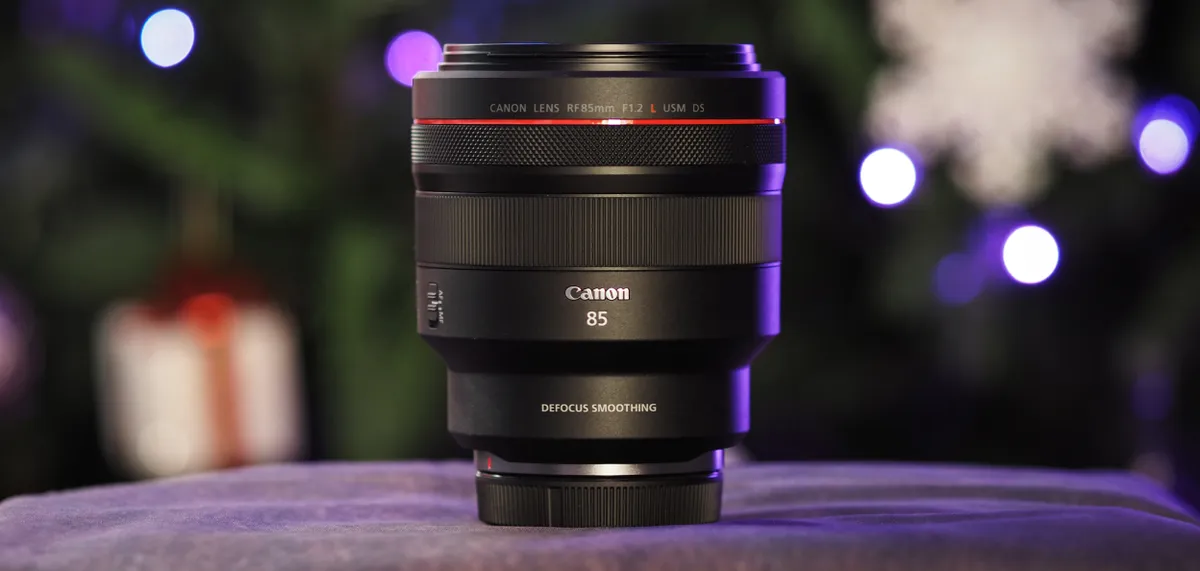
A close second, to me, is the Canon RF 85mm f/1.2L DS lens that features Defocus Smoothing for truly beautiful backgrounds. However, you lose over a stop of light (due to the optical coatings used to achieve the effect) and the backgrounds look a little bit artificial (indeed, AI-generated) for my tastes.
The Canon RF 135mm f/1.8L is a great lens, and in many ways the 135mm focal length is more pleasing. But I find the working distance can be too challenging – both in terms of having enough space to shoot, and being able to connect and communicate with your subject.
Can you use Canon RF lenses on a Canon DSLR?
No, Canon RF lenses are not compatible with Canon EF-mount DSLRs, and there is no adapter available to make them compatible. However, the reverse is possible. You can use old EF lenses on Canon R system cameras if you use an EF-EOS-R adapter.
What is the difference between L lenses and regular Canon RF lenses?
Like with the EF lenses for its DSLRs, Canon employs an 'L' in the names of certain lenses to denote higher quality build and internal optics. L-series lenses can be identified by the red ring around the lens barrel. Most of the longer lenses are white rather than black.
L lenses tend to have larger and higher-quality glass elements and superior lens coatings for sharper images with fewer distortions. They have full weather sealing, come with lens hoods and can also have better autofocus control and image stabilization. They also tend to have faster apertures than standard Canon RF lenses.
How we test the best Canon RF lenses

