





Wearable and not much bigger than your thumb, the POV camera is a new sub-category of action camera that is exciting for vloggers and anyone who wants to capture their lifestyle with as little interruption as possible.
If the traditional boxy GoPro-style action camera is too big, then wearable POV cameras are the solution. Some are small enough to be known as pill cameras (but not for medical reasons). Most designs now include the very practical magnetic clip – so much so that "magnetic camera" is another term for them. They are worn as easily as modern wireless microphones, and can be controlled in different ways.
Like the traditional action cameras, these cameras compete on their compact nature and low weight, their ability to capture high-resolution (and store it), and the ability to get stable video despite being worn on clothing. Desirable features also include waterproofing, a good battery life, and some form of remote control – via case, app, or both.
Image stabilization takes processing power, but there is no way that you can wear a camera on a hat, your chest, or handlebars without it picking up some movement. I've already picked all the best action cameras; here I've looked closely at the best tiny POV cameras and put them to the test myself.

I've been shooting with action cameras since the early days – and testing them to their limits. Yes, I love cycling and snowboarding, but the real reason is that I'm also a drone geek, and, in the early days, the best camera to strap onto a drone was the smallest good one: so I've had GoPros and their competitors since day one!
Best POV cameras
Why you can trust Digital Camera World Our expert reviewers spend hours testing and comparing products and services so you can choose the best for you. Find out how we test.
Best for most people

Coming with a battery housing (”Action Pod”) that boasts a folding 2.5-inch touchscreen, from which the detachable 4K 60fps camera pops out, even without the ‘tiny camera’ option, this would be a compelling action camera with the vlogger’s favorite benefit of a good-sized fold-up display. A nice touch is that a MicroSD card can be added to the Action Pod to increase storage options, though video is initially recorded to the camera’s internal memory.
The camera has a 1/1.28-inch image sensor, making it ever so slightly bigger than any of the competition. The result is a camera that has very little in the way of compromise, and even has an acceptable low-light mode.
As camera-only, it can be worn in two main ways – clipped onto a hat or, thanks to the magnet, worn on a pendant. Typically, you'd hang the chain around your neck and the other side of the magnet behind your clothes, so you can pop the camera on and off very discreetly. Cleverly Insta360 has also designed the pendant to be twisted to set the camera angle up or down – a very useful touch.
Insta360’s image stabilization does seem to have the edge, and includes a horizion balancing mode which many find useful. There is also support for Insta360's microphones for vloggers.
Read my full review of the Insta360 Go Ultra and see sample video
Best for pro quality

Offering creatives the benefit of a The 1.9-inch display isn’t the biggest in this list, but it is a crisp OLED touchscreen which I found great to use (it's responsive) and it’s worth remembering that it is easily detached from the camera so you can keep it nearby if you are worried about the size. The design also means you can point the camera away from or toward the 'screen side' when it is attached to the "Multifunctional Vision Dock" as DJI call it.
The camera’s other big plus point is the 4K120fps slow motion. 4K60 can be captured with DJI's impressive digital stabilization, too, which can also balance the horizon if you want. Another nice touch is pre-roll (hit record after the moment!), though this feature is never quite as good as I hope – because you do need the lens pointing the right way!
The key advantage, though, to this camera is the 10-bit recording in DJI's D-Log M, which allows a lot of flexibility for those who like to preserve color and brightness information until the edit.
DJI has also built in a receiver for the company’s own microphones, as well as cramming stereo mics into the frame. Included with the camera 9either 64GB or 128GB versions) you'll find a hat clip and a magnetic lanyard, as well as a protective case and a ball joint mount with a suction cup (to, perhaps, sticck the camera on a dashboard?)
See my full DJI Osmo Nano review for a sample video
Best cheap

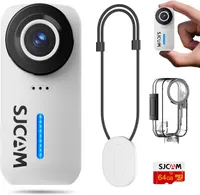
This is a super-cheap camera without a screen, but a form factor that seems to owe a lot to the Insta360 Go 3, or 3S, cameras. It it also worn with a magnetic lanyard so it appears to float on the fabric of what you are wearing but is held in place firmly enough for activity.
Unlike that camera, though, there is no separate wireless controller. There is a TF card slot (compatible with a MicroSD card) in the camera, and it records 4K video directly to this. Simple operation is via a start-and-stop button. It is incredibly compact and remarkably robust, constructed from a sturdy plastic composite that easily survives accidental drops. It also skips a display entirely to keep its footprint as small as possible, making it a very simple, no-nonsense point-of-view shooter.
In low light the output will be a bit less than ideal – the noise or grain is a factor – but the 120-degree field of view has decent (if not perfect) clarity across the whole image.
The camera offers respectable battery life for an action cam, providing around 90 minutes of 4K recording or up to three hours if you drop the resolution down to 1080P (fine for burts of action, but not ideal if you want body cam-like life). Ultimately, for a starter camera or an affordable way to capture memories on vacation without worrying about premium low-light performance, it exceeds expectations at its bargain price.
See our full Boblov W4 review for sample videos
Best for low weight

The Insta360 Go 3S was the first 4K camera in this form factor (though the even cheaper Go 3 came before it if you're happy with 2.7K). It's light enough to clip nearly anywhere and go unnoticed, yet it retains the benefit of the magnetic pendant that many of the other cameras on this list offer.
Insta360 has not left this camera alone since launch, either. Retro chic fans will love the unique 3S Retro Bundle with old-style housing, with prism-and mirror framing device much like an old 110 camera.
In lower light, a camera this small will inevitably experience some "noise" (look a bit grainy), and the battery life is only 30 minutes when you're not inside the 'Action Pod' housing, but the housing can top it up fast. The housing also boasts a flip-up display which, again, makes this a handy vlogging tool.
The camera also has good image stabilization – including horizon balancing, and a 'kids mode' that enables you to let the kids wear the camera while you control it remotely (and they don't press anything that'll ruin your POV capturing of their future memories).
Read my full review of the Insta360 Go 3S with samples
Best glasses

An alternative to a clip-on or body-worn camera is a pair of sunglasses with a built-in camera – controlled from your phone. That is what Meta, the owners of FaceBook, created jointly with Ray-Ban (a brand you just might have heard of). The result is a very convenient in a lot of POV shooting situations.
Smart camera glasses work by connecting to your phone wirelessly, and you can command them from the touchpad on the arm, the app on your phone, or using the built-in microphone with an instruction beginning "Hey Meta...". For example "take a picture," but the AI can also take advantage of the camera to see from your POV, so you could also ask, "What does that sign mean?"
There are hidden speakers over your ears in the arms, which you can use to listen to music and take calls – though the sound is audible to anyone very near you.
Incidentally, here is a cost-saving option: The Gen 2 model that I have chosen here is the better quality option for photo/video with 3K recording but I'll freely admit to being the camera nerd. Just as good (as it uses exactly the same camera system and software) are the Oakley Meta smart glasses.
A word of warning: these glasses have a wide field of view, like an action camera, so won't record a lot of close-up details, but they have nevertheless been associated by some sections of the media with creepy behaviour. To combat this, a light flashes as you record video and the camera won't work if you obscure the light.
If you're looking for a cheaper way to capture the fun from your POV, and the specs don't matter the original RayBan Meta smart glasses are still Ray-Bans, so you still look cool, but will have enough left over for a nice holiday drink or ten too.
Read our full review of the Ray-Ban Meta (Gen 2)
Cheap alternative
How we test POV cameras
Like everything, the best way to get to know something is to try it out in the real world, so this list includes products that we at Digital Camera World have hands-on personal experience with. That also means that if you want to know even more, you can tap through to a full detailed review.
See how we test cameras at Digital Camera World

