





A lot of people look at the Canon EOS R50 V vs R6 V equation and boil it down to one thing: sensor size.
But while it's true that one of the main differences between these cameras is the sensor, there's more to the Canon EOS R50 V vs R6 V discussion than that.
The bodies are more alike than they are dissimilar (in fact, they make a great complementary outfit as an A and B camera), but they offer distinctly different propositions for distinctly different kinds of creator.
So, whether you're an aspiring creator or someone who's already making money from your content, it's time for a Canon EOS R50 V vs R6 V comparison to see which is the right one for you.

Canon EOS R50 V vs R6 V: Specifications
| Row 0 - Cell 0 | R50 V |
R6 V |
Release |
April 2025 |
May 2026 |
Sensor |
24.2MP APS-C |
32.5MP full frame |
Lens mount |
Canon RF / RF-S |
Canon RF / RF-S |
Autofocus |
Dual Pixel CMOS Autofocus II, subject detection (Auto, People, Animals, Vehicles) |
Dual Pixel CMOS Autofocus II, subject detection (Auto, People, Animals, Vehicles) |
Image stabilization |
- |
Up to 7.5 stops |
Weather sealing |
- |
Yes |
Active cooling |
- |
Yes |
ISO range |
100 to 32,000 (exp to 51,200) |
100 to 64,000 (exp to 102,400) |
Max video resolution |
4K 60p (cropped), 4K 120p, FullHD 120p; UVC up to 4K 60p |
Open gate 7K 30p; 7K 60p RAW (internal), 4K 60p (oversampled), 4K 120p, FullHD 180p; UVC up to 4K 60p |
Max burst |
15fps electronic (7 RAWs), 12fps mechanical (7 RAWs) |
40fps electronic (150 RAWs) • Pre-capture (1/2 second / 20 images) |
Viewfinder |
- |
- |
Rear screen |
3-inch, 1.04 million dot, vari-angle touchscreen |
3-inch, 1.62m dot, vari-angle touchscreen |
Memory |
1x SD UHS-II |
1x CFexpress Type B, 1x SD UHS-II |
Dimensions |
119.3 x 73.7 x 45.2mm |
141.8 x 83.3 x 79.7mm |
Weight |
370g (with battery & card) |
688g (with battery & card) |
Canon EOS R50 V vs R6 V: Photo
At first glance, this one is a whitewash for the R6 V. It has better resolution (32.5MP compared to 24.2MP on the R50 V), a higher sensitivity ceiling (native ISO64000 versus ISO32000) and faster burst shooting (40fps against 15fps) – with Pre-Continuous Shooting, too.
However, there are a couple of key considerations in the R50 V's favor – and the first one relates to that burst shooting.
True, the R6 V can shoot continuously at up to 40fps via its electronic shutter – but it only has an electronic shutter. The R50 V's top electronic speed of 15fps isn't nearly as fast, and nor is its mechanical shutter speed of 12fps, but having a mechanical shutter offers some big advantages.
First of all, if you happen to be shooting at those speeds, shooting electronically risks introducing rolling shutter – the effect where fast-moving subjects or scenery appears skewed (because the sensor's pixels are read line-by-line, top-to-bottom, meaning that moving objects shift and skew as the image is recorded).
Flash photography can also be far more problematic with electronic shutters – and, indeed, the R6 V does not support flashguns at launch, though a firmware update to add it has been promised.
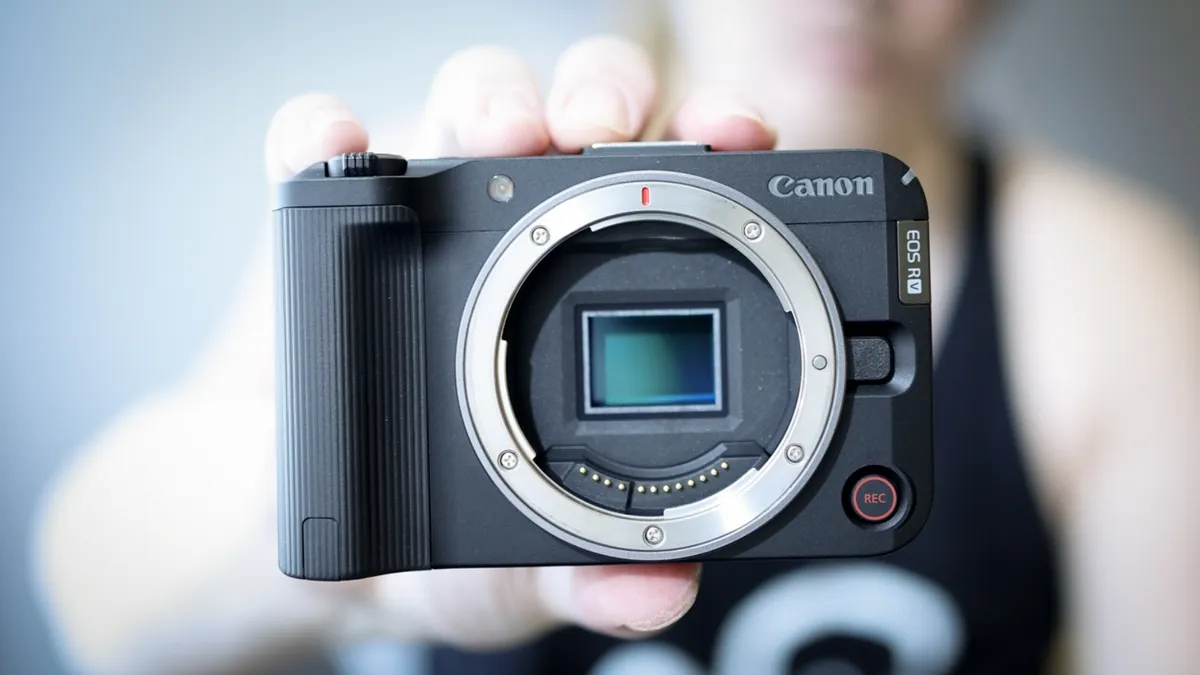
However, the main benefit to a mechanical shutter is when it comes to shooting in artificial lighting. Electronic shutters commonly suffer from banding under artificial and LED light, which can be virtually impossible to remove in post-production.
On the other hand, the R50 V lacks in-body image stabilization. This makes it harder to handhold shots, especially with slow shutter speeds or when using larger lenses. The R6 V, by contrast, has up to 7.5 stops of IBIS – so if you rely on shake compensation, that's a big factor.
It's also weather-sealed, meaning that you can keep shooting when environmental conditions get challenging (provided you're using a weather-sealed lens, of course), and boasts dual memory card slots in case one of them fails.
In all, there's a lot to weigh up. The R6 V has higher resolution, faster bursts and IBIS. On the other hand, the R50 V has a mechanical shutter and is better for flash photography – and it's also much smaller and lighter, making it a better everyday and street photography comparison.
Still, in terms of raw specs and horsepower, it's hard not to give the nod to the bigger brother.
🏆: Canon EOS R6 V
Canon EOS R50 V vs R6 V: Video

When it comes to pure muscle, the R6 V is an absolute unit. Its 32.5MP sensor is capable of 7K 60p capture, 7K 30p open gate video, 4K 120p and FullHD 180p. It boasts both C-Log 2 and 3, and crucially it has an active cooling system for extended shooting times – which you'll need for cranking out 7K!
By contrast, the R50 V only offers C-Log 3 and its 24.2MP sensor tops out at 4K 60p – but this comes with a 1.56x crop. But its 4K 30p video is oversampled from 6K for extra crispiness, while it can crank out FullHD at up to 120p. And while it lacks active cooling, at 4K 30p you effectively get unlimited shooting.
So horsepower-wise, it's a cakewalk for the R6 V – but that horsepower is only better if you actually need it.
Trust me, 7K open gate sounds amazing on paper – and it is amazing – but you can quickly end up with files that are hundreds of gigabytes in size. Do you have the storage to handle that? The processing power on your computer? Do you really even need open gate?

Unless you consistently cross-post content, you're filming high-end studio work or you're shooting for clients that want multiple deliverables, I would argue that open gate is a nice-to-have – not an essential.
For most people, 4K 60p – which gives you the flexibility to do light slow-motion – is enough. The key difference here is that the R50 V imposes a 1.56x crop – and that's on top of the existing 1.6x crop introduced by Canon's APS-C sensor, which makes it much more challenging to shoot wide.
For example, a 16mm lens becomes an effective 25.6mm lens just by mounting it to the R50 V; shoot in 4K 60p and it becomes an effective 39.9mm. Which isn't necessarily a problem, but it does mean being conscious of your lens choice and shooting space, and potentially having to reposition your camera between shots.
Another key difference is the choice of log modes. C-Log 2 is the more professional, but again that doesn't mean it's better by default. In Canon's own words:
"Canon Log 2 provides the absolute maximum dynamic range (more than 16-stops on the EOS C300 Mark III and EOS C70), with detailed shadows and rich highlight information. Canon Log 3 provides the same highlight performance with slightly less information in the shadows (up to 14-stops)."

The long and short of it is that C-Log 2 has more shadow detail but also a lower noise ceiling, so you really need to know how to grade properly. C-Log 3 offers lots of highlight retention and is easier to work with, thus making it faster and friendlier.
Pro-level features aside, I think the biggest consideration is in-body image stabilization (IBIS). The R6 V offers up to 7.5 stops of shake compensation, which makes it possible to shoot handheld footage without too many jitters (though bear in mind that Canon's IBIS does introduce a "Jell-O effect" in the corners when using wide lenses).
The R50 V lacks IBIS, which means you're relying on a tripod, gimbal or the electronic stabilization. The latter crops into your footage (to give headroom for the camera to stabilize your shots), which you need to be extra-conscious of if you're shooting in 4K 60p. This means the R50 V is better for shooting on sticks, rather than handheld.
While the paper specs of the R6 V make it the technical winner, consider what your personal requirements actually are. I think IBIS is important, but it doesn't matter if you only ever shoot indoors on a tripod. C-Log 2 is great, but only if you do heavy post-production. Open gate is awesome, but only if your content needs it and your workflow can support it.
🏆: Canon EOS R6 V

Canon EOS R50 V vs R6 V: Price
No contest here: the R50 V is the most budget-friendly option and gives you incredible bang for your buck.
The Canon EOS R50 V is currently available body-only for as little as $649 / £549 / AU$1,099, or in a kit with the Canon RF-S 14-30mm f/4-6.3 IS STM PZ for $799 / £799 / AU$1,499.
The Canon EOS R6 V is priced $2,499 / £2,399 / AU$3,599 on its own, and is available in a kit with the Canon RF 20-50mm f/4L IS USM PZ in the US and UK for $3,699 / £3,549.
It's a very valid consideration that you could buy a pair of R50 Vs and have a two-camera setup for the same price as a single R6 V. Or buy an R50 V and have almost 2,000 bucks to invest in lenses. Either way, you can have a far more complete and versatile setup by going for the junior camera.
🏆: Canon EOS R50 V
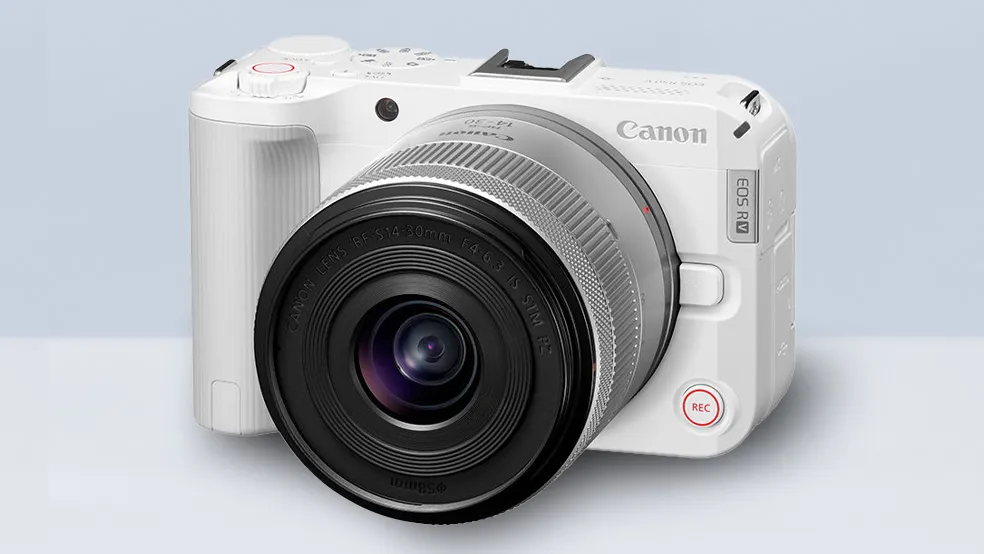
Canon EOS R50 V vs R6 V: Winner
It's hard not to say that the Canon EOS R6 V is the better camera. It has a full-frame sensor, 7K 60p, open gate capture, uncropped 4K 60p, an active cooling system, in-body image stabilization, Canon Log 2…
However, it may be more accurate to say, depending on your needs, the R6 V is the superior specced camera; for some people, the R50 V with its smaller footprint, more manageable files, photographic versatility and price tag that's thousands of bucks less will be a more appealing option.
I would recommend the R6 V for professional creators and videographers who need the highest quality and the ability to output multiple deliverables for clients. And for aspiring or casual creators just building a brand or getting established, the R50 V gives you plenty of firepower at a more affordable price.
Still, in terms of pure capability, the R6 V is the more powerful system and the clear winner.
🏆: Canon EOS R6 V


