





Yes, it’s a new camera in the Canon EOS R6 pantheon, but the full-frame Canon EOS R6 V is completely different from the EOS R6 III, maybe more akin to the APS-C format EOS R50 V'. It’s built for Video with a capital V, and while you can shoot stills with both of these EOS V-series cameras, the design, specifications and handling are firmly aimed at content creators who major very much on vlogging and videography.
Starring roles in the EOS R6 V’s videocentric line-up include 7K open gate video capture with active cooling, image stabilization and weather-sealing, all wrapped up behind an interface that’s comprehensively geared towards videography, and works equally well in landscape and portrait orientations.
So what are the best lenses for the EOS R6 V? By design rather than coincidence, Canon has been really ramping up the video and hybrid side of its new RF lenses, with both zooms and primes to suit pretty much any and every shooting scenario and being equally adept at video capture as well as stills – in fact, even more so.
You can use APS-C format lenses in crop mode, including some of the best lenses for the EOS R50 V, but you’ll really need full-frame glass to make the most of the EOS R6 V – and that means that you can't currently buy third-party lenses for the camera, so have to use Canon's own RF lenses.
Naturally, you can use any Canon RF lens to shoot video, but the hybrid and more specialized video glass focuses more on what type of autofocus system is employed, the suppression of focus breathing, fast aperture ratings and in some cases dedicated aperture control rings. There’s sometimes the inclusion of optical image stabilization, although the EOS R6 V features both IBIS (In-Body Image Stabilization) and advanced digital video stabilization. Some new top-choice lenses also feature power zoom, either built into the lens of via an optional Canon PZ-E2 / PZ-E2B Power Zoom Adapter. I’ll cover all of these topics and more at the end of this guide, in my ‘how to choose’ section. But for now, let’s crack on with the best lenses to suit a variety of videography.

Matthew Richards is a photographer and journalist who has spent years using and reviewing all manner of photo gear. He is Digital Camera World's principal lens reviewer – and has tested more primes and zooms than most people have had hot dinners!
The Best lenses for the Canon EOS R6 V
Why you can trust Digital Camera World Our expert reviewers spend hours testing and comparing products and services so you can choose the best for you. Find out how we test.
The best everyday lens for the Canon EOS R6 V


For my money, this lens has everything I could wish for in a versatile zoom for everyday videography. The zoom range is generously wide-angle at the short end, and great for vlogging in conjunction with the lens’s close-focusing abilities, while stretching to the natural perspective of a ‘nifty fifty’ at the long end. It also boasts a 6-stop optical stabilizer, boosted to 8-stop effectiveness by the EOS R6 V, but its killer feature is ‘power zoom’, for smooth, motorized zooming.
Typical L-series attractions include superior build quality, complete with extensive weather-sealing. That can be an important factor for ‘everyday shooting’, especially where I live in the South West of England (it’s raining right now). Optical finery includes two GMo (Glass Molded aspherical) elements and three UD (Ultra-low Dispersion) elements, along with both Super Spectra coating and more high-tech ASC (Air Sphere Coating). If I had to choose just one lens for the EOS R6 V, it would probably be this one.
Read more: Canon RF 20-50mm f/4L IS USM PZ review
The best standard zoom for the Canon EOS R6 V


When this lens launched, I felt it was a genuine gamechanger, ushering in Canon’s new range of hybrid lenses for video and stills photography. Moreover, it combines the desirably generous 24-105mm zoom range of Canon’s back-catalog f/4L kit zooms, with the faster constant f/2.8 aperture of a 24-70mm trinity standard zoom. And as with other Z series zooms, it’s compatible with the Canon Power Zoom Adapter PZ-E2 / PZ-E2B. Autofocus is powered by dual Nano USM motors which are rapid and virtually silent, as well as enabling super-smooth focus transitions. There’s also effective suppression of focus breathing.
I’d be tempted to pick this lens as my everyday zoom for walkabout shooting, except that it’s big and bulky, and weighs in at 1,350g. Indeed, it’s noticeably heavier than the stills-focused Canon RF 70-200mm f/2.8L IS USM trinity telephoto zoom, which only weighs 1,070g. On the upside, the large size does accommodate chunky focus and aperture control rings, more like what I’d expect to find on a cine lens. 5.5-stop optical stabilization rises to as much as 8 stops with IBIS, and the high-grade optical path includes two GMo elements, four UD elements and one replica aspherical element, along with Super Spectra and ASC coatings.
Read more: Canon RF 24-105mm f/2.8L IS USM Z review
The best telephoto zoom for the Canon EOS R6 V
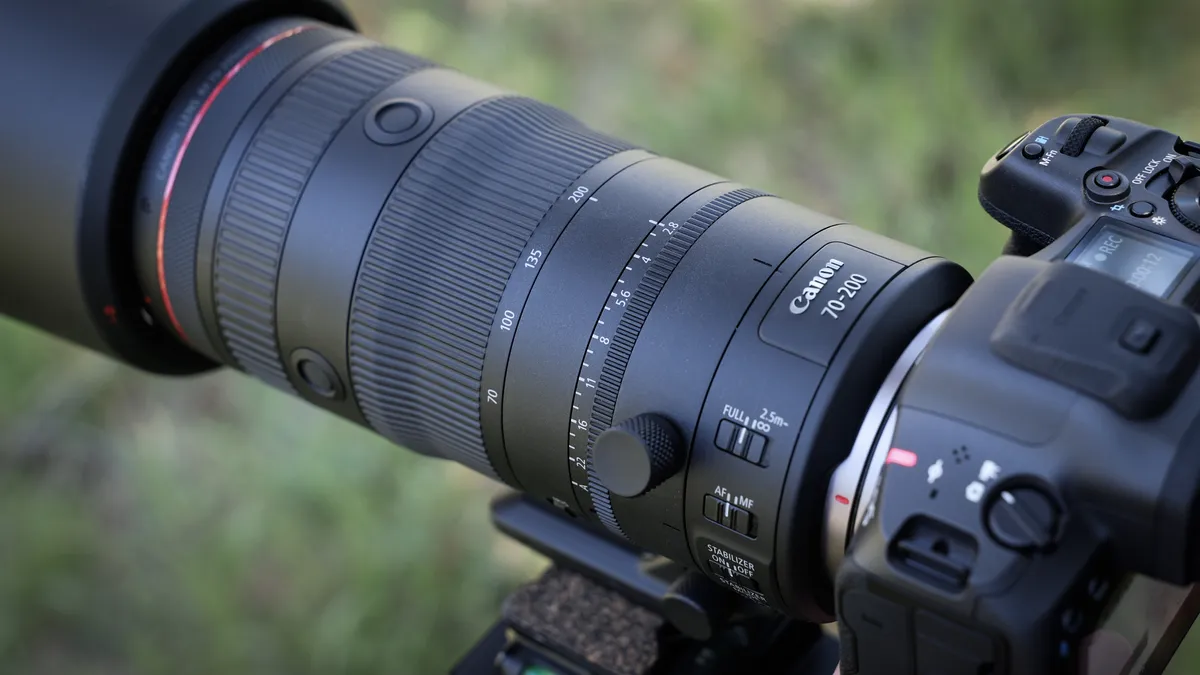


Zoom lenses with a relatively fast and constant f/2.8 aperture rating are often referred to as ‘trinity’ wide-angle, standard and telephoto zooms, the last of these having a 70-200mm zoom range. Canon actually offers a threesome of RF 70-200mm telephoto zooms, this third and latest in the line being a Z series lens that’s designed more for videography than for stills shooting. As such, it’s compatible with the Canon Power Zoom Adapter PZ-E2 / PZ-E2B. It also has a dedicated aperture control ring along with the more usual mode switches and forward rank of customizable function buttons.
This Z lens also happens to be Canon’s first trinity telephoto zoom that’s available in black as well as the usual white finish, and I think it’s nice to get the choice. On a more practical note, advantages over the previous pair of RF 70-200mm zooms is that the Z lens has a fixed physical length thanks to an internal zoom mechanism, which is a plus point when using a gimbal as the center of gravity remains more centralized. It’s also compatible with Canon’s RF Extenders for gaining extra telephoto reach, which can’t be said for either of the earlier RF 70-200mm zooms. The Z lens is simply a brilliant zoom for weddings and events, sports and wildlife videography, complete with dual Nano USM autofocus, 5.5-stop optical stabilization, and two GMo, one UD GMo, one UD and two Super UD elements in its optical line-up.
Read more: Canon RF 70-200mm f/2.8L IS USM Z review
The best ultra-wide prime for the Canon EOS R6 V


It’s not so long ago that the Canon RF 20mm f/1.4L VCM was the most ‘ultra-wide-angle’ prime in the RF hybrid lens line-up, and that lens remains an excellent option for a really expansive field of view. But if you want to go all out for ultra-wide perspective, this newer 14mm lens really takes the blinkers off your videography. It’s simply epic for landscapes and cityscapes, and for exaggerating the apparent distance between foreground and background areas in the frame, for creative effect. The lens is also great for vlogging, when you want to set the scene by shoehorning in a large expanse of background while you’re presenting to camera.
Autofocus is driven by the highly effective, rapid, smooth and virtually silent combination of Nano USM and VCM (Voice Coil Motor) actuators. Despite its monster viewing angle and fast aperture rating, I like that the lens is relatively compact and lightweight, ideal for handheld shooting. Speaking of which, there’s no optical stabilization, which isn’t at all surprising for a lens with such a ‘fast’ aperture, but you do get up to 6-stop stabilization with IBIS at the center of the frame. Optical highlights include one each of fluorite, UD and BR (Blue Spectrum Refractive) elements, along with three GMo elements and both Super Spectra and ASC coatings. One word of warning is that the lens has an integral hood to protect the bulbous front optical element, so there’s no front filter attachment thread.
Read more: Canon RF 14mm f/1.4L VCM review
The best wide-angle prime for the Canon EOS R6 V
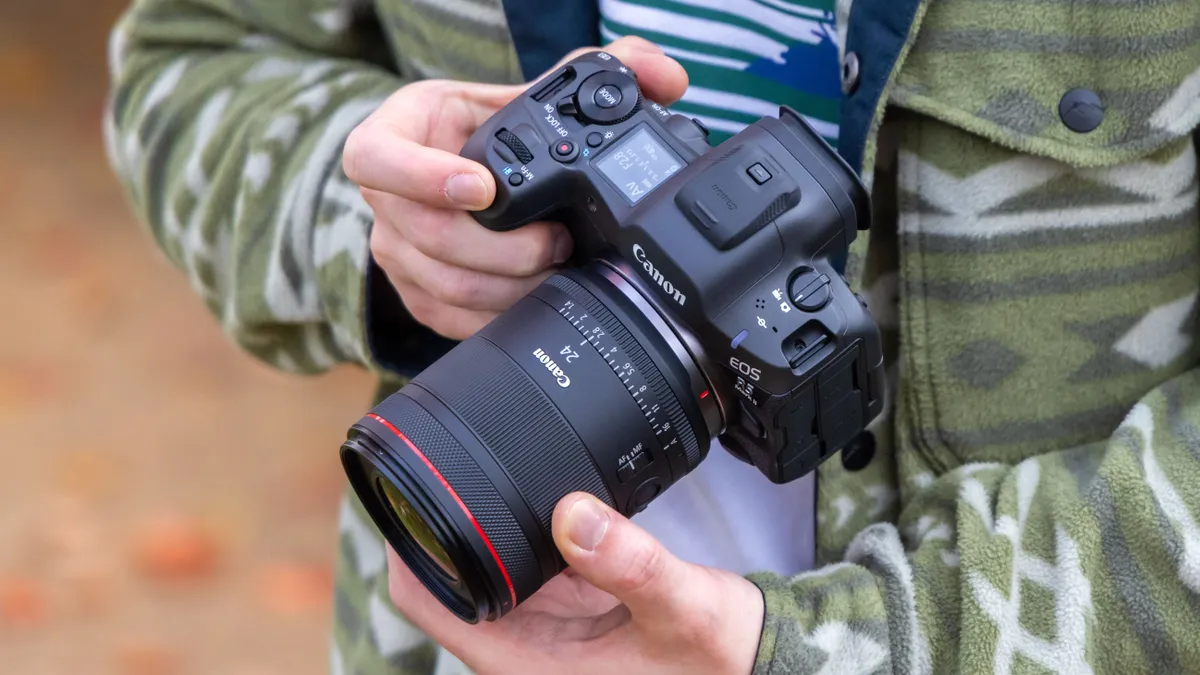


I’ve always felt that 24mm is a classic wide-angle focal length for full-frame cameras, and this lens serves up that desirable perspective with a fast f/1.4 aperture rating. Along with other f/1.4 prime lenses in the RF hybrid series, this lens therefore enables me to shoot in low-light conditions without bumping up my ISO too much, as well as delivering a tight depth of field to isolate subjects within a scene by blurring the background. That can actually be a struggle with short focal length lenses but this lens nevertheless enables a tight depth of field for close-up shooting.
Typical of Canon’s RF hybrid primes and (so far) two Z series zoom lenses, the 24mm has a particularly well-rounded 11-blade aperture diaphragm, which helps to maintain high quality bokeh when stopping down a little. Other attractions include 8-stop IBIS at the center of the frame, despite the lack of any optical stabilization in the lens, and the inclusion of both Nano USM and VCM autofocus motors. Optical finery includes a GMo element, two UD elements and no less than three ASC, SWC and Super Spectra types of coatings.
Read more: Canon RF 24mm f/1.4L VCM review
The best standard-wide prime for the Canon EOS R6 V


A natural perspective can go a long way in keeping things real when you’re storytelling. I love the way that a 35mm focal length gives a slightly wide but entirely natural perspective on a full-frame camera. There’s a good reason why it’s the classic choice for street photographers and for walkabout shooting. This lens gives me my golden focal length with a fast f/1.4 aperture that it has in common with the RF 24mm, 50mm and 85mm f/1.4 lenses, all of which are also on my hit list.
I really like that all four of these prime lenses have exactly the same physical dimensions, handling characteristics and filter attachment threads, making it dead easy to swap between them without any disruptions to the creative flow. That counts for handheld shooting as well as for use with a gimbal. Again, the inclusion of Nano USM plus VCM autofocus motors is a common trait, and this time around you get 7-stop IBIS at the center of the frame, despite the lens not featuring optical stabilization. High-end glass includes two GMo and two UD elements, along with ASC and Super Spectra coatings.
Read more: Canon RF 35mm f/1.4L VCM review
The best standard prime for the Canon EOS R6 V


Maybe I’ve shot myself in the foot by saying that the RF 35mm above gives an entirely natural perspective, but I stand by my words. Even so, for many photographers using full-frame cameras, a ‘nifty fifty’ with its 50mm focal length is seen as the ideal for delivering a ‘normal’ perspective, as it closely mimics the sense of scale, relative distance and proportion that are perceived by the human eye. If a 50mm lens is your go-to prime, and there’s no reason why it shouldn’t be, then this is the perfect example for the EOS R6 V.
Like others in the ‘VCM’ hybrid system, it’s designed and built for exceptional videography performance, along with sublime handling characteristics and tough L-series build quality. I find the uniform, consistent dimensions and aperture rating with other VCM lenses in the RF prime line up to be a real advantage, as well as the dual Nano USM and VCM autofocus motors. A further bonus for handheld shooting is that IBIS is worth up to a class-leading 8.5-stops at the center of the frame with this lens, narrowly beating the effectiveness of IBIS with other primes in the series. The optical line-up includes one GMo and one regular aspherical element, a UD element and both ASC and Super Spectra coatings.
Read more: Canon RF 50mm f/1.4L VCM review
The best portrait prime for the Canon EOS R6 V


We’re a bit spoilt for choice when it comes to RF portrait lenses and I’d go so far as to recommend any of the lenses in this guide for portraiture of varying styles. That includes the versatility of the zoom lenses for portraiture at weddings and other events, the ability of an ultra-wide-angle prime to add context in environmental portraiture and vlogging, wide-angle and standard primes for full-length and half-length portraits, and even the focal length of the 100mm macro lens in my guide for tight head-and-shoulders portraits (while not taking advantage of its actual macro abilities). But if I had to pick just one portrait prime, it would be this RF 85mm f/1.4 hybrid lens.
Like the others in the series that I’ve already covered, the RF 85mm is designed with videography in mind, so autofocus is fast yet offers smooth transitions in virtual silence, this time delivered purely by a VCM (Voice Coil Motor). There’s also an absence of focus breathing and, again, the physical size and layout of the lens is impressively uniform among most in the series. A generous 8 stops of IBIS is available at the center of the frame, courtesy of the EOS R6 V camera body, and quality glass includes a GMo aspherical element and a UD element, along with ASC and Super Spectra coatings. Another similarity is the 11-blade aperture diaphragm, which helps to keep that all-important bokeh looking gorgeous even when stopping down from the generously wide f/1.4 maximum aperture.
Read more: Canon RF 85mm f/1.4L VCM review
The best macro prime for the Canon EOS R6 V


Shock, horror! Unlike every other lens in this guide, the RF 100mm wasn’t designed as a video or hybrid lens. Even so, there’s no beating it for extreme close-ups and macro shooting. It’s arguably the best of its kind on the planet. Whereas most autofocus macro lenses top out at 1.0x maximum magnification, this lens delivers a huge 1.4x magnification, so small objects are reproduced at nearly one and a half times life size on the image sensor. That gives phenomenal scope for enlargement when viewing images on screen or in print.
Another totally tricked-up feature is the ‘Spherical Aberration Control’ ring, which gives you the power to adjust how bokeh looks in defocused areas of images. This makes the lens literally a thing of beauty for portraiture, as well as for extreme close-up shots of the tiny things in life. Dual Nano USM autofocus fits the bill nicely, and the lens features ‘hybrid’ optical image stabilization that’s particularly efficient for close-up photography, counteracting x-y shift as well as the usual angular vibration. If you’re into shooting macro in videography, stills or both, this is a must-have lens.
Read more: Canon RF 100mm f/2.8L Macro IS USM review
How we test lenses and lab test comparisons
The lens experts in our testing lab run a range of tests under controlled conditions. We take photos of Imatest SFR (spatial frequency response) charts, then use the Imatest Master testing suite to analyze for sharpness, distortion, and chromatic aberrations at the centre of the image frame, corners, and mid-point distances across the range of aperture settings (up to f/22).
For zoom lenses, we repeat our test at the widest and longest ends of the zoom range, plus intermediate 'mid-wide' and 'mid-telephoto' settings. Use the dropdown menus to select between them (for primes, the same data appears on all the graphs for comparison purposes).
The graphs below show the comparative performance of the lenses in this guide, based on our in-house lab tests. High-end primes typically lead the way for sharpness, but the Canon RF 24-105mm f/2.8L IS USM Z is particularly impressive for a zoom lens. We don’t yet have lab data for the Canon RF 20-50mm f/4L IS USM PZ and the Canon RF 70-200mm f/2.8L IS USM Z, but they performed very well in our hands-on, real-world tests.
For more detailed graphs of each lens's performance that give the full picture, check out the graphs in our standalone lens reviews.
Center sharpness
Use the dropdown menu to select between wide-angle, mid-wide, mid-tele, and telephoto zoom settings (prime lens data is replicated across all charts for ease of comparison)
| Timestamp (f-stop) | Canon RF 24-105mm f/2.8L IS USM Z () | Canon RF 14mm f/1.4L VCM () | Canon RF 24mm f/1.4L VCM () | Canon RF 35mm f/1.4L VCM () | Canon RF 50mm f/1.4L VCM () | Canon RF 85mm f/1.4L VCM () | Canon RF 100mm f/2.8L Macro IS USM () |
|---|---|---|---|---|---|---|---|
| 1 | N/A | 1857 | 1903 | 2613 | 2359 | 2233 | N/A |
| 2 | N/A | 2088 | 2028 | 2804 | 2750 | 2387 | N/A |
| 3 | 2965 | 2053 | 2088 | 2771 | 2764 | 2276 | 2422 |
| 4 | 2907 | 1995 | 1996 | 2576 | 2707 | 2236 | 2446 |
| 5 | 2658 | 1929 | 1782 | 2524 | 2639 | 2376 | 2048 |
| 6 | 2452 | 1780 | 1738 | 2219 | 2413 | 2224 | 1933 |
| 7 | 2145 | 1644 | 1596 | 1941 | 2054 | 1997 | 1645 |
| 8 | 1635 | 1355 | 1385 | 1607 | 1731 | 1626 | 1604 |
| 9 | 1342 | N/A | N/A | N/A | N/A | N/A | 1299 |

Fringing @ f/8
Use the dropdown menu to select between wide-angle, mid-wide, mid-tele, and telephoto zoom settings (prime lens data is replicated across all charts for ease of comparison)
| Product | Value |
|---|---|
| Canon RF 24-105mm f/2.8L IS USM Z | 0.35 |
| Canon RF 14mm f/1.4L VCM | 0.02 |
| Canon RF 24mm f/1.4L VCM | 0.15 |
| Canon RF 35mm f/1.4L VCM | 0.01 |
| Canon RF 50mm f/1.4L VCM | 0.54 |
| Canon RF 85mm f/1.4L VCM | 0.18 |
| Canon RF 100mm f/2.8L Macro IS USM | 0.19 |
Distortion
Use the dropdown menu to select between wide-angle, mid-wide, mid-tele, and telephoto zoom settings (prime lens data is replicated across all charts for ease of comparison)
| Product | Value |
|---|---|
| Canon RF 24-105mm f/2.8L IS USM Z | -9.12 |
| Canon RF 14mm f/1.4L VCM | -9.7 |
| Canon RF 24mm f/1.4L VCM | -9.42 |
| Canon RF 35mm f/1.4L VCM | -4.97 |
| Canon RF 50mm f/1.4L VCM | 0.64 |
| Canon RF 85mm f/1.4L VCM | 1.21 |
| Canon RF 100mm f/2.8L Macro IS USM | 0.48 |
There's more to it than just the technical side, though! Beyond the lab, our reviewers test lenses in real-world environments. We work with lenses both indoors and outdoors, in studio conditions and in natural light, with as many different subjects as possible (or appropriate – there's no point testing a landscape lens' ability to shoot a portrait!).
We take into account everything from handling and ease of use to autofocus speed and the overall quality of the images produced.
Find out more about how we test and review on Digital Camera World
How to choose the best lenses for the EOS R6 V
Here are some of the things to look out for when choosing your ideal lenses, with videography firmly in mind...
Hybrid lenses
Designed with content creation front and center of the thought process, Canon’s RF hybrid lenses are built to handle and perform equally well in videography and stills shooting scenarios. Desirable features typically include smooth and virtually silent autofocus (or manual focus) transitions, often based on dual Nano USM and/or VCM actuators, along with a dedicated aperture control ring and suppressed focus breathing. Most prime RF ‘VCM’ RF lenses also have uniform dimensions and are of a very similar weight, which is a particular advantage when using a gimbal.
Power zoom
A motorized zoom mechanism can be very useful for transitioning between different focal lengths with the ultimate in smoothness, while avoiding any unwanted jerks along the way. At the time of writing this guide, the Canon RF 20-50mm f/4L IS USM PZ is the only full-frame compatible RF lens to feature a built-in ‘Power Zoom’ mechanism, but Z series RF zoom lenses including the Canon RF 24-105mm f/2.8L IS USM Z and Canon RF 70-200mm f/2.8L IS USM Z are compatible with the Canon Power Zoom Adapter PZ-E2 / PZ-E2B, which you can buy separately (at considerable expense).
RF vs RF-S
While they use the same camera/lens mount, Canon RF lenses are full-frame compatible whereas RF-S lenses only produce an image circle that’s large enough to cover an APS-C format sensor. Unlike with EF and EF-S lenses for Canon DSLRs, you can use RF-S lenses on full-frame EOS R system bodies, but you need to shoot in crop mode, which only utilizes a relatively small central area of the full-frame image sensor, and therefore only a smaller number of the total available megapixels. An upside is that you get a 1.6x image multiplier or ‘crop factor’, effectively extending your telephoto reach with no loss in aperture rating.
Autofocus
The autofocus system used Canon’s hybrid lenses typically involves either one or two Nano USM motors, a VCM motor, or a combination of both. The Nano UltraSonic Motor dates back to Canon DSLR lenses and was designed to be super-fast and near-silent, as well as enabling smooth transitions when shooting video. The Voice Coil Motor is a more recent introduction, used in Canon’s hybrid lenses. It’s exceptionally fast and virtually silent, based on a similar electromagnetic technology to that used in audio loudspeakers.
Image stabilization
Historically, Canon always built optical image stabilization into its ‘IS’ lenses, in preference to using IBIS (In Body Image Stabilization) within camera bodies. The main reason for this was that the optical stabilizer could be specifically designed for maximum performance in each particular lens. That ethos continued up to and including the original EOS R and EOS RP cameras, but most subsequent full-frame EOS R system cameras and the EOS R7 APS-C format cameras now feature IBIS. Combining optical image stabilization with IBIS often gives a further boost to effectiveness, especially for telephoto lenses.
Focus breathing
Focus breathing is an unwanted aberration in lenses that causes the perspective (angle of view) to alter when you adjust the focus distance. In practical terms, if you change the focus distance setting of the lens, it can look as if you’re also zooming in or out. The effect is of little consequence when shooting stills but can be a big problem when shooting video. As such, Canon’s video and hybrid lenses are designed to have minimal focus breathing.
Aperture rating
A ‘faster’ aperture rating (denoted by a lower f/number) can often be preferable when choosing lenses. More light is transmitted through the lens to the camera, so you can shoot in low-light conditions without needing to bump up your ISO setting so much, which can degrade image quality. Faster apertures also give the bonus of being able to gain a tighter depth of field, ideal for isolating the main subject within a scene by blurring the background. Most Canon RF hybrid prime lenses have a fast aperture rating of f/1.4, whereas it’s typically f/2.8 for hybrid zoom lenses.
Aperture control ring
Many of Canon’s RF lenses have customizable control ring that you can assign to the function of adjusting the aperture setting. However, these control rings often work in click steps, so they’re less than ideal if you want smooth, silent aperture transitions when shooting video rather than stills. Canon’s RF hybrid lenses generally feature a dedicated aperture control ring, that operates silently with no click steps, often referred to as having a ‘de-clicked’ action.
