
Digital Camera World Verdict
Sometimes pros have to admit that the best features are available to enthusiasts first – DJI's tracking is one of them. The RS 5 (with Tracking Module) solves all that, and means pro filmmakers with 'proper' cameras will be able to get more work done faster. Worth its weight in gold.
Pros
- +
Tracking via camera and touchscreen
- +
Rugged build and solid locking
- +
All-day battery life
- +
Extensive accessory range
- +
Easy to set up
- +
Strong motors handle heavy cameras and lenses
Cons
- -
Premium pricing
- -
Takes time to get to grips with all possibilities
- -
Legal in the US, but hard to find
Why you can trust Digital Camera World Our expert reviewers spend hours testing and comparing products and services so you can choose the best for you. Find out how we test.
Shooting smooth video with a mirrorless camera is still harder than it should be, but DJI may have just changed that. With built-in AI tracking finally arriving for “proper” cameras, the RS 5 promises to do more than stabilize your shots. It could change how you shoot entirely.
Since the gimbal doesn't have access to the sensors and TTL cleverness of the camera, the previous DJI RS 4 Mini brought a tracking module, which has its own camera to identify the subject of your shot and that has moved up the chain to the RS 5.
Other key gear seeing significant updates are the automated locks; the process of safely putting the device away is now almost completely automatic.
AI intelligent tracking, a new guide for camera operators so they know the limits of their step, premium quality components, compatibility with more cameras, and a new briefcase handle might all offer something to filmmakers – but is it enough?
RS5: Price
With two price options, at £485 (about $650) for the gimbal (including all the essential accessories like the battery grip, tripod base, quick-release plates ) and £619 (about $830) for the RS 5 combo I tested here, which adds the AI tracking module and briefcase handle this isn't the cheapest of gimbals, but DJI has always been a premium player in this space. The RS 5 also takes a high payload and, price-wise, is essentially the same as a Zhiyun Crane 4, for example, despite the RS 5's better features, so still seems like a value win.
RS5: Specs
Payload |
3Kg / 6.6 pound |
Standby time |
14h |
Standby with battery grip |
30h |
Touchscreen |
1.8-inch |
Controls |
2 x toggle, joystick, 3 x button |
Weight |
1.46 kg (3.21 lbs) |
RS5: Build and handling
The RS 5 feels suited to serious tasks right from the unboxing. Specifically I tested the RS 5 Combo edition, which arrived in an excellent zip-able hard case which has just enough flex in it that, when it comes to packing up at the end of a long shoot, you don't have to worry too much about getting everything just right, but also just enough padding that you can be confident of the RS 5's future (with pockets for your battery, tripod, and other screw-in parts).

After unboxing, you'll need to pair the device with your phone and camera, so don't expect to have things working immediately the first minute on set. Why your phone, you ask? Because this is the means of firmware updates.
I'm testing the combo with the RS Enhanced Intelligent Tracking Module, which includes a camera so the AI can watch humans (up to 10m away). It clips easily but firmly onto the top of the Ronin with two hinged clips, and contacts on its base do the rest. At the front a LED ring around the lens indicates whether it has acquired a tracking lock or not, so the talent can know what is going on.

The tracking module works via the 1.8-inch touchscreen, accessed via with a right-swipe (I found the size fine).
Thanks to gesture recognition, it also works the other way by holding your palm to initiate things (and you get a clear indicator light). You can shoot on your own and have the camera follow you – not something easily possible with a mirrorless cam before. Solo content creators were often forced to use either a tripod (no motion) or a clever gimbal on a phone for the lack of a tracking module. DJI has sovled this, and done so well.

Of course this is still a gimbal you need to take the camera on and off of. Balancing the camera is never the easiest part of life with a gimbal. Again it's something you need to follow the instructions for step by step if you're doing it for the first time.
Wouldn't it be awesome if DJI's plate fitted my tripod so I didn't have to unscrew it and swap when it came time to do tripod shots? Not a fault of the Ronin – there are a lot of different tripod base plates – just occurred to me!) On the plus side, it is easy to re-fit thanks to the supplied screws and the design with a lens center guide.
DJI also do a lot to make the balancing as easy as possible, too, with a video tutorial and the presence of DJI's crisp display which can indicate a lack of balance. The final stage is an automated auto-balancing which is fun to watch – just rest the camera on a surface, put the feet of the included tripod attachment out, and let it do its thing for a few moments.

The gimbal has a grip beneath and the option to attach a "Briefcase handle" at almost any angle you choose, yet it still has a working Gimbal and camera control (and one I didn't detect lag on).
That means, in practical terms, you can set it up to hold the RS 5 and your favoured camera like a top-held movie camera (say a Sony Venice) and get swooping cinematic shots from low to the ground.

The design's also replaces the battery grip from the RS 4, the new one charging in less than half the time – just an hour – and I found that I was able to shoot continuously for several hours, certainly a lot longer than my arm is happy supporting a camera, lens, and gimbal. I have little problem believing that it'll get close to 14h.
Performance
In terms of stability, I had very little by the way of complaints. I am, I admit, the kind of operator who will – from time to time – balance quickly and tolerate the orange warning or (as you'll see in the video) not even take the camera strap off. Despite this naughty laziness on my part (and so long as I ensured the strap had free movement), the DJI managed to cope with the extra strain.
This can be the advantage of a powerful device and a long battery life – the option to operate beyond the ideals for expediency.
The Intelligent Tracking impressed me a great deal when I was acting as operator and using the screen. The RS 5 was quick to identify humans (or pets or cars) near the camera for me to tap on and track.
Despite the screen size, it was also easy enough to draw a square around objects that the AI doesn't automatically suggest. This makes a nice walk past shot, like a close orbit, easy to achieve.

I also found essentially zero issues when it came to connecting my camera's Bluetooth and using the RS 5's record button.

Overall verdict
Strictly reviewing the 'RS 5 Combo', including the tracking module and briefcase handle, I feel like I'm reviewing the camera gimbal to replace all gimbals. Often products are just iterative steps along a product line, but here there is a genuinely significant improvement – combined with a series of iterations too. There is no previous generation that wouldn't benefit from the RS 5 as an update (though, to be fair, the tracking module can be bought for the RS 4).
Getting used to using a gimbal takes a little time, especially if your camera or lens are less able to communicate, but this is the easiest to balance and now supports Canon, Fujifilm, Nikon, Panasonic Lumix, and Sony. The AI tracking is incredibly intuitive, too. Admittedly, when you're thinking about your camera settings too, all the mode toggles can be overwhelming, but you'll welcome having simple physical switches rather than menus to tap through.
Ultimately, the RS 5 is a great gimbal, and the RS 5 Combo – with that handle and the tracking module – can empower an operator to achieve a lot more than they might have imagined. The reliable battery (a whole day's work is unlikely to be an issue) plus a firm mechanism make it close to perfect.
Features ★★★★★ |
The automatic locking system, tracking module and touch-screen (plus effective AI) all make this a premium and effective device. |
Design ★★★★★ |
The robust design makes use as simple as I've found any gimbal; even setup was painless. |
Performance ★★★★★ |
Battery life is excellent, even with slightly weighty lenses the motors seemed not to struggle. Subject tracking, too, comfortably exceeded expectations. |
Value ★★★★☆ |
The fact you need to spend more for the 'Combo' to get that tracking module costs a star here, but in truth this device has the power to help capture a lot of amazing video. |
Alternatives
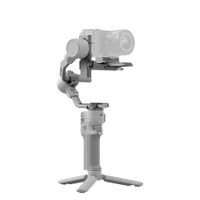

See our full guide to the best gimbals for DSLRs and mirrorless cameras.
We also have separate guides for the Best gimbal for smartphones,
and for the best gimbals for GoPros
How I tested the DJI RS 5 Combo
I tested the RS 5 over a couple of weeks in different locations. For the most part, I used my Sony A7 III camera, connecting using the Bluetooth. This included attempting to move around a small studio and capture shots of Ariane X for a music video, by hand and using the AI tracking.
DJI loaned me the Combo kit to test.

