Digital Camera World Verdict
An excellent tool for the less intensive shooter, or for those who struggle with dark bag changes but want a sleek method to develop at home. The modular nature is good for those who shoot both 120 and 135 formats too.
Pros
- +
Develop any time in any location
- +
Compact and durable
- +
Easy to use
- +
Can cut down on chemical costs
Cons
- -
More expensive than the alternatives
- -
Can only handle a single roll at a time
Why you can trust Digital Camera World Our expert reviewers spend hours testing and comparing products and services so you can choose the best for you. Find out how we test.
The comeback of film photography doesn’t seem to be tailing off any time soon. In fact, I’d suggest the resurgence is in rude health with the likes of Kodak releasing new film stocks, Lomography and others releasing new film cameras, and social media hiking the prices of classic cameras to eye-watering levels.
The costs of shooting analog are undeniably high, so finding ways to reduce the overheads is a common mission. One surefire way to do this is to develop and scan your own film, which also brings numerous other benefits, like being in total control of the entire process, having the ability to push-pull, cross-process, or simply enjoy being hands-on.
There are a multitude of different processes, chemicals, and bits of hardware to choose from, but one thing is constant, and that is the need to safely get your exposed film from the camera into a light-tight container for the processing to happen. This has meant either a dark room or a dark bag is needed, which is either costly or has somewhat of a learning curve. This is where the Lab Box comes in, promising to make the whole process easy and achievable anywhere, even in sunlight. Having been developing my own film since the early nineties, I’m pretty practiced at loading a Paterson tank in a dark bag, but was very interested to see if the Lab Box delivered on the promise, so I’ve developed a bunch of film using it now and have been pleasantly surprised, albeit with a caveat.
Ars-Imago Lab Box: Specifications
Max volume |
490ml |
Dimensions |
98mm x 182mm x 124mm |
Chemical suitability |
Any |
Agitation |
Knob or crank |
Ars-Imago Lab Box: Price
At $189/£175, the Lab Box is rather more costly than a traditional developing tank, like a Jobo or a Paterson, but then, there are more parts, some pretty clever engineering, and the ability to develop in the light will be worth the asking price to many. It’s available around the globe varies, but is available from specialist photo stores like B&H, or Analogue Wonderland.
Ars-Imago Lab Box: Design & Handling
The Lab Box comes either as a kit for 135 film or as a kit with a 120 film section. The two are swappable, so the rest of the tank and mechanism is the same. I’ve only tried the 35mm version at this point, but I will be testing the 120 once I have one.
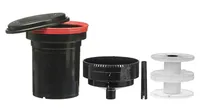
Everything arrives in a nicely designed box, keeping everything protected. There is a little work to be done putting everything together, but it’s a two-minute job. The spool needs to be put together, which is a case of pushing them over the axle and twisting to lock them in place. There are indents for both film sizes, much like on a Patterson tank. This also holds the metal film clip that pulls the film onto the spool when you turn the handle. It's held on by a flexible band of plastic, which looks fragile but actually feels pretty robust.
Next up is the film guide. Again, this needs to be clipped together, with space for 35mm or 120 film. This drops into the tank and can’t be done wrong, as there are guides holding it in place.

The Lab Box ships with a big orange knob for loading and agitating the film, but I’d heard from other users that it was worth buying the crank instead, which I did. It’s definitely a little easier than the knob, but not massively so. It also emits a pretty intrusive squeak at times, which I really didn’t like. Maybe a little lubrication would help.
The back side of the tank is the film-specific part and is released by pressing a clip underneath. Also found under there is a big button that, when pressed, raises a blade between the two thin metal rods, to cut the film. I’ve heard that the blade can get a little rusty, but I’ve seen no evidence of this, but I’m picky about washing and drying my gear after each use.
All in all, everything is built from good-quality plastics that feel like they will last. Everything fits together very well, and it’s also really compact. I like the eye-catching orange components and particularly appreciate the asymmetry of the front edge, which makes emptying the tank much cleaner than a cylindrical one and means no funnels are needed. A small thing, but one less item to clean and store.

Ars-Imago Lab Box: Performance
Normally, I’d use a dark tent to load my films into a tank. My practised hand has got pretty good at it, but I must admit, not having to do it has been rather rewarding, and it is a faster process with the Lab Box. Plus, there’s no chance of mishaps with scissors in the dark, or damaging film whilst popping the canister open.
One thing to note, and this will be very camera-dependent, is that you will need to have some film available outside the canister. You can always use a cheap leader retrieving tool, or be careful when rewinding, leaving some of the leader out, but you will need it to trim, then clip to the Lab Box spool.
Simply trim your leader, ideally rounding the corners too, drop it into the film holder and under the two metal rods, then attach the metal clip. This allows you to use the winder to draw the film out and onto the spool. I’ve done this multiple times now, and it hasn’t shown any sign of not loading properly, something I was slightly anxious about. I would say making sure the clip is centred is wise, and the trimmed corners probably help, as with any kind of spool system.
Make sure the film guide is set to the correct width, in my case fully closed for 35mm film, then click the orange lid into place and start winding. As I mentioned earlier, the crank is my preference for this, but it does come at an extra cost, although it’s not too expensive at £22. There is also that annoying squeak to contend with, but that may just be my particular one, as I’ve not heard reports of that from anywhere else.
You’ll feel the crank tighten as you get to fully wind the film, at which point you reach under the back section of the tank and press up on the orange button. That lifts a blade between the two metal rods, trimming the film from the canister. A few more turns of the crank and everything is ready to get wet!

Now, one key difference between this and most other tanks, at least when hand developing (rather than machine), is that the roll sits horizontally. This means that, along with the shape and size of the tank, you can get away with less volume of chemicals, as every part of the roll will be submerged as it rotates. Less of a deal for 35mm, but if you shoot a lot of 120 more so. It’s not a huge difference, around 100ml, but if you regularly develop, that will add up in no time, something I hadn’t considered when first thinking about the Lab Box, and a welcome bonus.
There’s a decent lip around the edge of the lid, which slopes toward the front edge, where the chemicals enter and exit. This makes it fairly clean and easy to pour into.
Then it’s a simple case of setting a timer to suit your particular chemicals and winding the crank as needed. I much prefer this method to a cylindrical tank, but I couldn’t tell you why. Both work well, and there’s a romance to a Paterson tank that I really like, but this feels somehow more efficient, although it really isn’t, as you need to be just as hands-on.
It’s a really clean system too, which is nice. As much as I love Paterson tanks, they can be a little leaky when agitating, unless you go for the twizzle stick only method, but the Lab Box sits flat on the worktop and agitation is purely internal, making it fuss-free.
I mentioned before that you still need to be hands-on, but that might not be true. There is soon to be available the M-Box, which is a motorised unit that fits where the hand crank is, with various programs to suit different chemical needs, agitating for you. This means you can wander off or do other things for a few minutes. I will definitely be trying one of those and will report back.
Now, there is one, rather beefy, elephant in the room, and I’m sure you’ve probably spotted it. You can only develop one roll of film at a time. For most casual shooters, this won’t be a problem at all. However, if you shoot a lot, this could become a real issue. With Paterson or Job tanks coming in various sizes, you can develop multiple rolls in one session, adding only a couple of minutes to load the film. Development takes no longer. With the Lab Box, you are stuck, meaning for three rolls, you are probably looking at an hour and a half to develop, rather than the twenty minutes it would take using other methods.
This does irk me somewhat, but not as much as I thought. I enjoy developing and usually put on a podcast or music, so an extra bit of time isn’t such a burden. I know some people will find that more problematic than I do. I do wonder if a solution is in the works, but I’ve reached out to Ars Imago but no reply as of yet, understandably.

Anyway, back to the process. Once development is done and a final wash with some flow aid is done, you can pop the lid off, lift out the spool, and bask in the glory of a film well developed. Remove it from the spool and hang it to dry. Done.
I like to wash my equipment immediately, to avoid any contamination or corrosion, and I’d suggest this to anybody, especially when there are metal components. You really don’t want dust particles getting on future rolls.
Although there are some nooks and crannies, a little paper towel does the job of drying, and it can be stored away for its next use.

Ars-Imago Lab Box: Verdict
While I love working with Paterson tanks, I found the Lab Box to be a real winner. It’s nice not having to use my tent and fumble in the dark, although that has never felt like a burden. The Lab Box feels nice to use and produces results as good as any other system. It’s a shame only one roll can be developed at a time but for many that will be a non-issue. The modularity is a plus, too, and I’ll definitely be adding the M-Box motor to automate agitation. All in all, I’d highly recommend it for any home developer.
Features ★★★★☆ |
One roll at a time is the only real limitation |
Design ★★★★★ |
Excellent ergonomics and looks smart too. |
Performance ★★★★☆ |
While it works flawlessly that motor might be wise |
Value ★★★★★ |
It’s more costly than rivals but is worth it |
Alternatives