
Digital Camera World Verdict
Despite outward appearances, the Leica SL3-P is far more than a minor update in the evolving SL mirrorless line. This is by far the most technologically advanced camera ever to have been produced by Leica - and its combination of top-end photo and video features makes this an impressive hybrid camera that holds its head up high amongst its Japanese rivals.
Reasons to buy
- +
8K open gate RAW video
- +
40fps electronic shutter
- +
Improved hybrid autofocus system
- +
IP54 weatherproofing
- +
5-stop in-body stabilization
- +
C2PA Content Credentials support
Reasons to avoid
- -
Chunky design
- -
LCD does not flip out sideways for self-shooting
- -
Buffer size limited to 70 RAW shots
- -
Luxury price tag
Why you can trust Digital Camera World Our expert reviewers spend hours testing and comparing products and services so you can choose the best for you. Find out how we test.
The Leica SL3-P is the third full-frame mirrorless camera in the SL3 range – so what does it offer that its relatively recent siblings don't? In short, it tries to outperform both of them, with a set of specifications that make it the first can-shoot-anything camera that Leica has ever produced.
It comes with a new speed of AI-assisted autofocus and burst rate that puts it right up there in contention with the likes of Canon, Nikon, and Sony. It is also the most video-centric camera that Leica has ever produced – with 8K RAW open gate video shooting being the headline feature that outguns some of its better-known hybrid rivals.
In terms of resolution, it takes a middle ground between the existing Leica SL3 and SL3-S – offering a BSI sensor with a 44MP resolution (compared to the 60MP and 24MP of its siblings). It is a sensor that we believe has been used on the Panasonic S1R II, which offers a similar specification, but with some significant differences.
But what does this camera actually deliver? We have extensively field tested it and put it through our lab to find out…
Leica SL3-P: Specifications

Sensor |
45.8 MP full frame BSI CMOS (44.9MP (effective) |
Lens mount |
L-Mount |
Autofocus |
Hybrid: 315 contrast-AF points • 819 phase detection AF points |
Image stabilization |
5-axis, 5 stops |
Weather sealing |
IP54 certified |
ISO range |
50-200,000 • Dual Basis Low 50-360 • Dual Basis High 400-200,000 |
Max video resolution |
8K 24p open gate, 10-bit, 4:2:0 |
Max burst |
40fps with AF (electronic shutter), 7fps with AF (mechanical shutter) |
Viewfinder |
Electronic, 5.76 million dots, 60fps or 120fps refresh |
LCD |
3.2-inch, 2.33 million dots |
Memory |
1x CFexpress Type B, 1x SD UHS-II |
Connectivity |
HDMI, 3.5mm headphone jack, 3.5mm microphone jack, timecode, USB-C, WiFi, Bluetooth 5.0 |
Size |
151.45 x 108.05 x 84.6mm |
Weight |
768g (body only) |
Price

The Leica SL3-P is now on sale at $6,690 / £5,150 / AU$10,500 for the body on its own.
Three kit versions of the camera are also available with a choice of either one or two zooms from Leica's SL lens range:
• SL3-P with Vario-Elmarit-SL 28–70mm f/2.8 ASPH. - $7,790 / £6,100 / AU$12,600
• SL3-P with Vario-Elmarit-SL 24–70mm f/2.8 ASPH. - $8,390 / £6,480 / AU$13,500
• SL3-P with Vario-Elmarit-SL 24–70mm f/2.8 ASPH. and Vario-Elmarit-SL 70–200mm f/2.8 ASPH. - $10,995 / £8,560 / AU$17,600
It is not a cheap camera – but given its specification and the usual luxury price tags you expect from Leica, one of our team commented that it was not as expensive as she thought it would be. There are certainly hybrid mirrorless cameras from Japanese manufacturers that cost as much.
In terms of Leica's own range of full-frame mirrorless cameras, it is priced to sit in the middle. The lower-resolution SL3-S body costs $5,665 / £4,500 / AU$9,300 and the 60MP SL3 body is priced at $7,485 / £5,920 / AU$12,500 – compared to these, the SL3-P certainly looks like by far the best value for your money.
Leica SL3-P: Design & Handling


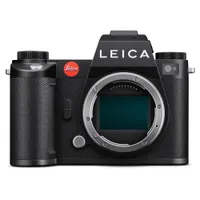
Curiously, the Leica SL3-P makes do without the iconic red dot Leica logo on its front – giving it a visual distinction from the SL3 and SL3-S, which, from the outside, look almost exactly the same as the new model.
The three all-metal bodies share the same size, weight, LCD screen, viewfinder, monochrome status panel, twin card slots, battery and more – so having this as a distinguishing mark for this new poster boy of the Leica range makes some sort of sense.
However, the "P" designation has historically been used for stealth, less-branded versions of existing models (such as the M11-P). However, the SL3-P is much more than a minor, cosmetic update of an existing model.
Sure, the minimalism continues on the camera itself. Only four of the buttons or dials on the SL3-P have any type of label to suggest their purpose - and that's the Play, Function, Power and Menu buttons on the rear. This, however, is exactly the same as found on the SL3 and SL3-S.
The simplicity, of course, means you are given the ability to customize practically every button and input to the way you want to use the camera – although these choices do run the risk that you will end up with your camera being harder to use rather than easier, if you don't know what you are doing (and harder to pass to someone else to use).
Leica has worked hard on the UX of the camera, however, and the menu system takes a subtle, monochrome approach to the layout which keeps everything looking impressively clean as you scroll through the options.
There are some clever implementations - such as being able to toggle quickly between video and photo options. Also, as you toggle between video settings, for instance, it gives you a headline number of options you have with that setting – so as you select 8K settings, the unavailable options simply aren't shown.
Again, this is a boon when you know what you are doing and what is available - but not necessarily helpful for the first-time user.

One thing I love is the big diopter control for the electronic viewfinder – its mechanical dial isn't fiddly to use in the way that eyesight adjustment is on other models, and you can even see where it is set (so you can quickly set it to where you need it if you lend your camera to someone else).
Another big plus point is the app. I get rather tired of camera apps that are not reliable and difficult to use. Leica has obviously spent a lot of time getting Fotos so that it looks good and works without any fuss.
I was impressed at the speed at which I was able to set up the SL3-P with the app, and download images that I had taken, and review the settings I had used
Leica SL3-P: Performance

I shot some 3,500 photos with the SL3-P. shooting in a range of different shooting scenarios, including street portraits, studio fashion, garden flowers, travel and motorsport. It gave me a thorough chance to put the camera through its paces.
I was impressed with the improvements to the autofocus system. With portraits and motorsports, in particular, providing strong proof that the AI detection options work well – with eyes being reliably in focus, and 150mph racing cars looking sharp in every frame.
There are only six AF detection modes to choose from, two each for people, cars and animals – so not as many options as with some rival cameras (there are no options for planes or insects, for instance).
I was also able to test out the camera's remarkable 40fps burst mode on the Nurburgring track. This worked well - but was perhaps overkill for the subject in hand, as the movement through the frame is not as great as the track speeds suggest.
Part of the issue here is with the buffer. The maximum frames it can shoot at 40fps which is just 70 RAW files - so just over 1.5 seconds' worth, which is not enough time for the vehicles to enter the frame and pass you. In this instance, a 15fps setting would have been more appropriate - but even then I would still have only got 70 frames before the buffer filled up.
The most impressive part of the camera is the quality of the images... It could be the color science, or a secret sauce created between the way the DNG RAW files are handled and the SL lenses – but the image looked much better straight out of camera than I would have expected. That's a quality that we should all be willing to invest more money in than most of us actually do.
Leica SL3-P: Sample photos


Leica SL3-P: Sample video
This review does not do a deep dive into the video performance of the SL3-P, but the video clips shows the performance and in particular shows the excellent stabization that the camera can provide when using heavy zoom lenses with it (the SL 24-90mm and 90-280mm).
It is worth noting that the SL3-P combines two seemingly incompatible features – open gate and weatherproofing.
The IP54 water protection rating is unusual for system cameras (of its rivals, only OM System offers this). But shooting 8K open gate means that the camera is more likely to overheat – and the standard solution for this would be big vents to help the cooling.
It is extremely impressive that we get both in the same camera. Leica quotes typical recording times at 25°C for 8K/30 fps as approximately 20 minutes (25mins for 6K/30 fps, and 30mins with 4K/30 fps).
Although Open Gate recording is impressive, it is limited to shooting at 24p – and if you want to shoot RAW open gate you need to use an external recorder. Nonetheless, the video specs are impressive for a manufacturer that has always been photo-first.
Leica SL3-P: Lab results
We compared the SL3-P to its older brother the Leica SL3-S, as well as to its cousin the Panasonic S1R II in our standard lab tests. Into the mix, we've also thrown in the popular Canon EOS R5 Mark II – which has a similar resolution and specification.
We test resolution using Imatest charts and software, and dynamic range and signal-to-noise ratio with DxO Analyzer.
| Timestamp (ISO) | Canon EOS R5 II () | Leica SL3-P () | Panasonic S1R II () | Leica SL3-S () |
|---|---|---|---|---|
| 1 | 41.46 | 44.64 | 43.48 | 46.75 |
| 2 | 38.03 | 42.08 | 39.59 | 43.47 |
| 3 | 36.5 | 39.06 | 36.94 | 41.24 |
| 4 | 34.29 | 36.17 | 33.8 | 38.6 |
| 5 | 31.05 | 33.63 | 31.3 | 35.6 |
| 6 | 27.51 | 30.66 | 28.26 | 32.84 |
| 7 | 24.01 | 28.38 | 26.57 | 30.11 |
| 8 | 21.39 | 25.37 | 23.3 | 27.61 |
| 9 | 17.89 | 22.21 | 20.18 | 24.64 |
| Timestamp (ISO) | Canon EOS R5 II () | Leica SL3-P () | Panasonic S1R II () | Leica SL3-S () |
|---|---|---|---|---|
| 1 | 12.3 | 12.82 | 12.54 | 12.49 |
| 2 | 12.31 | 12.82 | 12.25 | 12.4 |
| 3 | 12.01 | 12.46 | 12.23 | 12.47 |
| 4 | 12.12 | 12.46 | 12.25 | 12.47 |
| 5 | 11.16 | 12.07 | 11.78 | 12.48 |
| 6 | 9.95 | 11.26 | 10.91 | 12.29 |
| 7 | 8.95 | 10.62 | 10.47 | 11.71 |
| 8 | 7.98 | 9.76 | 9.49 | 10.88 |
| 9 | 7.01 | 8.95 | 8.8 | 10.06 |
| Timestamp (ISO) | Canon EOS R5 II () | Leica SL3-P () | Panasonic S1R II () | Leica SL3-S () |
|---|---|---|---|---|
| 1 | 39 | 34 | 40 | 28 |
| 2 | 39 | 34 | 40 | 28 |
| 3 | 39 | 34 | 40 | 28 |
| 4 | 39 | 34 | 40 | 28 |
| 5 | 39 | 34 | 40 | 28 |
| 6 | 38 | 34 | 40 | 28 |
| 7 | 38 | 32 | 38 | 28 |
| 8 | 35 | 30 | 35 | 26 |
| 9 | 32 | 28 | 33 | 26 |

The SL3-P performs better in terms of dynamic range and signal-to-noise ratio when compared to the other two 45MP cameras, but can not quite compete with the SL3-S with its larger-sized photo sites.
Despite the new Leica performing better than its cousin the Lumix S1R II in these two tests, the Panasonic does provide a higher resolution across the ISO range.
Verdict
There is a lot to like about the Leica SL3-P. Part of its appeal should be the way that Leica has not changed everything, but simply upgraded major internal components to bring us the latest and greatest member of the SL3 family.
I also salute the way in which Leica – a small player in the global mirrorless market – has successfully collaborated with other companies.
The L-mount Alliance means that there is a great range of lenses available for the camera – even if the SL range itself is relatively small. It also has obviously worked with Panasonic on the source of the sensor, to ensure that the camera can be produced profitably.
But there are smaller cooperations embedded in the camera to. It is Leica's latest C2PA camera – enabling you to add content credentials to your files so that you can prove they are not created with AI. It supports Frame.io for cloud collaboration on work projects – and offers in-body de-squeeze when used with Sirui anamorphic lenses.
What I particularly loved about the camera was the photos that it delivered. I think there are three ways to fall in love with a camera. The first is the specifications and looks. The second is in terms of the way it feels in your hands and its general ergonomics. The third is in terms of the results that it delivers. It is the last of these that is the most persuasive for picking the SL3-P.
Features ★★★★☆ |
This is Leica's most feature-packed camera yet, with photo and video options that compete well with many of its rivals |
Design ★★★★☆ |
Much of the design is the same as its older SL3 siblings – but it now has a more minimalist twist. |
Performance ★★★★½ |
Image quality is excellent, and matched with the best autofocus we have seen from Leica yet. |
Value ★★★☆☆ |
The SL3-P may not be as expensive at you might have thought for something with this specification from Leica – but it won't win budget prizes. |
Overall |
★★★★☆ |
Alternatives
Check out our full guide to the best full-frame mirrorless cameras

