Digital Camera World Verdict
For such a compact flashlight-shaped LED, the Godox RS100Bi is surprisingly powerful, emitting a searing 28,600 lux if you attach its supplied reflector and set it to a CCT of 5600K. This enables photographers and videographers to summon a powerful yet portable battery-operated LED while shooting in any location. It is also compatible with a wide range of S-mount Godox accessories (such as softboxes), so it should fit nicely into your existing Godox ecosystem. You can control the LED manually via buttons and a knob on the rear of the light, or operate it remotely using the Godox Light smartphone app. If you need a run-and-gun lighting solution when shooting on location, then the Godox RS100Bi will do the job, but do investigate whether you need the extra color output of its more expensive (but less bright) sibling – the RS100R – before committing to the RS100Bi.
Reasons to buy
- +
Strong brightness
- +
Built-in battery
- +
Runtime countdown
- +
11 creative lighting effects
- +
Precision dimming control
Reasons to avoid
- -
Lacks RGB colors
Why you can trust Digital Camera World Our expert reviewers spend hours testing and comparing products and services so you can choose the best for you. Find out how we test.
The Godox RS100Bi is a continuous LED (Light Emitting Diode) video light designed to illuminate your video or photography subjects while on location. Its compact design enables you to fit it easily into your camera backpack, and its built-in USB-C chargeable battery means that you don’t need to carry a chunky V-mount battery (as I had to when I tested the Godox ML150Bi).
Godox released a very similar-looking RS100R version at the same time as the RS100Bi. The key difference between the two lights is that the Godox RS100Bi emits light in degrees Kelvin (K), with a color temperature range of a very warm 2800K to a cooler 6500K. The RS100R is an RGB LED, so it has much more control over color. The RS100R can emit a wider range of CCT values than the RS100Bi, between 1800K and 10,000K. It can also mix RGB LED bulbs to produce a rainbow of creative colors. This extra color output means the RS100R has 14 animated video effects, whereas the color restrictions on the RS100Bi limit it to 11 animated effects.

So on paper, it would appear to be a no-brainer to buy the RS100R instead of the RS100Bi. But hold on a tick – it all depends on your needs as a videographer/photographer. If you need creative color output (beyond a typical CCT range), the RS100R should be the model for you. But if you need a brighter LED with a longer reach, then the RS100Bi will meet your requirements. I’ll delve into the key differences between the two models in the Design and Handling section so that you can make an informed choice between the RS100Bi and the RS100R, both of which aim to be among the best LED video lights.
Godox RS100Bi: Specifications
Color temperature range: |
2800-6500K |
Maximum luminous flux |
28,600 lux at 1m (5600K) |
Main material |
Plastic |
Weight of LED |
1.95lb (886g) |
Color Rendering Index |
CRI≥98, TLCI≥98 |
Dimensions |
9.21 x 3.07 x 3.07in |
Battery Life |
52 minutes |
Video lighting effects |
11 animated lighting effects |
Bluetooth control range |
100ft (30m) |
Godox RS100Bi: Price
The Godox RS100Bi retails for an official price of $229 / £209. It’s a fair bit cheaper than its sister light – the RS100R, which costs $319/£289. As well as being cheaper, the RS100Bi is much brighter than its more expensive sibling, with the RS100Bi emitting 28,600 lux compared to the 15,900 lux from the RS100R.
So if you need a portable LED with a long reach, then the RS100Bi offers good value for money. However, if you need a light capable of producing more creative colors, then the RS100R might be worth the extra cost. As an RGB light, the RS100R can produce a wider range of color temperatures, plus it can cast thousands of atmospheric colors on your subjects. This extra color control gives the RS100R more effective animated lightning effects, such as a red, yellow, and blue cop car effect – something that is absent on the cheaper RS100Bi model that I am testing for this review.
So, if you need more creative color control, can compromise on a weaker lux output, and have more money to spend, go for the RS100R. If you’re on a tighter budget, don’t need to produce colors beyond a 2800-6500 Kelvin range, and want a much brighter light source, then the RS100Bi is the model for you.

Godox RS100Bi: Design & Handling
The Godox RS100Bi looks virtually identical to its more expensive sibling, the RS100R. However, the RS100R uses a full-color LED array to produce an extensive range of RGB hues, whereas the RS100Bi is dedicated to bi-color (warm and cool) white light. This limits its CCT range to 2800-6500K, compared with the RS100R’s broader 1800-10,000K range, but enables the RS100Bi to deliver considerably more brightness. With the supplied lens reflector fitted, the RS100Bi produces up to 28,600 lux at 1m and 5600K, compared with the RS100R’s 15,900 lux under the same conditions.
Now that I’ve got the crucial difference between the RS100Bi and the RS100R out of the way, I’ll focus on my experience with testing the Godox RS100Bi for the rest of this review.

The RS100Bi is constructed of a black plastic material and is shaped like a chunky flashlight (or torch). It feels satisfyingly heavy at 1.95lb (886g), giving it the feeling of a well-constructed and professional piece of kit. Yet at under two pounds (one kilogram), it’s not too heavy to cart around in your camera backpack, and at just under 10 inches in length, it’ll fit easily into your backpack (or into one of the tripod/bottle holders on the side).
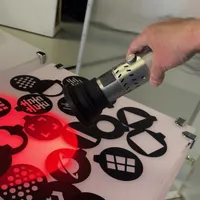
The RS100Bi ships with a few accessories. The most important one is the high-efficiency lens reflector. This slots onto the front of the LED with a click and a twist, massively boosting the output of the light’s LEDs. A USB-C charging cable enables you to charge up the RS100Bi’s internal battery. This battery is designed to operate for 52 minutes at full power, though I found that 50% power output was more than bright enough in my studio location. Talking of power, a really nice touch is that the little OLED display on the rear of the unit gives you a battery countdown, so you know how long the power should last during a shoot. I could have done with a runtime countdown when testing the Godox ML150Bi LED, as it ran out suddenly before I’d finished the shoot. The RS100Bi is compatible with 18-140W PD chargers (though a charger is not included).

The kit also ships with a little lighting stand mount. This screws into the RS100Bi’s 1/4-inch thread and then slots onto a standard light stand. You can adjust the angle of the mount with ease so the light points up or down at your subject. There’s also a cloth carry bag in the box. Thanks to the LED’s Godox S-mount compatibility, you can replace the supplied reflector with a wide range of Godox accessories, such as softboxes (not supplied).
The properties of the Godox RS100Bi are controlled by three buttons and a knob at the rear of the light. The knob also functions as an extra button. The settings or modes that you select are visible on a little OLED screen, so you can operate the light with ease using these features. You can also use the free Godox Light smartphone app to adjust lighting settings or trigger effects from a distance. I found the app was very useful as I could adjust the light while it was illuminating me from a distance, which makes it the perfect piece of kit for a self-shooter.

Godox RS100Bi: Performance
To test the Godox RS100Bi, I took it to a TV studio. I used the studio’s row of ceiling-mounted cyclorama lights to light the backdrop curtain, and used the RS100Bi as my key light, mounted on a lighting stand at approximately 26 feet (8m) away. When the RS100Bi was turned off, I was in silhouette, so I was easily able to demonstrate the difference that the RS100Bi’s output made during my test shoot. If you watch the supporting video that accompanies this review, then you’ll see the light in action!
The RS100Bi was easy to set up. I screwed the supplied mount into the 1/4-inch thread at the base of the light and slotted the bottom of the mount onto a standard light stand. I then adjusted the light stand’s height and tilted the mount so that the light would illuminate me when I was standing on a stage in the center of the studio.
I started the test by manually operating the RS100Bi using its rear panel controls. It was a simple matter to press the On switch, and (as with most Godox LEDs) I then had to rotate the main dial to turn on the light. This two-step button press/dial twist process ensures that the light doesn’t get turned on by accident on your way to a shoot, so you know that you’ll have plenty of battery power when you arrive on location. The little OLED screen makes it easy to see what setting you’re adjusting. Rotate the dial to toggle between CCT (Color Temperature) and DIM (brightness). Press the dial to select one of these options, then rotate it again to choose a specific color temperature or adjust the brightness. The brightness can be adjusted very smoothly and in fine increments of 0.1%. It was handy to refer to the runtime countdown on the display so that I knew I had enough battery power to conduct a thorough test shoot.

During my shoot, I used an iPhone 16 Pro to record my “talking to camera” pieces while being lit by the RS100Bi. I used an iPhone 17 to run the Godox Light app so that I could operate the LED remotely while standing in its illumination. I found it even easier to change the properties of the RS100Bi when using the app, as you’ll see from this review’s supporting video. I was able to trigger a variety of animated effects, such as Lightning, Broken Bulb, and Fire, with a tap and a few swipes on my iPhone’s display. You can also use the app to fine-tune the way the effects behave, such as making a Broken Bulb flicker more slowly.
The RS100Bi was so bright that at 100%, the highlights in the shot were blown out. I found that 50% was the perfect setting, even when the LED was shining at me from 26 feet away. This gave me the confidence that the RS100Bi would perform well (and for long enough) on a model shoot on location.

Godox RS100Bi: Verdict
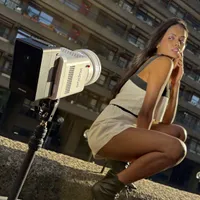
If you need a portable LED that can illuminate a subject (such as a model) without the light appearing in the shot, then the RS100Bi will meet your needs. It’ll fit easily in your camera backpack and thanks to the 1/4-inch thread you can mount it on a mini tripod or use its supplied mount to attach it to a standard light stand. The handy runtime countdown on the OLED screen ensures that you know how long the light will shine on a specific setting, so you can adjust your settings on the fly to make sure the light doesn’t “die” before you finish the shoot.
The RS100Bi has a narrower CCT range than its more expensive RS100R sibling, and it lacks a couple of extra animated lighting effects, but the RS100Bi is cheaper and brighter, which should make it an attractive purchase.
Features ★★★★☆ |
Controllable via a built-in button/dial combination or via the Godox Light smartphone app. Emits a range of colors in degrees Kelvin between 2800-6500K, but lacks the extra colors produced by an RGB LED. |
Design ★★★★★ |
The RS100Bi is compact and portable, and compatible with a host of Godox S-mount accessories. The buttons and knob on the rear enable you to adjust a host of properties and the runtime countdown lets you know how long you can shoot for on specific lighting settings. |
Performance ★★★★☆ |
Even when illuminating my subject from the corner of the studio, the Godox RS100Bi was too powerful at 100% brightness, so I had to dial it down to 50%. |
Value ★★★★☆ |
The Godox RS100Bi offers a cheaper solution than the Godox ML80Bi. It’s also cheaper and brighter than its sibling LED – the RS100R – though that model can produce far more colors. |
Alternatives