Digital Camera World Verdict
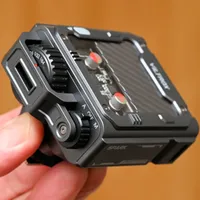
I like that the Viltrox Vintage Z1 Pro is genuinely small enough to fit in a spare pocket, ready to spring to my aid at a moment’s notice, especially as none of my current mirrorless cameras features a pop-up flash. Compared with the Viltrox Vintage Z1 Retro version that I reviewed nearly a year ago, the ‘Pro’ is more powerful, faster, and adds a wealth of new features, in dedicated options for four major camera systems. Amazingly, there’s little difference in the budget-friendly price tag.
Reasons to buy
- +
Dedicated versions
- +
TTL, HSS and RC flash
- +
Mini color touchscreen
- +
Inexpensive to buy
Reasons to avoid
- -
No bounce or swivel
- -
No zoom
- -
Modest maximum power
Why you can trust Digital Camera World Our expert reviewers spend hours testing and comparing products and services so you can choose the best for you. Find out how we test.
Roll the clock back almost a year and I was fairly impressed with the Viltrox Vintage Z1 Retro. Plus points included pocketable compactness, simplicity of use and a pretty much universal fit to suit the vast majority of current cameras. However, the universal nature of the flash came with various limitations, including the lack of Auto flash metering (TTL or otherwise), and no HSS (High-Speed Sync). I generally don’t mind setting flash power manually but the lack of HSS reduced the usefulness of the ‘Retro’ for fill-in flash in the likes of sunny-day portraiture, where fast shutter speeds can be hard to avoid.
The new ‘Pro’ version aims to put all of these ‘wrongs’ to right. It comes in four different dedicated options to suit Canon, Nikon, Sony and Fujifilm camera systems. It adds Auto TTL flash metering instead of being limited to purely manual adjustments, and there’s HSS as well as rear-curtain flash on the menu. Speaking of which, the menu itself is more intuitive. Whereas the Retro version had a single operating dial, the Pro adds a color touchscreen which eases navigation as well as giving a useful display of the additional settings and options.
Recycling speeds are a whole lot faster between high-power flashes but everything is packed into the same-sized package, with pretty much the same eye-catching retro design. It might be a stretch to call the Viltrox one of the best flashguns on the market, but it’s certainly one of the most compact and budget-friendly.

Viltrox Vintage Z1 Pro: Specifications
Dedication |
Canon, Nikon, Sony, Fujifilm |
Max output (Gn, ISO 100, m / ft) |
Gn 12 / 39.4 |
Bounce |
None |
Manual Power Settings |
1/1 to 1/64.7 (1/3 steps) |
Auto flash exposure |
TTL |
Batteries |
Internal Li-ion |
Full power flashes |
350 per charge |
Wireless master/slave |
Optical slave, dual mode |
Dimensions |
69x50x73mm / 2.7x2x2.9in |
Weight (inc battery) |
136g / 4.8oz |
Viltrox Vintage Z1 Pro: Price
The more basic and fully manual Viltrox Vintage Z1 Retro flash has been on the market for about a year now, retailing for $49.99 / £46.99 / AU$76. At the risk of repeating myself, the new ‘Pro’ version looks pretty much the same from the top, front and sides, but adds a mini color touchscreen around the back and packs much smarter, dedicated electronics. With that in mind, it’s pretty remarkable that Viltrox has been able to produce the Pro edition in its various dedicated options for only a few dollars more, at a list price of $59.99 / £56.99 / AU$TBA. On the face of it, that’s enormously good value for a dedicated flashgun.
Viltrox Vintage Z1 Pro: Design & Handling
The Pro edition of the Viltrox Vintage Z1 flash looks every bit as retro as the original ‘Retro’ version. One of the things that I most liked about the Retro was its tactile power adjustment dial, which was marked in a scale from 1/64 (minimum) to 1/1 (maximum) output settings. The dial is retained in the new Pro version but the numbered scale is removed, replaced by a color touchscreen that I’ll come to in a moment.

The whole area taken by the circular color touchscreen in the Pro version was given over to the on/off switch in the Retro. The touchscreen is a whole lot more useful, while the on/off switch is now a relatively small sliding button that’s still perfectly easy to use. Below this is the flash ready lamp which, in the time honored tradition, doubles as a flash test button.

The color touchscreen enables you to swipe up or down to toggle between regular sync and high-speed sync, and to swipe left or right to switch between Auto TTL flash metering and manual power settings. Power adjustments themselves, whether it’s TTL flash exposure compensation or manual output settings, are made using the large rotary knob. That’s a good shout as far as I’m concerned, as touchscreens can be a bit fiddly for adjusting flash power in either large or small increments.

Another upgrade is that with the Retro version, you could only adjust manual power settings in fairly coarse, full EV increments, and there was no TTL flash metering at all. In the Pro edition, you can alter manual power settings in finer 1/3EV steps, from full power output right down to 1/64.7. The addition of TTL metering comes with similar 1/3EV adjustment steps for flash exposure compensation, from -3EV to +3EV.

A couple of things I’m pleased to see retained from the original design are on the left hand side of the flash. First up, there’s a USB-C socket which you can use to recharge the internal Li-ion battery. If the battery is completely flat, it takes about 70 minutes for a full charge, using a standard 5V 0.8A USB charger. That gives you enough juice for up to 350 full-power flashes – or many more at lower power settings. Just next to the USB-C socket is a dual-mode Slave switch.

The Slave switch itself is a 3-way switch with an Off position at the center, for firing the flash directly from the camera, when it’s mounted in the hot-shoe or connected to the hot-shoe via an off-camera extension cable. The dual S1 and S2 slave modes are for triggering the Z1 from a master flash unit. Mode 1 is for use with regular studio flash or manual flashguns, whereas Mode 2 disregards the pre-flash pulses of a master flashgun when it’s set to Auto TTL flash mode.

Both of the slave modes are optical rather than featuring RF (Radio Frequency) connectivity. That’s entirely as I’d expect, given the low-budget selling price of the Z1. Optical triggering can be a little problematic in very bright and sunny outdoor shooting conditions but I found the Z1 to be comparatively reliable indoors and out.

Although compact and lightweight at just 136g / 4.8oz including the built-in battery, the flash features a metal rather than plastic mounting plate. The Sony dedicated version comes complete with gold-plated electronic connection pins. They’re typically small and delicate but the flash is supplied complete with a sturdy slip-on protective plastic cover.

As with the original edition, the Pro comes complete with a slip-on diffusion panel. That’s really the only modification you can apply to shape or alter the flash output. There’s no zoom facility for focusing the beam for use with telephoto lenses. As such, the head is fixed at an angle of coverage equivalent to using a 28mm lens on a full-frame camera. There’s also no bounce or swivel facility for bouncing the flash off a ceiling or adjacent walls.

The diffusion dome softens the quality of light. It does this partly by virtue of its white translucent nature, but also by bouncing some of the light off walls and ceilings, so you’re not limiting yourself to purely direct flash. The angle of coverage is also increased, making the diffusion dome useful when using very wide-angle lenses.
Viltrox Vintage Z1 Pro: Performance
Let’s start with speed. When you’re trying to capture definitive moments that can’t be repeated (I’m thinking wedding and event photography in particular) it can be enormously frustrating if your flash takes a few seconds to recycle before it’s ready for the next shot. That was one of my gripes with the original Retro version. Despite being Li-ion battery-powered, which usually enables very fast recycling, it took 4.3 seconds to recycle after a full-power flash in my tests. The Pro is very much faster, taking about 1/10th of a second to recycle at everything up to and including 1/4 output power. It slows to a still very quick half a second after a 1/2 power flash, and a speedy single second after a full-power flash. That’s more than four times faster than the Retro edition.

The overall range in output power drops off in high-speed sync mode, available for shutter speeds up to and including 1/8000th of a second. Rotation of the power knob in Manual flash mode enables selection through a range of full output down to 1/16th, instead of right down to 1/64.7, again in 1/3EV increments.

High-speed sync as well as rear-curtain flash are available for both Auto TTL and Manual flash modes. When combining high-speed sync and Auto TTL mode, you get the same +/-3EV range of flash exposure compensation as in regular sync mode. However, as with Manual mode, the overall range of output is reduced.

I found the optical slave modes to be consistently reliable during my testing. When triggering the Z1 in slave mode from a master flashgun or studio flash, it can be useful to support it in a cold shoe or tripod/tabletop mount. There isn’t one of these supplied with the flash but they’re available to purchase separately and are cheap to buy.

Direct flash can often look rather harsh, especially if it’s the main light source in a photograph rather than just supplying some supplemental fill-in flash. That’s the case with the photo above, taken of a model car with the Z1 being the primary light source. For comparison, the shot below was taken with the same setup, using the Z1 in the hot-shoe of the camera, but this time with the diffusion dome fitted. The dome softens the quality of the light and reduces the hard outline of shadows.

Another notable factor in performance is the accuracy of Auto TTL flash exposure. Testing the Sony dedicated version of the Z1 with a couple of different Sony full-frame and APS-C format mirrorless cameras, I found TTL flash exposure to be consistently reliable.
Viltrox Vintage Z1 Pro: Lab Results
We test all available features for each flashgun that goes through out labs. To test power output, we use a Sekonic flash meter placed at a distance of one meter from each flashgun. We check the complete range of manual power settings, in one-stop increments. Based on a sensitivity of ISO 100, the figures correlate directly with the Gn (Guide number) in meters. The results are double-checked by taking shots of a gray card with the appropriate lens apertures and using the camera’s histogram display in playback mode. We also use the gray card to test the accuracy and consistency of Auto and Auto TTL flash metering, where featured.
We check the speed with which each flashgun can recycle to a state of readiness, throughout its range of power settings, culminating in a full-power flash. We use freshly charged Ni-MH rechargeable batteries for this, or the supplied rechargeable Li-ion battery pack where featured in some flashguns.
The table below shows both the power output (Gn, ISO 100, meters) at each full EV step through the complete power range, from minimum to maximum output. The recycle speed in seconds is shown for the same settings.
Power setting |
Output, Gn (ISO 100, meters) |
Recycle speed, seconds |
1/64.7 (min) |
Gn 1.2 |
0.1s |
1/64 |
Gn 1.6 |
0.1s |
1/32 |
Gn 2 |
0.1s |
1/16 |
Gn 2.8 |
0.1s |
1/8 |
Gn 4 |
0.1s |
1/4 |
Gn 5.6 |
0.1s |
1/2 |
Gn 9 |
0.5s |
1/1 (max) |
Gn 13 |
1.0s |
Power output
In my tests, maximum power output proved a little stronger than from the original Vintage Z1 Retro, equating to Gn 13 compared with Gn 12. For the sake of further comparison, the maximum output power of the pop-flash in the Nikon Z50 II camera is much less, at a mere Gn 7. The Pro version also has a larger overall range than the Retro, so I could turn it down to Gn 1.2 rather than Gn 2 for super-subtle fill-in flash.
Recycling speed
Recycling speeds after high-power flashes are very much faster than in the Retro edition. At half-power and full-power settings, the Pro takes 0.5 seconds compared with 2.4 seconds for the Retro, and 1 second vs 4.3 seconds respectively.
Viltrox Vintage Z1 Pro: Verdict
I was pretty impressed with the original Viltrox Vintage Z1 Retro mini on-camera flash when I reviewed it a year ago. I’m now very much keener on the new Z1 Pro edition, which adds dedication for Canon, Nikon, Sony and Fujifilm cameras, along with a host of extras. Useful additions include Auto TTL flash metering, high-speed sync, a color touchscreen, a greater power range and much faster recycling speeds after high-power flashes. That’s a long list of very useful upgrades.
All in all, the Z1 Pro might struggle to live up to its ‘Pro’ billing as a properly professional flashgun, but it’s a much more serious photographic tool than the original Retro version, adding greater power, speed and versatility at very little extra cost. Bargain!
Features ★★★★½ |
Dedicated versions bring Auto TTL flash metering and high-speed sync to the party, but there’s still no flash zoom nor a bounce and swivel facility. |
Design ★★★★½ |
The design retains the eye-catching retro looks of the original edition, while adding a color touchscreen that helps you change settings and keep an eye on them. |
Performance ★★★★½ |
The maximum power output isn’t going to set the world alight but should prove adequate for most scenarios, given that the Z1 doesn’t cater to power-hungry bounce flash usage. |
Value ★★★★★ |
Typical of Viltrox, you get a great deal for your money in terms of features, design, build quality and performance, making the Z1 Pro a great deal financially. |

Alternatives