




Digital Camera World Verdict
To my mind, the Viltrox AF 26mm f/2.8 Evo proves that the best things sometimes do come in small packages. Despite its wide-angle perspective and reasonably fast f/2.8 aperture, the lens is less than an inch thick, quintessentially qualifying as a pancake prime. Even so, its image quality is impressively sharp and crisp, and the lens manages to pack both focus and aperture control rings – although they’re necessarily thin. Autofocus isn’t super-fast and is slightly audible, but this Viltrox is a terrific, budget-friendly option for street and travel photography, as well as for vlogging and everyday shooting on full-frame Nikon and Sony mirrorless cameras. It also works great as a neat 'standard prime' for the same makes of APS-C format cameras.
Reasons to buy
- +
Impressive image quality
- +
Compact and lightweight
- +
Sturdy metal build
- +
Weather-sealed mount
Reasons to avoid
- -
Pedestrian autofocus speed
- -
Necessarily thin control rings
- -
No de-click option
Why you can trust Digital Camera World Our expert reviewers spend hours testing and comparing products and services so you can choose the best for you. Find out how we test.
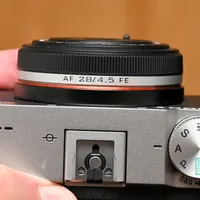
The Viltrox AF 26mm f/2.8 Evo gives me a slight but not completely convincing case of déjà vu. A couple of years ago I reviewed the Viltrox AF 28mm f/4.5 pancake lens.
Just a tiny slip of a thing, it’s only about half an inch thick and only weighs a couple of ounces. Indeed, I found that it made my interchangeable lens camera even more pocketable and convenient than some compact cameras.
Full-frame compatibility is shoehorned into this featherweight lens, but little else. There’s no manual focus nor an adjustable aperture diaphragm, and therefore no control rings. Handling is basic, to say the least. Originally for Sony E-mount cameras, it later became available for Nikon Z, L-mount and Fujifilm X system APS-C cameras.
The new lens that I’m reviewing here, the Viltrox AF 26mm f/2.8 Evo, is twice as long but still less than an inch thick, qualifying as a pancake prime.
Currently the latest in the Viltrox Evo line-up, it’s a much more sophisticated lens than the 28mm. Again it’s full-frame compatible, so far being produced in Nikon Z and Sony E options, but is equally viable on APS-C cameras from both camps.
Instead of acting as a full-frame, 26mm wide-angle lens, it has an ‘effective’ focal length of 39mm on APS-C, pretty much identical to the 40mm of various alternative standard primes.
Either way, handling and build quality are relatively upmarket, and the Evo lens aims to be one of the best pancake lenses on the market.

Viltrox AF 26mm f/2.8 Evo: Specifications
Mount options |
Nikon Z (FX), Sony E (FE) |
Full frame |
Yes |
Autofocus |
Yes |
Image stabilization |
No |
Lens construction |
8 elements in 6 groups |
Angle of view |
81.2 degrees |
Diaphragm blades |
7 |
Minimum aperture |
f/16 |
Minimum focus distance |
0.2m |
Maximum magnification |
0.2x |
Filter size |
43mm (hood) |
Dimensions |
66x23.8mm / 2.6x0.94" |
Weight |
130g / 4.6oz (FE) 170g / 6oz (Z) |
Viltrox AF 26mm f/2.8 Evo: Price
Pancake lenses aren’t exactly slim pickings (ironically), but they often have skinny price tags. The previously launched Viltrox AF 28mm f/4.5 is pretty much as cheap as they come, selling for just $99 / £90 / AU$169.
For about the same price, there was also the now discontinued Olympus Fisheye Body Cap 9mm f/8 for Micro Four Thirds cameras.
The new 26mm lens that I’m reviewing here is much more sophisticated, but still very competitively priced at $299 / £279 / AU$579. That’s potentially very good value, so long as the design, handling and performance pass muster. Let’s find out.
Viltrox AF 26mm f/2.8 Evo: Design & Handling
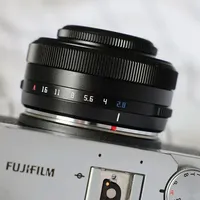
There’s thin and then there’s super-skinny. Unlike the half-inch Viltrox AF 28mm f/4.5, the new 26mm lens is just under an inch thick, still easily qualifying as a pancake lens. That’s despite boasting a pair of manual focus and aperture control rings, which are both absent on the 28mm lens.
As a quick size guide, the picture below shows the lens mounted on my Nikon Z6 III, which itself is fairly svelte for a full-frame body. As you’ll notice, the lens doesn’t really stick out any further than the Nikon’s sculpted hand grip.

Not just physically thin, the lens also has a very small-bore optical path. This is immediately apparent when looking at the front of the lens head-on, or from its rear.
One thing you’ll also notice when looking into the front or back of the lens is the seven-blade aperture diaphragm. As I’ve mentioned, the Viltrox 28mm pancake has no adjustable aperture diaphragm at all, just a fixed heptagonal cutout that’s inserted into the optical path.

Squeezing two control rings into a lens this small is a tall order. The Viltrox nevertheless features an electronically coupled manual focus ring up front and an aperture control ring near the rear. They’re both necessarily very thin, or they just wouldn’t fit, but work well enough

The aperture ring operates in one-third f-stop click steps and has the usual Auto position just beyond the f/16 mark, at the narrow end of the aperture range. Unsurprisingly in such a small lens, there’s no room for an AF/MF focus mode switch or a click/de-click switch for the aperture ring

As I mentioned earlier, the lens itself has no filter attachment thread. However, it comes complete with a hood. The hood isn’t reversible but only protrudes by a small amount when fitted, as it’s similarly thin.
As well as further combating ghosting and flare, the filter has a 43mm filter attachment thread, so you can actually use screw-in filters or filter holders with the lens.

When fitted to the lens, the hood only adds about a quarter of an inch to the overall physical length. You certainly couldn’t call it large, but it does have the usual bayonet-fit attachment mechanism.
A smart addition is that it features a magnetic ring around its inner circumference, which I’ll come back to in a moment.

Build quality feels very solid, especially considering that the Viltrox is such a small, lightweight lens. It has a sturdy metal barrel and, taking advantage of the fact, the front lens cap attaches by magnetic attraction.
When the plastic hood is fitted to the lens, this attraction would be lost, hence the inclusion of that magnetic ring on the inside of the hood. You can therefore use the front cap in exactly the same way, regardless of whether or not the hood is fitted.

Like with other Viltrox Evo lenses so far, the mounting plate as well as the barrel is made from metal rather than plastic, and features a rubber weather-seal gasket, plus a USB-C socket. The latter enables the easy application of firmware updates, if and when needed.

Viltrox AF 26mm f/2.8 Evo: Performance
The standout performance characteristic of the Viltrox AF 26mm Evo, as far as I’m concerned, is its tiny size. It makes my camera small enough to take anywhere and everywhere, thus enabling me to get shots that I’d otherwise miss altogether (with my camera left at home).
And the lens doesn’t come along just for the ride; I find that its 26mm focal length delivers a generously wide-angle perspective that I love for travel and street photography, and for casual walkabout shooting.

Getting down to the nitty gritty, one thing I haven’t mentioned so far is the autofocus system. Whereas most Viltrox AF lenses employ a linear stepping motor or a voice coil motor, this one uses a gear-type stepping motor.
To some extent, this is necessitated by the design criterion of squeezing a quart into a pint pot. The relatively small motor is comparatively pedestrian in terms of speed but still quick enough for the vast majority of shooting scenarios.
It’s also slightly more audible than a linear stepping motor, so you can just about hear it in a quiet room and might pick up on it when shooting video using a camera’s internal microphone.

Some say that an f/2.8 aperture doesn’t quality as ‘fast’ and I’d tend to agree. Even so, it’s generally fast enough to freeze motion and avoid camera shake under very dull lighting conditions, without needing to massively bump up your camera’s ISO setting, which can degrade image quality.
Naturally, the other main advantage of faster aperture ratings is that you can get a tighter depth of field. You might struggle with this lens, as the short focal length makes it more of a challenge. However, the combination of the 26mm focal length and f/2.8 aperture enable a fairly tight depth of field when shooting close-ups.

Most camera lenses use relatively large-diameter glass, compared with pancake lenses. Pancake lens design can therefore be a compromise, causing concerns over image quality, especially in terms of sharpness and clarity, and the suppression of unwanted aberrations like distortion, vignetting and color fringing.
This Viltrox lens really impressed me in all these respects, with plenty of bite and sharpness right out to the edges and corners of the image frame on a full-frame camera.
Sure, barrel distortion can be noticeable when automatic in-camera correction is disabled – as can vignetting at the widest aperture of f/2.8. However, unlike with many modern lenses for mirrorless cameras, these aberrations aren’t very severe and the Viltrox gives you the choice of whether or not you want to use auto corrections, rather than having them ‘forced on’.

Viltrox AF 26mm f/2.8 Evo: Sample Images
The gallery below comprises shots taken at Bristol Docks in the English south-west city. I’ve used a variety of subject matter and aperture settings to demonstrate the qualities of the lens in general, walkabout shooting.


Viltrox AF 26mm f/2.8 Evo: Lab Results
We run a range of lab tests under controlled conditions, using the Imatest Master testing suite. Photos of test charts are taken across the range of apertures and zooms (where available), then analyzed for sharpness, distortion and chromatic aberrations.
We use Imatest SFR (spatial frequency response) charts and analysis software to plot lens resolution at the center of the image frame, corners and mid-point distances, across the range of aperture settings and, with zoom lenses, at four different focal lengths. The tests also measure distortion and color fringing (chromatic aberration).
Sharpness:

For a pancake lens, sharpness is very good even when shooting wide-open at f/2.8, becoming excellent at f/4 and narrower apertures, dropping off at f/16 due to diffraction. As I'd expect, the lens is less sharp at the edges and corners of the frame than in the central region, but it's still impressive.
Fringing:

There’s only very minimal color fringing throughout the entire aperture range, even out at the extreme edges and corners of the frame. You’ll rarely notice any fringing in images, even with automatic in-camera correction disabled.
Distortion: -2.14
Something has to give when you’re cramming a wide-angle perspective into such a small but full-frame compatible lens. Sure enough, barrel distortion is visible but the lens is still usable without in-camera correction, which isn’t ‘forced on’ in the menu system.
The Viltrox is a step ahead of many modern lenses for mirrorless cameras in this respect, especially those designed with compactness in mind.
Viltrox AF 26mm f/2.8 Evo: Verdict
Sometimes I really feel that less is more. As if to prove the point, this Viltrox AF 26mm f/2.8 lens is less than an inch thick, fully qualifying it as a pancake prime. And yet it has solid metal build quality with a weather-sealed mount, along with sophisticated handling characteristics that include an aperture control ring and slimline hood (complete with filter attachment thread).
The ultra-compact and lightweight design genuinely enables me to take my camera pretty much anywhere and everywhere on a daily basis, capturing shots that would naturally be impossible if I’d left it at home.
Getting down to the business of actually taking pictures, I love the wide perspective that the 26mm focal length delivers on a full-frame camera. I find it ideal for travel and street photography, as well as landscapes, cityscapes and many other shooting scenarios. It’s also ideal for vlogging.
On an APS-C body, it transforms to give a very natural perspective, akin to using a 40mm lens on a full-frame camera. The autofocus system won’t break any speed records and it’s not completely silent, but it’s definitely up to the job, delivering consistent accuracy.
All in all, I love this lens as a travel companion and for everyday shooting, and it’s great value at the price.
Features ★★★★★ |
The feature set might not look overly exotic but in the context of a pancake lens, it’s relatively rich with stepping motor autofocus and focus/aperture control rings. |
Design ★★★★★ |
Build quality feels very sturdy, with an all-metal construction and weather-sealed mounting plate. The design manages to shoehorn useful features and high-end handling into an ultra-compact build. |
Performance ★★★★½ |
Performance is impressive by any standards and image quality is outstanding for a pancake lens, with excellent edge-to-edge sharpness, great clarity and well-controlled aberrations. |
Value ★★★★★ |
The lens costs about three times as much as the previously launched Viltrox 28mm lens but I reckon it’s more than three times as good, making it great value. |

Alternatives