Digital Camera World Verdict
I like that the Thypoch Voyager 24-50mm f/2.8 is relatively compact and lightweight for a full-frame compatible standard zoom lens, along with a reasonably lightweight price tag. I’m impressed with the weather-sealed build quality and handling characteristics, my only complaints being that it doesn’t stretch beyond a standard 50mm focal length, and that it’s only available in a Sony E-mount option. Image quality is pleasing but was let down by a frequent lack of autofocus accuracy during my testing.
Pros
- +
Compact and lightweight
- +
Constant f/2.8 aperture
- +
Weather-seals
- +
Internal zoom and focus
Cons
- -
Inconsistent autofocus accuracy
- -
Only for Sony cameras
- -
No real telephoto reach
- -
Aperture ring lacks de-click
Why you can trust Digital Camera World Our expert reviewers spend hours testing and comparing products and services so you can choose the best for you. Find out how we test.
What’s in a name? Thypoch is a Chinese manufacturer best known for its Simera f/1.4 manual-focus prime lenses and more movie-focused Simera-C T1.5 cine lenses. Thypoch takes its name from ‘epoch’ and Simera is Greek for ‘today’. Taking a step forward, the new Voyager 24-50mm is the company’s first autofocus zoom lens, advertised as ‘the cine-soul in motion, bringing world-class cinematic rendering to your everyday kit’.
I’ve seen a variety of full-frame compatible standard zoom lenses that aim to be as compact and lightweight as possible, but they usually come with the compromises of a fairly slow aperture rating that varies with focal length, a lack weather-seals, and come up short at the long end of the zoom range. A couple that spring to mind are the Canon RF 24-50mm f/4.5-6.3 IS STM and the Nikon Z 24-50mm f/4-6.3. On the other hand, traditional ‘trinity’ standard zooms with a constant f/2.8 aperture rating tend to be much bigger and heavier, but a variety of downsized alternatives have come to market, generally with a different zoom range to the classic 24-70mm (see ‘pricing’ below).
A notable recent newcomer in the alternative trinity camp is the LK Samyang / Rokinon AF 24-60mm f/2.8 FE for Sony Alpha mirrorless cameras, designed in partnership with Schneider-Kreuznach. Like the Samyang, Thypoch’s first autofocus zoom aims to be one of the best standard zooms on the market, as well as one of the best lenses for Sony full-frame E-mount cameras, at least if you’re on a tight budget.

Thypoch Voyager 24-50mm f/2.8: Specifications
Mount options |
Sony E (FE) |
Lens construction |
16 elements in 13 groups |
Angle of view |
83-47 degrees |
Diaphragm blades |
10 |
Minimum aperture |
f/22 |
Minimum focus distance |
0.3m |
Maximum magnification |
0.22x |
Filter size |
67mm |
Dimensions |
70x93mm / 2.8x3.7in |
Weight |
432g / 15oz |
Thypoch Voyager 24-50mm f/2.8: Price
The launch price of the Thypoch Voyager 24-50mm f/2.8 is a relatively budget-friendly $649 / £489 / AU$926. For the sake of comparison, other ‘alternative trinity’ standard zooms include the Canon RF 28-70mm f/2.8 IS STM at $1,249 / £1,249 / AU$1,599 and the Nikon Z 28-75mm f/2.8 at $1,197 / £889 / AU$1,499. Naturally, the Thypoch is also a direct competitor to the Sony FE 24-50mm f/2.8 G, which has a much more expensive list price of $1,298 / £1,149 / AU$2,000, costing about twice as much.
Third-party offerings for Sony E-mount cameras include the Sigma 28-70mm f/2.8 DG DN | C at $989 / £779 / AU$1,320 and the Tamron 28-75mm f/2.8 Di III RXD G2 at $899 / £649 / AU$1,279. The LK Samyang / Rokinon AF 24-60mm f/2.8 FE that I mentioned earlier launched at $899 / £635 / AU$1,209. On the face of it, the Thypoch looks very competitively priced.
Thypoch Voyager 24-50mm f/2.8: Design & Handling
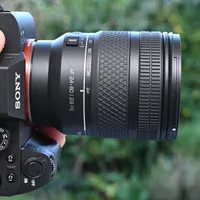
Along with a constant f/2.8 aperture, an almost constant theme to ‘alternative trinity’ standard zooms is that they sacrifice wide-angle coverage, typically starting at 28mm instead of 24mm. The Thypoch, along with the Samyang / Rokinon, buck the trend and match full-sized trinity zooms with a 24mm minimum focal length. The wider perspective is very noticeable when shooting. However, something’s gotta give and what you gain in wide-angle coverage you lose in telephoto reach. Again, most alternative trinity standard zooms stretch to 70mm or 75mm, the Samyang / Rokinon only gives a nod to telephoto reach, maxing out at 60mm, and the Thypoch has none at all, only going to a ‘standard’ 50mm focal length at the long end.
In its defense, Thypoch claims that its first autofocus zoom lens covers three classic or ‘golden’ focal lengths of 24mm, 35mm and 50mm. I’d personally add 28mm to the list, bringing the total up to four. Either way, the net result in terms of handling is that you get a very useful range of focal lengths, all with the same ‘constant’ f/2.8 aperture rating. More remarkably, and unlike with the Samyang / Rokinon lens, the Thypoch has a fully internal zoom mechanism, so the physical length of the lens doesn’t extend at any zoom setting.

Despite the downsized design and lightweight build, the lens is based on no less than 16 optical elements arranged in 13 groups. Those include two aspherical elements, three ED (Extra-low Dispersion) elements and three HR (High Refractive index) elements. The aim is to maximize sharpness, clarity and color rendition while minimizing unwanted aberrations. Nano-structure coatings are also applied to suppress ghosting and flare.

A key facet of any ‘trinity’ zoom lens is the relatively fast and constant f/2.8 aperture, that remains available at all focal lengths. Advantages include the ability to maintain quick shutter speeds under low lighting conditions, to freeze motion and avoid camera-shake without needing to bump up your camera’s ISO setting too much. But the biggest plus point is that you can gain a tighter depth of field for creative effect, isolating subjects within a scene by blurring the background. Bokeh becomes an important factor in the overall performance of the lens and to help ensure that bokeh remains attractive when stopping down a little, the aperture is based on a well-rounded 10-blade diaphragm.

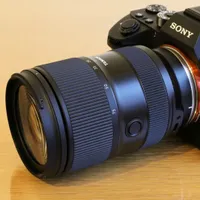
Handling feels impressively up-market, especially for such a budget-friendly lens. The zoom and focus control rings work with smooth precision. Helped by the fully internal mechanisms for both, there’s no hint of zoom creep. The dedicated aperture control ring operates in one-third click steps through its entire range of f/2.8 to f/22, complete with a marked, calibrated scale for easy reference. As usual, there’s an ‘A’ (Auto) position at the narrow end of the range, for controlling the aperture from the host camera body, rather than on the lens itself. It’s a must if you’re shooting in Program AE or Shutter-priority modes.
A couple of downsides are that there’s no switch for locking the aperture ring in its Auto position, so you need to be careful not to nudge it accidentally to a narrow aperture setting when controlling the aperture from the camera body. A bigger problem for videographers is that there’s no de-click switch for the aperture control ring. The upshot is that smooth, silent and stepless aperture transitions are unavailable. Back on the plus side, handling extras include an AF/MF focus mode switch and a customizable function button on the left hand side of the barrel. I’d generally use the latter for autofocus-hold.

Low-budget lenses from certain camera manufacturers (Canon and Nikon spring to mind) are notorious for being supplied with no hood, the item in question being sold separately as an ‘optional extra’. I’m happy that a good-quality and efficient petal-shaped hood is supplied with the Thypoch, as part of the standard kit.

When attached, the hood doesn’t extend very far but does offer extra resistance against ghosting and flare, as well as giving some physical protection to the front element of the lens. It’s a win-win.

I’ve used various lenses that are designed to be lightweight, which have plastic rather than metal mounting plates. That’s not the case here, as the Thypoch features a ‘proper’ metal mounting plate with gold-plated electronic contacts, a rubber weather-seal and a USB-C port for applying firmware updates, if and when needed.

Thypoch Voyager 24-50mm f/2.8: Performance
Like most modern lenses designed for mirrorless cameras, the Thypoch utilizes a linear stepping motor for autofocus, as well as for shifting the relevant groups of elements when focusing manually. Autofocus speed is quite pedestrian for this type of focusing system but typically whisper-quiet in operation. Similarly, manual focusing is smooth and precise. The lens’s autofocus abilities are compatible with Sony AF options like face/eye-detection and tracking, while focus peaking is available for manual focusing.

In my ‘real-world’ tests, sharpness was a bit of a mixed bag. I found center-sharpness to be generally very good when the lens was correctly focused, even at the widest aperture of f/2.8, although it paid to stop down a little at the longest zoom setting. Levels of sharpness towards the edges and corners of the frame were a little lackluster at f/2.8, but noticeably better at medium apertures, again dropping off at the longest zoom setting, where narrowing the aperture gave relatively little improvement.
My main issue with the Thypoch's performance is that I encountered a problem with the lens frequently autofocusing a little short of the subject on which I was trying to focus, especially at or near the long end of the zoom range. This front-focusing issue made foreground areas look sharp, but sharpness was lacking in areas in the scene that were at the distance I was autofocusing. I’m confident that the problem doesn’t lie with my Sony A7 III camera body, as I haven’t had the same issue before or since with all of my other Sony and third-party E-mount lenses (I have many). I’m hoping it's an issue that Thypoch might be able to fix with a firmware update for the lens.

Back on the plus side, the quality of bokeh is pleasingly soft and smooth at f/2.8 and remains attractive when stopping down a bit, aided by the well-rounded 10-blade aperture diaphragm. This helps to maintain a reasonably circular appearance for ‘bokeh discs’ caused by defocused lights or bright spots. In addition to smooth bokeh, there’s good control over axial chromatic aberration (bokeh fringing) at f/2.8, with an absence of colored fringes around high-contrast transitions just in front of or behind the plane of focus. The following gallery contains shots of a phrenology head against a garden backdrop, taken at various apertures from f/2.8 to f/8. It serves as a good test for sharpness, bokeh and axial chromatic aberration.


For such a relatively compact f/2.8 constant-aperture zoom, there’s fairly little vignetting even with automatic in-camera correction disabled. The same holds true for distortions, which rely rather less heavily on automatic in-camera correction than many recent lenses designed for mirrorless cameras, especially those that aim to be compact in size. Unlike when using many of these lenses, you can opt to disable automatic in-camera correction for distortion, rather than it being forced on.
Thypoch Voyager 24-50mm f/2.8: Sample Images
The following gallery of sample images was shot at the Bishop’s Palace and Gardens in the English city of Wells. Most of the pictures were shot in pairs, demonstrating the field of view and overall image quality at the shortest and longest zoom settings, respectively. Some of them taken at or around f/8 demonstrate the front-focusing issue that I encountered mostly at the long end of the zoom range. I also shot some of the images wide-open at f/2.8, to give an idea of the quality of bokeh.


Thypoch Voyager 24-50mm f/2.8: Lab Results
We run a range of lab tests under controlled conditions, using the Imatest Master testing suite. Photos of test charts are taken across the range of apertures and zooms (where available), then analyzed for sharpness, distortion and chromatic aberrations.
We use Imatest SFR (spatial frequency response) charts and analysis software to plot lens resolution at the center of the image frame, corners and mid-point distances, across the range of aperture settings and, with zoom lenses, at four different focal lengths. The tests also measure distortion and color fringing (chromatic aberration).
Sharpness:


In laboratory conditions, center-sharpness generally proved very convincing even wide-open at f/2.8, although it dropped off substantially at the long end of the zoom range. Edge/corner-sharpness is comparatively disappointing at wide apertures and fails to improve much when stopping down to medium aperture settings at the longest zoom setting.
Fringing:

The lens does very well to minimize both lateral and axial chromatic aberrations, which remain negligible across the whole image frame, throughout the entire zoom and aperture ranges.
Distortion:

There’s the typical swing of barrel distortion at the shortest zoom setting, switching to pincushion at the long end. However, the Thypoch does a whole lot better to keep distortions to a minimum, compared with many modern lenses designed for mirrorless cameras. As such, it relies much less on automatic in-camera corrections than is often the case.
Thypoch Voyager 24-50mm f/2.8: Verdict
As some say, ‘if something looks too good to be true, it probably is’. An alternative trinity standard zoom lens that’s so compact and lightweight, selling for such a budget-friendly price, makes the Thypoch Voyager 24-50mm f/2.8 look like a lens that would be wonderfully easy to live with, as well as a standout bargain to buy. Add to that the impressive, weather-sealed build quality, handling extras like an AF/MF focus mode switch, customizable function button and dedicated aperture control ring, and the lens does indeed look a little too good to be true, considering its selling price.
I wanted to fall in love with this Thypoch lens but, while I do like it a lot, I have a couple of reservations. My main problem is that I found autofocus accuracy to be inconsistent in my real-world tests, and that edge/corner-sharpness was disappointing at f/2.8 throughout the zoom range. Narrowing the aperture to medium values brought little improvement at the longest zoom setting. Center-sharpness was also relatively poor at the long end of the zoom range when using the widest aperture.
For a lens based on a rich cine heritage and billed as being ‘cine-soul in motion’, I’m also surprised that there’s no de-click switch for the aperture control ring, or that the ring isn’t permanently de-clicked. Maybe it’s just because I only tend to use an aperture control ring (where available) when I’m shooting video rather than stills.
Ultimately, the Thypoch looks an attractive lens at an appealing price, and it’s refreshingly compact and lightweight, with solid build quality. It’s just not as excellent as I’d hoped, mostly because my review sample was hampered by poor autofocus accuracy.
Features ★★★★½ |
Smart features include a constant f/2.8 aperture (albeit with a relatively limited zoom range), an aperture control ring and a customizable function button. |
Design ★★★★☆ |
The design is impressively compact and lightweight but with good build quality that includes weather-seals. The lack of a de-click facility for the aperture ring is a frustration for videographers. |
Performance ★★★☆☆ |
Sharpness proved a moveable feast in my tests, generally being good at the center but fairly poor towards the edges at f/2.8, as well as suffering from a lack of consistency in autofocus accuracy. |
Value ★★★★½ |
The Thypoch is very good value for money for an f/2.8 constant-aperture standard zoom lens, especially one with a comparatively rich feature set. |

Alternatives