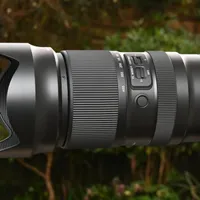
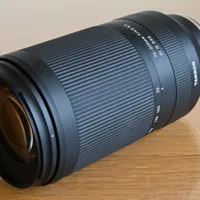
Early Verdict
The Tamron 50-300mm f/4.5-6.3 Di III VC VXD looks rather like the 70-300mm telephoto zooms I was using decades ago on my 35mm film SLRs. I like that it feels like an old friend, but with new autofocus and optical stabilization tech, a customizable function button, weather-seals and up to 0.5x macro magnification. All in all, it’s a lot more high-tech than my tele zooms of yesteryear, but retains a similarly budget-friendly price tag.
Reasons to buy
- +
Voice-coil motor autofocus
- +
Optical image stabilization
- +
Function button and zoom lock
- +
Weather-seals, fluorine coating
- +
USB port
Reasons to avoid
- -
Physical zoom extension
- -
Modest long-end aperture
- -
Only for Sony cameras
Why you can trust Digital Camera World Our expert reviewers spend hours testing and comparing products and services so you can choose the best for you. Find out how we test.
Enthusiast and professional photographers often seek to supplement their standard zoom lens with one of the best 70-200mm lenses, when adding telephoto reach to their outfits. The relatively fast and constant f/2.8 aperture rating is a major selling point, but these lenses don’t come cheap and they tend to be relatively big and heavy. Tamron is renowned for offering great glass at competitive prices, and sure enough, it launched its current budget-friendly, ‘alternative trinity’ Tamron 70-180mm f/2.8 Di III VC VXD G2 for Sony E-mount cameras back in 2023, following up two years later with a Nikon Z-mount version in 2025.
That 2-year offset also applies to the most cut-price Tamron 70-300mm f/4.5-6.3 Di III RXD, a more traditional low-budget telephoto zoom released for Sony in 2020 and for Nikon in 2022. The more powerful Tamron 50-400mm f/4.5-6.3 Di III VC VXD also follows suit, Sony and Nikon editions launching in 2022 and 2024 respectively.
The 50-300mm lens that I’m reviewing here is yet another budget-stretching Tamron telephoto zoom, released in the summer of 2024, but so far there’s no Nikon version. In terms of technical prowess, performance and price, it sits between the Tamron 70-300mm and 50-400mm zooms, aiming to be one of the best budget telephoto lenses and one of the best lenses for Sony cameras, at least if you’re wanting to keep your costs down.
Tamron 50-300mm f/4.5-6.3 Di III VC VXD: Specifications
Mount options |
Sony E (FE) |
Full frame |
Yes |
Autofocus |
Yes |
Image stabilization |
Yes |
Lens construction |
19 elements in 14 groups |
Angle of view |
46.8 to 8.3 degrees |
Diaphragm blades |
9 |
Minimum aperture |
f/22-32 |
Minimum focus distance |
0.22m (W) 0.9m (T) |
Maximum magnification |
0.5x (W) 0.32x (T) |
Filter size |
67mm |
Dimensions |
75x150mm / 3x5.9in |
Weight |
665g / 1.5lb |
Tamron 50-300mm f/4.5-6.3 Di III VC VXD: Price
What price a budget telephoto zoom? The Tamron 50-300mm f/4.5-6.3 Di III VC VXD lists at $699 / £629 / AU$1,158, substantially undercutting the ‘alternative trinity’ Tamron 70-180mm f/2.8 Di III VC VXD G2, which sells for $1,099 / £999 / AU$2,349. It’s also less expensive than the Tamron 50-400mm f/4.5-6.3 Di III VC VXD, which delivers longer maximum telephoto reach at a price of $1,299 / £999 / AU$2,399. The flipside is that the more down-market Tamron 70-300mm f/4.5-6.3 Di III RXD with its relatively basic autofocus system and no optical stabilizer is cheaper to buy at $399 / £399 / AU$999.
Tamron 50-300mm f/4.5-6.3 Di III VC VXD: Design & Handling
If you don’t feel the need for the extra 100mm of reach delivered by the Tamron 50-400mm zoom, this 50-300mm will save you a fair chunk in size, weight and cash. It’s very travel-friendly for a telephoto zoom, measuring a compact 75x150mm / 3x5.9in and weighing in at a mere 665g / 1.5lb. Ultimately, it’s very lightweight for carrying around all day and for handheld shooting, as well as being small to stash away when you’re done.
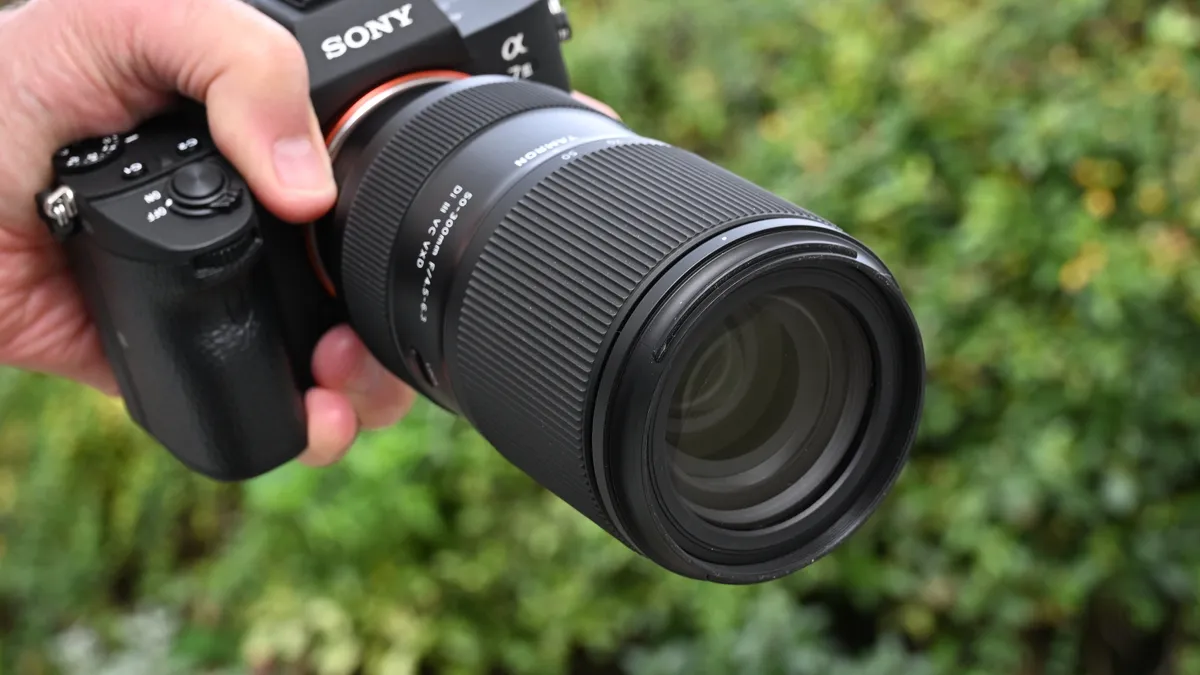
Despite being a bit of a lightweight (in a good way) the Tamron packs quite a lot of glass into its optical path. The arrangement comprises 19 elements in 14 groups, including two LD (Low Dispersion) elements and two XLD (eXtreme Low Dispersion Elements) with a view on enhancing sharpness and clarity while minimizing color fringing. Tamron’s high-tech BBAR G2 (Broad Band Anti-Reflection, Generation 2) multi-coating is applied, to add extra resistance against ghosting and flare.

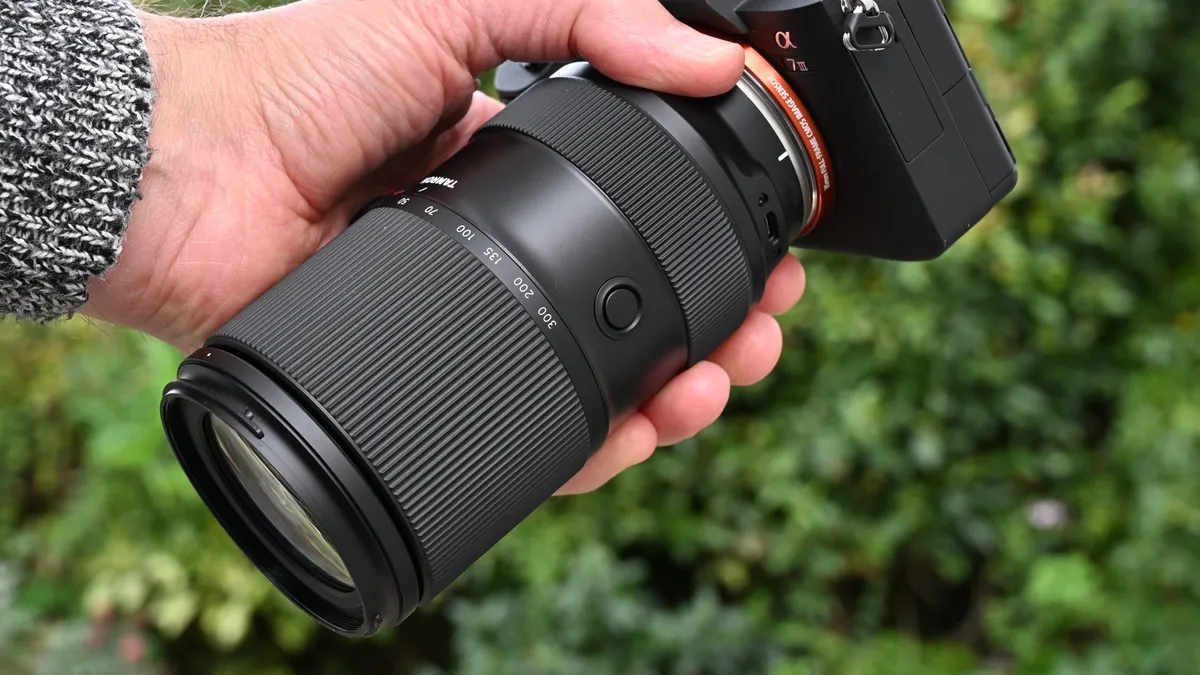
Although a touch under 6 inches long in its shortest configuration, the Tamron is typical of budget telephoto zooms in having an extending inner barrel. The upshot is that as you stretch through the zoom range from 50mm to 300mm, the lens physically grows in length to a maximum of just over 8 inches, as shown in the images above and below.

The act of zooming itself is based on a large, forward-mounted control ring. It has a grippy, ridged surface and the ring operates smoothly and precisely, without any stiff or jerky spots along the way. It’s conveniently marked at focal lengths of 50, 70, 100, 135, 200 and 300mm.

Typical of autofocus lenses, the manual focus ring is rather smaller but it’s still bigger than in many similar lenses. The chances are that you might never even use it, as the lens has a particularly fast, virtually silent and consistently accurate autofocus system. Indeed, it’s based on a VXD (Voice-coil eXtreme Drive) motor, rather than the more run-of-the-mill linear stepping motor that’s often featured in modern lenses. A further bonus for close-up photography is that you can focus right down to 22cm / 8.7in at the short end of the zoom range (as measured from the image sensor in the camera body) enabling up to 0.5x macro magnification.

Despite the budget-friendly price of the lens, it features a ‘Focus Set’ function button on the side of the barrel. You can customize the button’s action by using the Tamron Lens Utility software (more on that later), selecting options that include focus preset, A-B focus, a focus range limiter and AF/MF focus mode selection.

One bugbear with any zoom lens that physically extends through its zoom range is that it might tend to stretch out when you’re carrying it around. This makes it more awkward to live with and more likely to get bumped somewhere along the line. To keep it restricted to its minimum length, the Tamron features a zoom lock switch on the side of the barrel.

A petal shaped hood is supplied with the lens. It does its job simply and effectively, having the usual bayonet-fit mechanism. Also as usual, you can reverse-mount it on the lens for compact stowage.

I always tend to fit a hood when using a lens, if one is available. Apart from reducing the risk of ghosting and flare when shooting against the light, they always give physical protection to the front glass element.

As I mentioned earlier, you can use the free Tamron Utility software to apply firmware updates and to customize the lens, linking it to a computer with a USB-C cable. A more elegant and portable solution is to invest in the Tarmon-Link Bluetooth Module, which is tiny, weighs next to nothing and sells for $50 / £59 / AU$80. You can plug this into the lens’s USB-C port at the rear of the barrel and work your customization magic from an app on your smartphone, when you’re out and about.

Although compact and lightweight, the Tamron feels robust and nicely engineered. The mounting plate is made from metal rather than plastic and features a rubber weather-seal gasket to guard against the ingress of dust and moisture through the joint between the lens and camera body. Further weather-seals are incorporated into the lens barrel to ensure a weather-resistant construction.

Tamron 50-300mm f/4.5-6.3 Di III VC VXD: Performance
As I’ve come to expect from many of Tamron’s current lenses, the voice-coil motor autofocus system is very fast and consistently accurate. While testing the lens with my Sony A7 III camera body, I found that autofocus snapped into position almost instantaneously, with all but the trickiest subject matter or the gloomiest of lighting conditions. Autofocus was also well able to keep up with swiftly moving subjects in continuous AF mode. Similarly, Tamron’s proprietary ‘Vibration Compensation’ system works very well, although it doesn’t have the switchable modes of some of the company’s more exotic lenses, including the Tamron 50-400mm f/4.5-6.3 Di III VC VXD.
I feel it’s good that optical stabilization is included, even if all but Sony’s first generation of Sony Alpha full-frame cameras feature IBIS (In-Body Image Stabilization). An upside is that optical or ‘in-lens’ stabilization tends to work better than IBIS at long telephoto focal lengths. Furthermore, the lens is easily compact and lightweight enough for use with Sony’s A6000-series of APS-C format cameras, on which it has a powerful ‘effective’ zoom range of 75-450mm, taking it into ‘super-telephoto’ territory. Historically, most of Sony’s APS-C cameras didn’t feature IBIS, making optical stabilization even more of a must-have feature.

I’d class the actual zoom range of the lens as a performance factor. Unlike the 70-300mm lenses of old, as well as Tamron’s relatively new edition that has an identical zoom range, this lens kicks of at a completely standard focal length of 50mm, which gives an entirely natural perspective. The practical value is that when alternating between standard and telephoto compositions, you’re less likely to have to keep swapping the lens on your camera body. Not only is this more convenient, it also enables you to capture fleeting, definitive moments instead of missing important shots altogether, because you were swapping between different lenses. The images above and below demonstrate the extremities of the zoom range, taken of the same scene from the same position, using 50mm and 300mm zoom settings.

Levels of sharpness are impressive, both throughout the entire zoom range and across the whole image frame, from the center to the extreme edges and corners. Clarity, contrast and color rendition are also very good, optical performance benefitting from the LD and XLD optical elements that I mentioned earlier. Conversely, bokeh is nice and smooth, which I’ve generally found to be a common trait of Tamron lenses. Despite this one not having a very fast aperture, longer focal lengths enable a tight depth of field.

As well as delivering very respectable sharpness, the lens does well to suppress color fringing. Again, this holds through throughout the whole zoom range, right out to the corners of the frame. Pincushion distortion can be a bit noticeable, especially at longer zoom settings, but this can be virtually eliminated by automatic in-camera correction, along with any visible trace of color fringing.

Not just a telephoto zoom with long reach, the lens is also advertised as having a 0.5x macro facility at its 50mm focal length, for extreme close-ups. When trying this out, I found that images were nice and sharp at the center of the frame. However unlike ‘proper’ macro prime lenses with a flat field design, the Tamron gets really blurry towards the edges of the frame, when shooting flat subjects head-on. You’ll see this in the 0.5x macro shot below, taken of a row of color pencils on a sheet of paper.

Tamron 50-300mm f/4.5-6.3 Di III VC VXD: Sample Images
The following gallery of example images was shot on a mostly overcast morning in the area between Underfall Yard and Bristol Marina, part of the Floating Harbour in Bristol, South West England. I used various focal lengths to give an idea of image quality throughout the zoom range. Some of the pictures were taken in pairs, shot of the same scene from the same position using the shortest and longest focal lengths respectively, to demonstrate the quality at both extremities of the zoom range.


Tamron 50-300mm f/4.5-6.3 Di III VC VXD: Verdict
I feel that the Tamron 50-300mm f/4.5-6.3 Di III VC VXD gives a lot of bang per buck. I’m impressed with the speed and accuracy of its VXD voice-coil motor autofocus system, and the effectiveness of its VC optical stabilizer. They combine to ensure an excellent hit rate when shooting tricky subjects in action, sports and wildlife photography, to which this telephoto zoom is ideally suited.
Sharpness, clarity and color rendition are all very good, and the lens also delivers smooth bokeh along with good suppression of distortion, color fringing, ghosting and flare. In practical terms, I also like that the lens is compact and lightweight, making it easy to carry around and comfortably convenient for even long periods of handheld shooting.
All in all, I think that the Tamron is a very wise buy for both full-frame and APS-C format Sony mirrorless cameras, giving a powerful ‘effective’ 75-450mm zoom range on the latter. I just wish it was also available for other makes of camera, instead of just for Sony.

Alternatives