Digital Camera World Verdict
I really enjoyed using Fujifilm’s slim new monochrome disposable – honestly more than I was expecting. It’s so tiny and pocketable, with better ergonomics than you’d expect from a camera that’s designed to be used once and tossed away, and the punchy, contrast-y, fine-grained images it produced were more hits than misses.
Reasons to buy
- +
Produces attractive monochrome images
- +
Small, slim, chic form factor
- +
Can be developed using C41 color print film process
Reasons to avoid
- -
Fixed settings limit creative options
- -
Wasteful single-use plastic
Why you can trust Digital Camera World Our expert reviewers spend hours testing and comparing products and services so you can choose the best for you. Find out how we test.
Fujifilm’s disposable QuickSnap cameras are very, very big business. As of 2026, the manufacturer has sold more than 1.7 billion of these little single-use 35mm cameras in the 40 years that they’ve been on the market – and yes, that’s ‘billion’ with a ‘b’. This year, Fuji refreshed the line a little with two new QuickSnap models, one of which is the slim, fetching Fujifilm QuickSnap Black and White.
Pre-loaded with 27 shots of ISO400 monochrome 35mm film, the Fujifilm QuickSnap Black and White is exactly what you’d expect from a disposable camera. It sports a wide-angle lens made of plastic, its settings are fixed, and once you’ve rattled through your exposures, you’re done – it’s time to send the camera off to be broken open and developed.
So, the QuickSnap Black and White promises to be a take-everywhere all-rounder of a disposable camera in fetching, stylish monochrome. How does it measure up? I took it on a long walk to find out.

Specifications
Type |
Disposable 35mm film camera |
Exposures |
27 |
Lens |
Plastic, 32mm f/10, fixed focus |
Shutter speed |
1/140 sec |
Min. focus distance |
1m |
Viewfinder |
Optical |
Flash |
Built-in |
Battery |
AAA x 1 (included) |
Dimensions |
115 x 54 x 34 mm |
Weight |
90g |
Processing |
C41 |

Price
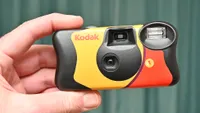
The Fujifilm QuickSnap Black and White is, as you might expect, very cheap. It comes at a recommended price of $22.90 / £20.99 / AU$34.95, pre-loaded with a roll of 27 exposures. This isn’t the cheapest on the market – Kodak’s FunSaver disposables tend to be a few dollars less – but it’s about in line with what you’d expect a disposable to go for in 2026.
Also, interestingly, despite the fact that this edition of the QuickSnap uses black & white film, Fujifilm says that it can be developed via the standard C41 process normally used for color film. This not only provides some fairly strong hints as to which film stock is probably inside it (more on which later), but also means that development is slightly cheaper, as most labs will charge less for C41 development than B&W.

Design & handling
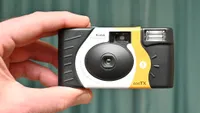
One of the first things that will likely strike you about the Fujifilm QuickSnap Black and White is just how tiny it is. Weighing just 90g and measuring just 115mm along its longest edge, this is a properly pocketable camera. Heading out with the QuickSnap, I found I was able to tuck it neatly into my front jacket pocket and quickly draw it out when I wanted to capture a moment. I loved that.

Controls are, of course, very limited. On the top is the shutter release button, on the rear is the standard wind-on wheel, and on the front is the switch to activate the flash. When you do activate the flash, a clear plastic cube pops up on the top of the camera, which then glows red once the flash is charged and ready to use. An inconsequential little touch, maybe, but I rather liked it.
It’s all made of cheap plastic, of course. But overall, the ergonomics of the QuickSnap Black and White were better than I expected. It was addictively easy to pull the camera out for quick grab shots, and once I hit my limit of 27 exposures and the wind-on wheel no longer stopped turning, I was genuinely a little disappointed – though of course, I now had the excitement of waiting to see how my shots had come out.

Performance
Fujifilm has not specified what exactly the ISO400 monochrome film inside the Quicksnap actually is – whether it’s a proprietary new stock, or something borrowed from another manufacturer like Ilford. Given that it’s a ISO400 black and white film that can be developed using the C41 process, it seems entirely plausible that it’s Ilford XP2 Super 400; Fujifilm doesn't make its own ISO400 black and white film - the only one it does make is the ISO100 Neopan Acros 100II. Looking at my QuickSnap scans side by side with images I’ve previously shot on XP2, I can’t say for sure whether it is the same film – but it is pretty similar.


Fine by me. I like XP2. Regardless, whatever the stock inside actually is, the Fujifilm QuickSnap Black & White delivers images that look pretty darn good, with a wide range of tones from deep blacks to glowing highlights. The fine grain means a decent level of detail when you’re shooting up close, and there’s enough contrast for images to have the level of drama that monochrome shooters are looking for. The flash is also handy, providing a burst of illumination where needed – I found it filled out a self-portrait quite pleasantly, adding drama and contrast without blowing the image out.
There are limits, of course. It’s a disposable. The plastic lens is only going to give you so much, and the edges and corners of images are very soft indeed. You’re locked into a 27mm perspective, and at distance, details can become a bit muddy and indistinct. The camera’s fixed settings mean that you can’t adjust exposure for challenging shooting situations, like a strong backlight. And sometimes, conditions are so bright that the exposure is simply overwhelmed.


But of course, none of these are problems with the Fujifilm QuickSnap specifically – they’re baked into the concept of a disposable. You’re not going to buy this camera if any of these things are a deal-breaker. And honestly, this is one of my favourite disposables that I’ve used.
Verdict
I really enjoyed shooting with the QuickSnap Black & White and I really liked a high percentage of the images I produced with it. It’s tough to argue with that. All the criticisms I’d make of it are just things that are inherent to disposables – the limited settings, the soft lens, the wasteful nature of all its single-use plastic. You know all that.
What can I say – I was charmed! The camera is a slim, tidy object that’s genuinely pocketable, easy to take everywhere, and its attractive monochrome images feel a cut above standard disposable shots in terms of quality. Black & white isn’t for everyone, of course – but of all the disposables I’ve used, this is the one that I’m most tempted to buy again.
Features ★★★☆☆ |
There aren’t many features to the QuickSnap, but it’s not the sort of camera where you’d expect there to be. |
Design ★★★★½ |
Delightful – slim and attractive, with good ergonomics and even a couple of stylish touches. A proper take-everywhere camera. |
Performance ★★★★☆ |
The monochrome film stock is lovely, with strong contrast and fine grain. The plastic lens has its limits. |
Value ★★★★☆ |
Very cheap at $22.90, and the fact that it can be processed via C41 is also a saving – though of course it's one-use-only. |
Alternatives