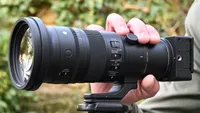
Digital Camera World Verdict
The Sony FE 400mm f/4.5 GM OSS is a high-performance super-telephoto prime with outstanding features and handling, shoehorned into an incredibly compact and lightweight build, with a downscaled price tag to boot. It’s a first-class lens, standout value for money and has completely won me over!
Pros
- +
Unfeasibly compact and lightweight
- +
High-end handling
- +
Spectacular performance
- +
Excellent value for money
Cons
- -
Not the fastest aperture
Why you can trust Digital Camera World Our expert reviewers spend hours testing and comparing products and services so you can choose the best for you. Find out how we test.
Rock up to any major sporting event and you’re likely to see massed ranks of pro photographers with their ‘great white’ super-telephoto lenses. The lenses on parade have several things in common, beyond their white paint jobs that are applied to minimize the build-up of heat when you’re shooting for long periods under a glaring sun. Equally common traits are that these lenses are very big, hugely heavy and massively expensive, sometimes costing as much as most of us would expect to pay for a decent family car.
All of this makes the new Sony FE 400mm an absolute trend-bucker. Pick one up and it just doesn’t seem to make sense. Sure, it’s physically long and finished in white, but this lens is so relatively lightweight that it almost feels like Sony has built some kind of anti-gravity device into the design, or at least stripped out most of the glass. For comparison, the FE 400mm f/2.8 is considerably longer, has about 50 per cent more girth and is almost 2kg heavier at approximately three times the weight. Bearing in mind that the f/2.8 lens is marketed as ‘the lightest in its class’, it goes to show just how much weight loss we’re talking about in the new lens, which is advertised as being ‘the lightest of its type in the world’.
There’s a similar slashing in terms of purchase price, making the new FE 400mm f/4.5 much more affordable as well as being highly desirable. All in all, it aims to be one of the best Sony telephoto lenses, best lenses for sports, best lenses for bird photography and wildlife, and best lenses for safari, while also being outstanding value for money.

Sony FE 400mm f/4.5 GM OSS: Specifications
Mount options |
Sony E (FE) |
Full frame |
Yes |
Autofocus |
Yes |
Image stabilization |
Yes |
Lens construction |
22 elements in 16 groups |
Angle of view |
6.2 degrees |
Diaphragm blades |
11 |
Minimum aperture |
f/22 |
Minimum focus distance |
TBC |
Maximum magnification |
TBC |
Filter size |
95mm |
Dimensions |
108x242mm / 4.3x9.5in |
Weight |
994g / 2.19lb |
Sony FE 400mm f/4.5 GM OSS: Price
Feel the need for speed? It’s going to cost you, with the Sony FE 400mm f/2.8 GM OSS selling for an eye-watering $12,999 / £10,490. The new FE 400mm f/4.5 is only 1.33 f/stops slower but still looks and feels a properly pro-grade lens with most of the same handling luxuries. And yet this lens is massively more affordable at just $2,699 / £2,579 / CA$3579, little more than the veteran Sony FE 100-400mm f/4.5-5.6 GM OSS zoom at $2,799 / £2,149. Skip the G Master credentials, and there’s also the Sony FE 200-600mm f/5.6-6.3 G OSS at a less expensive $2,099 / £1,599.
A tempting alternative prime is the Sigma 500mm f/5.6 DG DN OS Sports, available in L-mount as well as Sony E-mount options, selling for $2,999 / £2,779. The Sigma is also a relatively compact and lightweight option at a very keen selling price, but it’s still nearly 40 per cent heavier than the Sony lens, trading a longer focal length for a slower f/5.6 aperture.
Sony FE 400mm f/4.5 GM OSS: Design & Handling
You need strong arms and a fat wallet for a top-end lens like the Sony FE 400mm f/2.8 GM OSS, which weighs in at 2,895g / 6.38lb and carries a price tag detailed above. Set your sights a little lower and this new f/4.5 lens still boasts a reasonably fast aperture (at least in super-telephoto terms) but in a much more manageable and affordable package. It sneaks in at just under a kilogram, with an official weight of 995g / 2.19lb, making it suitable for even lengthy periods of handheld shooting, rather than relying on a monopod or tripod to take the strain.
And for when size matters, or rather the lack of it, the lens measures 108x265mm / 4.3x10.4in, compared with the much larger dimensions of the f/2.8 lens at 158x359mm 6.2x14.1in. With a girth of only about two-thirds, the f/4.5 lens has a regular 95mm front filter attachment thread, rather than a 40.5mm drop-in filter arrangement near the rear.

The front element shown in the picture above has a fluorine coating to repel moisture and grease, and to aid easy cleaning. Move further back along the extensively weather-sealed barrel and there’s no shortage of handling exotica, which I’ll come to in a moment. Dip inside and you’ll find not one but two XD (eXtreme Dynamic) linear motors that power the fully internal focusing mechanism. Autofocus speed and tracking is designed to cope with 120fps shooting and 240p video capture. The lens shares its top-ranking autofocus system with the much pricier f/2.8 lens, along with switchable full-time DMF (Direct Manual Focus).

Another feature shared with Sony’s top-dollar telephoto primes is an additional, customizable control ring, or ‘function ring’ positioned just in front of the main focus ring. You can assign the secondary ring to various functions but a favorite is Power Focus, which delivers smooth, motorized manual focus transitions when shooting video. One thing that’s featured in the pricier lenses but is lacking in this one is that you don’t get a Preset focus facility with optional confirmation beep.

Moving to the forward end of the black section in the lens barrel, just in front of the focus ring and function ring, there’s a rank of four function buttons. Again, these are customizable but the most popular assignment is AF/L (Autofocus Lock). You can therefore easily lock the focus position and the fact that there are four buttons at 90-degree intervals around the whole barrel means that one of them will naturally fall under the thumb in any shooting orientation.

The further you get into the design of the lens, the more it looks and feels like Sony’s top-end super-telephoto primes, just with a drop in size and radical weight loss. As I’ve mentioned, Preset and Beep switches are absent but you do get a bank of five switches for AF/MF focus modes, full-time DMF on/off, an autofocus range limiter, OSS (Optical SteadyShot) on/off and three selectable OSS modes. These include regular static and panning modes, while Mode 3 delivers adapted stabilization in the viewfinder that makes it easier to acquire and track erratically moving subjects in shooting scenarios like sports, action and wildlife.

If you happen to need even more powerful telephoto reach, the lens is compatible with Sony’s 1.4x and 2.0x teleconverters. The 2.0x version might cramp your style with its 2-stop impact on aperture rating, but the 1.4x will extend your focal length to a mighty 560mm while giving you a still entirely workable aperture rating of f/6.3. Intriguingly, that’s the same as the aperture rating of Sony’s simultaneously launched and extremely similar Sony FE 600mm f/6.3 GM OSS prime, which is physically only marginally longer than this 400mm lens and has a virtually identical weight.
Another viable alternative for gaining extra reach is to switch your Sony full-frame camera body to APS-C crop mode. And with the most high-res ‘R’ models, you’ll still get plenty of megapixels to play with. The lens’s lightweight build also makes it feel relatively at home on one of Sony’s APS-C format camera bodies. Both of these approaches will give you an ‘effective’ 600mm focal length but without the narrowing of aperture from using a teleconverter.

Ghosting and flare can impact the image quality of long telephoto lenses but the Sony has a couple of things in its arsenal to put up a good fight. The first is Nano AR Coating II, which is a high-tech, nano-structured coating designed specifically for lens elements that have a large diameter or are strongly curved. The other is a highly efficient hood, which is very well made and features a release button so that it stays locked in place until you want to remove it.

Even with the combination of optical and in-camera stabilization, a tripod or monopod can help to keep everything steady, as well as bearing the (albeit lightened) load. As I’d expect, the lens comes complete with a tripod mounting ring, that ensures an equally good balance for both landscape and portrait orientation shooting, as well as easy swapping between the two. A simple locking knob enables smooth and easy rotation, and firmly fixes the lens at any position.

Unlike with many lenses that feature tripod mounting rings, the collar is not completely removable. Instead, only the foot detaches, as shown in the image below. The foot itself has both sizes of standard 1/4in and 3/8in mounting threads and once removed, there’s only a small stub that remains. Unlike the stub featured in some other lenses of its type, this one takes up very little additional space and doesn’t impinge on handheld shooting.

The hefty FE 400 f/2.8 has additional attachment screws in its mounting plate, to ensure sufficient strength, rigidity and durability. Those aren’t necessary in this lens, because it’s so much more lightweight. Even so, the metal mounting plate is very durable and features a weather-seal gasket and gold-plated electronic contacts.

The lens is very slim for its type but still necessarily quite long. I’m glad that Sony has seen fit to include a high-quality carrying bag as part of the package. And as a further bonus, the carrying bag has a smart, space-saving design.

Sony FE 400mm f/4.5 GM OSS: Performance
I tested the FE 400mm with a Sony A7R V camera body, which puts great demands on the autofocus speed and resolving power of any lens, with its revamped AI-powered autofocus system and 61MP image sensor. I found that when shooting lakeside birds that were darting around and moving their heads quickly and erratically, the lens was able to take full advantage of the A7R V’s advanced recognition and tracking abilities, with sufficient speed to ensure a really high hit rate of sharply focused images.

The focal length itself is a serious performance factor in that it gives sufficient telephoto reach to cover an awful lot of distance. Naturally, it’s a major bonus when shooting action sports, where you’re confined to a spectator’s area or (if you’re really fortunate) a designated photographer’s spot. It’s equally advantageous for shooting birds and wildlife, where you can’t physically get as close as you might like without invading their personal space, scaring them away, or being attacked by some of the more ferocious examples. As well as shooting birds with the lens, I used it at a heritage railway site, and was pleased that I was able to get the shot below from a long way down the line.

Moving onto resolving power, I was again impressed that the lens is able to capture immensely fine detail and texture. There’s also excellent clarity and contrast, with powerful resistance against ghosting and flare. Color rendition is very natural and the lens is capable of a tight depth of field, along with a smooth and dreamy quality of bokeh. Suffice it to say that all of the essential ‘image quality’ boxes are well and truly ticked.

Unwanted aberrations are kept to negligible levels, with very good control over distortion and color fringing. These attributes are demonstrated in the image below, which shows a lack of distortion and no visible color fringing around the high-contrast transitions of the window and door frames.

Sony FE 400mm f/4.5 GM OSS: Sample Images
When taking the sample shots for the following gallery, I started off at the East Somerset Railway in the South West of England. It’s a delightful historic railway that’s run as a charity by a friendly bunch of volunteers, and is well worth a visit. Next, I moved on to the Chew Valley Lake, also in Somerset, to test the lenses by shooting some lakeside birds. Finally, I took them on a stroll around the picturesque town of Stockbridge in Hampshire. I took all of the sample shots at the widest available aperture of f/6.3, which is the sternest test of the lens but often needed to enable sufficiently fast shutter speeds.


Sony FE 400mm f/4.5 GM OSS: Lab Results
We run a range of lab tests under controlled conditions, using the Imatest Master testing suite. Photos of test charts are taken across the range of apertures and zooms (where available), then analyzed for sharpness, distortion and chromatic aberrations.
We use Imatest SFR (spatial frequency response) charts and analysis software to plot lens resolution at the center of the image frame, corners and mid-point distances, across the range of aperture settings and, with zoom lenses, at four different focal lengths. The tests also measure distortion and color fringing (chromatic aberration).
Sharpness:

You’ll often need fast shutter speeds to freeze action in sports and wildlife photography with this type of lens, so I feel that wide-open sharpness is an important performance factor. The Sony really delivers, with stellar sharpness even at its widest aperture, not just at the center of the frame but right out to the edges and corners.
Fringing:

Color fringing is entirely negligible, again not just at the center of the frame but deep into the corners. Performance is excellent in this respect, throughout the entire aperture range.
Distortion: 0.67
Technically, there’s just a hint of pincushion distortion but it’s of a very low order and will generally go unnoticed in ‘real-world’ shooting. And that’s without any input from automatic in-camera correction.
Sony FE 400mm f/4.5 GM OSS: Verdict
The Sony FE 400mm f/4.5 GM OSS is a dream come true as far as I’m concerned. Some photographers say that if you can’t shoot at 200mm, you’re just not close enough. I’m not one of them. I love shooting action, sports, wildlife, birds, aircraft and plenty of other subjects where it’s simply not possible to get as close as I might like to. I love that this Sony lens really covers the distance, without weighing me down. It’s very compact for its type and I can comfortably shoot handheld for long periods of time without feeling any strain.
The pricing of the lens also makes it massively more affordable than most top-flight super-telephoto primes. Couple that with epic performance in terms of super-fast and consistently accurate autofocus, along with stellar sharpness, clarity and color rendition, and you have a real winner of a lens. The quality of bokeh is very appealing as well, and the lens keeps all unwanted aberrations to an absolute minimum. I feel that Sony has pulled off something a masterstroke with this lens. It’s absolutely fabulous.
Features ★★★★★ |
Top-flight features include dual XD autofocus motors, highly efficient triple-mode optical stabilization, and a bucketload of handling extras. |
Design ★★★★★ |
The design is a masterpiece of miniaturization, shoehorning a 400mm super-telephoto focal length into an incredibly compact and lightweight, yet tough and weather-sealed build. |
Performance ★★★★★ |
Autofocus is super-fast and tenacious, optical stabilization works brilliantly and image quality is gorgeous in all respects. |
Value ★★★★★ |
I’m not going to pretend it’s a cheap lens to buy but considering its design, handling and performance, it’s great value for money. |
Overall |
★★★★★ |

Alternatives