Digital Camera World Verdict
The Amaran T2c two-foot-long tube light should appeal to photographers and videomakers who want accurate white light in degrees Kelvin, creative gel colors, or even animated effects. Its RGBWW LEDs, battery-powered portability, and Sidus Link app make it particularly useful on location, while the tube-shaped light itself can even double as a fun prop (lightsaber style!). It isn’t the cheapest tube light option on the market, and the small OLED screen and buttons can feel a bit fiddly, but the T2c’s metal build quality and wide range of lighting options help justify its more professional-level price.
Reasons to buy
- +
CCT output
- +
RGB output
- +
Green/magenta tunability
- +
Portable and durable
- +
Control panel or app
- +
15 light effects
Reasons to avoid
- -
No 1/4-inch thread on ends
- -
Only 20W output
Why you can trust Digital Camera World Our expert reviewers spend hours testing and comparing products and services so you can choose the best for you. Find out how we test.
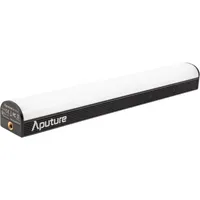
The Amaran T2c is a two-foot-long light tube that can be set to produce light matching specific color temperatures (such as daylight of 5600K), or provide gel-like colors that change the mood of a portrait in more creative ways.
Amaran is part of Aputure, a company that has been producing lighting equipment for professional filmmakers and photographers since 2005. Aputure launched its Amaran brand around 2020, creating a more affordable range of lighting products aimed at photographers, independent filmmakers, and content creators – so its lights should appeal to readers of Digital Camera World (you can read our review of an Aputure-branded MT Pro tube light for comparison).
Often, you’ll find that Amaran products have the Aputure branding added at the front of the title on retailer listings anyway, and indeed, the box the T2c shipped in states "Amaran by Aputure."
The Amaran range includes compact LED panels, full-color COB lights, flexible light mats, and portable battery-powered models. In addition to the two-foot-long T2c featured in this review, Amaran produces the four-foot-long T4c. The company also makes PT-series pixel tubes, which feature individually controllable lighting zones for more elaborate color and animation effects. For more recommendations for tube/wand/stick LED lights, check out our light wands buying guide.
More recently, Amaran has broadened its ambitions beyond lighting. Its current range includes the Amaran Mic, a wireless desktop microphone aimed at creators who want straightforward, studio-quality audio without a complicated setup. That expansion makes Amaran increasingly relevant to photographers who also shoot video, produce content for social media, or work from a home studio.
Amaran also provides modifiers, softboxes, and other accessories designed to turn its lights into more versatile creative tools. I’ve enjoyed testing Amaran lights before for DCW, such as the home studio flat panel Amaran Verge Max.

Amaran T2c: Specifications
Power output |
20W, 1,631 lux @ 1.64 ft (0.5 m) |
Material |
Metal and plastic |
Dimensions |
23.6 × 1.7 × 1.7 in (60 × 4.2 × 4.2 cm) |
Weight |
1.67 lbs (0.8 kg) with battery grip attached |
Mounting point |
3/8-inch screws with locating pin x3; NATO Rail |
Color |
2500K–7500K |
CRI/TLCI |
CRI 95+, TLCI 98+ |
Battery life |
Up to two hours at full power |
Amaran T2c: Price
The Amaran T2c light tube can be picked up for around $199 / £206 / AU$379. This isn’t the cheapest light tube wand on the market, but as they say, you get what you pay for. It feels like a solidly built unit, with a black metal battery station/handle that blends beautifully with the matching metal section running along the length of the tube’s rear. Cheaper light wands tend to be constructed almost entirely from plastic, so the T2c feels more like a professional lighting accessory, deserving of its more professional-level price.
At 20W, the T2c isn’t the brightest light source, so if you’re prepared to pay more, you can upgrade to the similar but brighter T4c kit for in the region of $330 / £340 / AU$575. This gives you two tube lights, each with a 40W output. Despite being twice the length and twice the power, the T4c kit doesn’t cost twice as much as a T2c – and you get two lights in the kit. That makes it a tempting step up if you need more illumination output or want to create a more effective key-and-fill light setup.
Amaran T2c: Design & Handling
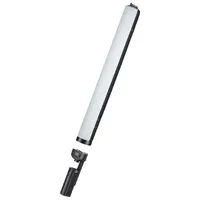
The Amaran T2c light tube has a reassuringly solid black metal spine running along its length, which should give the unit plenty of protection while being handled on a shoot. The tube is also capped with metal at either end for extra protection. On the opposite side of the metal spine is a white plastic diffuser that softens the output from the LEDs hidden inside the unit, producing a more flattering light with less harsh shadows – perfect for portraits!
On its own, the T2c weighs 2 lbs (0.91 kg), and you can power it by connecting the supplied power cable to the mains. I prefer to shoot models on location, so fortunately the T2c also ships with a sturdy 0.66 lb (0.3 kg) metal battery grip that you can charge at home. When docked to the light tube with a satisfying 'push and twist' motion, the battery grip makes the T2c a little heavier to wield – especially when doing the inevitable lightsaber impression – but my model, Maryna, had no trouble maneuvering the T2c and attached battery handle while we tested the light on location.

On the rear of the tube, along the black metal side, you’ll find a small OLED display with an adjacent plastic control dial that doubles as a button. This dial, in conjunction with a couple of additional Mode and Menu buttons, enables you to adjust a wide range of LED properties. The monochrome OLED screen is very small, though, and it takes a fair bit of pressing and twiddling to cycle through the various menus and sub-menus. I therefore preferred using the Sidus Link smartphone app to adjust the light’s color and effects while on location – as you’ll see in the Performance section (and in the accompanying video of my T2c test).

It’s important to note that the Amaran T2c isn’t simply an RGB LED light. In addition to red, green, and blue LEDs that can be mixed to produce a huge range of colors, the T2c uses an RGBWW chipset, with dedicated warm-white and cool-white LEDs. These enable you to select specific color temperatures and produce more natural-looking white light than you’d typically get by mixing RGB LEDs alone. This design feature also contributes to the T2c’s high CRI and TLCI scores, which indicate how accurately it can reproduce colors and skin tones. You can also tweak the greens and magentas individually, which enables you to remove unwanted tints.

Amaran T2c: Performance
To test the Amaran T2c light tube, I booked a model (any excuse!) and headed into London. Instead of my usual gloomy Barbican Centre interior, I decided to shoot Maryna in the busy Soho district, which is packed with colorful locations, such as Chinatown and the theatre district.
The day before, I’d tested the larger, more powerful Harlowe Max Spectra at the Barbican. The Spectra required a full-size lighting stand – which would be a tripping hazard in Soho. So for the slimmer, tube-shaped Amaran T2c I wanted something much more portable and with a much narrower footprint. I therefore brought along a Manfrotto Pixi mini tripod, planning to screw it directly into one of the mounting points at the top or bottom of the light tube.

However – while on location – as soon as I tried to screw the Pixi’s 1/4-inch mounting screw into the fitting at the end of the T2c, I realized that the light’s thread was too large. I’m used to many of the smaller tube lights I test having a standard 1/4-inch socket, so I had automatically assumed the same would apply here.
The thread that I was looking at was actually a larger 3/8-inch mounting point. The T2c does have 1/4-inch mounting options elsewhere on its body, alongside 3/8-inch threads with ARRI-style locating pins and a NATO rail. That wider selection reflects the T2c’s more professional video-production heritage, where 3/8-inch fittings and grip accessories are commonplace. It gives you plenty of ways to rig the light securely, although it does mean you need to pay a little more attention to which mounting point you’re using before heading out on a shoot.

I could have attached my Manfrotto Pixi to one of the 1/4-inch threads running along the rear of the T2c, but that would have positioned the tube horizontally, a few inches above the ground. For my portrait shoot, I wanted the light standing vertically, so the larger 3/8-inch fittings at either end were the more relevant mounting points, but useless to my needs on the day of the test.
Lacking a tripod that could hold the T2c vertically, I had to adapt – and this led to some unexpected but enjoyable results during my portrait test shoot. I was able to lean the light upright against a window and illuminate Maryna from the side, using HSI mode to dial in some creatively colored lighting. It was then a simple matter to paint the light itself out of the finished image in Photoshop using its highly effective Generative Fill tools.

I also laid the tube-shaped T2c horizontally on a table in a gloomy pub and added a strong daylight-balanced key light to the side of Maryna’s face, making it look as though she was being illuminated by light from an off-screen window. When there was no convenient surface available, I simply asked Maryna to hold the light just out of shot. As a result, I ended up shooting far more tight and intimate portraits than I usually would, just to keep the handheld light out of the frame.
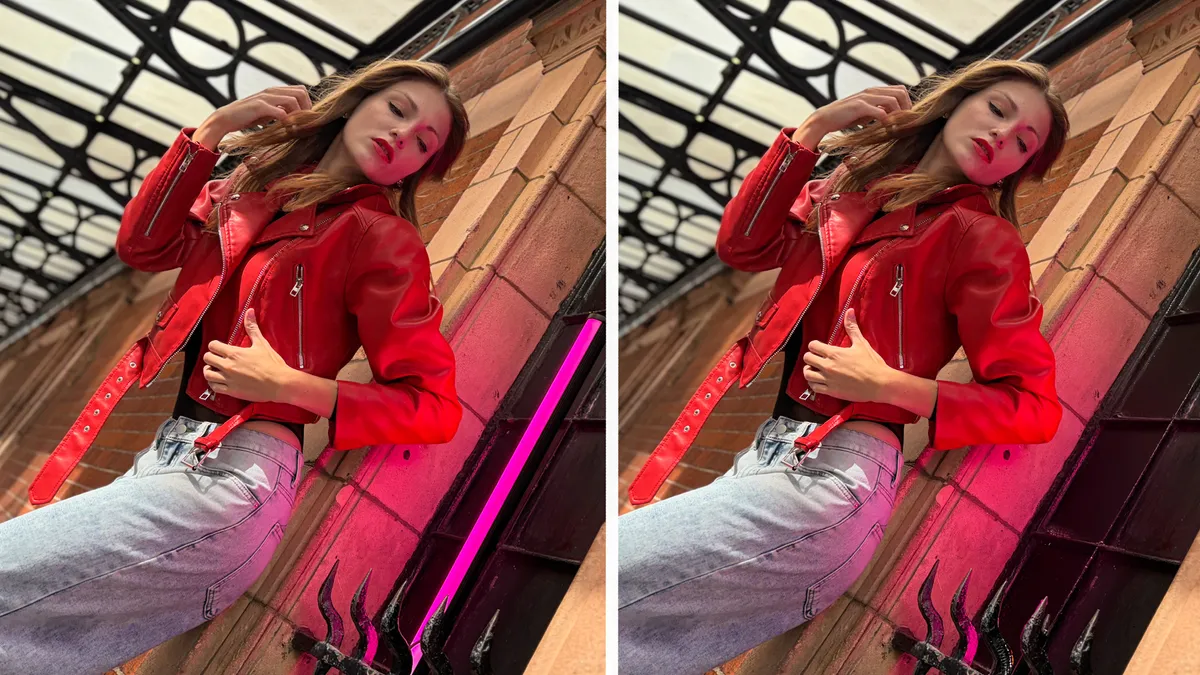
And because the T2c looks a bit like a lightsaber, Maryna also had fun posing with the LED in shot. In fact, this inspired the header image for my review. I popped my iPhone 17 onto the Manfrotto Pixi and photographed Maryna wielding the T2c 'lightsaber' while it was set to a colorful RGB mode. I then shot a second version with the T2c set to CCT mode, with Maryna appearing to defend herself from her colorful alter ego. This demonstrated the versatility of the tube light’s LEDs and also gave me the ingredients for a fun Photoshop composite, using masks to blend the two shots together using an old-school split-screen technique.

As I mentioned in the Design section, I found the monochrome OLED screen and physical controls/buttons a little slow to navigate, so I preferred using the free Sidus Link smartphone app to control the T2c. From the app, I could tap and swipe to adjust the color of the light, dial in specific industry-standard gels, and trigger any of its 15 animated lighting effects.
The app was especially useful on location, where I could change color, brightness, and effects remotely without having to keep walking back to the light. To save myself the hassle of having to switch back and forth between Sidus Link and the Camera app, I ran the Sidus Link app on a separate iPhone, as you’ll see in the video below.
I also took the Amaran T2c along to an airshow to film my brother displaying his restored Willys Jeep. However, I found that the 20W output was just too weak when faced with the competing unshaded daylight of the outdoor location. However, as you’ll see from my test shots with Maryna, the T2c added plenty of atmospheric color and effective key light in shadier city locations.

Amaran T2c: Verdict
The Amaran T2c is a well-built LED tube light that seems to be aimed more at serious photographers and videomakers than casual content creators. Its RGB LEDs give you plenty of creative color options, while the dedicated warm-white and cool-white LEDs make it equally useful as a more conventional key or fill light.
I particularly enjoyed using the T2c in a busy city location, where its battery grip and relatively compact size made it easy to deploy without needing a full-size lighting stand. The mounting options are extensive, although the larger 3/8-inch threads at either end caught me out when I initially expected a 1/4-inch socket at the end of the tube for my mini tripod. But that’s my fault for not checking my kit before the shoot, as I could then have taken an adapter with me – as I did in my second airshow shoot.
The T2c’s small OLED screen and physical controls also felt a little fiddly, but the Sidus Link smartphone app made adjusting color, brightness, and lighting effects much more intuitive. And more importantly, the T2c encouraged me to experiment with the tube light both as a light source and as a prop, which made it genuinely fun to use while producing some creative and colorful results.
Features ★★★★☆ |
The Amaran T2c combines a 20W RGBWW LED array with adjustable color temperature, full HSI color control, and 15 built-in lighting effects. It can run from mains power or its rechargeable battery grip. |
Design ★★★★☆ |
The T2c feels reassuringly solid, with a black metal spine, metal end caps, and a matching metal battery grip. A white diffuser runs along the front, while the rear houses the OLED display, control dial, and buttons. It did lack a 1/4-inch thread on the end, though. |
Performance ★★★★☆ |
The T2c proved easy to use creatively on location, whether leant against a vertical surface, laid horizontally, or held just out of shot by my model. It also joined in the fun as a 'lightsaber' prop. However, its 20W output,struggled to make a difference in bright daylight. |
Value ★★★☆☆ |
The T2c isn’t the cheapest LED tube light, but its solid metal construction, RGBWW output, rechargeable battery grip, and extensive control options help justify the price. It’s much less 'plasticky' than many alternatives. |
Alternatives