Digital Camera World Verdict
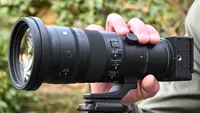
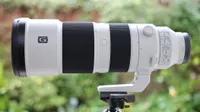
To my mind, the Sony FE 600mm f/6.3 GM OSS redefines the genre of ‘great white’ super-telephoto prime lenses. Compared to others of its breed, it’s incredibly compact, lightweight and easy to live with, while retaining some seriously high-end handling exotica. And it does all of this at a comparatively knockdown price, although it costs a chunk more than the simultaneously launched Sony FE 400mm f/4.5 GM OSS.
Pros
- +
Relatively lightweight and compact
- +
Exotic handling characteristics
- +
Impressive performance
- +
Very good value for money
Cons
- -
Modest aperture rating
- -
40% pricier than the 400mm
Why you can trust Digital Camera World Our expert reviewers spend hours testing and comparing products and services so you can choose the best for you. Find out how we test.
Like countless others of my generation, I was glued to the first ever series of Star Trek on TV. An iconic quote that’s stood the test of time (fittingly from an episode called ‘The Naked Time’ comes from Scotty in the engine room of the USS Enterprise… “I can’t change the laws of physics.” Well, it seems Sony has just got one over on Scotty with its new 600mm super-telephoto prime lens.
Compared with Sony’s FE 600mm f/4 lens, the new FE 600mm f/6.3 is only about half as big and less than a third of the weight. That’s a major achievement, considering that the older lens was renowned for being ‘the lightest in its class’. Yet the new one is a whole 2kg lighter, weighing in at just 995g / 2.19lb, making it ‘the lightest of its type in the world’.
Another plus side is that the new lens is certainly no lightweight in terms of its aspirations to top-end performance, aiming to be one of the best Sony telephoto lenses, best lenses for sports, best lenses for bird photography and wildlife, and best lenses for safari. And just wait until you see what they’ve done with the price. It’s only a fraction of the cost of its 600mm f/4 sibling.

Sony FE 600mm f/6.3 GM OSS: Specifications
Mount options |
Sony E (FE) |
Full frame |
Yes |
Autofocus |
Yes |
Image stabilization |
Yes |
Lens construction |
24 elements in 17 groups |
Angle of view |
4.2 degrees |
Diaphragm blades |
11 |
Minimum aperture |
f/22 |
Minimum focus distance |
TBC |
Maximum magnification |
TBC |
Filter size |
95mm |
Dimensions |
108x265mm / 4.3x10.4in |
Weight |
995g / 2.19lb |
Sony FE 600mm f/6.3 GM OSS: Price
What is the price of a top-class 600mm prime lens? We’re talking ‘family car’ money here, with the Sony FE 600mm f/4 GM OSS costing a monstrous $14,099 / £11,999. That puts it well beyond the reach of most of us. It’s remarkable that this new 600mm f/6.3 lens is only 1.33 f/stops slower but massively more affordable, costing a ‘mere’ $3,699 / £3,609 / CA$4999. That’s only about a quarter of the asking price.
But before we get too carried away, consider that the very capable Sony FE 200-600mm f/5.6-6.3 G OSS matches the new prime for aperture rating at the long end of its zoom range, while also adding the flexibility and versatility of a zoom lens, for a relatively ‘cheap’ $2,099 / £1,599. That said, the zoom lens lacks G Master credentials. Getting back to prime time, there’s the Sigma 500mm f/5.6 DG DN OS Sports in both Sony E and L-mount options, which also undercuts the FE 600mm at $2,999 / £2,779, while having a faster aperture rating and nearly as much telephoto reach.
Then there’s Sony’s own new Sony FE 400mm f/4.5 GM OSS, which looks and feels almost identical to the 600mm lens, again has some seriously strong telephoto reach and a faster f/4.5 aperture. This lens is significantly less expensive to buy at $2699 / £2,579 /CA$3579. Overall, you might feel that the FE 600mm f/6.3 is a bargain, or not, depending on which way you look at it. Let’s see what you actually get for your money.
Sony FE 600mm f/6.3 GM OSS: Design & Handling
Life can be a strain with a lens like the overarching (overwhelming?) Sony FE 600mm f/4 GM OSS. It’s big and burdensome, with vital statistics of 164x449mm / 6.5x17.7in. That’s almost half a yard long and it tips the scales at a back-bending 3,040g / 6.7lb. Handheld shooting for any length of time is pretty impractical. With the new lightweight FE 600mm f/6.3 long periods of handheld shooting turn from being a non-starter into a no-brainer.
The new contender is much shorter and slimmer, at just 108x265mm / 4.3x10.4in, and weighs a mere 995g / 2.19lb. That’s less than the weight of some 24-70mm standard zoom lenses that I’ve owned in the past, and more than 2kg / 4.4lb lighter than the FE 600mm f/4. Indeed, the new lens is less than a third of the weight of its chunky sibling. The relatively skinny design also enables the inclusion of a regular 95mm front filter attachment, instead of the need for a rear drop-in filter holder.

As I’d hope for in any lens that’s geared to action, sports and wildlife photography, this one is extensively weather-sealed and has a fluorine coating on its front element. Beneath the skin, there are dual XD (eXtreme Dynamic) linear motors that power the fully internal focusing mechanism, just like in Sony’s top-dollar 600mm prime. Autofocus speed and tracking is designed to keep pace with 120fps shooting and 240p video capture. And if you still feel the need to focus manually, there’s a switchable full-time DMF (Direct Manual Focus) mode.

Just in front of the focus ring there’s another control ring, again also featured in Sony’s recent top-flight telephoto primes. The secondary customizable ‘function ring’ can be assigned to various functions but one of my favorites is ‘Power Focus’. It’s great for ensuring smooth manual focus transitions when shooting video, thanks to its motorized nature.

The middle section along the length of the lens barrel is colored black and plays host to the main shooting controls. As well as the focus ring and function ring, there’s a rank of four function buttons. Maintaining the theme, these buttons are customizable but I’d generally use them for AF/L (Autofocus Lock). I like that there’s a full set of four of them, placed at 90-degree intervals around the barrel, so one of them naturally falls under the thumb in any shooting orientation.

It would be unreasonable to expect every single feature that you get on the top-dollar 600mm lens to be replicated here and sure enough, there are no Preset or Beep on/off switches. Oh well, never mind. There are still plenty of positives though, including a bank of five switches for AF/MF focus modes, full-time DMF on/off, an autofocus range limiter, OSS (Optical SteadyShot) on/off and three selectable OSS modes. The stabilization modes in question include both of the regular static and panning modes, plus a third mode that stabilizes the viewfinder image in a way that it that makes it easier to track erratically moving subjects.

Should you feel the need to photograph something in the next county without driving there, the lens is compatible with Sony’s FE teleconverters. The 2.0x version naturally bumps up the focal length to a mammoth 1200mm, but with the usual catch of a 2 f/stop narrowing of the aperture, which shrinks to a disappointingly small f/13. The 1.4x teleconverter will likely prove more practical, equating to an 840mm focal length with a widest available aperture of f/9.
To gain extra telephoto reach, it’s also perfectly viable to switch to APS-C crop mode, especially with one of Sony’s ultra-high-res full-frame cameras, which would still give you a healthy megapixel count. And given the relative lightweight build of the lens, you could even mount it on an APS-C format Sony camera body. In both of these cases, you’d get an ‘effective’ 900mm focal length without the aperture reduction of using a teleconverter.

Long telephoto lenses can be particularly susceptible to ghosting and flare, which can degrade image quality. This one offers two-fold resistance with Nano AR Coating II, along with a very effective hood. First up, the high-tech, nano-structured coating is designed specifically for lens elements that have a large diameter or are strongly curved. The hood has a circular profile and is sufficiently long to do an efficient job, as well as being well made and featuring a lock/release button.

Building on its lightweight design, the combination of optical and in-camera stabilization makes handheld shooting entirely viable, but a tripod or monopod can still come in handy to keep things steady. True to type, the lens features a tripod mounting ring that ensures an equally good balance for both landscape and portrait orientation shooting. It also enables quick and easy swapping to any desired orientation, having a simple locking knob and smooth action.

As with a fair few other telephoto lenses, the tripod ring isn’t completely removable and only the foot can be detached. The foot itself features both standard sizes of 1/4in and 3/8in mounting threads. With the foot removed, there’s only a very small stub that protrudes from the lens. It doesn’t really add to the size of the lens and doesn’t impair handheld shooting.

The mounting plate of the relatively huge and heavyweight FE 600 f/4 features additional fixing screws to enhance strength and rigidity. That’s unnecessary for this relatively lightweight lens, so it has Sony’s more regular mounting plate which still includes a weather-seal gasket.

Despite its downsized design and build, the lens takes up most of the length (height?) of my camera backpack, leaving relatively limited space for all my other paraphernalia. I’m pleased therefore that Sony includes a nicely tailored and stylish looking bag with the lens.

Sony FE 600mm f/6.3 GM OSS: Performance
Throughout my time testing the FE 600mm, I paired it with a Sony A7R V camera body. This camera places big demands on the resolving power and autofocus speed of lenses, with its 61MP image sensor and tenacious AI-powered autofocus system. The lens definitely proved up to the task. I spent some time shooting lakeside birds that were very skittish and moved very erratically, but the lens took full advantage of the A7R V’s advanced recognition and tracking abilities. Autofocus speed proved a match for birds that were rapidly moving their heads around, or darting along the banks.

As a performance factor, I couldn’t help but be impressed by the lens’s generous super-telephoto reach. It covers a whole lot of distance for action, sports and wildlife photography, especially when you’re limited to a spectator’s area or a birding/wildlife hide. That oversized reach can make all the difference between getting the shot and missing it. As a case in point, I was shooting at a heritage railway site, and was able to get the shot below from a long way down the tracks. It would have taken quite a few minutes to walk up the line for a closer shot with a lens that had less telephoto reach, during which time the photo opportunity would have passed.

In terms of sharpness, the lens is able to do justice to Sony’s highest-resolution cameras like the A7R V, with their abundance of megapixels. It can capture plenty of fine detail and texture, along with superb clarity and contrast, although the simultaneously launched FE 400mm f/4.5 proved a little sharper in our lab tests. True to its claims, resistance to ghosting and flare is very good. And although the aperture rating of f/6.3 certainly isn’t ‘fast’, its combination with a 600mm focal length enables a tight depth of field, along with pleasantly smooth bokeh.

The lens also exhibits very good control over unwanted aberrations, with color fringing and distortion being of a very low order. Again, our lab test results weren’t quite as excellent as from the FE 400mm f/4.5, but were very impressive nonetheless. The image below serves as a graphic demonstration, the regular geometric shapes and high-contrast transitions of the window and door frames revealing minimal distortion and fringing.

Sony FE 600mm f/6.3 GM OSS: Sample Images
When taking the sample shots for the following gallery, I started off at the East Somerset Railway in the South West of England. It’s a delightful historic railway that’s run as a charity by a friendly bunch of volunteers, and is well worth a visit. Next, I moved on to the Chew Valley Lake, also in Somerset, to test the lenses by shooting some lakeside birds. Finally, I took them on a stroll around the picturesque town of Stockbridge in Hampshire. I took all of the sample shots at the widest available aperture of f/6.3, which is the sternest test of the lens but often needed to enable sufficiently fast shutter speeds.


Sony FE 600mm f/6.3 GM OSS: Lab Results
We run a range of lab tests under controlled conditions, using the Imatest Master testing suite. Photos of test charts are taken across the range of apertures and zooms (where available), then analyzed for sharpness, distortion and chromatic aberrations.
We use Imatest SFR (spatial frequency response) charts and analysis software to plot lens resolution at the center of the image frame, corners and mid-point distances, across the range of aperture settings and, with zoom lenses, at four different focal lengths. The tests also measure distortion and color fringing (chromatic aberration).
Sharpness:

Sharpness is very good even when shooting wide-open at f/6.3, and holds up well right out to the edges and corners. That’s an important point to me, as I often tend to want shutter speeds that are as fast as possible to freeze motion when shooting action, sports and wildlife with this type of lens. However, the sibling FE 400mm f/4.5 proved a little sharper in our lab tests, across the whole image frame.
Fringing:

There’s fairly little in the way of color fringing, which will generally go unnoticed in real-world shots, even with automatic in-camera correction disabled. Optically, fringing isn’t quite as minimal as with the FE 400mm f/4.5 lens but in-camera correction completely eliminates it.
Distortion: 0.96
As with color fringing, there’s only minor pincushion distortion. Again, you’ll rarely notice it even with automatic in-camera correction disabled, and if you enable the auto fix, the Sony effectively becomes a zero-distortion lens.
Sony FE 600mm f/6.3 GM OSS: Verdict
The Sony FE 600mm f/6.3 GM OSS has a lot going for it. I love the incredibly compact, lightweight design and build of the lens, making it a painless pleasure even for long periods of handheld shooting. Moreover, the speed and accuracy of the autofocus system coupled with the highly effective optical image stabilization ensure an epic hit rate, where practically every shot is a keeper. Handling is sublime, not only because of the manageable weight but also because of the plethora of buttons and switches for its advanced focusing and stabilization modes. Meanwhile, the weather-sealed build quality is reassuringly robust.
My only caveats are that while the f/6.3 aperture rating certainly isn’t slow for modern super-telephoto lenses, it’s definitely not fast either. It’s merely modest. You can generally enable sufficiently fast shutter speeds for freezing the action in sports and wildlife photography, to which the lens is tailor-made, but often this is at the expense of needing to push your camera’s ISO setting further than you might wish. And while the lens seems epic value for money compared with the top-flight Sony FE 600mm f/4 GM OSS, it looks comparatively expensive up against its sibling Sony FE 400mm f/4.5 GM OSS and the Sigma 500mm f/5.6 DG DN OS Sports, both of which are also relatively compact and lightweight for their type.
Features ★★★★★ |
Fancy features include dual high-speed XD autofocus motors, triple-mode optical stabilization, and a handful of handling exotica. |
Design ★★★★★ |
The smart design packs an epic 600mm of super-telephoto reach into an unfeasibly compact and lightweight, yet tough and weather-sealed build. |
Performance ★★★★½ |
You’re pretty much guaranteed superb image quality thanks to super-fast and consistently accurate autofocus and highly effective image stabilization, although the companion 400mm f/4.5 gave better results in our lab tests. |
Value ★★★★½ |
The bottom line, so to speak, is that the lens is only about a quarter of the price of Sony’s top-grade 600mm f/4 lens, but it’s significantly more expensive than the similar Sony FE 400mm f/4.5 and Sigma’s 500mm prime. |
Overall |
★★★★½ |

Alternatives