Weddings are perhaps the most important day in the lives of the participants, but they're pretty important for the photographer to get right, too! My guide to the best lenses for wedding and event photography suggests the best and most versatile lenses to take with you, and the best examples of each for Canon, Nikon, and Sony mirrorless users.
I asked a lot of wedding and event photographers which lenses they found most useful, and while there was a lot of individual variation, particular types of zoom lenses came to the fore.
Which are the best zoom lenses for wedding and event photography?
Why you can trust Digital Camera World Our expert reviewers spend hours testing and comparing products and services so you can choose the best for you. Find out how we test.
- 70-200mm f/2.8 telephotos: Perfect for portraits and creative background blur
- 24-70mm f/2.8 standard zooms: The ideal ready-for-anything lens to keep on the camera
- 16-35mm f/2.8 wide-angle (or thereabouts): Perfect for the church, reception, and group shots
I've stuck to full-frame cameras for this roundup, since these are the most popular amongst wedding and events photographers who are most likely doing these jobs on a commercial basis. There's no reason why you shouldn't use an APS-C or MFT camera, but while the quality is fine, you might not have such a wide choice of constant-aperture zoom lenses.

Matthew Richards is a photographer and journalist who has spent years using and reviewing all manner of photo gear. He is Digital Camera World's principal lens reviewer – and has personally tested and reviewed the majority of the lenses on this list!
Best telephoto zooms
I've chosen telephoto zoom lenses in preference to portrait prime lenses, and for two reasons. First, zooms let you quickly adapt to different circumstances, subject distances, and backgrounds. Second, at longer focal lengths the background blur can be just as effective, and you have more control over composition and framing.
Best Canon telephoto zoom

This RF-mount zoom for EOS R-series cameras is relatively lightweight and suits the more compact Canon EOS R camera bodies. It’s also much smaller than most 70-200mm lenses, due to having a telescoping rather than fixed physical length. As such, the inner barrel extends at longer zoom settings, which adds the risk of dust being sucked into the lens.
The autofocus system is driven by dual Nano USM motors for blazingly fast yet virtually silent operation. The image stabilizer is similarly impressive, with three operating modes and up to 5-stop effectiveness. All in all, it’s the ideal telephoto zoom for R-series cameras, but it comes with a weighty price tag.
Read our full Canon RF 70-200mm f/2.8L IS USM review
Best Nikon telephoto zoom

This Nikon Z mirrorless lens is a perfect choice (well, the only choice) for Nikon Z owners in this category right now. It’s pretty big and heavy but certainly packs a lot in. Fully weather-sealed and with a fluorine coating, it’s built for top-end professional use. Handling is superb, with smooth and precise zoom and focus rings and dual customizable Lens-function buttons.
There’s also a customizable control ring for the likes of aperture and ISO, and an OLED screen for displaying parameters like focus distance, focal length, depth of field, aperture, and ISO. Autofocus is fast for stills and smooth and silent for video capture, while the optical stabilizer has 5-stop effectiveness. As with Canon's own mirrorless 70-200mm f/2.8, you are paying for the privilege of an own-brand lens.
Read our full Nikon Z 70-200mm f/2.8 VR S review
Best Sony telephoto zoom

Let’s get something straight: there’s absolutely nothing wrong with either edition of Sony’s classic 70-200mm f/2.8 ‘trinity’ telephoto zoom. But the newer 50-150mm is somewhat unique and brings major advantages for wedding/event photography. First up, its faster f/2 aperture enables a tighter depth of field while also delivering particularly smooth and dreamy bokeh.
Secondly, while it doesn’t have quite as much telephoto reach as a 70-200mm zoom, the short end shrinks down to a standard 50mm focal length. This gives a more natural perspective, and, because it’s so popular, it’ll save you swapping between lenses and potentially missing key moments in the process.
The no-expense-spared design and build of the FE 50-150mm is entirely in keeping with the market sector at which it’s aimed – that of high-ranking professional photographers with deep pockets. With that in mind, it has all of the high-end handling extras you could wish for and levels of image quality and all-around performance that are simply exceptional.
Read our full Sony FE 50-150mm f/2 G Master review
Best standard zooms
The 24-70mm f/2.8 is a real go-to lens for wedding and event photographers. It's wide enough for most interiors, yet 'long' enough for impromptu portraits and couple shots. Many will focus close enough for quite small details too, and the constant-aperture, pro-grade optics mean you can shoot wide open to isolate subjects against defocused backgrounds.
Best Canon standard zoom

Canon’s heavyweight RF 28-70mm f/2L USM tips the scales at 1,430g and lacks image stabilization, so we think this 24-70mm zoom is a better fit for wedding and event photography. It has a wider maximum viewing angle, adds highly effective 5-stop stabilization, and is less than two-thirds the weight. Even so, it still feels pretty hefty on a slim-line EOS mirrorless body.
Build quality is up to Canon’s usual L-series standards, complete with comprehensive weather-seals. The optical line-up includes three moulded aspherical elements and three UD elements, plus Air Sphere Coating. Autofocus is courtesy of a super-fast and practically silent Nano USM system. Image quality is fabulous in all respects, with particularly impressive sharpness throughout the entire zoom range.
Read our full Canon RF 24-70mm f/2.8L IS USM review
Best Nikon standard zoom

Pretty much everything about this lens is upgraded from the original version, which was already excellent. Headline attractions of the Mark II include a fully internal zoom mechanism, so the physical length of the lens doesn't extend, a more lightweight yet sturdy and robust build, and it's the first Nikon zoom to feature the company’s ‘Silky Swift Voice Coil Motor’ (SSVCM), which drives multiple groups of elements to make autofocus as fast and precise as possible.
Handling is improved with a click/de-click switch for the aperture control ring, boosting suitability for video capture as well as stills. Even the hood is redesigned, now featuring a sliding door for rotating filters fitted to the lens.
Performance is simply epic, with stunning image quality in all respects, backing up that super-fast autofocus system. This is as good as it gets for Z-system full-frame cameras.
Read our full Nikon Z 24-70mm f/2.8 S II review
Best Sony standard zoom

The Sony FE 28-70mm f/2 GM lens goes a whole stop faster than most fast standard zooms, with an f/2 constant aperture that is ideal for shooting inside gloomy churches, though it does lose out a little at the wide-angle end, with a 28mm rather than the more usual 24mm starting focal length.
It's reasonably lightweight considering the oversized max aperture, tipping the scales at (just) under a kilogram, which makes it suitable for all-day carry. It boasts two customizable focus lock buttons, an aperture/iris ring with a lock switch, a switch to adjust the zoom ring's feel, and an AF/MF switch.
The image quality is exceptional, with superb sharpness and no noticeable vignetting or chromatic aberrations. Autofocus is quick and silent, and it's a versatile lens for all manner of shooting situations. However, the hefty price tag limits this to well-heeled professionals who require the widest aperture in a standard zoom, regardless of size or cost.
Read our full Sony FE 28-70mm f/2 GM review
Best wide-angle zooms
Wedding and event photography typically combines a variety of styles, from portraits to group shots and from detail shots to big interiors and large-scale outdoor venues. You don't always know how big (or small) the venue is going to be, where you're going to be able to stand and how far back you can get. An ultra-wide zoom can really get you out of trouble, especially if you need to get a big group shot in a confined space.
Best Canon wide zoom

Designed for EOS R-series full-frame mirrorless cameras, this is the wide-angle member of the f/2.8 ‘trinity’ zooms. As you’d expect from such an ultra-wide lens with a fast f/2.8 aperture rating, it’s quite big and weighty but is nevertheless smaller and lighter than, for example, the Sigma 14-24mm f/2.8 Art lens for Canon DSLRs. Unlike the Sigma, the RF lens has a separate hood that enables the easy attachment of filters or filter holders via an 82mm thread.
The Canon almost matches the Sigma for maximum viewing angle, at 110 degrees, while adding a 5-stop image stabilizer that’s great for handheld shooting indoors or at twilight. Other highlights include a rapid and virtually silent Nano Ultrasonic autofocus system and stellar image quality. It’s a superb lens but, then again, it really should be at the price.
Canon RF 15-35mm f/2.8L IS USM full review
Best Nikon wide zoom

Nikon's top-of-the-line 'trinity' wide-angle zoom is the Z 14-24mm f/2.8 S, but I think this is the better option for weddings and events. While this one doesn't go quite as wide, starting at 17mm rather than 14mm, I think that's plenty wide enough for squeezing everyone into a group shot without people on the extremities becoming overly distorted, and going longer to 28mm rather than 24mm gives a bit more wiggle room when zooming in without having to swtich to your standard zoom.
Delivering excellent image quality in a lightweight and portable body, the Z 17-28mm f/2.8 is a fairly straightforward lens, built around that constant f/2.8 aperture. It's significantly lighter than you'd expect an f/2.8 zoom to be, due in part to the omission of such features as stabilization, an OLED display, Fn buttons, or a third control ring. As long as you can live without all that, you get absurdly good image quality for the money here – this lens received the full five stars in our testing.
See our full Nikon Z 17-28mm f/2.8 review
Best Sony wide zoom
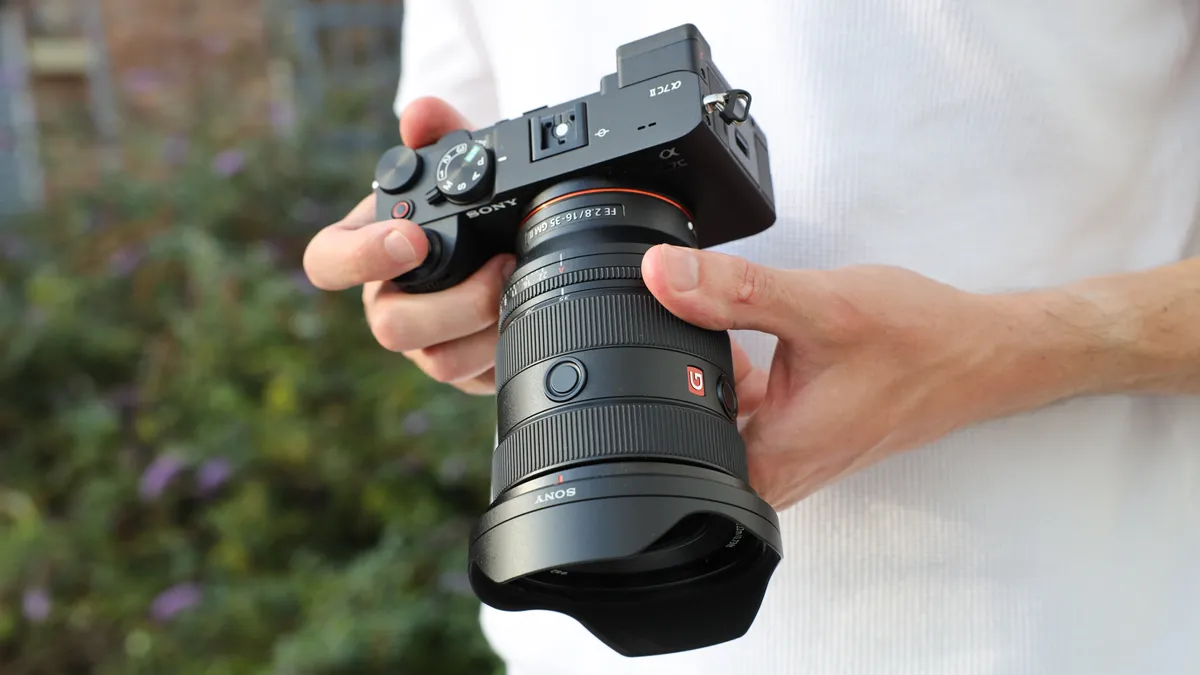
Sony’s G Master lenses have a reputation for optical quality, so it’s no surprise that this second-generation version of Sony’s 16-35mm f/2.8 zoom comes with a hefty price tag. If this is your favored focal range for stills and video, this lens will be your dream buy; otherwise, take a look at the Sony FE PZ 16-35mm f/4 G, which is less than half the price.
You might also want to check out third-party alternatives. The Sony FE 16-35mm f/2.8 G Master II justifies its cost, however, with no fewer than four Linear XD focus motors and suppressed focus breathing. It really is quite a lens with stunning pictorial quality and all-round performance, and a lens that you'll probably want to keep for a lifetime.
Read our full Sony FE 16-35mm f/2.8 GM II review
Lab data and comparisons
The graphs below show the comparative performance of the lenses in this guide, based on our in-house lab tests. On the face of it, the Nikon and Sony lenses slightly outpace their Canon counterparts for sharpness, but the bar is very high indeed, and these are all razor-sharp optics, as you would expect from trinity glass. Automatic in-camera corrections are available for color fringing and distortions across the board.
Scores for sharpness and color fringing are averaged from data taken across the entire image frame, from the center to the edges and corners, throughout the aperture range. For zoom lenses, the scores are also averaged from data measured at all marked focal lengths, and the same applies to distortion.
Bear in mind that these average values don't fully reflect specific areas of performance. For example, a zoom lens might have noticeable barrel and pincushion distortion at its shortest and longest focal lengths, respectively, which tends to average out when looking at the data overall. For more detailed graphs of each lens's performance, which give the full picture, check out the graphs in our full standalone lens reviews.
How we test lenses
We test lenses using a mix of both real world sample images and lab tests. Our lab tests are carried out scientifically in controlled conditions using the Imatest testing suite, which consists of custom charts and analysis software that measures resolution in line widths/picture height, a measurement widely used in lens and camera testing. We find the combination of lab and real-word testing works best, as each reveals different qualities and characteristics.